👋 Rebooting my Twitter. Follow for:
1. 📚 Lessons learned building deep-tech Computer Vision startup [~100M exit in 2 years]
2. 💻 CV & ML in real world from Staff Eng perspective
3. 🚀 Fun Google Colab AI tutorials
🧵 Lesson 1: Principles when building a deep-tech startup👇
🥳 Today we're excited to officially launch LightlyTrain — a self-supervised pretraining framework that helps you build better vision models without any labels.
Try it Free: https://t.co/ty5m2pzh75
Read more: https://t.co/n48ZrbC0gs
Star us on Github: https://t.co/J2eSVAbPGt
1/ I just finished a 2.5 week trip through China today, my first visit in about a decade. I was there for family reasons, but it also happened to be my first time in the country as a tech industry observer
My amateur travel journal on the China tech market -
Returning from an experimental ~2 week detox from the internet. Main takeaway is that I didn't realize how unsettled the mind can get when over-stimulating on problems/information (like a stirred liquid), and ~2 weeks is enough to settle into a lot more zen state.
I'm struck by how an over-stimulated brain automatically keeps bubbling up problems into consciousness, creating a state of persistent anxiety and nervousness. After some time, in the settled state, this activity just... stops. You can sit down and your brain doesn't immediately go into some kind of problem solving overdrive, it just stays silent. Nothing happens.
I'm sure this could read a bit duh to many, but I haven't been to this subset of "brain dynamics" state space in I think a very long time and it is comforting to know that 1) it exists, and 2) you can visit, if you like, but the journey there takes a few weeks.
Anyway, where were we :D
8 years ago, Jensen Huang hand delivered to OpenAI, the first AI-focussed GPU made by Nvidia.
This moment marks the end of Intel's dominance.
It wasn't luck, it was deeper.
Jensen has said publicly that Nvidia 'did it' by religiously following 4 core values 👇🏻
i never believe recorded demos so I reached out to the @cognition_labs team for early access to try for myself and got it!
will be sharing my unfiltered opinions on #devin here.
🧵🧵 1/n
I apologize but won't be amplifying startups whose mission is to fully replace software engineers with "AI devs."
It's clear why VCs & investors love this idea; and why founders as well. Imagine how much money they could make if they succeed!
I hate the idea of that future.
# automating software engineering
In my mind, automating software engineering will look similar to automating driving. E.g. in self-driving the progression of increasing autonomy and higher abstraction looks something like:
1. first the human performs all driving actions manually
2. then the AI helps keep the lane
3. then it slows for the car ahead
4. then it also does lane changes and takes forks
5. then it also stops at signs/lights and takes turns
6. eventually you take a feature complete solution and grind on the quality until you achieve full self-driving.
There is a progression of the AI doing more and the human doing less, but still providing oversight. In Software engineering, the progression is shaping up similar:
1. first the human writes the code manually
2. then GitHub Copilot autocompletes a few lines
3. then ChatGPT writes chunks of code
4. then you move to larger and larger code diffs (e.g. Cursor copilot++ style, nice demo here https://t.co/u8ueY0mGxZ)
5....
Devin is an impressive demo of what perhaps follows next: coordinating a number of tools that a developer needs to string together to write code: a Terminal, a Browser, a Code editor, etc., and human oversight that moves to increasingly higher level of abstraction.
There is a lot of work not just on the AI part but also the UI/UX part. How does a human provide oversight? What are they looking at? How do they nudge the AI down a different path? How do they debug what went wrong? It is very likely that we will have to change up the code editor, substantially.
In any case, software engineering is on track to change substantially. And it will look a lot more like supervising the automation, while pitching in high-level commands, ideas or progression strategies, in English.
Good luck to the team!
How to write the Introduction?
As a junior student, writing the introduction of a research paper is arguably the most daunting part of paper writing. 😱
Here is a simple template I find useful:
3 Figures 🖼️ + 5 Questions 🤔
I've generated 10,000+ images with DALL-E 3.
My Logo Creator GPT is also the #1 GPT under DALL-E.
Here are the 10 most useful DALL-E prompting tips I've learnt:
TikTok presents Depth Anything
Unleashing the Power of Large-Scale Unlabeled Data
paper page: https://t.co/fgga7kjUfb
demo: https://t.co/I7x17X4Qsi
Depth Anything is trained on 1.5M labeled images and 62M+ unlabeled images jointly, providing the most capable Monocular Depth Estimation (MDE) foundation models with the following features:
zero-shot relative depth estimation, better than MiDaS v3.1 (BEiTL-512)
zero-shot metric depth estimation, better than ZoeDepth
optimal in-domain fine-tuning and evaluation on NYUv2 and KITTI
my AI-powered career exploration app (Wanderer) has been experiencing explosive growth and my GPT-4 costs were starting to pile up ($100+ a day 💀)
here's the playbook I used to lower my AI costs by 99%, while also decreasing latency and maintaining quality:
1. start with the most powerful model for your app's usecase. for 95% of companies, this is GPT-4 (not GPT-4-turbo). you want the best quality outputs, as we'll be using this to fine-tune a smaller model.
2. store your AI requests/responses so they can be easily exported. i personally use @helicone_ai for this and love it. easy swap-in with OpenAI APIs and it stores all of your AI requests in an exportable table.
3. once you've collected ~100-500+ request/response pairs, export them and clean the data so that the inputs and outputs are of high quality. if you collect feedback from your users (e.g. thumbs up thumbs down), you can potentially use this as well
4. with your clean dataset, use a hosted OSS AI service like Together or Anyscale to fine-tune Mixtral 8x7B. you can also try to fine-tune GPT-3.5-Turbo on OpenAI, but I've personally gotten better results from Mixtral 🤷
5. swap out GPT-4 with your fine-tuned model and enjoy your healthy margins 😎
Recently, I decided I wanted to read every page of one of my favorite websites, @OurWorldInData.
I’m about halfway now.
Here are the 30 most surprising things I’ve learned about the world so far! 🧵
@levelsio ChatGPT4 is truly incredible at times.
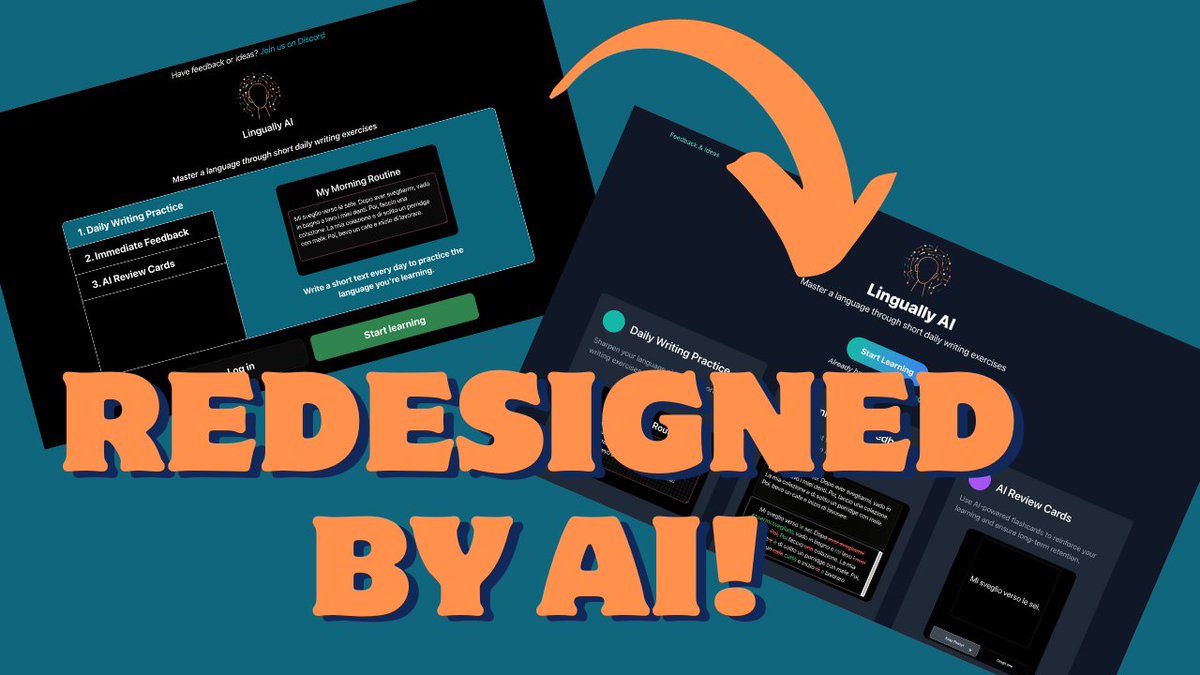
I used it to redesign my site and write a whole new frontend for my web!
Started with a screenshot of the old ugly site and ended with a beautiful and 100% functional HTML code using Tailwind CSS.
https://t.co/bqGNH1ef0P
I've recently had a fun little session with ChatGPT.
I've asked it to first critique, then redesign a website for me.
It took a few iterations, but the results are stunning 👇