New paper out in @JCRNEWS
How do consumers react to political ads that meddle in the primaries of the opposing party?
In the most recent elections, Democrats did something strange.
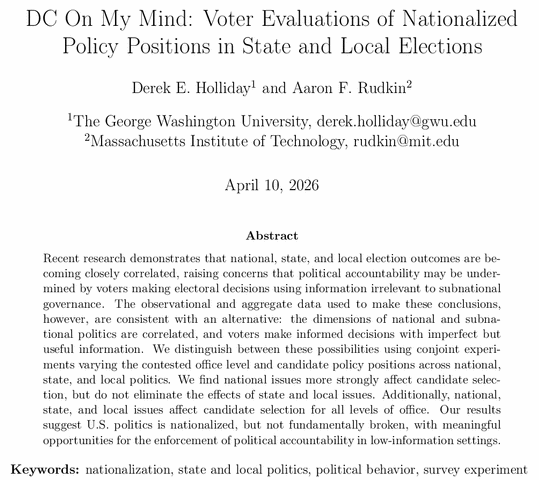
In increasingly nationalized elections, how do voters use policy information to choose candidates?
In a paper just accepted at @The_JOP (with @aaronrudkin), we provide experimental evidence of nationalized information-processing in the electorate, but with a few nuances
🧵1/8
Imagine a 19-year-old scrolling TikTok. She watches a creator list five "signs you have undiagnosed anxiety." She recognizes three in herself. By the end of the week, she's describing herself as anxious to her friends. A month later, she's avoiding situations she used to handle fine.
What went wrong?
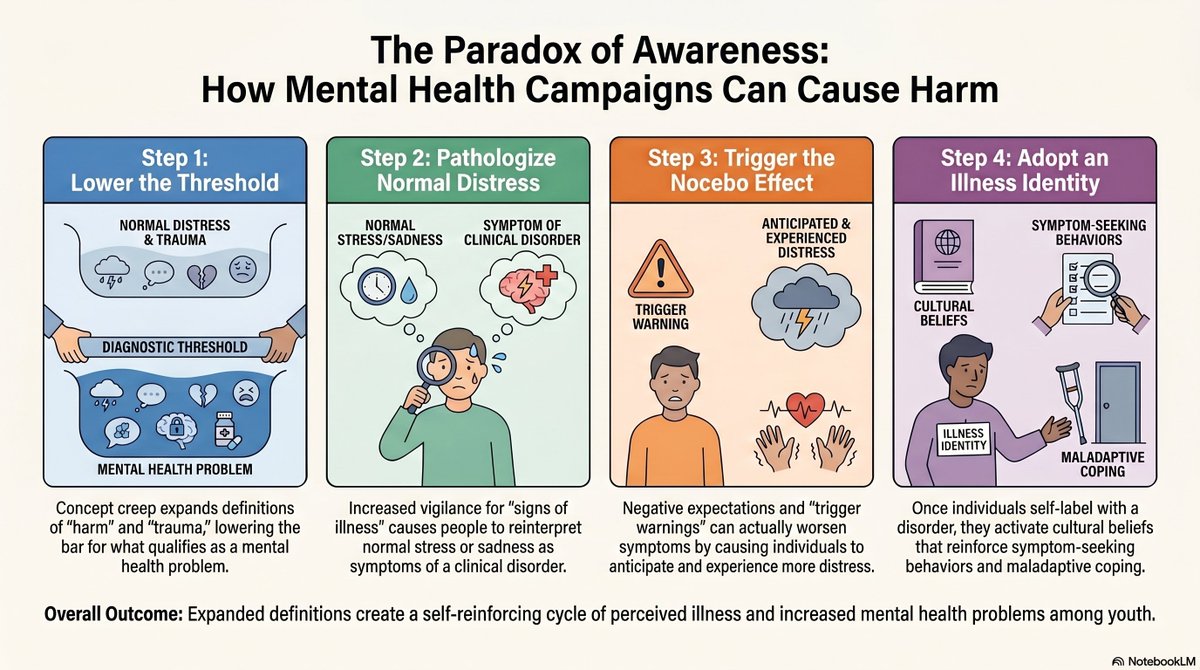
In a new paper by my PhD student Dasha Sandra, titled "Why mental health awareness can harm: Converging explanations for a societal problem", we argue that well-meaning mental health awareness can backfire, and we identify how. Four separate literatures (concept creep, nocebo effects, prevalence inflation, and illness self-labeling) have been circling the same problem from different angles. We show they converge on three mechanisms:
1.Awareness lowers the threshold for what counts as a disorder.
2. It trains people to scan their inner lives for symptoms and reinterpret normal distress as pathology.
3. Once someone adopts an illness identity, they behave in ways that confirm and deepen it.
The evidence is wide. Learning that loneliness is harmful makes solitude feel worse. Learning that stress is harmful worsens well-being and performance. Awareness videos about fake conditions like "wind turbine syndrome" produce real headaches. Trigger warnings raise anticipatory anxiety without reducing distress.
This does not mean awareness should stop. It means awareness can have unintended consequences, including manufacturing the suffering it tries to prevent. Inoculating people against these mechanisms works, and we already have evidence it does.
Link to paper: https://t.co/ucoGyhEuAj
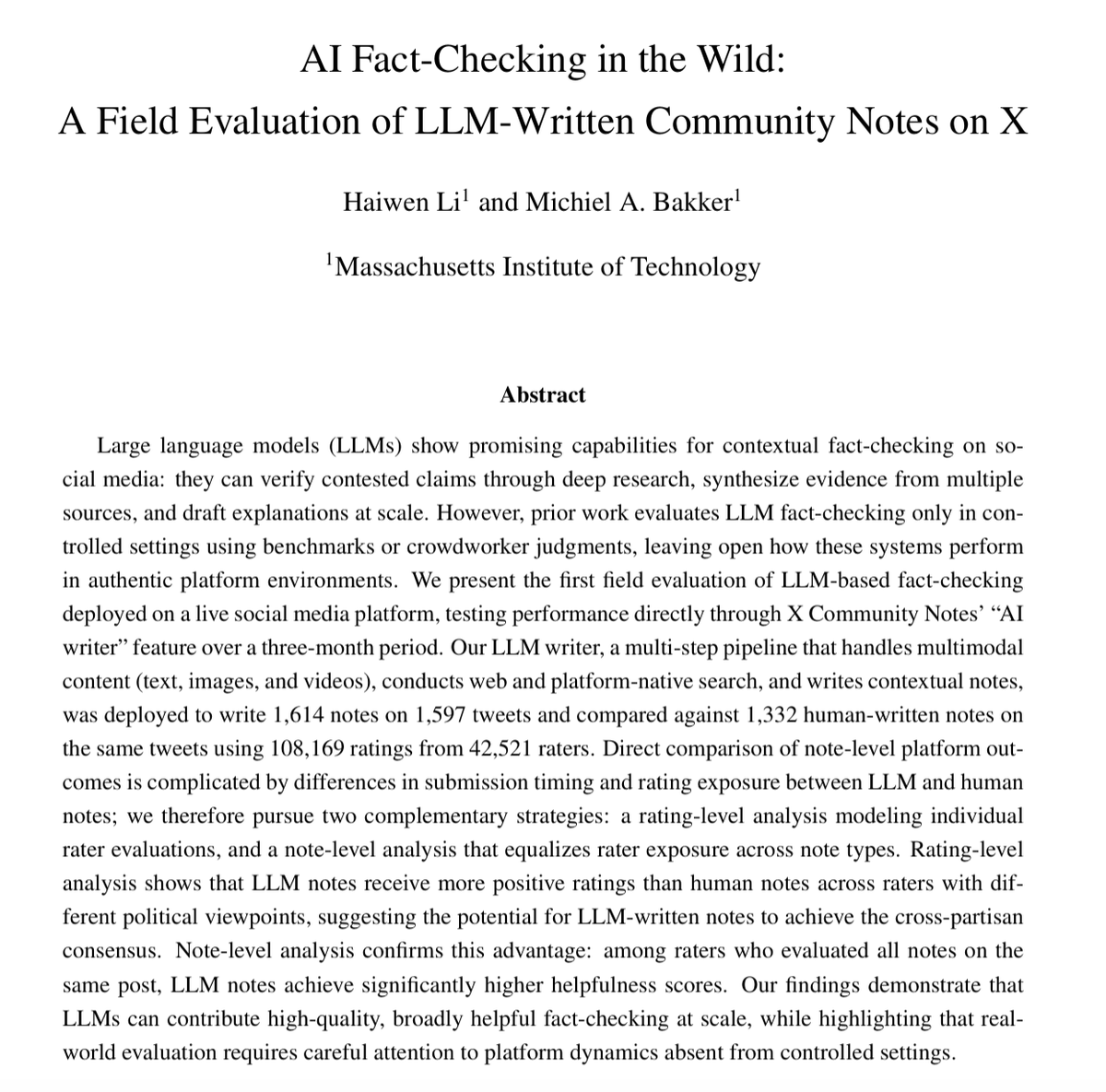
🚨New preprint. Many papers show AI can write fact-checks as well as humans (or better) in the lab, but very few test this in the real world.
We run the first online evaluation of AI fact-check writing with X Community Notes’ AI writer API.
Paper w. @bakkermichiel 1/
Very excited that this interview and paper on the "Narrow Search Effect" are both out.
The paper, led by Eugina Leung, is here:
https://t.co/Vq9s9u1DJ1
🧵
🚨🚨 My lab is hiring a Pre-doc Researcher/Lab Manager! 🚨🚨
Full-time pre-doc research opening in my lab at Harvard Psych (start: Summer/Fall 2026)
Review begins April 10
To Apply: https://t.co/qAYSqPuXYX
Please retweet + tag folks who might be a good fit! 👇
New preprint out today (https://t.co/UChyCZTcxv). We tested whether AI agents are actually infiltrating online surveys.
Spoiler alert: they aren't
Thread 🧵
[1/9]
Consumers aren’t separating politics from purchases anymore. Join MSI’s webinar with Columbia’s Oded Netzer on brand preference polarization—plus real-world cases & strategies for navigating risk. April 14 | 12–12:30 PM ET https://t.co/T3uMguX2VQ #Marketing#BrandStrategy
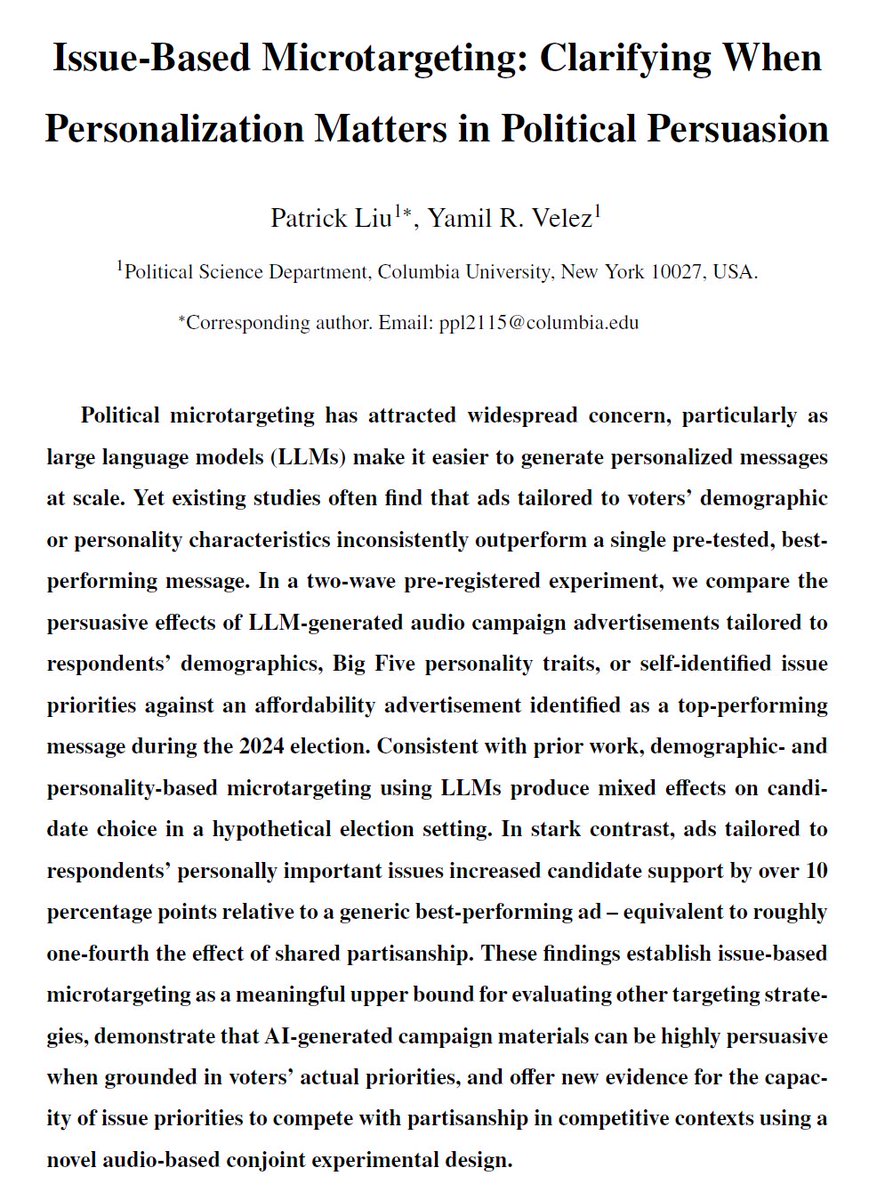
New paper w/ @YamilRVelez! A lot of great research on political microtargeting discounts personalization: tailored ads (using AI or not) rarely beat a single-best message. We define two types of microtargeting, clarify when tailoring matters, & showcase a novel audio-based design
Gotcha questions and telemetry checks won’t catch agentic AI for long. Liveness verification via physical interaction is a more promising path forward in the short term.
Learn more here: https://t.co/q5exaXihjn
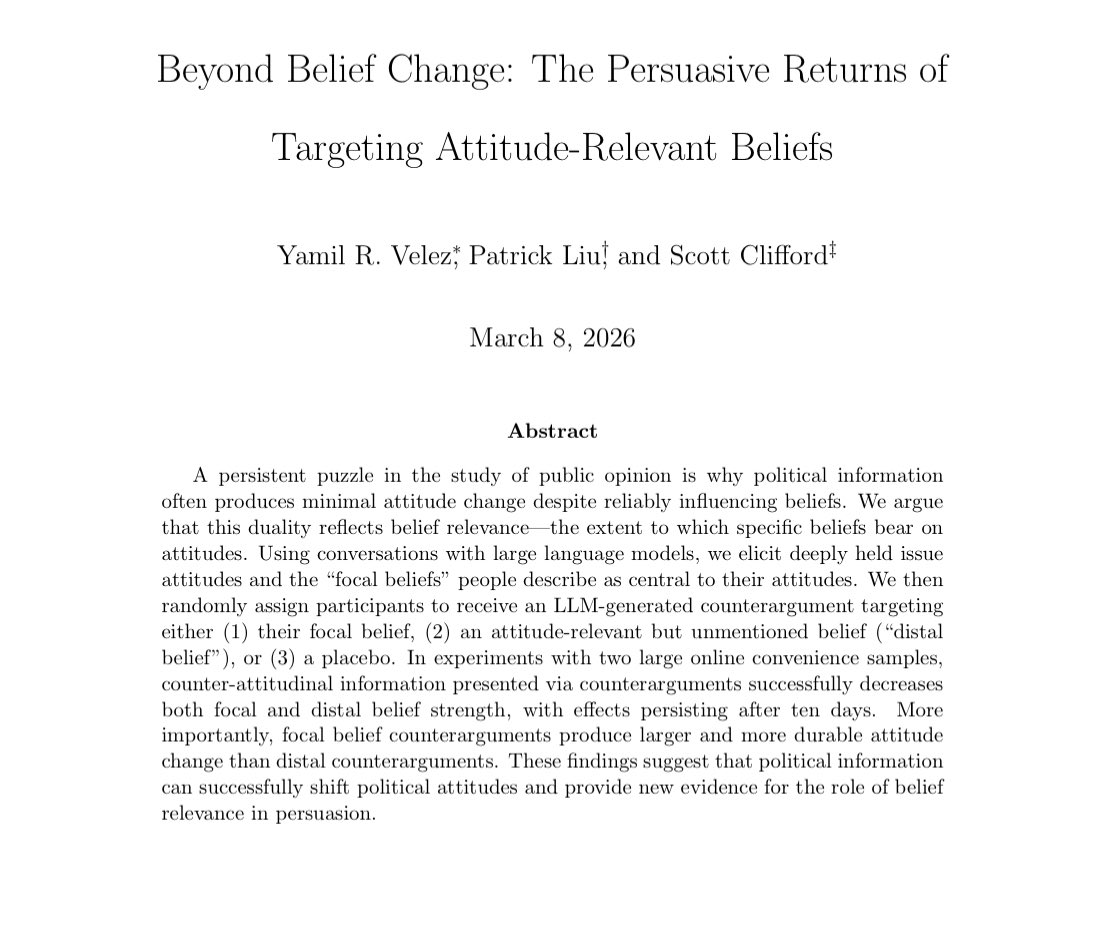
Conditionally accepted at the APSR (w/ @scottclifford & @patrickpliu):
Why does political information so often change beliefs but NOT attitudes? We highlight the role of belief relevance, or the extent to which beliefs bear on attitudes.
When you collect data online, are the results from humans or AI? In a project led by Booth PhD student Grace Zhang, we estimate the prevalence of AI agents on commonly used survey platforms:
https://t.co/Kztjdi8bFg
🧵
"when opinions felt more linked to identity, people were more likely to choose candidates with extreme views than those with moderate views." - @MAHusseinLab, Zakary L. Tormala, & S. Christian Wheeler https://t.co/juQwQAJH9U
New #SPSPblog: Why Do People Prefer Extreme Political Candidates? by @MAHusseinLab, Zakary L. Tormala, & S. Christian Wheeler https://t.co/oT02lTUTKF
🚨New WP!🚨
Structured AI Dialogues Can Increase Happiness and Meaning in Life
In a preregistered RCT, four psychology-grounded #AI chatbots improved well-being across several outcomes.
Co-authors: @JonasP_Schoene@JEichstaedt@AadeshSalecha@slyubomirsky
🧵👇
🚨 Call for PostDoc or Visiting PhD Student 🚨
We're seeking an American Politics scholar of leg. institutions or representation, under the direction of Jim Curry, Jeff Harden, and Rachel Porter (me!), affiliated with our Representation and Politics in Legislatures Lab
👬 A Digital Twin Mega-Study!
Researchers at Columbia University asked both humans and their “digital twins" to complete the same set of tasks. How closely did digital twins mirror their human counterparts?
Your responses will help inform how people perceive the potential (and limitations) of digital twins in simulating human judgement and decision-making.