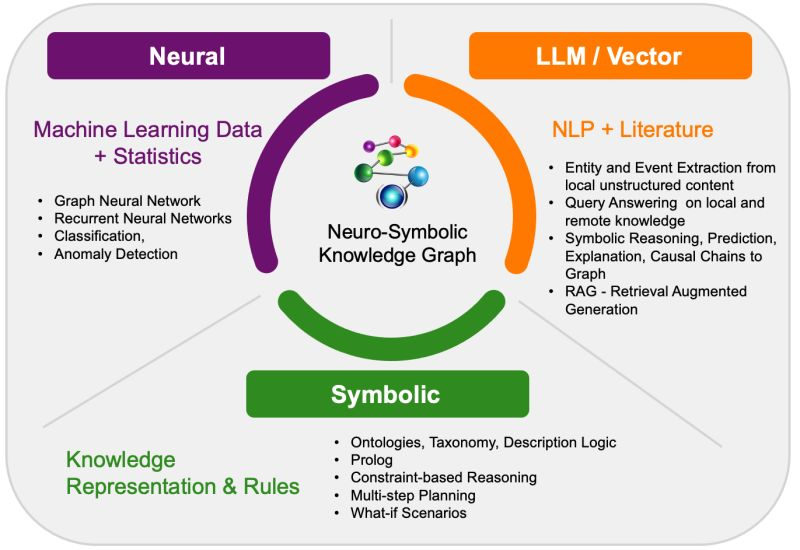
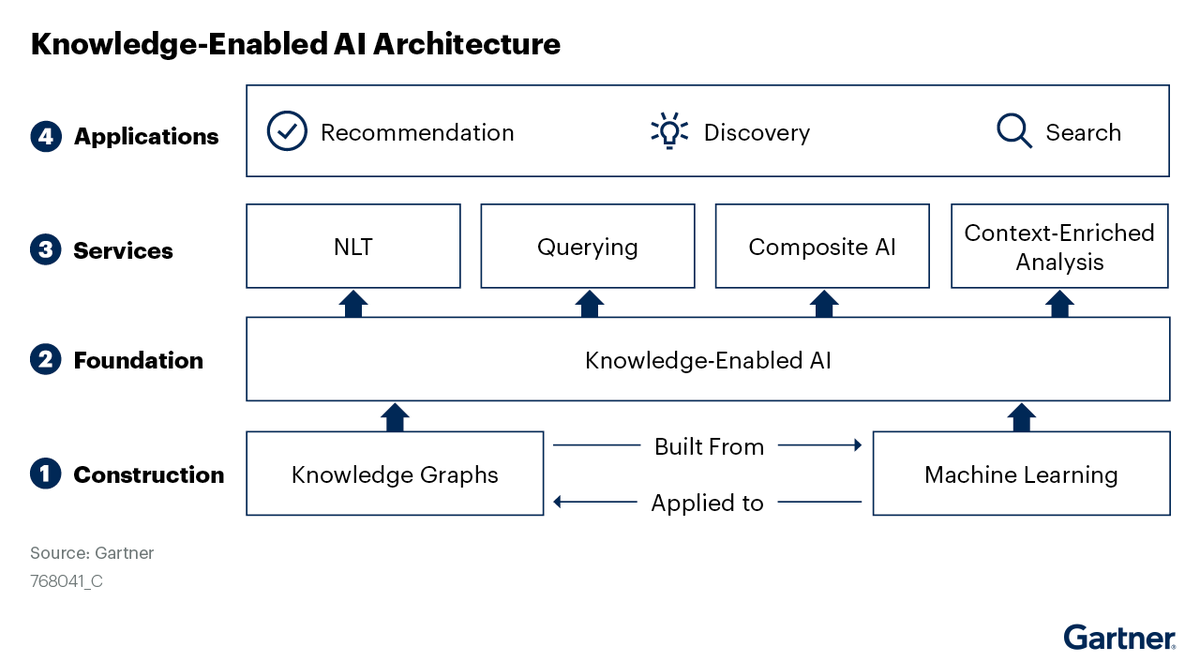
Gartner Says Lack of Semantics Causes Inaccurate AI Agents and Wasted Spending. #AllegroGraph provides the semantic foundation for governed, context-aware, explainable AI with enterprise #KnowledgeGraphs at the core of #AgenticAI.
#AI#SemanticAI https://t.co/LzQXd95v8y
AllegroGraph v9 is here — and it introduces GraphTalker, a major advancement in how people and AI agents interact with enterprise Knowledge Graphs. GraphTalker brings natural-language intelligence directly to the #semanticlayer. https://t.co/gn6Ubu8elT #KnowledgeGraphs#NSAI
Transforming Research Visibility with RAiD at Oak Ridge National Laboratory
Interesting blog post. Also fascinated with the Acorn CLI mentioned in this article: https://t.co/HX3FxvUrLl
https://t.co/aGGQO5Rjhv
The spring 2026 edition of AI Magazine features the special topic article "An actionable framework for AI-ready data" by Neil Majithia, Thomas Carey-Wilson, Elena Simperl, and Nigel Shadbolt. Read more, including further steps that should be taken for the open data ecosystem to be made AI-ready in order to realize its true potential in supporting an innovative future: https://t.co/9lb2hTHQuf.
AI Magazine Spring 2026 Issue is here. The purpose of AI Magazine is to disseminate timely and informative expository articles that represent the current state of the art in AI and to keep its readers posted on AAAI-related matters. View all the articles:
https://t.co/0MJJhcg22A
Even if we only consider AI, there was an official web standard for Web Ontology Language established in 2004, building on ontology work in AI (using that term) going back to the early 1990s.
Proceedings of the Fortieth AAAI Conference on Artificial Intelligence are now available to review online. The proceedings have been published in 48 consecutive issues which are all available here: https://t.co/d5OwIZQGXX
AllegroGraph 8.5: Strengthening the Semantic Foundation for Agentic AI
AllegroGraph is a Neuro-Symbolic AI Platform that fuses machine learning (statistical AI) with symbolic AI, enabling it to solve complex problems with fewer data and provide explainable outcomes.
The latest release announced today, AllegroGraph v8.5, aims to help enterprises build Agentic AI solutions by enabling more intuitive, human-like interaction between users and intelligent systems—critical for agents that need to reason, plan, and act autonomously.
AllegroGraph v8.5 combines knowledge graphs, vector embeddings, and neuro-symbolic reasoning to provide the semantic layer needed for AI agents to interpret data meaningfully and deliver more accurate, explainable results.
New capabilities include:
* Optimized Natural Language Query (NLQ): Faster, more token-efficient translation of natural language questions into graph queries, reducing LLM usage while improving response times.
* Expanded MCP Support: Simplifies connecting models, tools, and enterprise knowledge graph workflows into agentic AI systems.
* Faster Vector Processing: Accelerates vector creation and supports configurable vector sizes to optimize performance and cost.
* Enhanced Observability: Enhanced integration with Prometheus and Grafana for improved monitoring and operational visibility.
* Production-ready AI Semantic Graph Infrastructure: Strengthens AllegroGraph’s role as a production-ready platform for AI applications that combine knowledge graphs, vector search, and LLM reasoning.
@Franzinc was recently listed as a Neuro-Symbolic AI vendor in Gartner’s 2025 Hype Cycle for AI in recognition of AllegroGraph’s Neuro-Symbolic AI capabilities.
According to Gartner, “Neurosymbolic AI addresses limitations in current AI systems, such as incorrect outputs, lack of generalization to a variety of tasks and an inability to explain the steps that led to an output. The neurosymbolic approach leads to more powerful, versatile and interpretable AI solutions and allows AI systems to reason through more complex tasks. Generative AI systems are starting to leverage neurosymbolic methods to overcome their reasoning shortcomings.”
Source: Gartner, Hype Cycle for Artificial Intelligence, July 2025.
“AI requires structured knowledge,” said Charles Betz, VP Principal Analyst at Forrester. “GenAI and large language models (LLMs) require structured and contextualized data. Graphs provide a foundational knowledge model that enhances AI-driven automation, reasoning, and prediction. If unstructured data and the LLMs and vector databases that make sense of it are like flesh, graphs are the skeleton, the bones that give it structure. You need both.”
Source: Forrester, The Graphic Future of IT Management, March 2025.
--
The Year of the Graph's Spring 2026 newsletter issue on all things #KnowledgeGraph, #GraphDB, Graph #Analytics / #DataScience / #AI and #SemTech is coming soon.
Subscribe and follow to be in the know. Reach out if you'd like to be featured 👇
https://t.co/7pg6gqWYvw
New Predictions for Data and Analytics in 2026 by @Gartner_inc
"By 2030, universal semantic layers will be treated as critical infrastructure, alongside data platforms and cybersecurity."
https://t.co/bAsTZgLQ33
Interesting ESIP report on PIDs and rich metadata.
From the Zenodo page:
"The Data Stewardship Committee of the Earth Science Information Partners (ESIP) has begun tackling this issue by gathering and synthesizing stewardship practices across organizations within the context of the FAIR Principles. This report presents initial findings related to persistent identifiers and rich metadata."
https://t.co/yia3aSkKk4
Ontology and knowledge graph insights, tools and education
A key finding of the State of the Graph survey for 2025 is that knowledge graphs and graph databases are driving adoption, but guidance and training are still critical. Here are some pointers to knowledge graph and ontology educational resources.
@Connected_Data London 2025 was a gathering of top minds and practitioners in this space, featuring use cases, innovation and educational content from the likes of Airbus, AstraZeneca, AWS, Barclays, Bloomberg, Netflix, Nvidia, SAP, ServiceNow, S&P, Vodafone and more.
@metaphacts recently published their Semantic Modeling Guidelines for Knowledge Engineers. These semantic modeling guidelines are designed for beginners as well as advanced modelers, offering a step-by-step introduction to semantic modeling concepts, key elements and practical techniques.
Kurt Cagle shares tips for building knowledge graphs, noting that the hard part of building a knowledge graph is not the technical aspects, but identifying the types of things that are connected, acquiring good sources for them, and figuring out how they relate to one another.
It is better to create your own knowledge graph ontology, possibly building on existing upper ontologies, than it is to try to shoehorn your knowledge graph into an ontology that wasn’t designed with your needs in mind.
In “Becoming an Ontologist“, Cagle notes there is a surge in interest in the profession of ontologist. Some of it can be attributed to the fact that people are beginning to realize the value of knowledge graphs, but there is also the opportunistic element here. Like many other fields in the past, ontology work is seen as a ticket to big money. But perceptions and reality are not necessarily aligned.
Dean Allemang shares his insights on a day in the life of a working ontologist. Building ontologies is actually the last thing on the list, as there isn’t much spent on that compared to other tasks. Allemang notes that “ontologist” is going to be a much more sought after skill in the near future.
Check also these tools for visualizing, editing and creating ontologies and conceptual modeling and Linked Data. Robert Sanderson shared his 10 design principles for knowledge graphs and ontology, and Giancarlo Guizzardi shared a tutorial on the Unified Foundational Ontology. And the AIOTI published a report on the different Data to Ontology mapping tools available.
For more in-depth education:
* Pragmatic AI Training: A holistic AI education program, including modules on knowledge graphs, Graph RAG and ontology design
* The Knowledge Graph Academy: learn how to build and scale knowledge graphs through a unique program led by global experts
--
📩 Excerpt from The Year of the Graph Winter 2025-2026 newsletter
Read "The Ontology issue: From knowledge to graphs and back again" with more sections, references and attribution here 👇
https://t.co/sviXFOwPPj
All things #KnowledgeGraph, #GraphDB, Graph #Analytics / #DataScience / #AI and #SemTech.
Subscribe and follow to be in the know. Reach out if you'd like to be featured
Why Healthcare Leads in Knowledge Graphs, and What Other Industries Can Learn from Healthcare
How science, regulation, collaboration, and public funding shaped the world’s most mature semantic infrastructure
Healthcare is the most mature industry in the use of knowledge graphs for a few fundamental reasons. At its core, medicine is grounded in empirical science (biology, chemistry, pharmacology) which makes it possible to establish a shared understanding of the types of things that exist, how they interact, and causality. In other words, healthcare lends itself naturally to ontology.
The industry also benefits from a deep culture of shared controlled vocabularies. Scientists and clinicians are natural librarians. By necessity, they meticulously list and categorize everything they can find, from genes to diseases. This emphasis on classification is reinforced by a commitment to empirical, reproducible observation, where data must be comparable across institutions, studies, and time.
Finally, there are structural forces that have accelerated maturity: strict regulation; strong pre-competitive collaboration; sustained public funding; and open data standards. All of these factors incentivize shared standards and reusable knowledge rather than isolated, proprietary models.
Together, these factors created the conditions for healthcare to build durable, shared semantic infrastructure — allowing knowledge to accumulate across institutions, generations, and technologies.
Healthcare didn’t become a leader in knowledge graphs by adopting new technology early. It did so by investing, over centuries, in shared meaning.
Long before modern data platforms or AI, medicine aligned on what exists (ontologies), how entities are named (controlled vocabularies), how evidence is generated (observations), how data moves between systems (interoperability standards), and how alignment is enforced (through regulation, collaboration, and public funding).
Healthcare is not unique in needing these foundations, and it is no longer unique in building them. Other industries are already developing shared ontologies, vocabularies, observation standards, and exchange models in law, finance, climate science, construction, cybersecurity, and government.
The difference is not feasibility, but maturity and coordination.
Steve Hedden walks through the key lessons other industries can take from healthcare’s experience, highlighting what healthcare got right, and pointing to concrete examples from other domains where similar approaches are already working.
https://t.co/RsKmn6V9bF
https://t.co/EoSvqemQYU
#Ontology #Science #Analysis
--
📩 The Year of the Graph Winter 2025-2026 newsletter issue is out!
The Ontology issue: From knowledge to graphs and back again 👇
https://t.co/sviXFOwPPj
All things #KnowledgeGraph, #GraphDB, Graph #Analytics / #DataScience / #AI and #SemTech.
Subscribe and follow to be in the know. Reach out if you'd like to be featured
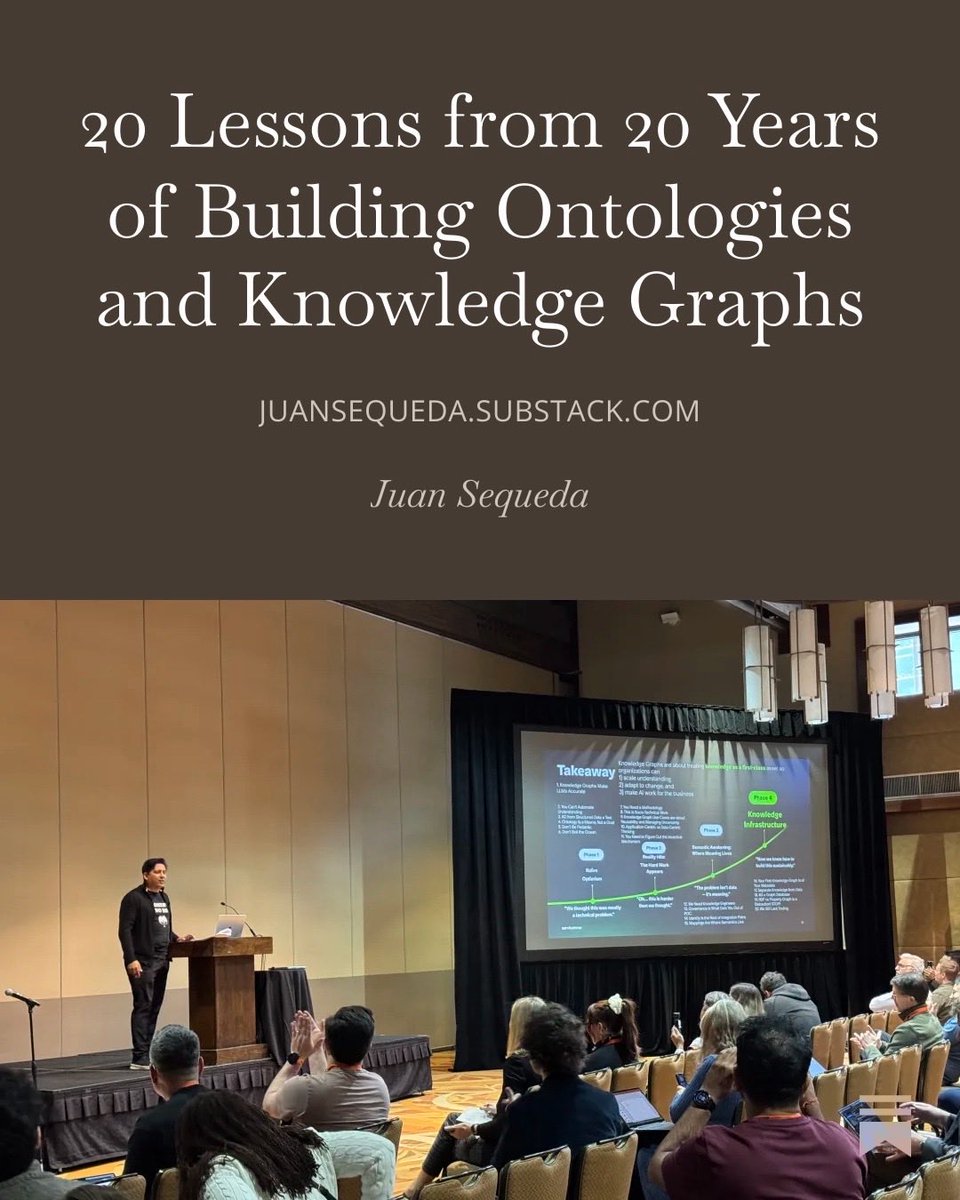
I’ve been posting on LinkedIn every day details of each lesson from my talk “20 Lessons from 20 Years of Building Ontologies and Knowledge Graphs”. I’ll working on a single article that puts all the lessons together that I’ll publish on Substack. So stay tuned. In the meantime, you can read about each lesson on LinkedIn
https://t.co/N6RFqt8aVB
For everyone excited about Knowledge Graphs and Ontologies: check out this talk on the History of Knowledge Graphs.
I just found this video on YouTube that Prof Claudio Gutierrez and I gave at EDBT 2021 conference. It’s based on our Communication of the ACM article.
Link to video: https://t.co/kA6S8JPfhS
Link to paper: https://t.co/pumCoGi6dj
Hopefully it’s a fun weekend watch
The “O” word
If you talk to people working with data, AI, or enterprise architecture and ask, “what is an ontology?”, you’ll get different answers.
For some, ontology is a kind of clever data schema. For others, it’s a business glossary. For others still, the heart of a knowledge graph. They’re all right, and that’s the problem as per Juha-Pekka Joutsenlahti.
In “Demystifying ontologies“, Joutsenlahti gives a brief history of the concept of ontologies in IT and knowledge representation. He explains that different communities adopted “ontology” and bent it slightly towards their own needs, resulting in confusion.
The key to reducing the confusion is to always ask: What is this ontology for? Is it meant to clarify meaning or to define data structure (or both)? Once we make that distinction explicit, much of the mystery starts to disappear.
“The O word: do you really need an ontology?” was published in 2019. Before GenAI was a thing, Mark Hall made a compelling case for ontologies and offered an explanation as to why isn’t everyone doing this.
Today, as Ole Olesen-Bagneux notes, ontologies are once again hot because they are key to succeeding with AI: ontologies provide context for AI to perform better. Thus, we are seeing the re-introduction of knowledge engineering as if it were new.
Knowledge Management and the Library Sciences, from which taxonomies, ontologies, and knowledge graphs were born, are well-established disciplines, as Juha Korpela notes in “How Data Models and Ontologies Connect to Build Your Semantic Foundations“.
Korpela points out that people who have traditionally worked with ontologies and knowledge graphs have not been communicating much with domains such as data modeling, but the exchange would be meaningful.
Data modelers focus on the technical implementation of data solutions, thus following a path from Conceptual to Logical to Physical modeling.
Even if concept models and ontologies are different, as @JessicaTalisman notes, there is overlap. Conceptual modeling may be used to build an ontological foundation that acts as the context provider for agents and chatbots as well as humans.
--
📩 Excerpt from The Year of the Graph Winter 2025-2026 newsletter
The Ontology issue: From knowledge to graphs and back again 👇
https://t.co/sviXFOwPPj
All things #KnowledgeGraph, #GraphDB, Graph #Analytics / #DataScience / #AI and #SemTech.
Subscribe and follow to be in the know. Reach out if you'd like to be featured