Hello! We are scientists @montanastate across several departments who research life in extreme environments. Follow us if you are interested in extremophiles, astrobiology, or origins of life research 🌍
Congratulations to rockstar PhD candidate @hannah_goemann for being awarded a NIFA predoctoral fellowship to torture some plants (as we do!) and examine plant-microbe interactions and root exudates!!!! 👏 🥳
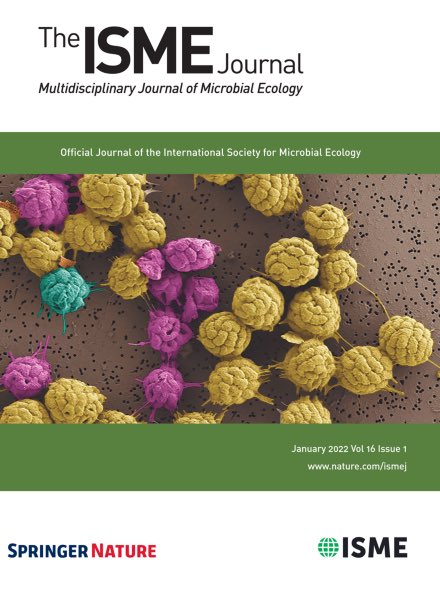
First issue of the @ISMEJournal showing the image I took of the multicellular magnetotactic bacteria I study. The image will grace the cover of the journal for the entire year of 2022! What an honor! Huge thanks to @environmicrobio for the opportunity!
❄️ GEO-BIO POST-DOC OPPORTUNITY ❄️
Join @NERCscience#Cryo365 working on Arctic glacier geomicrobiology with @arwynedwards and others @AberUni. 30 month position, year-round Arctic fieldwork in Svalbard, multi-omics approaches, superb international team.
https://t.co/fntcYdzG6w
Great opportunity for those working on agnostic biosignatures and approaches for detecting life as we don't know it to present their work at #AbSciCon22!
Submit an abstract here by Jan 19th: https://t.co/99inPuz0hF
#astrobiology#NFoLD
Hello, do you follow us and have an Instagram? If so, please follow our new TBI Instagram account for more research on life in extreme environments!
https://t.co/dxISUTkOgj
#Biofilm research is booming! Since the founding of the #CBE in 1990, the number of biofilm papers published has grown from 206 to a staggering 83,578. #biofilmfirst#MontanaState
PhD students sought for fellowship in “extreme biofilms” at Montana State Univ. You would gain professional development & experience researching biofilms in extreme systems. Apply by 1/28. Stipends of $34k are available for 2 years of a PhD program.
https://t.co/uonbLMN5MQ
Please RT. The Danish @Hadal_Center & @Nordcee at Univ. Southern Denmark is looking for 3 PhD students to study: Microbial Metabolisms in Deep Sea & Hadal Systems; Deep-Sea Microbial Degradation of Organic Matter; Benthic Carbon & Nutrient Cycling After Sediment Resuspension. 1/n
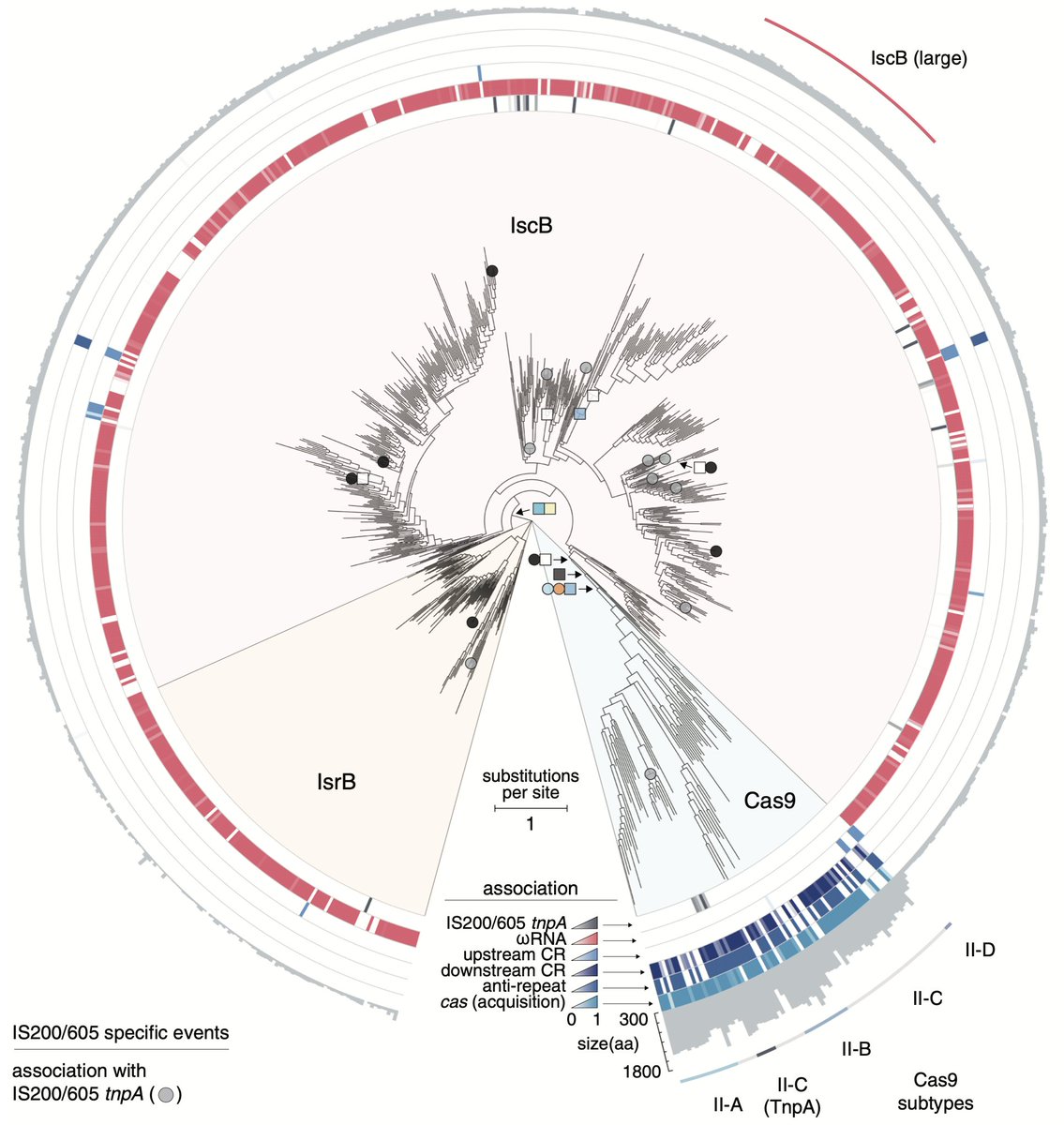
4/ Using phylogenetic analysis and enabled by collaborator (@GCACTAATTGAGAAC, MDlakic, @Ivan_Bilinski) samples from Yellowstone Lake, we identified a new Cas9 subtype II-D and show that CRISPR-Cas9 likely evolved from ancestral OMEGA systems.
CRISPR technologies are powerful gene editing tools because they are programmable. We are excited to describe 3 new programmable systems, IscB, IsrB, and TnpB, some of the most abundant genes on the planet, with potential for gene editing. @ScienceMagazine https://t.co/dY8FXBYIM8
Here is a radical idea:
How about requiring senior faculty to express their commitments & contributions to DEI before asking junior faculty and applicants to write DEI statements that many aren’t even qualified to evaluate because they have never done the work
I said it 🙊
Our new paper is out! #Metagenomics and metagenome-assembled genomes #MAGs of microbial communities across extreme temperature gradients on Deception Island volcano #Antarctica https://t.co/vBn51pIuQV
Researchers @EMSLscience, with @environmicrobio & Qian Wang @montanastate published a new mRNA-FISH protocol. fliFISH uses on/off cycles of photo-switch dyes to set predetermined threshold for distinguishing true signal from background noise. Read it here: https://t.co/OILGVpe3xk