Teaching Secondary English, History, and TESOL. CompTIA A+/Aviation/Paleoanthropology. “We are all in the gutter, but some of us are looking at the stars.” O.W.
I posted previously about Eastern Box Turtles migrating across my land between a kettle pond and a larger pond. To my surprise, on the way, a female turtle chose to lay her eggs in an unused raised bed enclosure. Now I will have to watch over this spot for the next 70 to 90 days.
Once again, stylized octopuses on earthenware from the region of ancient Greece. It’s truly fascinating how popular this motif must have been. Very cool.
Happy weekend!
Ancient clay pots with octopus decoration from Bronze Age Crete some 3,500 years ago! 🐙❤️
Heraklion Archaeological Museum 📷 by me
#Archaeology
“As far as we can discern, the sole purpose of human existence is to kindle a light of meaning in the darkness of mere being.”
C. G. Jung
Excerpt from, Memories, Dreams, Reflections (1963)
Am I to assume then that mead flavored with meadowsweet, since it was thought to be a healing drink, would not leave one with a hangover after overindulgence? 🤔😉
Meadowsweet, Filipendula ulmaria, was once used to flavour mead, the ancient honey wine. Mead infused with herbs was called “metheglin”, from Welsh words meaning “healing drink”; a fitting name for a beverage flavoured with a plant long valued as a healing herb. #FolkloreSunday
@AnSafiak Really? Good heavens, animal abuse?
I love horses. Friends of my parents had horses, and I used to ride frequently. Miss that experience.
Anyway, silence is not a bad thing. I take out my hearing aids at every opportunity.
The silence is calming. I hope it is the same for you.
Most people know the Army stormed Normandy. The Navy bombarded the shore. The Air Force owned the sky.
Nobody thinks about the Coast Guard.
They should.
The United States Coast Guard is not a combat force. Their entire purpose, the reason they exist, is to save people from the sea. They are trained to swim into storms, to pull drowning sailors from sinking ships, to run toward disaster when everyone else is running away.
On June 6, 1944, the Germans gave them more drowning men than they had ever seen in their lives.
The Coast Guard brought 800 men to Normandy. Five major assault transports were USCG-crewed. Eleven tank landing ships. Twenty-four troop carriers running soldiers directly onto Omaha and Utah Beaches. The USS Bayfield served as the command ship for the entire Utah Beach sector, the nerve center through which an entire army was directed ashore. The USS Samuel Chase led the assault group landing the 1st Infantry Division, the Big Red One, onto the eastern flank of Omaha.
But the thing almost nobody knows about is Rescue Flotilla One.
60 small Coast Guard cutters, nicknamed Matchbox ships because of how easily they burned, were assigned a single mission: pull men out of the water. As the landing craft were torn apart by German fire, as soldiers drowned in the surf under the weight of their own equipment, as wounded men on the beach were swallowed by the incoming tide, Rescue Flotilla One was already moving.
Their swimmers jumped into the Channel. Tethered to their boats by lines, they swam toward the men going under, grabbed them, and dragged them back. They did this 2,000 yards from shore. Under active German machine gun fire. Under mortar fire. Under artillery.
Again and again, all day long.
Two miles offshore a lookout spotted men from a sunken British landing craft floating in the Channel. One cutter went to them and pulled 24 soldiers and four Royal Navy sailors from the water before they went under.
One Coast Guard LCI was hit 25 times by German fire and kept going. Coxswain Delba Nivens kept driving his craft toward the beach after a grenade caught fire aboard his boat.
By the end of June 6, Rescue Flotilla One had pulled 400 men out of the sea.
400 men who would have drowned. 400 men who went home. 400 men whose families exist today because a Coast Guardsman jumped into the English Channel under machine gun fire and refused to let go.
Out of 800 Coast Guardsmen at Normandy, 15 were killed.
Every branch that fought on D-Day deserves its place in history. But the men who spent that day swimming between the dead to find the living, tethered to a burning ship with the whole weight of the German army trying to kill them, did something that has no good word for it.
They saved people. That's what they were built for.
On the worst day in the history of the sea, they were exactly who they were supposed to be.
The famous Mach Loop (Dolen Machynlleth) is part of a network of valleys in west-central Wales which allows for low-level flight training for military aircraft.
‘Hero’ is a moniker that gets tossed about sometimes too freely, but then there are the times where hero doesn’t begin to describe the character and devotion of a soldier like Staff Sergeant Lambert.
#DDay82
Ray’s Rock - Omaha Beach
On the morning of June 6, 1944, 23 year old Staff Sergeant Arnold “Ray” Lambert came ashore with the first wave of the 1st Infantry Division on the eastern side of Omaha Beach. At this small patch of concrete he saved nearly 20 lives:
The division came under intense fire from several German bunkers surrounding the entrance to the Colville Draw (one of two exits off Omaha Beach). Ray, a medic, immediately went to work.
He was shot in the arm. Moments later he was hit by shrapnel in the leg, but Ray kept pulling men to safety. He pulled nearly 20 wounded soldiers to cover behind this 8ft wide obstacle, treating each soldier before going out in search of others.
After several hours under fire, while pulling a wounded soldier from the ocean, he was struck by a landing craft. It dropped its ramp on top of him, breaking his back. He fell face down in the water, drowning. The craft backed up and nearby soldiers pulled an unconscious Ray to safety, eventually evacuating him off the beach.
Remarkably, Ray had already earned two Silver Stars and three Purple Hearts in Sicily and North Africa, prior to landing in France. But here in Normandy his war would end.
He awoke in a hospital back in England a day later. In the next bed over was his brother, who had also been wounded at Omaha.
When asked about his work on D-Day, Ray simply said, “I did what I was called to do.”
Ray Lambert passed in 2021 at 100 years old. He exemplified the best of American grit and why remembering this day is so important.
“The first wild rose in wayside hedge,
This year I wandering see,
I pluck, and send it as a pledge,
My own Wild Rose, to Thee.
For when my gaze first met thy gaze,
We were knee-deep in June:
The nights were only dreamier days, …”
From A Wild Rose
Alfred Austin
“On long, serene midsummer days
Of ripening fruit and yellowed grain,
How sweetly, by dim woodland ways,
In tangled hedge or leafy lane,
Fair wild rose thickets, you unfold
Those pale pink stars with hearts of gold!”
- from ‘Wild Roses’ by Edgar Fawcett (1847-1904) #wildflowers
The fairies once played so long catching sunbeams that darkness fell before they reached home. They hid the beams in their flower cradles as they slept, but by dawn they had spilled out, turning some flowers gold, like buttercups and marigolds, and giving others a golden heart 💛
June 5, 1944. 3:30am.
Eisenhower woke to howling wind and hard rain. At 4:15am, in a water-soaked tent, his meteorologist James Stagg told him: there's a 24-hour break in the storm coming. One window. Miss it, and the next date is June 19.
He had 5,000 ships and 160,000 men already moving toward France.
He said: "OK. Let's go."
That evening at 8:30pm, he drove to Greenham Common to stand among the paratroopers of the 101st Airborne. He had just been privately briefed they could expect 80% casualties. He didn't show it. He walked through the crowd, shaking hands, asking names, asking where men were from.
One soldier, Lt. Wallace Strobel, said Michigan.
Eisenhower smiled. "Oh, Michigan. I used to fish there. Great fishing in Michigan."
Witnesses said his eyes were wet when he got back in the car.
That night, alone, he wrote four sentences and stuffed the paper in his pocket:
"Our landings have failed to gain a satisfactory foothold and I have withdrawn the troops. My decision to attack at this time and place was based upon the best information available. The troops, the air and the Navy did all that Bravery and devotion to duty could do. If any blame or fault attaches to the attempt it is mine alone."
He misdated it "July 5." His mind was somewhere else.
Meanwhile, across the Channel, Field Marshal Rommel was in his staff car rolling through Germany toward home. His wife Lucie was turning 50 tomorrow. He had brought her a pair of shoes from Paris.
The Germans had no Atlantic weather stations. Their meteorologists had told high command: no invasion is possible in this weather. Rommel genuinely believed they had weeks.
The paratroopers jumped at midnight.
I most certainly do. Civilization, societies that recognizes individual rights, was teetering in the balance. Recall that the Soviet army was advancing from the east.
The importance of the success of the American, British, and Canadian forces at Normandy cannot be overstated.
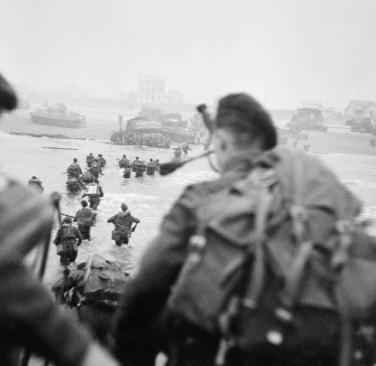
The more I look at photographs of the D-Day landings, the more humbling it becomes to grasp the sheer bravery of our Allied veterans.
I wonder if you feel the same?