🧵In December, I and my friends ran a survey across developers about vibe coding and AI tools.
👥 140+ participants
🧑💻 Most common roles across participants: Team/Tech Lead (24%), Full-stack (19%), Backend (14%), Founder (11%)
Key insights in this thread:
STATE OF THE TECH JOB MARKET IN 2026
Twice a year, I dig into trends in hiring and job openings. This is the fifth report I've done, and the most surprising yet:
1. PMs are winning in the AI era
2. Engineering demand has stalled
3. Design openings are at a record low
4. Every role now requires AI skills
5. Tech jobs are concentrating in the Bay Area
6. Remote roles are at a record low
7. The tech job market is growing fast, but mostly outside of software (gasp!)
Full report here: https://t.co/Gly6uqwKxe
I'm starting to sense a divide in the tech industry:
- People thriving on autonomy who are reinventing how they work and what tools they use with AI: LOTS of work, but they're enjoying it and getting very efficient
- People used to being mentored / trained / or simply told what to do and how. Frustrated with the lack of guidance from management on what to do with AI; also frustrated by seeing some of their peers thriving; increasingly bitter about AI and the state of the industry, as a whole
Neither group seems to be aware that there's another group, or have empathy for the other group
Meet Mistral Large 4, aka Le Chonk.
• 1T parameters, natively multimodal. 49B active.
It is the best open weights model from US or Europe on aggregated benchmarks.
• State-of-the-art on critical workloads, including cyber defense, manufacturing and finance and it surpasses closed frontier models on visual grounding.
• Forged in Europe end-to-end and is deployable from Europe via our own Mistral Cloud infrastructure.
• Available to all via API today. Working with cybersecurity partners privately.
Open weights release end of October.
I just finished my presentation at Berlin AI Day. I was speaking about scaling AI adoption in large technology teams.
The question behind my talk: how do you turn individual productivity gains into better delivery across thousands of engineers?
Giving people access to AI tools is a starting point. Even high usage tells you little about whether the organisation delivers faster or with fewer defects.
If engineers write code faster while review, testing and release processes stay the same, work can simply stack at the next bottleneck. The whole delivery workflow needs attention.
A several principles from my talk:
- Measure delivery outcomes: lead time, throughput, change failure rate and production defects. Track usage to understand adoption, then check whether it improves those outcomes.
- Make useful work reusable. Shared context, validated skills, agents and evaluation frameworks should reduce the effort required for the next team to adopt AI.
- Build governance into the workflow. Approved access, automated evaluation and traceable decisions help teams use AI with clear human accountability.
- Start with a baseline and a small number of pilot teams. Capture failures as carefully as wins, and expand based on evidence and team readiness.
The goal is an organisation where effective ways of working with AI can spread across teams without quality declining.
AI has collapsed the cost of building products, but not the cost of knowing what to build.
- The old loop: spec, scope, build
- The new loop: build, play, design, ship
Prototypes are cheap. Great products still require taste, judgment, and a clear understanding of what users actually need.
a16z's @joshelman on the artifact a product manager actually produces: https://t.co/neVI1kyCYY
We’re sharing a solution to the Navier-Stokes Millennium Prize Problem, one of the deepest problems at the frontier of mathematics.
The proof was produced by a group of agents, using an OpenAI next-generation model significantly more capable than GPT-6 Astra.
The problem concerns whether the description of smooth three-dimensional fluid motion modeled by the Navier-Stokes equations can break down. It has remained unresolved for roughly 90 years.
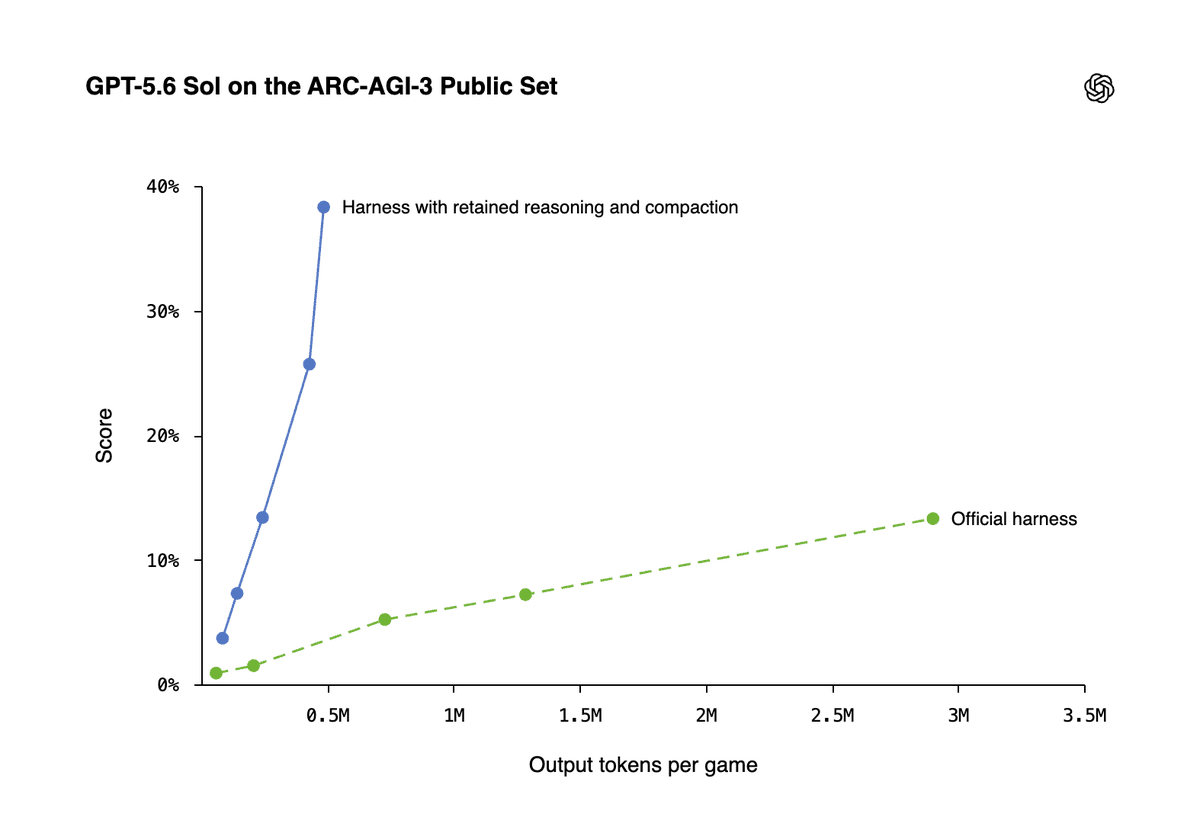
We implemented the harness with the Responses API and turned on:
→ Retained reasoning
→ Context compaction
On the public set, GPT-5.6 Sol’s score rose 188% while using 6x fewer output tokens.
AI has found a presentation for the absolute Galois group of the field of 2-adic numbers. This is the second problem to be solved in FrontierMath: Open Problems, our benchmark of significant unsolved problems from research mathematics.