1/3 Excited to share a paper 5 years in the making, now out in @PNASNews. We asked how does past exposure to violence shape the way people think in social situations, and how does that thinking drive future involvement in violence?
How is AI reshaping scientific discovery?
Join Prof. Sendhil Mullainathan (MIT & Oxford), Sir Nigel Shadbolt (University of Oxford) & Dr Raia Hadsell (Google DeepMind) for a panel at the University of Oxford.
Free Registration: https://t.co/2FDohHoSvW
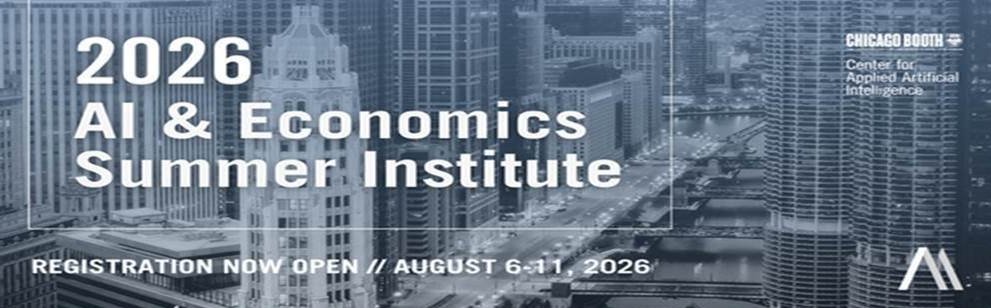
AI is changing economics, and --- as we just saw in Dwarkesh's interview with Dario --- AI researchers need to start thinking about economics too!
The Center for Applied AI at UChicago will be hosting an AI & Economics Summer Institute to explore exactly this.
We will bring together leading researchers with advanced graduate students in economics/AI/ML/NLP for an in-person program between Aug 6 - 11.
We have a 📢 Call for Papers out for our *AI and Society* conference (🗓️ 11-12 June 2026, @Unibocconi).
Keynote lecture by the one and only @m_sendhil!
Looking forward to your submission, details below! (Papers on AI research methods or AI econ/social impact are all welcome.)
ON PREFERRING PEOPLE TO ALGORITHMS - years in the making, just out in my favorite (and in important ways the best) academic journal. @WKipViscusi@m_sendhil@UncertaintyRisk
https://t.co/TiQF4Q1iUA
A new op-ed from Richard Locke, Dean of @MITSloan, highlights research from our co-directors @DAcemogluMIT, @baselinescene, and @davidautor and our affiliate @m_sendhil on choosing a pro-human path for AI.
https://t.co/6CAAKavikg
New research finds that valuable education data is being wasted: Large gains are possible at nearly zero cost simply by better leveraging all of the test items currently collected, from @jmb112485, Michael Gilraine, Jens Ludwig, and @m_sendhil https://t.co/tMCKuD4ogb
I'm on the academic job market!
I design and analyze probabilistic machine-learning methods---motivated by real-world scientific constraints, and developed in collaboration with scientists in biology, chemistry, and physics.
A few highlights of my research areas are:
We're building the wrong AI, @m_sendhil told a crowd at @UWMadison Thursday.
Mullainathan outlined his vision for a more beneficial AI at a sold-out event hosted by @UWLaFollette.
Learn more in my latest for @CapTimes
https://t.co/8hgHuhc46N
Workshop announcement! Send us your best papers or abstract if you want to present/discuss with others interested in HISTORY LLMs -- large language models trained or fine-tuned for historical contexts. @ellliottt@aadukia@m_sendhil
How can we evaluate whether LLMs and other generative models understand the world?
New guest video from Keyon Vafa (@keyonV) on methods for evaluating world models.
Can #LLMs grasp the real world? MIT & Harvard researchers (@m_sendhil, @asheshrambachan, @petergchang, @keyonV) propose a new way to test how predictive AI applies knowledge across domains. Learn more: https://t.co/npsSXgyHyT
Researchers from Harvard, Keyon Vafa (@keyonV) and MIT, Peter Chang (@petergchang), Ashesh Rambachan (@asheshrambachan), and Sendhil Mullainathan (@m_sendhil) have published what I consider the most interesting study on the abilities of AI models in 2025.
They wanted to address a fundamental question: Can AI models develop internal world models, or do they stop at being great predictors of token sequences?
They used orbital mechanics as the setting for their study. Kepler discovered how planets move around the sun in elliptical orbits and made accurate predictions of their future trajectories. This is what we know AI models do very well. But then Newton built on Kepler's discoveries and formalized them into a mechanistic explanation: the laws of gravitation and motion.
So the authors wanted to know: Can AI models do what Newton did? Do they encode the laws of gravitation to make their extremely accurate predictions?
Their conclusion is clear: no!
AI models do indeed make nearly perfect predictions - even for solar systems that don't exist - but surprise, not by encoding the real laws of physics that Newton discovered!
This was surprising: AI can tell you where Earth will be, but not why! It will completely miss the magnitude or direction of the force vector that represents the attraction to the sun, which is the underlying cause of the motion of the planets.
So, what are AI models actually doing to make good predictions?
The authors explored other scenarios (Lattice problems and Othello games) and concluded that the AI models are using case-specific heuristics that don't generalize. They care about next tokens, not world models, so whatever works to get the next tokens correct suffices!
The problem with this is that as soon as you change the conditions of the setting, their predictions would be wrong.
The authors also tested state-of-the-art LLMs like o3, Gemini 2.5 Pro, and Claude 4 Sonnet and found the same thing: great predictions, poor world models.
These findings unveil a big setback to AI models and LLMs as the path to artificial general intelligence (AGI). Can AI companies solve this? Will they be willing to accept that their current products can’t, as they are now, lead to human-level intelligence? What’s the breakthrough we need?
I explore all these questions in the post.
I don't know for sure, but one thing is clear: AI models are not ready to make scientific discoveries.
Can an AI model predict perfectly and still have a terrible world model?
What would that even mean?
Our new ICML paper formalizes these questions
One result tells the story: A transformer trained on 10M solar systems nails planetary orbits. But it botches gravitational laws 🧵
100+ filmmakers and celebrities voted for their favorite movies of the 21st century in the NYT poll.
Whose tastes are most similar to yours?
I made a website that lets you find out: Pick your top 10 movies and see your closest matches.
In this #AI era, we @Upwork are creating opportunity for customers through our human and AI-powered work marketplace. Our newly launched Upwork Economic Advisory Council will further advance this critical work and the trailblazing insights we can share: https://t.co/719o4zB2yW
The sweet taste of a new idea.
In a new profile LIDS PI Sendhil Mullainathan discusses the lifetime of unique perspectives he brings to research in behavioral economics and machine learning. Read the article. https://t.co/dOxXJHOM7b
The WORLD'S FIRST legally authorized AI medical device approved to make CLINICAL DECISIONS on skin cancer WITHOUT HUMAN REVIEW.
This is the tip of the iceberg. So much coming to improve accessibility and speed of healthcare.
Listen on Derby Mill. @m_sendhil@RichardSSutton NiamhG
https://t.co/F8Mo6qcVPO