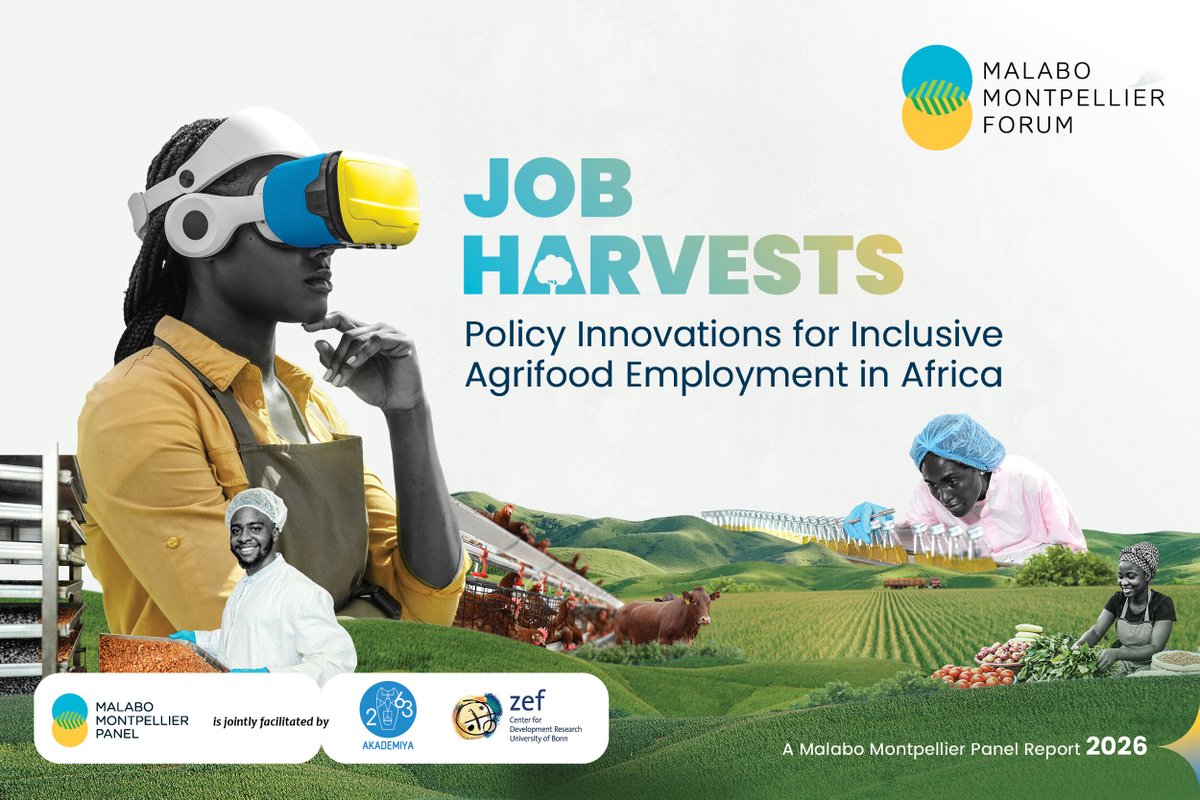
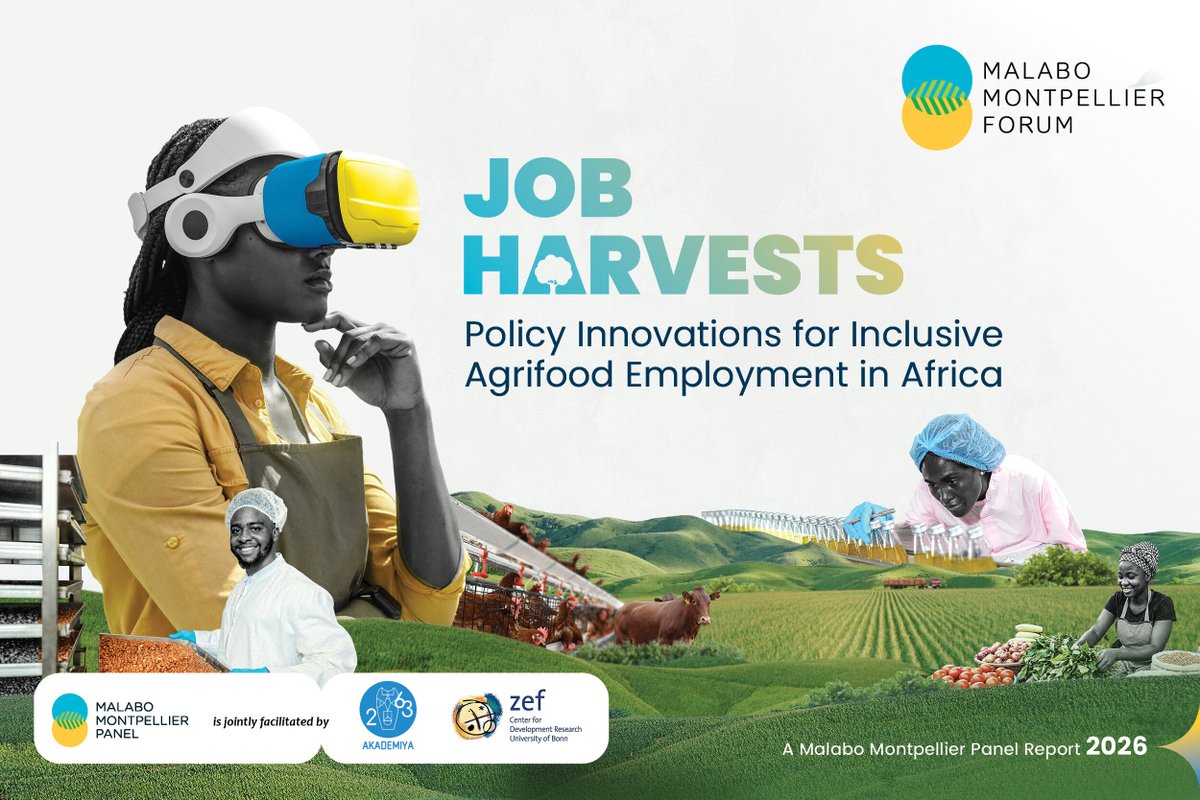
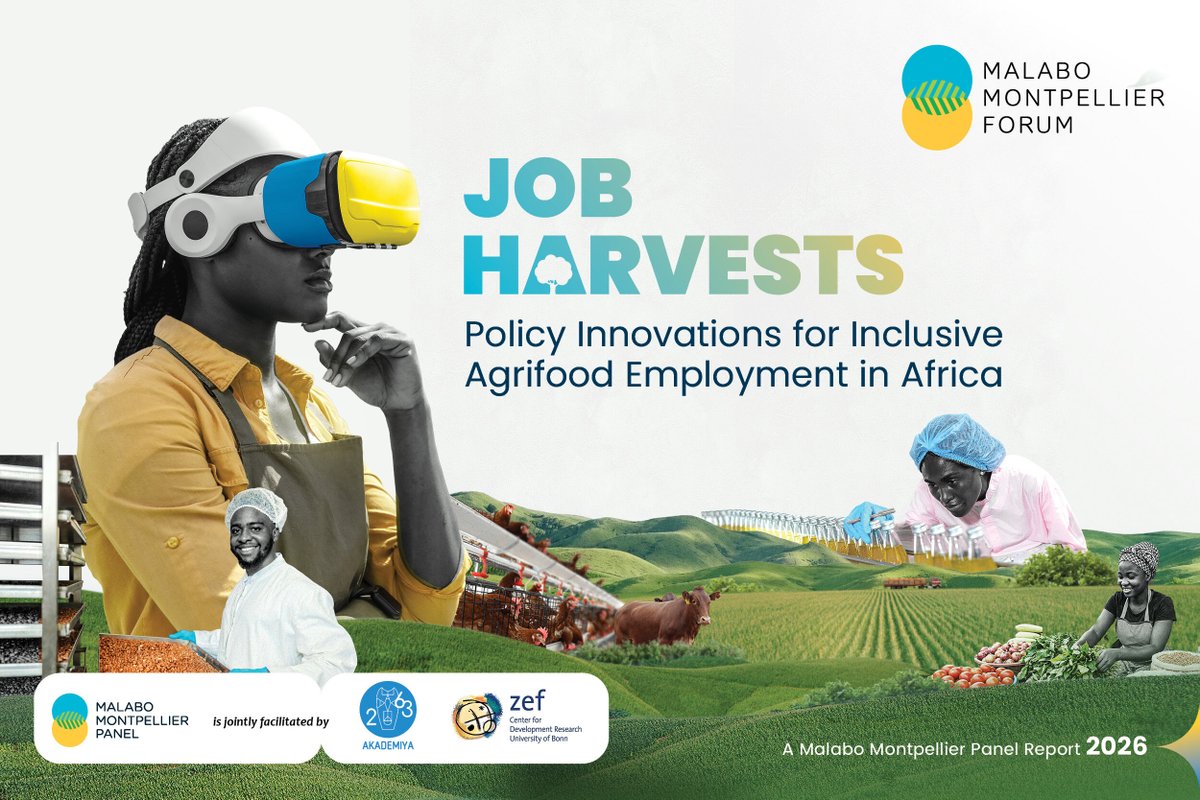
Sustainable employment creation in Africa depends on more than agricultural productivity growth. It also requires stronger rural economies, expanding agrifood value chains, and opportunities for workers to move into more productive activities.
@MaMoPanel’s latest report highlights how rising agricultural productivity can stimulate demand for processing, storage, transport, and other services, creating employment beyond primary production. However, productivity gains do not automatically translate into better employment outcomes; they must go hand-in-hand with job creation and improved working conditions.
#JobHarvests: https://t.co/Ma6nMWPqjh
Digitalization, innovation, and AI are creating new opportunities across Africa’s agrifood systems, from digital finance and e-commerce to logistics, data services, and agricultural advisory tools.
Ag-tech is generating jobs in software, data, and digital finance, but these roles often require specialized skills and are concentrated in urban areas.
Realizing the employment potential of digitalization requires investment in digital infrastructure, skills development, and inclusive innovation to help women, young people, and rural communities participate in the evolving agrifood economy.
More from @MaMoPanel’s “Job Harvests”: https://t.co/Ma6nMWPqjh
Agrifood value chains are creating growing opportunities for employment beyond primary agriculture.
As population growth, urbanization, and rising incomes reshape food demand across Africa, processing, logistics, storage, and distribution are becoming increasingly important sources of jobs and economic activity.
@MaMoPanel’s “Job Harvests” report highlights agro-processing as a key driver of this transformation. By adding value to agricultural products, extending shelf life, reducing postharvest losses, and connecting producers to urban markets, agro-processing can stimulate demand for agricultural outputs, inputs, and services while supporting food security and income growth.
Policy insights: https://t.co/Ma6nMWPqjh
As African countries pursue agrifood transformation, employment creation must be integrated into the policies, investments, and institutional reforms shaping the sector’s development.
“Job Harvests” examines policy innovations that can help countries connect agrifood systems transformation with employment creation. Aligning agricultural productivity, enterprise development, and upskilling in policy interventions will be essential to expanding productive work and economic opportunities for Africa’s growing population.
Policy insights: https://t.co/Ma6nMWPqjh
Turning Africa’s agrifood systems into engines of employment requires coordinated action across productivity, skills, investment, and rural development.
@MaMoPanel’s “Job Harvests” report recommends prioritizing agricultural productivity, aligning skills development with labor market needs, strengthening worker protections, mobilizing private investment, and investing in rural infrastructure.
As Prof. Joachim von Braun underscores: “A dual approach is called for to harvest the jobs: indirectly creating jobs by accelerated investment in agrifood system productivity, and directly creating jobs with labor-intensive public works building productive rural infrastructure.”
Read more via @Rural21Journal: https://t.co/8eM7MuhAkh
Innovate today. Nourish tomorrow.
This World Food Day, we reflect on progress and pathways toward ending hunger and ensuring access to reliable, affordable, and nutritious food for all.
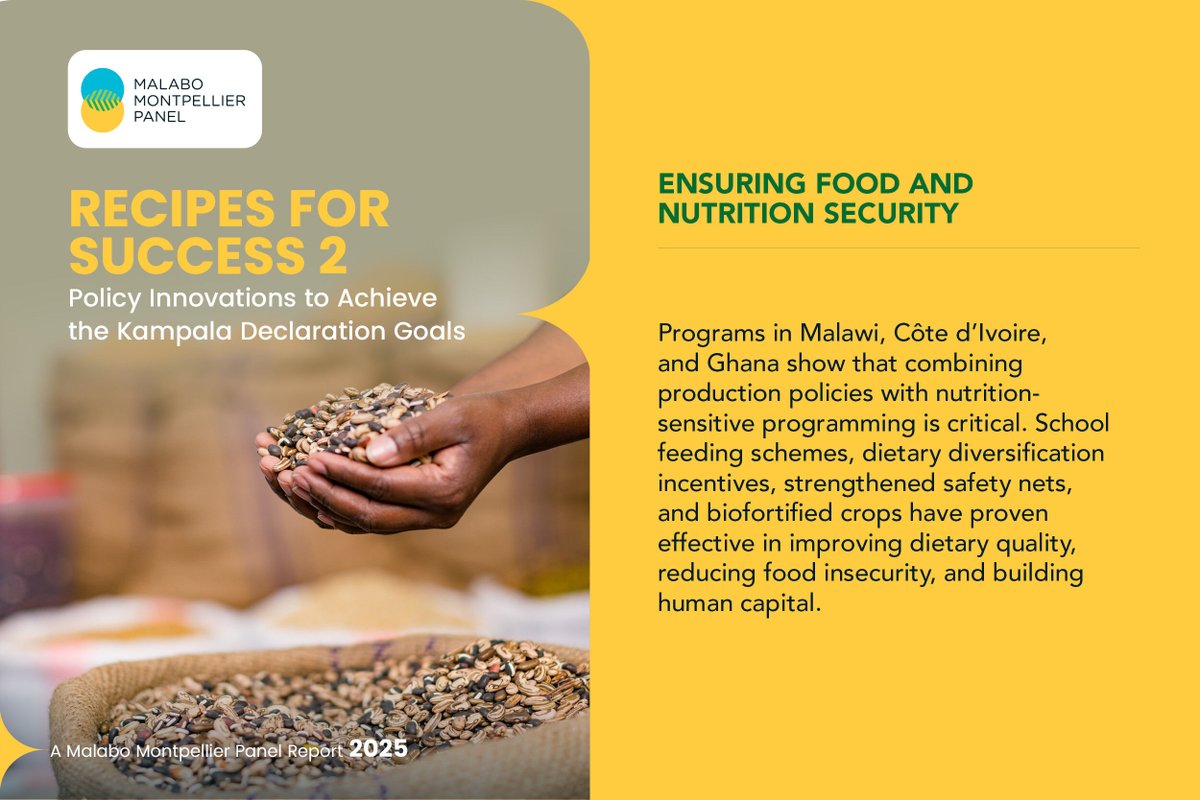
Research by @MaMoPanel highlights the effectiveness of school feeding schemes, dietary diversification incentives, stronger safety nets, and biofortified crops in improving dietary quality, reducing food insecurity, and building human capital.
Scaling up these interventions requires sustained political leadership, cross-sectoral coordination, and robust monitoring systems to track nutrition outcomes and strengthen food security.
With innovation, evidence, technology, research, and local knowledge, Africa can accelerate progress toward food systems that nourish its growing population.
Recipes for Success: https://t.co/bA6t6nvKKU
Agrifood systems are central to Africa’s employment challenge—but they are also a major part of the solution.
The @MaMoPanel’s Job Harvests report shows how agrifood systems can generate the productive jobs needed for Africa’s rapidly growing youth population, provided the right policies are in place to accelerate transformation and ensure these jobs are productive, resilient, and inclusive.
@DrOBadiane, Executive Chairperson of @AKADEMIYA2063 and Co-Chair of @MaMoPanel, joined @cnbcafrica’s Karabo Mashaba to discuss the report’s key findings and policy recommendations.
🎥 Watch the interview: https://t.co/8yCGKG0DmC
As countries advance the implementation of the @_AfricanUnion Kampala CAADP Declaration, the employment dimension of agrifood transformation should remain at the center of policy choices, public investment, and institutional reform.
For millions of young women and men, the promise of transformation will be measured not only by economic growth but also by whether that growth creates pathways to productive, secure, and meaningful livelihoods.
The “Job Harvests” report reminds us that the quality of employment matters. Safer workplaces, fairer opportunities, stronger skills systems, and more resilient livelihoods are essential to ensuring
agrifood transformation improves lives.
More insights: https://t.co/Ma6nMWPqjh
Africa’s employment challenge goes beyond unemployment rates. The real challenge is creating productive, secure, resilient, and inclusive jobs, particularly for the continent’s growing youth population and women.
The “Job Harvests” report highlights the central role of agrifood systems, which accounted for nearly two-thirds of Africa’s total employment in 2022. As employment shifts beyond primary agriculture, opportunities are expanding across agro-processing, trade, logistics, transport, storage, retail, and food services.
More insights: https://t.co/RsH4o516jL
Africa does not simply need more jobs. It needs better jobs.
With millions of young people entering the labor market, the question is how the continent can turn its agrifood systems into sources of productive, resilient and inclusive employment.
From rural infrastructure and skills development to entrepreneurship, finance, and worker protection, the “Job Harvests” report highlights the policy choices that can help make agrifood transformation a driver of better employment.
Read more from @angevict@TopafricanewsC: https://t.co/B9vSVYWcEB
The transformation of Africa's agrifood systems is increasingly linked to broader changes in rural economies, where livelihood diversification has become a defining feature of labor allocation. Households and individuals in the rural economy are increasingly engaged in multiple concurrent jobs across agriculture and non-agriculture sectors to stabilize income.
@MaMoPanel's #JOBHARVESTS examines employment in Africa's agrifood systems and rural economies through the lens of structural transformation and analyzes the constraints and enablers of inclusive agrifood employment transformation.
#JOBHARVESTS: https://t.co/Ma6nMWPqjh
Looking for a policy playbook to guide interventions under the @_AfricanUnion#KampalaDeclaration commitments?
@MaMoPanel’s #RecipesforSuccess aggregates nearly a decade of country case studies to provide policymakers with practical guidance for building resilient and sustainable agrifood systems.
Recipes for Success: https://t.co/ZvkUaUOkxK
How can African countries better align employment policies with labor market needs and emerging economic opportunities?
The “Job Harvests” report highlights the role of digital innovation in expanding access to opportunities and improving productivity in agrifood systems.
Experiences from #Nigeria, #Rwanda, and #Ethiopia demonstrate how high-level coordination mechanisms and digital labor market information platforms can improve job matching, align investment with workforce demands, and inform policy priorities.
#JOBHARVESTS: https://t.co/Ma6nMWPqjh
Strengthening high-level institutional coordination to support integrated employment outcomes!
African countries can benefit from strengthening coordination mechanisms that bring together government institutions, the private sector, and other stakeholders to ensure that employment objectives are consistently reflected and coordinated across development policies and programs.
In #Rwanda, high-level public-private coordination platforms, such as the Industrial Development and Export Diversification Council, have helped align investment and industrial development priorities with labor market demands.
#JOBHARVESTS: https://t.co/Ma6nMWPqjh
As governments around the world grapple with rising migration pressures, the conversation too often centers on border security, climate shocks, and conflict. These factors matter, but they overlook a deeper economic reality: in an increasingly interconnected global labor market, migration is often driven by the search for better jobs and higher incomes. For many young Africans and others from the Global South, migration is not simply an escape from hardship but a calculated investment in economic opportunity.
Investing in agrifood systems will create productive opportunities that enable young Africans to build prosperous futures where they are and reduce the economic pressures that drive irregular migration.
Read more from @DrOBadiane via @farmingfirst👇
https://t.co/irpSzEBner
.@TESSForum has mobilized an international expert group to examine the trade dimensions of sustainable agriculture through an integrated lens encompassing food security, development, and environmental sustainability objectives.
@AKADEMIYA2063 is pleased to see Aisha Nakitto, Ph.D., Head of Policy Innovation Unit and Program Lead, @MaMoPanel, among the members of the International Expert Group on Trade and Sustainable Agriculture.
More information about the Expert Group: https://t.co/MkeK9GFMrr
#JOBHARVESTS
Research, innovation, and extension services can help farmers and rural enterprises adopt productivity-enhancing technologies, improve product quality, and manage climate risks.
-In Zambia, the government’s e-voucher model enables farmers to purchase seeds and fertilizers from private agro-dealers through digital systems, while ZIAMIS supports registration, redemptions, and insurance functions.
-In Kenya, the government, through the Kenya Agriculture and Livestock Research Organization, developed the Big Data Platform and Kenya Agricultural Observatory Platform, connecting more than 1 million farmers to advisory services and agro-meteorological information.
Policy insights: https://t.co/Ma6nMWPqjh
Regional trade and AfCFTA-enabled employment opportunities
Within Africa’s agrifood systems, regional trade integration offers a significant pathway for employment generation through its effects on market expansion, structural transformation, and value chain development.
According to @MaMoPanel, the full implementation of the @AfCFTA agreement has the potential to raise real income by about 7% by 2035 and increase intra-African trade by over 80%, with strong growth in processed foods, agricultural products, and manufactured goods.
These gains are expected to translate into employment expansion through increased production, the entry of more firms into agribusiness, and value chain integration.
JOB HARVESTS: https://t.co/Ma6nMWPqjh
Agricultural productivity can create jobs beyond the farm!
Improving agricultural productivity can raise farm incomes while creating demand for goods and services across the wider rural economy.
In #Ethiopia, each unit of agricultural output generates an additional 1.23 units elsewhere in the economy—40% through production linkages and 60% through consumption linkages. These linkages create opportunities across agrifood value chains, including input supply, aggregation, transport, processing, trade, and rural services.
JOB HARVESTS: https://t.co/Ma6nMWPqjh
The @_AfricanUnion InnoFest’26 will bring together key stakeholders in the AI landscape to advance youth-led innovation, digital policy, entrepreneurship, and strategic partnerships.
@MaMoPanel’s YOUTH AHEAD report demonstrates how innovative agricultural technologies, digital tools, ICT, AI, and machine learning can support agrifood systems transformation and create new opportunities for young people.
Strengthening STEM education and digital skills can enable more young Africans to participate in emerging areas such as precision agriculture, digital agriculture, food processing, and agritech entrepreneurship.
YOUTH AHEAD (P.21): https://t.co/maKs4qhBuO