Man from Shenzhen had been posting videos reflecting infrastructures faults and offers solutions on his Douyin (Mainland Tiktok) account... and amazingly, they got rectified the next day!
He commented : "Seems like some departmental heads assigned their staffs to monitor my account for feedbacks"😂
This is a really fascinating paper that everyone interested in China's industrial policy should read.
It destroys so many myths (see below), and is written by deeply credible people who conducted over three years of fieldwork in China and interviewed 60+ Chinese officials, entrepreneurs, and engineers. When it comes to China studies, it literally doesn't get more rigorous than this.
First myth it destroys: contrary to popular belief, Beijing's industrial policy didn't build the companies that became China's EV champions. They rose largely **despite** it, through its cracks.
For sure, Beijing did favor EVs as an industry and pushed hard for it but their big bet was SOEs (State Owned Enterprises): research grants, pilot programs, licenses, cheap credit - virtually all of it flowed to state firms.
The result? China's actual EV champions - BYD, Geely, NIO, XPeng, Li Auto, etc. - are overwhelmingly private firms that succeeded despite Beijing favoring their SOE competitors.
How so? Because, when favoring SOEs, the central government didn't just pick winning companies, it picked winning cities, each SOE being anchored in a specific city: Shanghai (SAIC), Changchun (FAW), Wuhan-Shiyan (Dongfeng), etc.
Which means that every city not on the list, that wanted a piece of the auto boom, had only one option left: team up with private entrepreneurs who were equally excluded from central government favor.
That's what truly fueled China's EV miracle: an alliance of the excluded, between local private entrepreneurs and local mayors.
This is the biggest misconception this paper destroys: the reality is that the "Chinese state capitalism" that many in the West think powered the EV boom actually tried to block many of these companies from existing. In effect, it was closer to an obstacle course that local actors (mayors and provinces) learned to game.
Geely - now the third largest automaker in China - is a fantastic example of this.
First of all, it started off illegal since, to build passenger cars, you had to have a central government license and they couldn't get one. Zhejiang Province told them to go ahead regardless because the province had hundreds of auto parts suppliers but no carmaker of its own.
It's only a couple of years later, recognizing the fait-accompli that Geely was producing cars and was competitive, that the central government admitted them to the National Sedan Catalog - effectively legalizing them retroactively because there were facts on the ground.
Then there was the Volvo acquisition in 2010, which is fair to say - looking back - proved to be the most strategically valuable acquisition in Chinese automotive history. Despite it being presented at the time (and still described this way today) as "China buying Volvo", all 3 major state-backed banks in China (Export-Import Bank, China Development Bank, Bank of China) refused to finance the deal. The only state-bank money Geely managed to get was a $200 million loan from a provincial branch of China Construction Bank - a tiny fraction of what the deal required.
Geely actually did the deal with Goldman Sachs money via Hong Kong plus loans and equity from four local governments (Chengdu, Zhangjiakou, Daqing, Shanghai's Jiading district), each of which bought in by securing a Volvo plant or headquarters for itself.
In effect, the doors that Beijing controlled were largely closed to Geely, but it made it because the doors subnational actors controlled were opened.
Which all means this paper destroys another very common myth: the big merit of the central government in all this was to be relatively chill about it, to NOT be dictatorial.
I just imagine if that had happened in France and you had - say - the mayor of Lyon or Marseilles open, fund and promote an unlicensed carmaker against Renault: the préfet would shut it down within weeks, and the mayor would be lucky to escape prosecution.
That's the irony: on industrial policy, the supposedly "totalitarian" Chinese state proved more tolerant of local defiance than most Western liberal democracies would be. Beijing's greatest contribution to the EV miracle wasn't the plan - it was looking the other way while the plan was being violated.
To be sure, the paper doesn't hide the costs of this system: ferocious local competition also produced what's known today in China as "involution" (内卷-Neijuan, basically a hypercompetitive price war), as well as some spectacular failures. For instance one county lost 6.6 billion yuan on a carmaker that never really made cars.
But that's precisely the point: this is a high-risk, high-reward model of decentralized experimentation, the very opposite of the careful central planning Westerners imagine.
I've repeated this countless times but it bears repeating again: the single greatest misconception people have about China is - probably because we wrongly associate communism with centralized control - that it is a monolith run from Beijing. Some even say it's run by "one man."
The reality is the exact opposite: China is, in practice, one of the most decentralized countries on earth. Roughly 85% of government spending in China happens at the subnational level - against about 30% in the average OECD country (and even less in France, which is actually one of the most centrally controlled countries on earth). A Chinese mayor commands fiscal resources, land, investment funds and policy latitude that virtually no Western mayor could dream of.
Last but not least, I'd be remiss not to mention what the paper has to say on the positive legacy of Mao and its role in the rise of EVs (given I myself wrote an article titled "Mao's economic record wasn't bad, actually": https://t.co/1NZgHqBHwg).
When it comes to China myths, none is more entrenched than the idea that Mao left behind nothing but ruins.
This paper confirms a key argument of my article: Mao's deliberate dispersal of industry across China (during the Great Leap Forward and Cultural Revolution decentralizations) left dozens of cities with their own small auto works. Inefficient, yes - but these scattered factories survived into the 1990s and became the seed stock of everything that followed: the industrial base, the engineers, and the production licenses that EV startups would use to enter the market.
The paper even says it outright: the fragmentation that industrial policy "sought to eradicate" is "precisely" what "ironically enabled" the EV sector's rapid rise.
This is exactly the mechanism I described in my Mao article: structures built in the Mao era - communes becoming township governments, commune enterprises becoming TVEs, Third Front factories seeding interior industrialization - became load-bearing foundations of the reform miracle.
Fittingly, the spark for China's first municipal carmaker adventure was literally a TVE (Township and Village Enterprise), the institutional descendants of Mao's commune enterprises: Tongbao, a kit-car maker in Wuhu whose success stunned local officials into building what became Chery (one of China's biggest carmakers today). You can't tell the story of China's EV miracle without crediting the legacy of Mao.
What's the biggest lesson in all this for Western policymakers?
The obvious one is that the part of industrial policy that most people assume China does and that they sometimes want to copy - i.e. the state picking winners - is actually the part that failed.
The part that did succeed is the China nobody in the West believes exists: a radically decentralized system with a high degree of tolerance for disobedience and experimentation.
We imagine China as a country where nothing happens without Beijing's approval when the reality is closer to the opposite: China's EV miracle happened precisely because localities asked for forgiveness rather than permission.
All in all, and this is the lesson I often come back to, this is yet another illustration of the importance of understanding China for what it is as opposed to the caricature we've built of it. This matters whichever "camp" you're in. If you see China as a rival, you can't compete with someone you don't understand. If you see them as a source of lessons, you can't emulate what you've misunderstood. Whatever you want from China - to compete with it or learn from it - the entry fee is the same: genuinely understanding it.
DeepSeek is going heavy-asset.
On June 9, the company posted an opening for IDC planning engineers, a role explicitly scoped to the design and delivery of MW-to-GW scale infrastructure. It follows April's hiring of data center O&M engineers in Ulanqab, Inner Mongolia. Taken together, this is the first time DeepSeek has fully shown its hand on owning compute infrastructure rather than just renting it.
"You cannot govern a technology you have only been briefed on."
Singapore Minister for Foreign Affairs, Dr. @VivianBala, echoing @karpathy and @yacineMTB on why he runs NanoClaw: "you can outsource memory and computation, but you cannot outsource your understanding"
https://t.co/z4Aidf89ha
He also shared his tech stack for running his second brain for Singapore's Foreign Affairs Ministry and parliamentary affairs:
- @AnthropicAI Claude Agent SDK
- Baileys + WhatsApp
- Mnemon (Graph Memory)
- @ollama + @nomic_ai
- @ggerganov Whisper.cpp + OneCLI
With special notes on how he handles security and isolation, and what implications he sees for Singapore Inc.
After Singapore's Minister of Foreign Affairs @VivianBala shared his NanoClaw agent setup with 600 AI engineers, I went up and tried a weird experiment.
I put a QR code on screen that gave the entire audience access to an agent that was connected to my emails, calendar, and call notes.
300 people started chatting with it and 12 booked coffee meetings with me through it.
I could do this because of NanoClaw's architecture. The agent runs in an isolated sandbox. Credentials never enter the agent's environment. Every sensitive action that touches the real world, like sending an email, seeing calendar events, or scheduling a meeting, needed my explicit approval first.
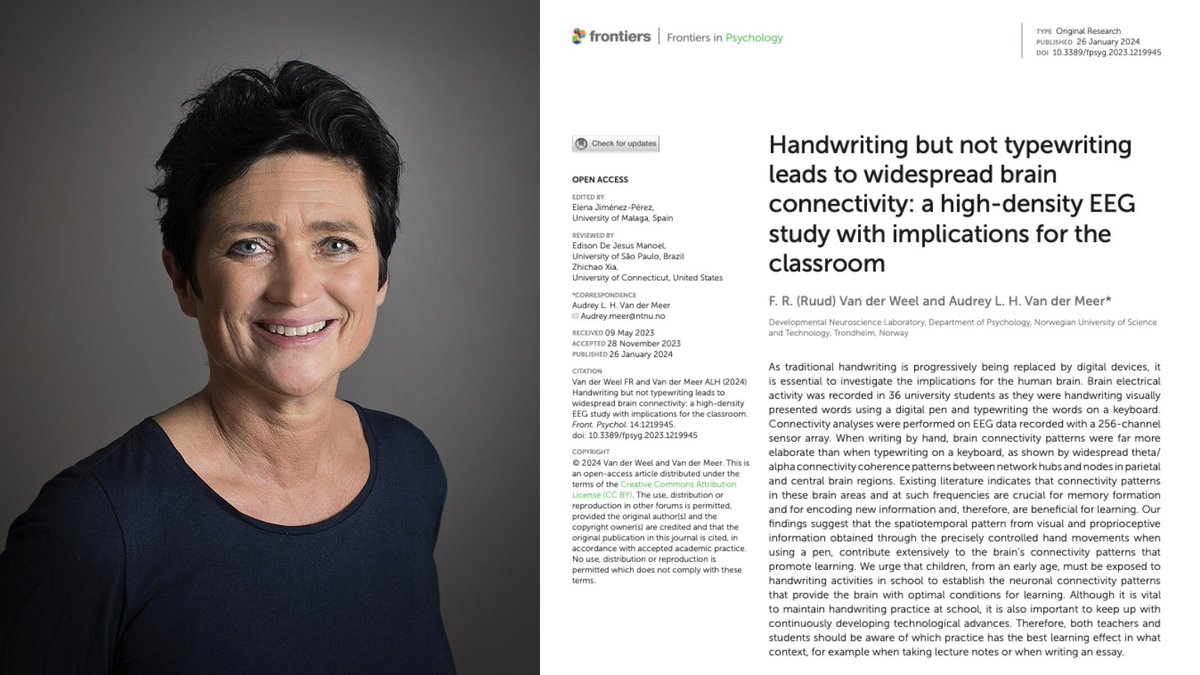
A Norwegian neuroscientist spent 20 years proving that the act of writing by hand changes the human brain in ways typing physically cannot, and almost nobody outside her field has read the paper.
Her name is Audrey van der Meer.
She runs a brain research lab in Trondheim, and the paper that closed the argument was published in 2024 in a journal called Frontiers in Psychology. The finding is brutal enough that it should have changed every classroom on Earth.
The experiment was simple. She recruited 36 university students and put each one in a cap with 256 sensors pressed against their scalp to record brain activity. Words flashed on a screen one at a time.
Sometimes the students wrote the word by hand on a touchscreen using a digital pen, and sometimes they typed the same word on a keyboard. Every neural response was recorded for the full five seconds the word stayed on screen.
Then her team looked at the part of the data most researchers had ignored for years, which is how different parts of the brain were communicating with each other during the task.
When the students wrote by hand, the brain lit up everywhere at once.
The regions responsible for memory, sensory integration, and the encoding of new information were all firing together in a coordinated pattern that spread across the entire cortex. The whole network was awake and connected.
When the same students typed the same word, that pattern collapsed almost completely.
Most of the brain went quiet, and the connections between regions that had been alive seconds earlier were nowhere to be found on the EEG.
Same word, same brain, same person, and two completely different neurological events.
The reason turned out to be something nobody had really paid attention to before her work. Writing by hand is not one motion but a sequence of thousands of tiny micro-movements coordinated with your eyes in real time, where each letter is a different shape that requires the brain to solve a slightly different spatial problem.
Your fingers, wrist, vision, and the parts of your brain that track position in space are all working together to produce one letter, then the next, then the next.
Typing throws all of that away. Every key on a keyboard requires the exact same finger motion regardless of which letter you are pressing, which means the brain has almost nothing to integrate and almost no problem to solve.
Van der Meer said it plainly in her interviews.
Pressing the same key with the same finger over and over does not stimulate the brain in any meaningful way, and she pointed out something that should scare every parent who handed their kid an iPad.
Children who learn to read and write on tablets often cannot tell letters like b and d apart, because they have never physically felt with their bodies what it takes to actually produce those letters on a page.
A decade before her, two researchers at Princeton ran the same fight using a completely different method and ended up at the same answer. Pam Mueller and Daniel Oppenheimer tested 327 students across three experiments, where half took notes on laptops with the internet disabled and half took notes by hand, before testing everyone on what they actually understood from the lectures they had watched.
The handwriting group won by a wide margin on every question that required real understanding rather than surface recall.
The reason was hiding in the transcripts of what the two groups had actually written down.
The laptop students typed almost word for word, capturing more total content but processing almost none of it as they went, while the handwriting students physically could not write fast enough to transcribe a lecture in real time, which forced them to listen carefully, decide what actually mattered, and put it in their own words on the page.
That single act of choosing what to keep was the learning itself, and the keyboard had quietly skipped the choosing and skipped the learning along with it.
Two studies. Two countries. Same answer.
Handwriting makes the brain work. Typing lets it coast.
Every note you have ever typed instead of written went into your brain through a thinner pipe. Every meeting, every book highlight, every idea you captured on your phone instead of on paper was processed at half depth.
You did not forget those things because your memory is bad. You forgot them because typing never woke the part of the brain that would have made them stick.
The fix is the thing your grandmother already knew.
Pick up a pen. Write the thing down. The slower road is the faster one.
NOW - Thomas Massie concedes his Kentucky Primary race: "Welcome to the most expensive congressional primary ever in the 250 year history of this country."
@disclosetv A class act till the end.
We have learned that it takes $30+ million, several speeches from the Sec of Defense, and multiple hoaxes to beat one House candidate.
Total Desperation.
Excited for what Massie does next. The man is a fighter, he won’t fade into obscurity this easy
This will undoubtedly be very surprising to folks who don't understand China, and/or have only ever been fed clichés about Mao. But if you've taken the time to understand Chinese history and how the Chinese view it, it makes perfect sense.
First of all, what makes a great leader in the context of China's history?
To classify as a great leader in Chinese historical memory, one must typically accomplish several key things.
First and foremost is unification - bringing together a divided China. There were several times in China's history when the country was divided, from the Warring States period to the Century of Humiliation, and these times always constitute the darkest chapters in Chinese historical memory - creating an almost reflexive aversion to division and a profound respect for leaders who can restore unity.
Which means that, to start with, you arguably cannot possibly qualify as a great leader in the long arc of Chinese history if you haven't reunified the country. This already dramatically shortens the list of potential "greatest leaders" to just 5-6 figures across all of Chinese history:
- Qin Shi Huang, who first unified China under the Qin dynasty;
- Liu Bang (founding the Han) who rebuilt unity after the Qin collapse;
- Yang Jian (founding the Sui) who first reunified North and South, followed by Li Shimin (as Tang Taizong) who cemented this unity;
- Zhu Yuanzhang, who expelled the Mongols and established the Ming;
- and finally, Mao, who unified China after a century of division and foreign domination.
I obviously exclude here foreign conquerors like the Mongol (Yuan) or Manchu (Qing) rulers, who "reunified" China but under foreign rule.
As an aside, interestingly, among of our list most of those figures have very humble beginnings: Liu Bang was a minor patrol officer who started as a peasant, Zhu Yuanzhang was a former beggar who grew up as an orphaned peasant and even spent time as a Buddhist monk, and Mao was the son of a former soldier who became a farmer & grain merchant in Hunan province.
Secondly, the Chinese tradition expects its greatest leaders to be more than just military unifiers or political strongmen. They should also be figures of profound cultural impact who reshaped Chinese society itself. As such, our short list gets even shorter; in fact only three figures from our list truly stand out for their massive cultural impact: Qin Shi Huang, Tang Taizong, and Mao.
Qin Shi Huang standardized writing, measurements, and currency while reshaping the very concept of what China could be as a unified state. Tang Taizong presided over what many consider China's cultural golden age, establishing systems of governance and cultural patterns that would influence East Asia for a millennium. And Mao, as everyone knows, fundamentally transformed Chinese society, from land ownership to gender relations to education, in ways that continue to reverberate today.
In fact interestingly, Mao was well aware of historical parallels with Qin Shi Huang in this context. In a 1958 speech about breaking with traditional authority (https://t.co/GrhxVJ4mM8), he declared "What's so special about Qin Shi Huang? [...] We've surpassed Qin Shi Huang a hundredfold" ("秦始皇算什么?[...] 我们超过了秦始皇一百倍").
Third, Chinese historical memory particularly values leaders who strengthened China's position relative to foreign powers and restored national dignity and sovereignty. This is especially true in the modern context, given the trauma of the Century of Humiliation. Through this lens, Mao's achievement in establishing China as a truly independent power - standing up to both the US and the USSR - takes on particular significance.
And lastly of course there's the question of lasting impact. While Qin Shi Huang's dynasty collapsed shortly after his death, and even the mighty Tang eventually fell, the system Mao established - albeit significantly modified by his successors - continues to govern China today. The foundational elements he put in place - universal education, industrialization, women's rights, national sovereignty, health reforms - made possible China's subsequent rise under Deng Xiaoping and his successors. This will be the ultimate litmus test of Mao's "greatness": how long his "new China" lasts. It's already 75 years old - surpassing the brief Qin (15 years) and Sui (37 years) dynasties (though still far from the mighty Tang's nearly three centuries of rule) - and shows no signs of fundamental instability.
Another comparison that's often made in China is between Mao and Cao Cao, the statesman, warlord, and poet who rose to power at the end of the Han dynasty. Precisely because - very much like Mao - he was all three: renowned for his military, political and literary achievements. The key difference, of course, is that Cao Cao never managed to fully reunify China: he only laid the foundation for the state of Cao Wei which ended the Eastern Han dynasty and inaugurated the Three Kingdoms period.
Of course, to Western observers educated to see Mao only through the prism of cold-war anti-communist propaganda, this perspective may seem jarring. But it illustrates a crucial point about historical memory: how differently the same figure can be viewed through different cultural and historical lenses. While the West tends to focus on the human costs of Mao's policies - particularly during the Great Leap Forward and Cultural Revolution - Chinese historical memory places him within a much longer continuum of nation-building leaders who transformed their society.
This is not to say that the Chinese aren't aware of the the complexities of Mao's legacy or ignore the more difficult chapters of his rule. Unlike Westerners, they lived it... hence Deng Xiaoping's famous saying that Mao was "70 percent right and 30 percent wrong", a very common view in China.
Rather, it helps explain why, despite full awareness of all this, many Chinese still genuinely view him as their greatest historical figure. Through the lens of China's millennia-old civilization, he stands among a very small handful of transformative figures who not only unified the nation but fundamentally reshaped its destiny.
We always say that China thinks long-term, and this is very characteristic of this: the Chinese will typically judge historical figures not through the lens of individual policies or events, but through their contribution to China's broader historical narrative of civilization, unity, and renewal. In this light, Mao's achievements become part of a larger story which we in the West typically aren't even aware of.
That's a great question 👇https://t.co/3IF6gSPcgA
And actually the answer is: much through the same length. Western leaders who are admired in China are those who defended their country's sovereignty, independence and dignity. As such one of the most admired Western leaders in China is De Gaulle, because he was all about France's sovereignty and independence, restoring France's dignity after Vichy. To this day, Chinese officials in France routinely go lay flowers on De Gaulle's grave.
This is incidentally also why the current crop of European leaders, vassalized by the US, are so despised in China.
Also, obviously, theses leaders' position on China matters a lot in their judgement. You're never going to be seen positively if you've been fundamentally hostile to China... This also applies in De Gaulle's case: he was the first Western leader to break ranks with the U.S. and formally recognize the PRC.
Watch a team of humanoid robots running a full 8-hr shift at human performance levels. This is fully autonomous running Helix-02 https://t.co/IdZR0T1F5I
Interesting problem that Stanford University & other US universities are having — numerous research grants across departments, which (has NOT but) needs to be all aggregated together to get a $1 billion dollar university fund to buy an AI supercomputer
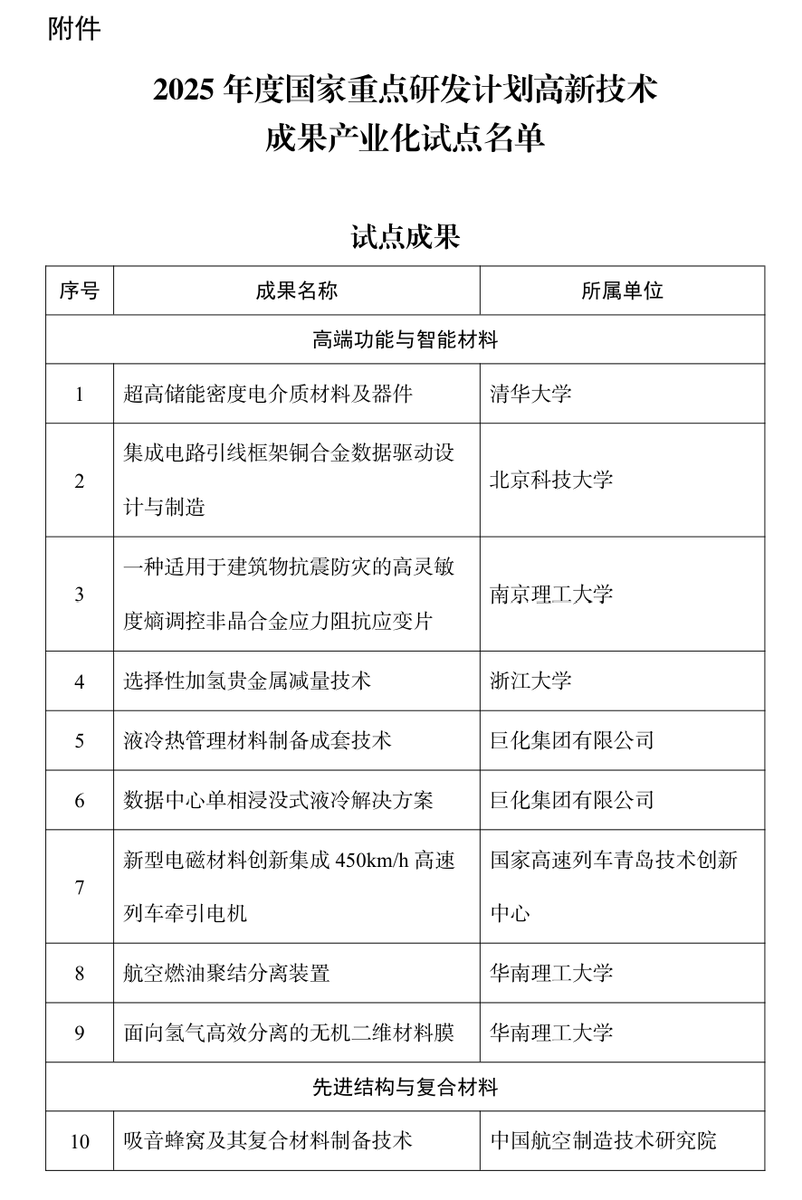
It's interesting to scan through MIIT's list of 67 pilot projects for high-tech industrialization to get a sense of what tech China thinks is important:
High-End Functional and Intelligent Materials
1. Ultra-high energy-density dielectric materials and devices — Tsinghua University
2. Data-driven design and manufacturing of copper alloys for integrated-circuit lead frames — University of Science and Technology Beijing
3. High-sensitivity entropy-regulated amorphous-alloy stress-impedance strain gauge for seismic resistance and disaster prevention in buildings — Nanjing University of Science and Technology
4. Noble-metal reduction technology for selective hydrogenation — Zhejiang University
5. Complete preparation technology for liquid-cooling thermal-management materials — Juhua Group
6. Single-phase immersion liquid-cooling solution for data centers — Juhua Group
7. 450 km/h high-speed train traction motor integrating new electromagnetic materials — National High-Speed Train Qingdao Technology Innovation Center
8. Aviation fuel coalescence-separation device — South China University of Technology
9. Inorganic two-dimensional material membranes for efficient hydrogen separation — South China University of Technology
Advanced Structural and Composite Materials
10. Preparation technology for sound-absorbing honeycomb and composite materials — China Aviation Manufacturing Technology Research Institute
11. Wear-resistant, fatigue-resistant, corrosion-resistant rails and frogs for the Sichuan–Tibet Railway — China Academy of Railway Sciences Corporation
12. Long-term performance-retention technologies for structural concrete in complex environments on the Sichuan–Tibet Railway — China Academy of Railway Sciences Corporation
13. High-performance shotcrete technology for complex environments on the Sichuan–Tibet Railway — China Academy of Railway Sciences Corporation
14. Crack-resistance improvement technologies for structural concrete in complex environments on the Sichuan–Tibet Railway — China Academy of Railway Sciences Corporation
15. Powder-making technology and applications for recycling coarse high-temperature alloy powder — AECC Beijing Institute of Aeronautical Materials
16. Large-tonnage carbon-fiber composite cables — University of Science and Technology Beijing
17. Multi-layer gradient cold-spray repair and nano-hard reinforcement composite plating for continuous-casting molds — Ansteel Group Beijing Research Institute
18. Key technologies and application development for ultra-high-stiffness magnesium-matrix composites — Harbin Institute of Technology
New Displays and Strategic Electronic Materials
19. Sub-6GHz GaN radio-frequency devices — CETC 13th Research Institute
20. High-frequency, high-power laser modulator technology — Fujian Institute of Research on the Structure of Matter, Chinese Academy of Sciences
Rare-Earth New Materials
21. Preparation technology for high-temperature-resistant cobalt-based permanent magnet materials — China Jiliang University
22. Heavy-rare-earth-free high-coercivity sintered NdFeB technology — Ningbo Institute of Materials Technology and Engineering, Chinese Academy of Sciences
High-Performance Manufacturing Technologies and Major Equipment
23. 6-inch semi-insulating SiC crystal-growth furnace and 6/8-inch compatible SiC epitaxial furnace — NAURA
24. New MOCVD equipment for Micro-LED — Advanced Micro-Fabrication Equipment Inc. China
25. Precision forming technology for large aerospace thin-walled aluminum-alloy integrated cylindrical sections — Shanghai Aerospace Precision Machinery Institute
26. High-temperature-resistant, corrosion-resistant transmission-system bearings — Luoyang Bearing Group
27. High-performance seals for aviation hydraulic systems — Guangzhou Mechanical Engineering Research Institute
28. Key manufacturing technology for ultra-large seamless titanium cathode rollers — Xi’an Taijin New Energy Technology
Intelligent Sensors
29. Advanced sensors, core components, and manufacturing processes for spacecraft control systems — Beijing Institute of Control Engineering
30. Flexible intracranial implantable multimodal sensing and modulation system for multiparameter brain monitoring — Aerospace Information Research Institute, Chinese Academy of Sciences
31. Self-powered sensor technologies for human health monitoring — Beijing Institute of Nanoenergy and Nanosystems
32. High-sensitivity MEMS magnetic sensing components and sensors — State Grid Smart Grid Research Institute
33. Miniature high-performance accelerometers — Beijing Aerospace Xinghua Technology
34. Rocket sensors — Long March Rocket Technology
35. New broadband ng-resolution triaxial accelerometer — Tianjin SIASUN Robot & Automation
36. Automotive-grade high-precision integrated navigation sensors — Hebei Meitai Electronic Technology
37. Series of sensors for deep-sea environmental observation and resource exploration — Shenyang Institute of Automation, Chinese Academy of Sciences
38. Multi-parameter differential-pressure flowmeter — Shenyang Zhongke Bowei Technology
39. Quantitative sensing-interface model and analytical instrument technology based on resonant cantilever beams — Shanghai Institute of Microsystem and Information Technology, Chinese Academy of Sciences
40. High-performance X-ray sensors — iRay Technology
41. Electromagnetic sensors — Xinlian Superconductor Shanghai
42. Thin-film getter structure with a micro-heater and its manufacturing method — Shanghai New Micro Technology R&D Center
43. High-performance acoustic sensing elements and sensors — Wuxi Weigan Semiconductor
44. New high-performance MEMS gas sensors — Suzhou Huiwen Nanotechnology
45. MEMS sensor mass-manufacturing platform — XINLIAN Integrated Circuit Manufacturing
46. Development and application of diamond quantum magnetic sensors — University of Science and Technology of China
47. In-situ continuous temperature sensors and measurement systems for molten steel — Maanshan Iron & Steel
48. High-performance laser gas-sensing components — Shandong Science & Technology Innovation Group
49. Key technologies and applications for biosensor sensitive elements — Shandong Kanghua Biomedical Technology
50. Wireless passive temperature sensors based on polymer-derived ceramic metamaterials — Zhengzhou University
51. High-precision printing technology and equipment for ultrafine fiber surfaces — Huazhong University of Science and Technology
52. Complete sensor set for high-speed rail vehicle health-monitoring systems — CRRC Zhuzhou Institute
53. Industrializable mass-producible automotive-grade solid-state LiDAR for autonomous driving — RoboSense
54. Sensing-computing integrated room-temperature infrared imaging detection technology — Chongqing Institute of Green and Intelligent Technology, Chinese Academy of Sciences
55. Nanometer-precision displacement-measurement grating sensors — Xi’an Jiaotong University
56. Distributed thin-film sensors for highway infrastructure — AVIC Electromechanical Measurement Instrument Xi’an
Industrial Software
57. Core components of an industrial internet operating system for discrete industries — Beijing Institute of Technology
58. Data-driven closed-loop performance analysis, regulation, and optimization technology and software for manufacturing processes — University of Science and Technology Beijing
59. Intelligent analysis and decision-making system for full-process industrial data in discrete manufacturing — Beihang University
60. Distributed time-series data management system Apache IoTDB — Tsinghua University
61. MEC-based edge control and real-time simulation theories and methods — Shenyang Institute of Automation, Chinese Academy of Sciences
62. Cloud-based service-oriented MES and intelligent management-control platform system — Beijing Xiaomi Mobile Software
63. Domestic isogeometric-analysis software ADIGA — Dalian University of Technology
64. Distributed factory industrial interconnection platform — Shanghai Aircraft Manufacturing
65. Industrial interconnection platform for personalized customization industries — Guangzhou MINO Equipment
66. End-edge-cloud interconnection integration technology and system for OT/IT convergence — Shenzhen Institute of Advanced Technology, Chinese Academy of Sciences
67. Industrial interconnection platform for large-scale manufacturing industries — Gree Electric Appliances of Zhuhai
Q: Did you talk to Xi about the cyber attacks that he's done in the United States?
TRUMP: I did. And he talked about attacks we did in China. You know, what they do, we do too. We spy like hell on them too. I told him, 'we do a lot of stuff to you that that you don't know about.'
Hate to admit it but trump is right about that. If it's China looking at us it's "spying", if it's us looking at China it's "intelligence gathering" People in this country seem to be totally unaware of the fact that we have an agency called the CIA that does the same stuff China and Russia do to us.
Elon completely stole the banquet 😂
He was already posing for someone else when Xiaomi CEO Lei Jun walked up to his idol asking for a selfie
Elon instantly poses with the funniest face
does the same funny expression with Apple CEO Tim Cook too
Now Elon became the MAIN attraction across Chinese media and the entire world 🤣