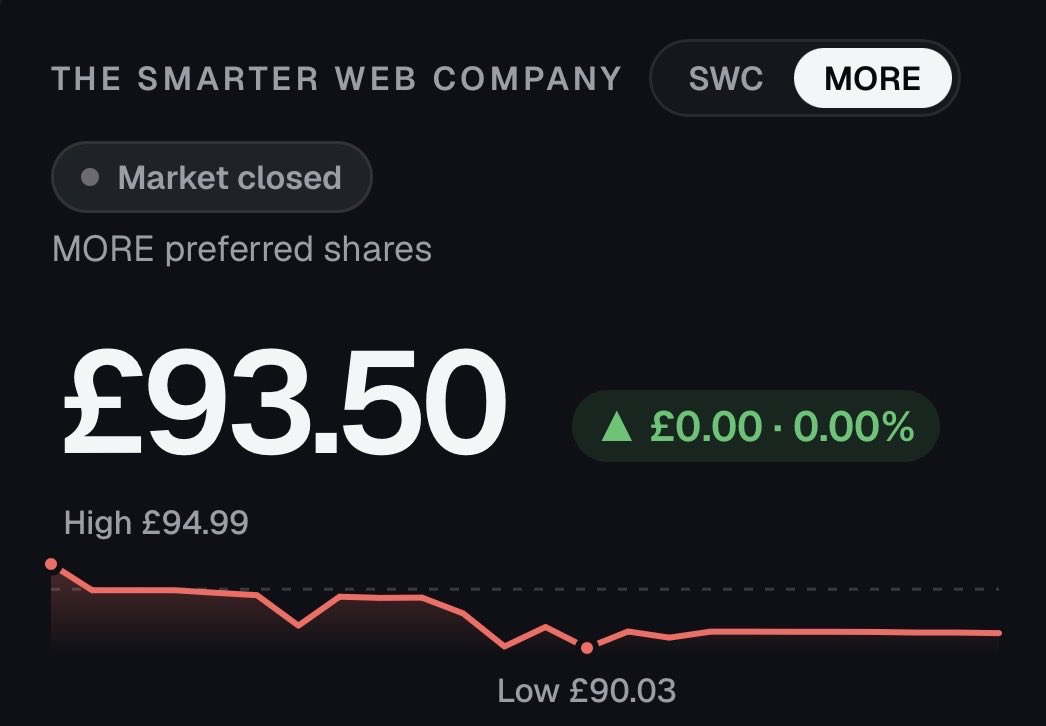
Proud to have a British horse in this pack, with MORE showing strong signs early.
9 days ago, MORE entered the race at £90 per share and an effective yield of 13.3%.
At the end of the first full week of trading, it’s circa £94 per share to buy, and an effective dividend yield of around 12.8%.
Growing liquidity, and narrowing spread.
The UK finally has its own homegrown Bitcoin backed high-yield paying income equity available with weekly dividends.
@andysmith_asap A lot #MORE... 😊
Honestly, I'm just doing it to support @smarterwebuk because I think they're a GREAT company, and I love @asjwebley's leadership. $TSWCF $SWC
Alright. There's been a lot of changes and I'm sure I haven't captured them well between the sleep issues, surgery, recovery, aquascaping hobby, and new dog.
For that I apologize. But I will say this. Yesterday, I got 14,000 steps in 😃 and I'm SO CLOSE to being fully back. So, expect A LOT MORE of me a few weeks from now.
What changed? A lot. I sold some $AKRG, $BMNR, and $PURR, to focus on mostly treasury companies. <-- Again, haven't been great at posting trades or updating the portfolio but that's going to get A LOT BETTER NOW! 🙂
NOTE - I share my thoughts, for very little, in hopes that you find it valuable perspective. If you want to support my work, I have the following methods.
1. You can subscribe here on X for unique posts I don't show anywhere else.
2. You can join the Discord for my charts and historical daily trades https://t.co/L1z7W28aPK
3. You can subscribe on Youtube to be able to chat in live streams. https://t.co/bpqROZG6xO.
Use Referral links for my favorite products.
a. Tesla - https://t.co/G2HtCVpA5f
b. Sofi - https://t.co/VwDg2MDsd2……
c. Robinhood - https://t.co/7dFQJUNbSh
d. Tradingview - https://t.co/KxEyoh9rks……
e.Fundstrat FSInisghts - https://t.co/tjnnBxNqBk……
5. Just comment on videos, share, and/or like.
6. Do nothing and hang out. <-- Not recommended. :P
As usual, if you have questions, please let me know.
At the Digital Credit Digital Conference this week, I was pleased to join @TimKotzman to discuss $MORE's first week of trading, the amplification level set out in the prospectus, and why a broader base of issuers is needed for the space to develop.
00:21 – The first week of MORE: price discovery and early trading
02:27 – Institutional interest in Bitcoin treasuries and Digital Credit
05:59 – UK media coverage through the highs and the lows
10:05 – The London Stock Exchange uplisting and a shareholder dinner
14:13 – How the two Smarter Web equities sit alongside each other
16:14 – Amplification and responsible leverage: Digital Credit and the Bitcoin treasury model
17:36 – Setting the amplification limit: a board decision
19:43 – Amplification through the Bitcoin cycle and the dividend cash reserve
22:46 – Digital Credit issuers: why more of them helps the sector
25:50 – Execution, total returns, and communicating with shareholders
29:15 – Building for Bitcoin in the UK: Digital Equity, Digital Credit and Digital Money
30:24 - Where to follow along and how to get in touch
LSE: #SWC #MORE | OTCQB: $TSWCF | FRA: $3M8
Yesterdays live stream Youtube version. Miller is only 20 years old but his knowledge and interview skills are incredible.
Smarter Web Livestream #9 - Adrian Morris & Miller Cole
https://t.co/yq1O9IhRSJ
Environmental campaigners and the local water company United Utilities have come up with a plan to build a huge sewage tunnel at Lake Windermere coming at a cost of more than £3.6 billion.
The plan is not yet approved but there are two proposals to fund the project: either taxpayers or United Utilities customers in the north west pay.
Lake Windermere is England’s largest natural lake and a UNESCO World Heritage site but has also been at the epicentre of the arguments over sewage.
We spoke with the CEO of United Utilities Louise Beardmore.
#News #Channel4News #LakeWindermere #Sewage #UK
$MORE – A GENERATION-BY-GENERATION LOOK AT INVESTING
Day 3: Generation X (Born 1965–1980, aged 46–61)
Over the past two days I've looked at Generation Z and Millennials, exploring their financial challenges, investing habits and why $MORE might appeal to them.
Today it's Generation X.
Many people in this generation have spent decades working, raising families, paying mortgages and hopefully building some financial security along the way.
But I think Generation X faces a particular challenge when it comes to retirement, and it's something that doesn't always get enough attention.
Generation X has, in many ways, fallen between two very different pension eras.
Many Baby Boomers benefited from generous final-salary pension schemes, where retirement income was largely determined by salary and years of service.
But during Generation X's working lives, many private-sector employers began closing these schemes to new employees, moving towards pensions where the individual carries much more of the investment risk.
And here's something worth remembering.
Automatic enrolment into workplace pensions didn't even begin in the UK until October 2012, with the rollout taking until 2018.
By then, many Generation X workers were already in their thirties, forties or even early fifties.
That means some missed years, potentially decades, of the automatic pension contributions that younger generations now benefit from.
Of course, many Gen X workers did have good workplace pensions, but others were left having to make their own retirement arrangements much later in their careers.
I think this is an important distinction.
For a generation now approaching retirement, there isn't necessarily another 30 or 40 years available to make up for lost pension contributions.
And that's why I think investments capable of generating income deserve serious consideration.
Which brings me to $MORE.
For anyone unfamiliar with it, $MORE is a perpetual preferred equity issued by The Smarter Web Company.
It currently carries a variable annual dividend rate of 12%, calculated against a £100 reference amount per share, with dividends scheduled weekly.
It's the possibility of reinvesting those weekly dividends that I find particularly interesting.
Rather than spending the income, you use it to purchase additional shares. Those shares potentially generate further dividends, which can themselves be reinvested.
Over time, this creates the potential for compounding.
Let's consider two very different situations.
SCENARIO 1 – INVESTING £100 A WEEK INTO A STOCKS & SHARES ISA
Imagine you're 45 or 50 years old and decide to start putting £100 a week into $MORE through your Stocks & Shares ISA.
That's £5,200 a year, well within the current £20,000 annual ISA allowance.
You reinvest every dividend and continue contributing £100 each week.
Assuming the dividend remains at 12%, the shares can always be purchased at £100 and the dividends are reinvested weekly, here's what the mathematics suggests.
AFTER 5 YEARS
Total invested: £26,000
Potential portfolio value: £35,571
Potential weekly dividend: £82
AFTER 10 YEARS
Total invested: £52,000
Potential portfolio value: £100,340
Potential weekly dividend: £232
AFTER 15 YEARS
Total invested: £78,000
Potential portfolio value: £218,275
Potential weekly dividend: £504
AFTER 20 YEARS
Total invested: £104,000
Potential portfolio value: £433,019
Potential weekly dividend: £999
Think about that final example.
Someone investing £100 a week over 20 years would have contributed £104,000 of their own money.
Under these assumptions, reinvested dividends could have helped build a portfolio worth approximately £433,000, potentially generating almost £1,000 every week if they stopped reinvesting.
And because the investment would be held within a qualifying Stocks & Shares ISA, that dividend income could be withdrawn free of UK income tax under current rules.
For somebody approaching retirement, that's a potentially substantial additional income stream.
But let's consider another situation that I suspect many people in Generation X will recognise.
SCENARIO 2 – WHAT IF YOU INHERITED £100,000 TODAY?
Perhaps you've inherited money from a parent or relative.
You've received £100,000 and don't immediately need it for living expenses.
What if you invested that money into $MORE and reinvested every dividend until retirement?
Using exactly the same assumptions as before, here's how the figures develop.
AFTER 5 YEARS
Original investment: £100,000
Potential portfolio value: £182,086
Potential weekly dividend: £420
AFTER 10 YEARS
Original investment: £100,000
Potential portfolio value: £331,553
Potential weekly dividend: £765
AFTER 15 YEARS
Original investment: £100,000
Potential portfolio value: £603,712
Potential weekly dividend: £1,393
AFTER 20 YEARS
Original investment: £100,000
Potential portfolio value: £1,099,274
Potential weekly dividend: £2,537
That final number is particularly striking.
In this hypothetical scenario, £100,000 invested today could become approximately £1.1 million over 20 years.
And if the 12% dividend rate were still being paid at retirement, that portfolio could potentially generate over £131,900 a year in dividends, before any applicable taxes.
It's important to understand that these are mathematical projections, not expected or guaranteed returns.
They assume two decades of uninterrupted dividends at 12%, a constant £100 share price, immediate reinvestment, no fees and no losses. All of those assumptions could prove unrealistic.
There's also an important ISA distinction.
You couldn't simply put the entire £100,000 inheritance into your own ISA in one tax year. The current annual allowance is £20,000, so you would need to move money into an ISA over multiple tax years, subject to future allowances.
Investing the full £100,000 immediately outside an ISA could result in dividend taxes that materially reduce the figures above.
Nevertheless, I think both examples demonstrate why dividend reinvestment deserves attention.
And there's another important factor for Generation X: inflation.
People approaching retirement need to think about what their money will actually buy in 10 or 20 years.
Simply maintaining the same amount of money isn't necessarily enough if everyday living costs continue rising.
An income-producing investment that allows dividends to be reinvested could potentially help build a larger portfolio before retirement.
Of course, $MORE isn't inflation-linked, and a 12% dividend today doesn't guarantee the same rate in the future.
What about the risks?
$MORE is an equity investment, not a bank deposit.
The dividend rate is variable, payments can be suspended, the share price can decline and the company has redemption rights. Its Bitcoin treasury strategy also introduces financial risks. Concentrating a substantial amount of retirement savings in one issuer would increase those risks considerably.
The weekly dividend entitlement is based on the £100 reference amount per share, not necessarily the price paid in the market.
But I believe $MORE gives investors something genuinely interesting to research: a preferred equity designed around regular cash distributions, with the potential to reinvest those distributions while building towards retirement.
And that brings me back to Generation X.
Some people will be able to invest £100 a week. Others might receive an inheritance, sell a property or release capital from a business.
The amounts and circumstances will be different, but the question is similar.
How could the money available today be put to work to create an income later in life?
For those who understand the structure and accept the risks, I think $MORE deserves consideration in that conversation.
Particularly for a generation where many didn't benefit from decades of automatic pension saving or the final-salary retirement arrangements enjoyed by some of their predecessors.
Because reaching retirement with investments capable of generating regular income could provide something particularly valuable.
More financial freedom and more choice over how you spend your time.
Tomorrow: Baby Boomers.
For many, retirement has already arrived, so I'll be looking at $MORE from a different perspective: generating weekly income from capital already accumulated, without needing to wait another 10 or 20 years.
$MORE $SWC #GenerationX #Investing #ISA #Dividends #Retirement
@STRC_live
$MORE from @smarterwebuk was the only BTC preferred equity which had positive price action yesterday. When are you going to update your tracker.
Today we announced the addition of a further 20 Bitcoin to the Smarter Web treasury, bringing our total holdings to 2,850 BTC and our quarter-to-date Bitcoin Yield to 2.41%.
We believe there is significant opportunity ahead this quarter to continue growing our Bitcoin treasury in an accretive and disciplined manner.
Plenty of work ahead. Plenty of ambition. MORE to come.
LSE: #SWC #MORE | OTCQB: $TSWCF | FRA: $3M8
Looking forward to chatting with @_Adrian next Thursday. His research is some of the best in the space, so I'm sure it'll be a great conversation.
LSE: #SWC#MORE | OTCQB: $TSWCF | FRA: $3M8