introducing PII Guard 2.0. protect user privacy, without compromising observability.
now with role-based access, audit logs, and more granular controls.
only in @raindrop_ai - i'm very proud of this ship.🧵
introducing rd-signal-2: a frontier classification model that is 1600x cheaper than GPT 5.6 Sol.
free to try in @raindrop_ai, and available via a new API for training/hosting custom classifiers with Zero Data Retention.
Today we are launching @mireyehq with @ycombinator
The easiest way to build agentic applications for the physical world.
AI agents are starting to act in the real world, but they can't reliably understand it.
Mireye is one API and MCP that connects agents to the physical world: data, enrichment, tools, and signals that power them to make decisions.
One line of code to make your agents street smart.
https://t.co/acQmRkYcdx
today, we’re excited to announce raindrop 2.0: self-healing agents.
we now train custom models that autonomously detect hidden issues with your agent.
i could tell you all about it, but wouldn’t you rather hear it from someone… else?
there's a lot of talk about self-improving loops. most of it is vaporware. i don't want anyone taking my word for it.
i think we'll increasingly see good companies making media that is just them + customers.
.@speak is an AI language learning app that serves over 15 million users.
cto/co-founder @adhsu discusses how speak approaches agent engineering, the importance of self-healing loops, and how they use @raindrop_ai
@alexisgauba@benhylak Still exploring and playing with it, but I thought this was particularly tasteful - just debugged an issue I was having through the in app chat.
we built the first sane way to debug your agent locally.
you can see your traces. codex/claude code can too. this lets them write evals and test your agents automatically.
best part: it's completely free and open source. install with 1 line.
(github below)
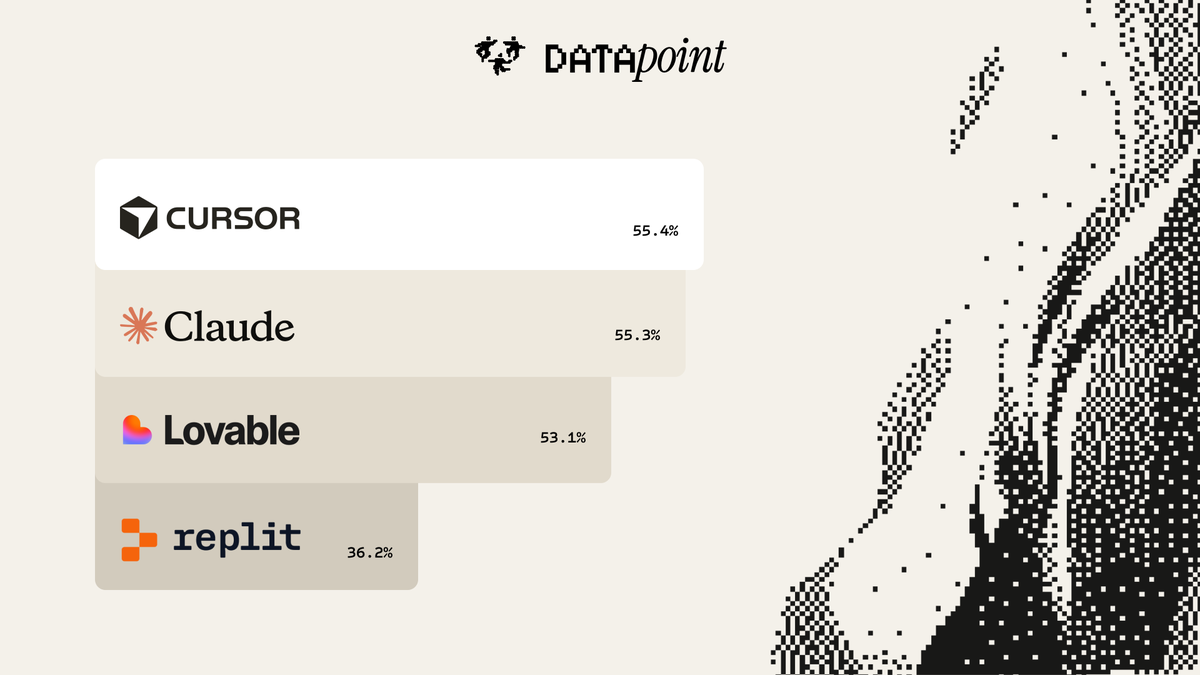
1/ What's the best tool to vibe code websites?
We gave @claudeai Code, @cursor_ai , @Lovable , and @Replit the same 100 landing page prompts. 3,492 humans judged the output. 36,000 side-by-side comparisons.
VLMs still suck at human motion.
So we collected the world’s largest human motion preference dataset, and used it to rank top video models on what people actually care about.
Results:
1) @Google Veo 3 Fast
2) Grok @imagine
3) @Kling_ai 1.5 pro
4) @LumaLabsAI Ray 2
Read more👇
1/ Introducing Datapoint AI
Intelligence is being commoditized. Good judgement is still rare.
We collect human preference data that trains frontier models, by replacing mobile ads with preference tasks.
7/ If you're building video models, here’s a dataset that was labelled through Datapoint.
29k+ human preference annotations across Grok Imagine, Veo 3 Fast, Kling 1.5 Pro, Luma Ray 2.
https://t.co/xEaiCOKzTC
We’re excited to introduce Doc-to-LoRA and Text-to-LoRA, two related research exploring how to make LLM customization faster and more accessible.
https://t.co/ApVzVsBuv1
By training a Hypernetwork to generate LoRA adapters on the fly, these methods allow models to instantly internalize new information or adapt to new tasks.
Biological systems naturally rely on two key cognitive abilities: durable long-term memory to store facts, and rapid adaptation to handle new tasks given limited sensory cues. While modern LLMs are highly capable, they still lack this flexibility. Traditionally, adding long-term memory or adapting an LLM to a specific downstream task requires an expensive and time-consuming model update, such as fine-tuning or context distillation, or relies on memory-intensive long prompts.
To bypass these limitations, our work focuses on the concept of cost amortization. We pay the meta-training cost once to train a hypernetwork capable of producing tasks or document specific LoRAs on demand. This turns what used to be a heavy engineering pipeline into a single, inexpensive forward pass. Instead of performing per-task optimization, the hypernetwork meta-learns update rules to instantly modify an LLM given a new task description or a long document.
In our experiments, Text-to-LoRA successfully specializes models to unseen tasks using just a natural language description. Building on this, Doc-to-LoRA is able to internalize factual documents. On a needle-in-a-haystack task, Doc-to-LoRA achieves near-perfect accuracy on instances five times longer than the base model's context window. It can even generalize to transfer visual information from a vision-language model into a text-only LLM, allowing it to classify images purely through internalized weights.
Importantly, both methods run with sub-second latency, enabling rapid experimentation while avoiding the overhead of traditional model updates. This approach is a step towards lowering the technical barriers of model customization, allowing end-users to specialize foundation models via simple text inputs. We have released our code and papers for the community to explore.
Doc-to-LoRA
Paper: https://t.co/87xEEpf0GN
Code: https://t.co/zBfQi2L9LW
Text-to-LoRA
Paper: https://t.co/emLRZ4Vdvo
Code: https://t.co/b9mrdoWWRB
Our work on the @StanfordSVL BEHAVIOR Challenge revealed something unexpected: less reactive control modes performed significantly better.
Committing to 50-step plans (vs replanning every timestep) boosted success from 30% → 100% on subtasks like navigating & grasping.