Cell companies pay landowners rent for tower spots. I built an agent that finds that land automatically and writes the letter to the owner.
Built on @mireyehq.
ai agents can't reason about the physical world if they don't know how far apart things actually are.
today we're shipping proximity.
calculate distances and drive times across 500 origins × 500 destinations in a single api or mcp call.
distance alone is just a number. enrich it with our 300+ data fields, and agents can start making real decisions about the physical world at scale.
demo: comparing office locations by commute times for thousands of employees across driving, transit, and walking. one agent. one mcp call.
try it: https://t.co/s1rIVIvdBj
building something around location? logistics, supply chains, transportation, warehouses, or anything else. reply or dm me, we'd love to help you build it.
Today we are launching @mireyehq with @ycombinator
The easiest way to build agentic applications for the physical world.
AI agents are starting to act in the real world, but they can't reliably understand it.
Mireye is one API and MCP that connects agents to the physical world: data, enrichment, tools, and signals that power them to make decisions.
One line of code to make your agents street smart.
https://t.co/acQmRkYcdx
Today we are launching @mireyehq with @ycombinator
The easiest way to build agentic applications for the physical world.
AI agents are starting to act in the real world, but they can't reliably understand it.
Mireye is one API and MCP that connects agents to the physical world: data, enrichment, tools, and signals that power them to make decisions.
One line of code to make your agents street smart.
https://t.co/acQmRkYcdx
people have been posting weekly updates, here's everything we shipped in two days
new website: https://t.co/acQmRkYcdx
templates: https://t.co/oVl3dddSX1
new research: https://t.co/ysU6b5z0LX
and we are just getting started, stay tuned (:
oh and i forget, now mireye has api pricing. gotta put food on the table.
launch week day 2
today we're shipping /lookup api
one address in. the parcel underneath it, its geometry, its owner, jurisdictions, land read, county market. every field cited.
land is the base layer of the physical world. every question about a property starts with a parcel and what surrounds it.
the data already exists. it's just scattered across expensive, fragmented sources with different formats and identifiers. now it's one api call.
to put it to the test, we ran a research study that would normally take a consulting team weeks to complete.
we took all 7,185 federally inspected meat, poultry, and egg processing plants in the us and had an ai agent screen every one of them through mireye.
14,400 api calls. about $4 worth of data. one afternoon.
a few interesting things came out of it.
- the surprise: hot isn't the problem. humid is. rank plants by hot days and then by wet-bulb temperature, and the two rankings barely agree. almost nobody has wet-bulb as a structured field. we do.
- the fragile tail isn't big meat. it's small gulf-coast fish houses in louisiana, mississippi, florida, and texas, where 161 plants have no power substation within 10 km.
this type of analysis was practically impossible to do in one afternoon before lookup.
we started by building the deterministic data layer for physical-world agents.
now we're building the tools, signals, and harness they need to reliably act in the real world.
study, code, and data are all public: https://t.co/f7gJld2LlF
launch week day 1
everyone has an address. nobody has a coordinate.
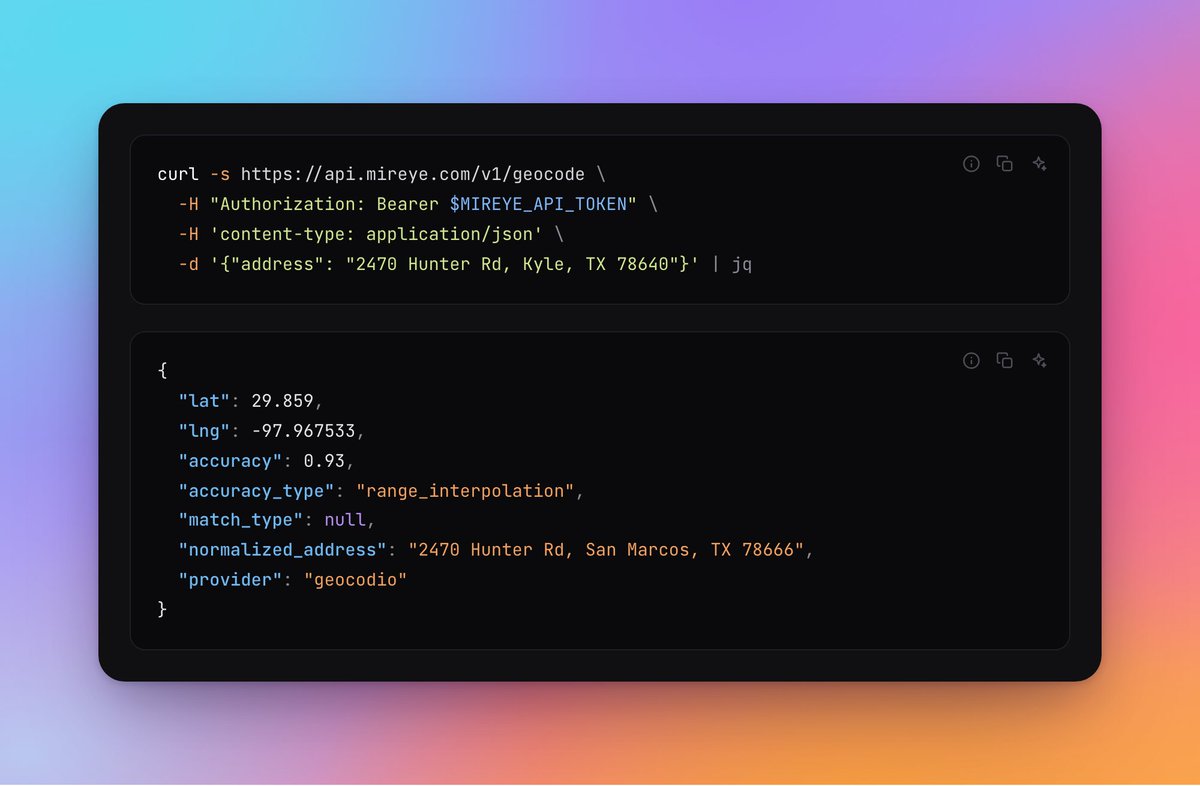
so we shipped built-in geocoding. send us a street address, we'll take care of the coordinate.
every mireye-earth api now accepts an address.
the hard part wasn't adding a geocoder.
it was realizing how often geocoding fails silently.
if a geocoder can't find your building, it'll often return the zip centroid. same six decimal places. same format. no warning.
humans catch that by glancing at a map.
agents don't.
they'll happily reason over a wrong coordinate.
every physical-world task starts here. get the first coordinate wrong, and everything downstream is wrong.
we evaluated this across 10 million parcels.
when we say a coordinate came from a building, it's inside the property boundary. when it's estimated from the street, it often isn't.
api + mcp usage is up 10x week over week, and people are already building things we didn't expect: land feasibility agents, solar site screening, property risk analysis.
we started by building the deterministic data layer for physical-world agents.
now we're building the tools, signals, and harness they need to act in the real world.
agi is achieved internally at mireye.
yesterday on a demo call, a customer asked us for sewer data for every state.
the perfect test for the on-demand, long-running agent we've been building. it ran for 6 hours, no human in the loop: researched, sourced, verified, planned, contracted, indexed, tested, evaluated, opened a PR, passed review, fixed, merged, published, deployed.
now sewer data for the whole country is live on the mireye-earth api + mcp.
for scale: 17,083 sewershed polygons across all 50 states, 4,300+ tests, two rounds of greptile code review, a 60MB national dataset built and shipped to prod.
every field cited to its federal source with a confidence rating. it even built its own truth eval and graded itself against independent county GIS, catching and quarantining places where the government data was flat wrong.
the real magic is the tools, signals, and harness loop we've been hacking together. its also self healing.
should we launch this long-running agent to the world?
what do you want us to index next?
i'm a technical founder who had never sold anything to an enterprise, and then i had to run gtm from scratch. no playbook, no coach, just me.
here's everything i learned taking mireye's gtm from 0 to 1, and the exact loop i'd run again.
tldr: gtm is mostly pattern recognition and positioning. and both of those you can engineer.
the exact loop i run every day:
thesis → prospecting → messaging → outreach → followups → retro → repeat
and for the entire first month i had one goal. not revenue, not logos. maximize calls booked.
it's a simple game theory move: collapse the whole game to one win condition, and every decision answers itself. does this book a call, yes or no. everything else is noise.
week 0. thesis.
> pick one. an insight, a customer conversation, a problem you hit yourself. don't overthink it, it will change anyway.
> mine was "data center developers want a cited site report in minutes and cheap, everything on the market today is slow and expensive." broad, and a little wrong.
> doesn't matter. a thesis isn't meant to be right, it's meant to be tested. write your best guess and go.
week 1. find the first 50 by hand.
> no lists, no scraping. i read 200 company sites one by one to find my first 50.
> my first list had xai and coreweave on it. reading their pages back to back, it clicked: those are the exact companies that will never buy from me.
> then the email. write as a founder, five sentences, no fluff. the bar is embarrassingly low. it just cannot read like ai wrote it. no links. don't ask for a call. simple cta.
> my first version opened with "80+ cited fields across 31 datasets." silence. the version that got replies was plain: "we'll analyze your site in minutes." same product. i just said it like a human.
week 2. run the loop by hand. automate nothing.
> i'm an engineer, so every instinct screamed automate this on day one. ignoring that was the best decision i made.
> because week 2 isn't about sending emails. it's about collecting the exact words people use for their problem. that vocabulary becomes your positioning.
> so i went from 10 emails a day to 15, all by hand, and after every call i wrote the problem down in their language.
> then two calls in one week cracked it open. one founder came from real estate, one came from oil and gas. completely different worlds, both walking into data centers, both missing the same thing: knowing which land actually clears.
> that overlap became my entire icp. that's the pattern recognition, and it only shows up when you do it by hand.
> helped us change the thesis and product positioning: agents will comb through every parcel in the country to find you off market sites that meet your exact requirements.
week 3. proof first, then automate.
> the signal i waited for: different people describing the same problem in the same words, all around the same company size, and 10% response rate.
> my icp went from a vague guess to three sharp ones:
1. land developers who just crossed into data centers chasing the ai boom.
2. developers whose site just got rejected, carrying a fresh loss i could fix.
3. powered-land flippers hunting land that already has power.
week 4. build the machine. now its a numbers game.
> i turned every step of the loop into its own claude skill. prospecting, messaging, crm, followups. now claude and i run the same loop every day and learn together.
> the stack is simple:
@ExaAILabs agent to find prospects
@EmailHunter api to find and verify emails
@meetgranola mcp to read my call notes
@Superhuman mcp to send
> a csv for a crm. yc agent when i want a second brain on a strategy call.
> company brain with all the learnings md files.
> a diligence doc before every demo, a learnings doc after every call.
> before one demo i ran our own screen on the prospect's own site and found a air-permit issue they didn't know about. i walked in knowing their land better than they did. that's how you win a call.
but the highest-leverage thing i did? followups.
> someone opens my email, and i reply with the close: here's what we do, the value, demo pdf and call link.
> i've booked more calls on that second email than on any first one. once they've read you, you're in. you just have to show proof.
the lesson under all of it: do things that don't scale, on purpose, to learn anly what you've proven works.
i still read every draft before it sends. if it smells like ai, i rewrite it by hand.
pattern recognition from the retro. positioning from their own words. both engineered by running the loop.
if i can do it, so can you. comment "gtm" and i'll send you my skills.
I analyzed the full Y Combinator S26 batch of 53 startups
Used https://t.co/V4Ygdq99TF to identify the audiences paying for them
These startups prove which markets deserve capital. If you’re building and still don’t know how to onboard your audience, this post is for you ↓
AI-agent & LLM builders. The single biggest audience. Tools for people shipping agents, automation, and AI apps: @explabsai, @MireyeHQ, @inkbox_ai, @markov__ai, @machine__0, @UseBylaw, @TouchmarkAI, @getcontextdev, @archal_labs, @try_glen, @keyserfaty (Agentcard)
Early-stage founders & startup operators. Tools to build, staff, and scale small teams: @coastyai, @talentpluto, @tryinstance, @getprescience, @shauryaagg (Florin), @formerlypeter (Florin), @philipxmeng (Shepherd)
Enterprise finance & revenue ops. CFO stack, AR/AP, RevOps, and support operations: @rexdotinc, @useprized, @Pango_ai, @merlinkafka (Rex)
Legal, compliance & risk. Legal ops, compliance, and risk review: @PerceptronML, @abe_yebe (Osmaura), @rookunderfire (Osmaura)
Healthcare & clinical operations. Clinics, practices, and care: @jackbeecher23 (Denta), @mchenofficial (Care GP), @anshtdn (Cova)
Industrial, manufacturing & process plants. Plants, controls, heavy industry: @alexytung (Whitespace), @warrren_shepard (Control Seat)
Deep-tech, VC & investment research. Funds, diligence, and research: @latolabs_io, @ParasmaAI, @os3robotics
Education & K-12. Schools, teachers, curriculum: @hursheybar2 (Edviro), @kstanuj (Edviro), @alexsouthmayd (Bloomy)
(audiences mapped with @meleaai)
Comment “yc” and I’ll send you the full table of startups and their audiences
yc day 4
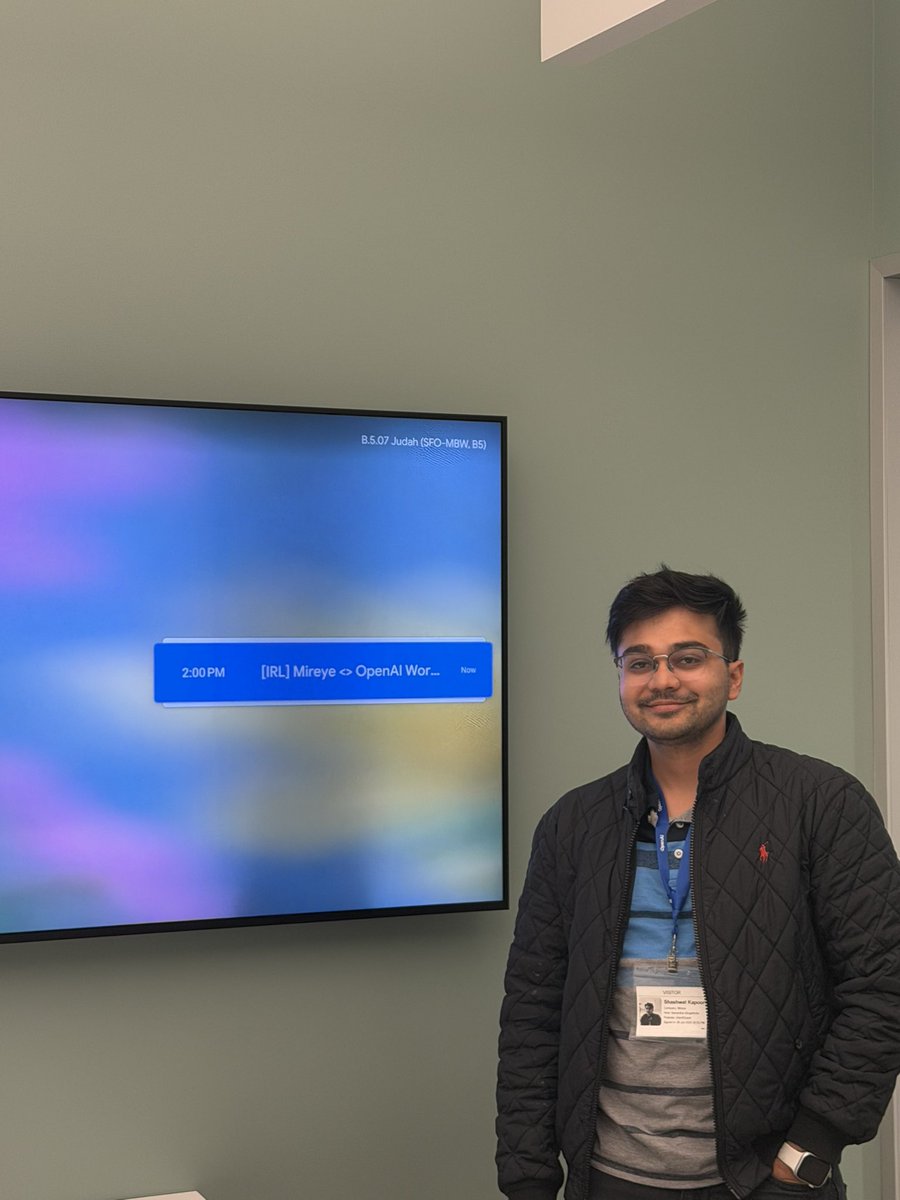
@OpenAI invited us to a working session in their new office.
@shshwt_ now holds the record for $2,600 in token spend in a single day...
excited to be working with the new models and harness to push the boundaries and accelerate our mission to index every inch of the earth.
new product launch soon (:
@strimblez thank you for having us!
yc's motto is "build something people want."
i grew up watching two people do exactly that.
32 years ago, my mom started a business from a tiny basement in india with no funding or family backing.
she believed in herself and set a goal to design and stitch clothes that people wanted.
my dad was just a friend at the time. He helped out while waiting for his u.s. master's visa.
when the opportunity finally came, he made the biggest decision of his life and turned it down because he believed in her.
they built the business together. somewhere along the way, they fell in love and got married. three decades later, they still run it.
their success came from caring deeply. they remembered the small details, went above and beyond for every customer, and treated employees like family.
some of those customers and employees have been with them for more than 20 years.
over the years, they served more than 100,000 people without spending a dollar on marketing.
all word of mouth. their customers became their community and that community became their growth engine.
what I learned from them is simple:
- do the unscalable things to build trust and relationships.
- conviction comes before evidence.
- show up every single day.
through every high and low, i never felt the weight of the business at home. only now do I understand how deliberate that was. the journey always mattered more to them than the milestones.
no matter how ambitious or delusional my ideas sounded, i was never told to play it safe. they believed in me unconditionally.
looking back, it was probably inevitable that i would start something of my own.
i grew up curious about the physical world. scout camps, books, questions like why one crop grows only in a dry season or why the same storm floods one town and not the next.
that curiosity is a big part of why we are building @MireyeHQ (YCS26).
ai agents are starting to act in the real world, but they can't reliably understand it. ask a model a specific question about a specific place and it guesses.
we’re building the infrastructure to change that. our mission is to index every inch of the earth and make it as queryable as the web.
for three decades, my parents built something people wanted.
now it is our turn.