🇺🇸 25 Heroes of 9/11 You Don’t Know: #12 Keefe Clark
He was 39. A Marine. A chef. Not a firefighter. Not a cop.
Benjamin Keefe Clark grew up in Brooklyn. He cooked in the Corps, served in the Gulf War, then trained at Le Cordon Bleu. He ran the cafeteria for Fiduciary Trust on the 96th floor of the South Tower. He was famous for his meatloaf.
He lived in Brooklyn with his wife, LaShawn, and their five children. He met her on the Penn Station platform, walked her home, and sent flowers for months. After they married he still left notes under her pillow.
Around 4 a.m. on September 11, their son Taj woke up and told his father not to go. “I don’t have a good feeling today.” Clark told him to go back to sleep. It was the first day of school. Clark left before dawn, same as always.
Their son Chaz, 17, was at Stuyvesant High School. He watched the towers from the windows.
When the North Tower was hit, Clark started moving people. Fiduciary vice president Bibi Conrad later said he was probably the reason hundreds from the company got out. He could have gone with them. He went back up instead.
He checked the floors. He locked up. He made sure no one was left behind.
He was last seen on the 88th floor with three other men, helping a woman in a wheelchair.
When the South Tower came down, Keefe Clark went with it.
His mother, Elsie, said what the morning already showed.
“He could have gotten out. Everybody else did. My son was a Marine. He wasn’t going to leave anybody behind.”
The funeral filled a Brooklyn Marriott. Marines came in dress blues. About 30 chefs came in whites and toques. People who got out because he pushed them downstairs were in the room.
He left behind LaShawn, Chaz, Taj, Sean, and two more children.
His chef’s knife, toque, and handwritten recipe cards for lamb shank and riz pilaf are in the 9/11 Memorial Museum.
His name is on the South Pool, Panel S-39.
Never forget Keefe Clark.
In 1904, a little-known distiller from a dry Tennessee county hauled his whiskey to the St. Louis World's Fair and won the gold medal.
His name was Jack Daniel. The big distillers didn't give him a chance. But when the judges finished, Jack Daniel's Tennessee Whiskey was named the finest in the world.
He'd bet on a simple idea: filter every drop through ten feet of sugar-maple charcoal. The giants had scale and money. Jack had a better whiskey. More than a century later, those gold medals are still printed on the bottle.
The dapper little man in the black hat, from a town where you still can't legally buy a drink, walked out of the World's Fair with proof he made the best whiskey on earth.
🇺🇸 In 1898, a 61 year old former Confederate general put on a U.S. uniform and took the field with Theodore Roosevelt.
Joseph Wheeler stood about 5 foot 2 and weighed 120 pounds. West Point class of 1859. He finished 19th out of 22.
He earned the nickname “Fighting Joe” in New Mexico in 1860.
When the Civil War came he resigned his U.S. commission and rode for the Confederacy. By age 26 he was a major general commanding the cavalry of the Army of Tennessee.
After the war he went to Congress from Alabama.
When war with Spain broke out he volunteered at once. His tender of service was already on file at the War Department. President McKinley made him a major general of volunteers and gave him the Cavalry Division of V Corps.
In that division was the 1st U.S. Volunteer Cavalry. Their lieutenant colonel was Theodore Roosevelt.
They landed at Daiquirí, Cuba, on June 22, 1898. Two days later Wheeler pushed forward and hit the Spanish at Las Guasimas, the first land battle of the war.
The Rough Riders were in the fight.
In the middle of it, the old Confederate forgot which war he was in.
“Let’s go, boys!” he shouted. “We’ve got the damn Yankees on the run again!”
The men cheered him anyway.
A week later Wheeler was down with fever when the guns opened on San Juan Hill. The sound of battle pulled him out of his sickbed. He rode to the front, the senior officer present, and took command of the field.
His division included Roosevelt’s Rough Riders. They took the heights.
Pictured: Wheeler (3rd from left), Teddy (far right) in Tampa 1898 before heading to Cuba
8) Early in the war, the British reliance on bayonet charges proved useful, but by the later stages of the conflict, continental troops had become adept at standing firm in the face of British steel.
10/20
On this day in 1776, about 400 men from Maryland threw themselves, again and again, at an entire British army that outnumbered them roughly twenty to one, knowing they would die, so that the rest of the American army could live. It is one of the greatest acts of sacrifice in American history, and most people have never heard of it.
Set the scene, because it followed straight from the trap sprung the night before. The British had marched around the American flank in the dark through the Jamaica Pass, and at dawn on August 27 they came crashing in from front and side at once. The Battle of Long Island, the largest battle of the entire Revolution, turned instantly into a rout. The American lines buckled and broke, and thousands of men began running for the safety of the fortifications at Brooklyn, with the East River at their backs. If the British caught that fleeing mob in the open, the war was over.
The one thing that could save the army was time, and time had to be bought with blood. On the American right, near a stone farmhouse by the marshy Gowanus Creek, stood General Lord Stirling and a body of Continentals that included the 1st Maryland Regiment, tough, well-drilled young men, many from prominent families. Stirling saw the whole army streaming past behind him toward the one narrow crossing to safety, and he understood what had to happen. Someone had to hold the British long enough for those men to get across. The Marylanders volunteered to be that someone.
What followed was almost beyond belief. Roughly 400 Marylanders turned and charged directly into the teeth of a British force of thousands, backed by artillery, dug in around the Old Stone House. They should have been swept away in a single volley. Instead they hit so hard they actually drove the British back and seized the house. Then they were thrown out. So they charged again. And again. Six times these men attacked, into cannon and musket fire, buying minutes with their lives, twice fighting all the way back into the stone house itself before being repulsed.
From a hill across the creek, George Washington watched it happen, watched a few hundred men deliberately sacrifice themselves to save his army, and he could not stop it and could not look away. He is said to have wrung his hands and cried out, "Good God, what brave fellows I must this day lose!"
And lose them he did. Of the roughly 400 Marylanders who made that stand, only a small fraction came back. Something like 256 were killed, wounded, or captured. Many of the dead were buried where they fell, in a mass grave somewhere under what is now the streets of Brooklyn, its exact location lost to this day. But their sacrifice worked. The minutes they bought with their bodies let the bulk of the American army escape the killing ground and reach the Brooklyn defenses, where, two nights later, John Glover's fishermen would row them all to safety.
Maryland has never forgotten. The state's old nickname, the Old Line State, is said to honor these men, the Maryland Line who held the line when holding it meant dying. Four hundred young men who looked at a hopeless charge and made it anyway, six times over, so that the army, and the Revolution, could survive to fight another day. Say their name. The Maryland 400.
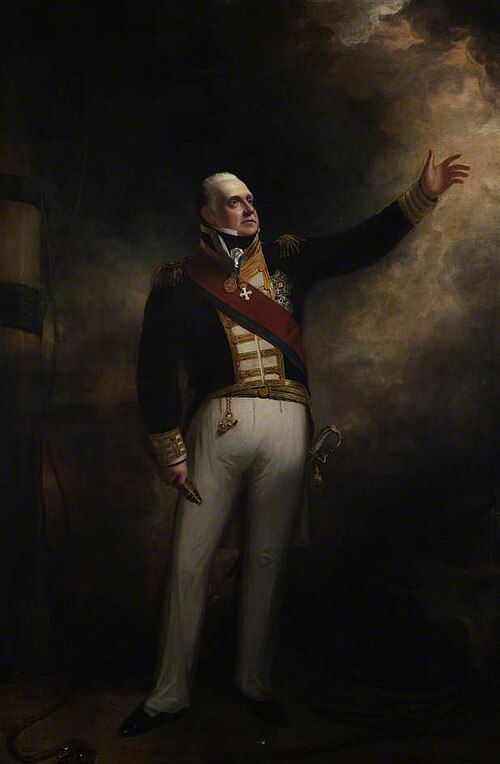
#OnThisDay 210 years ago in 1816 a Royal Navy fleet under Admiral Pellew, supported by the Dutch bombarded the port of Algiers to force them to cease the trade of Christian Slaves. The port was destroyed and over 1200 Christian slaves were freed.
"if Appalachia was a third world nation for white people"
You'd get an economy roughly the size of Spain's, divided among half as many people, giving you a GDP per capita comparable to Finland or Canada.
Finance & manufacturing are the top industries (15.6% & 14.1% of regional GDP, respectively). Note the irrelevance of tourism (3% of GDP) compared to other 'third world nations.'
Appalachistan would have a slightly lower Gini coefficient (less income inequality) than the U.S. as a whole. The unemployment rate is ~4%, comparable to the rest of the U.S. & half of France's.
Counting associates degrees + bachelors, Appalachistan would have a tertiary educational attainment rate of 39%, higher than the EU.
Counting bachelor's degrees only (4 yrs in the U.S. vs. 3 yrs in the EU, so biased toward EU), Appalachistan's educational attainment is comparable to Germany (29% vs 30%).
Fortunately, the flood spared the library of the Sakya Monastery in Tibet, and the 84,000 texts remain intact—even though 95% of this ancient collection has yet to be translated (and there is no real will to make that happen).
There is a hotel in Japan that opened in the year 705.
Not 1705. The year 705.
Rome still had an emperor in Constantinople.
The Vikings hadn't touched a boat yet.
America wouldn't exist for another thousand years.
The same family has run it for 52 generations.
Same hot spring. Same valley. Same job:
take care of the traveler.
It holds the world record as the oldest hotel on Earth,
and it is still taking reservations tonight.
And it's not alone.
A Japanese construction company was founded in 578,
building temples. It operated for over 1,400 years.
Japan has tens of thousands of companies
more than a century old —
more than any other country on the planet.
There's even a word for them: shinise.
Old shop. Said with deep respect.
In a world obsessed with scaling fast,
disrupting everything and selling the company by 40,
Japan quietly built something else:
businesses designed to outlive
everyone who will ever work in them.
Somewhere in Japan tonight, a 52nd-generation innkeeper
is checking the temperature of the same spring
her ancestor checked while Europe was in the Dark Ages.
That's not a business plan.
That's a promise, kept for 1,300 years.
This is 14-year-old Theodore Roosevelt Jr. in the White House greenhouse, 1902.
Forty-two years later, he would storm Utah Beach on D-Day.
The only general in the first wave.
His landing craft drifted a mile off target under German fire. He looked around, studied the map, and said:
“We’ll start the war from right here.”
Then he spent the day calmly directing troops, leading men over the seawall and turning the landing into a success.
General Omar Bradley later called it the single most heroic action he ever witnessed in combat.
In a sad turn of event, five weeks later, Ted Roosevelt Jr. died of a heart attack in France.
He was awarded the Medal of Honor.
From the White House greenhouse to the beaches of Normandy.
if men could comprehend all the minute subtleties that make this dude endearing to the average woman we would solve the male/female divide and birth rate issue with ease
The British built the first true aircraft carrier (the Argus). They built the first battleship (the Dreadnought).
Britain built the first effective torpedoes (Austria made some sucky ones earlier). They built the first torpedo boats. They built the first destroyer (and sold it to Spain). They built the first battle cruisers. They built the first torpedo plane. They built the first depth charges. They were the first navy to sink an enemy ship with an air-launched torpedo. They unwittingly showed the Japanese how to attack Pearl Harbor by doing the same thing in Taranto in Italy. They invented radar (the USA ran with it). This was the legacy of the Royal Navy.
Now all dust in the wind. Like Carthage. This picture shows the entire British fleet as of about a year ago.