Fan favorite.. S&P 500 price/free cash flow... 26.6x... down from right near 30.0x at the absolute peak a year ago
Remember: FCF = OCF - capex
Later, we can go through the DuPont decomposition. It'll be on the exam.
What does it all mean? Earnings are booming, which is great, and the optimistic view on the CWRV stuff is that we are getting some much-needed discipline in the AI buildout which will make the whole thing more sustainable. Against that rosy view are real yields that are now in the yellow zone of causing trouble in an over-indebted world. Cue France CDS for exhibit A. That suggests a combination of growing earnings and tightening financial conditions, which is the “after midnight” quadrant of my investment clock below. We are in a very similar position as 2018 and 2022 on that front. 🧵(1/2)
The big news last week was of course the sharp drawdown in high yield data center bonds and what that might mean for the broader AI buildout. I have been eyeing the price analog between the AI boom today and the internet boom-turned-bust in 1998-2000 and have been comforted by the fact that earnings are so strong today that equity valuations are falling instead of rising. We can see that below. 🧵(1/3)
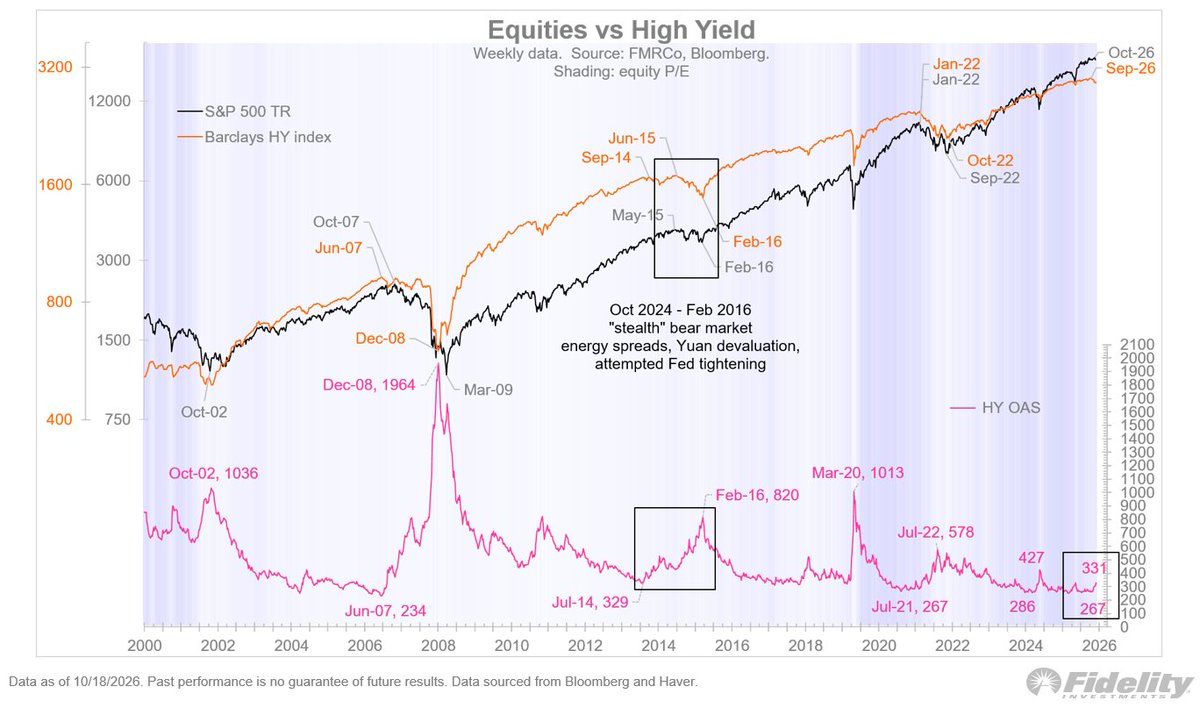
In the grand scheme of things, the widening in high yield spreads remains well contained with few signs of contagion. Beside the parallel to telecom credit during the late 1990’s, another interesting analog might be the high yield energy blowout in 2015. Back then it was a big factor in forcing the bull market to take an 18-month long pause. The square in the chart below shows that period from October 2014 to February 2016 when equities were stuck in a range while high yield spreads soared, the Yellen Fed was attempting to lift rates off the zero bound, and the Chines Yuan was under pressure. Different circumstances from today but a reminder that bull markets can take extended pauses as they digest a variety of headwinds.
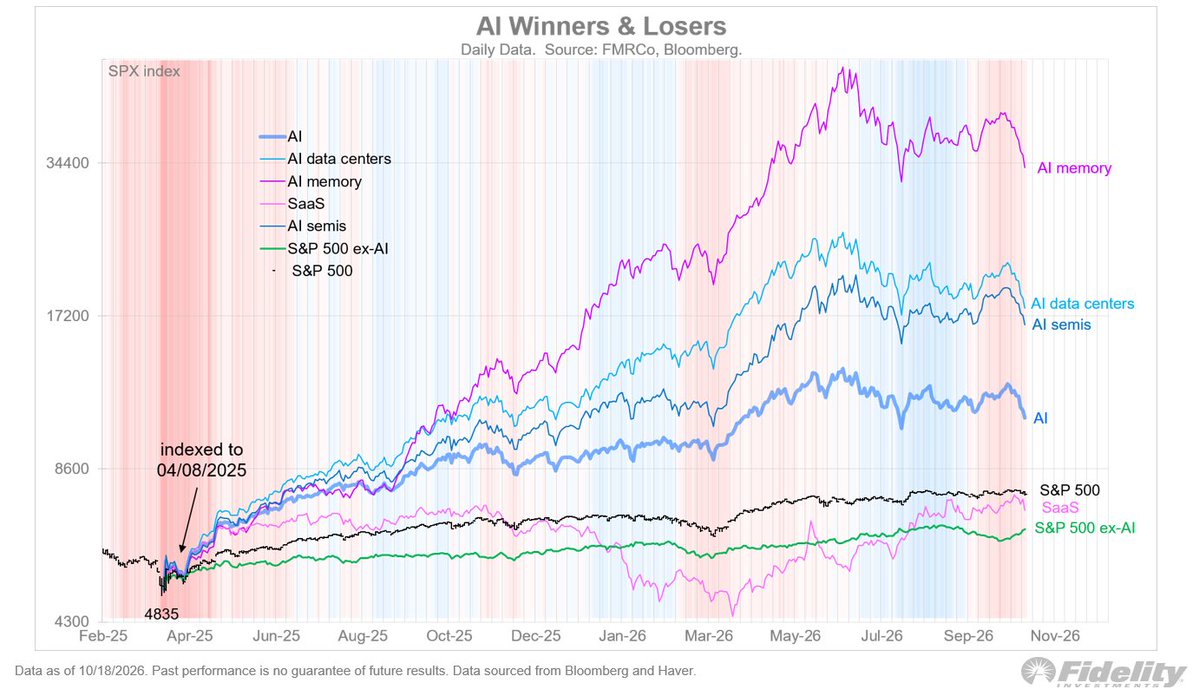
We can see the convergence between AI stocks and the non-AI stocks below, with the green line (ex-AI) recovering while all parts of the AI theme continued in what is now a 5-months long correction.
Li Lu on the six timeless principles of value investing.
(1) "Stock is a piece of ownership, not a piece of paper to trade around."
(2) "The market is there to serve you, not to instruct you."
(3) "Investing is about predicting the future — which is inherently unpredictable — therefore you always want to require a margin of safety that helps you protect the downside."
(4) "The most important [part] of a circle of competence is knowing the edge of it. Understanding the edge is as important as understanding what is inside the [circle]."
(5) "You've got to fish where the fish are."
(6) "Wealth, in the end, is really the percentage ownership of global purchasing power. What is really important is what you can buy with [that wealth]."
(Columbia University || 2026)
Finally, a forward looking indicator for the markets.
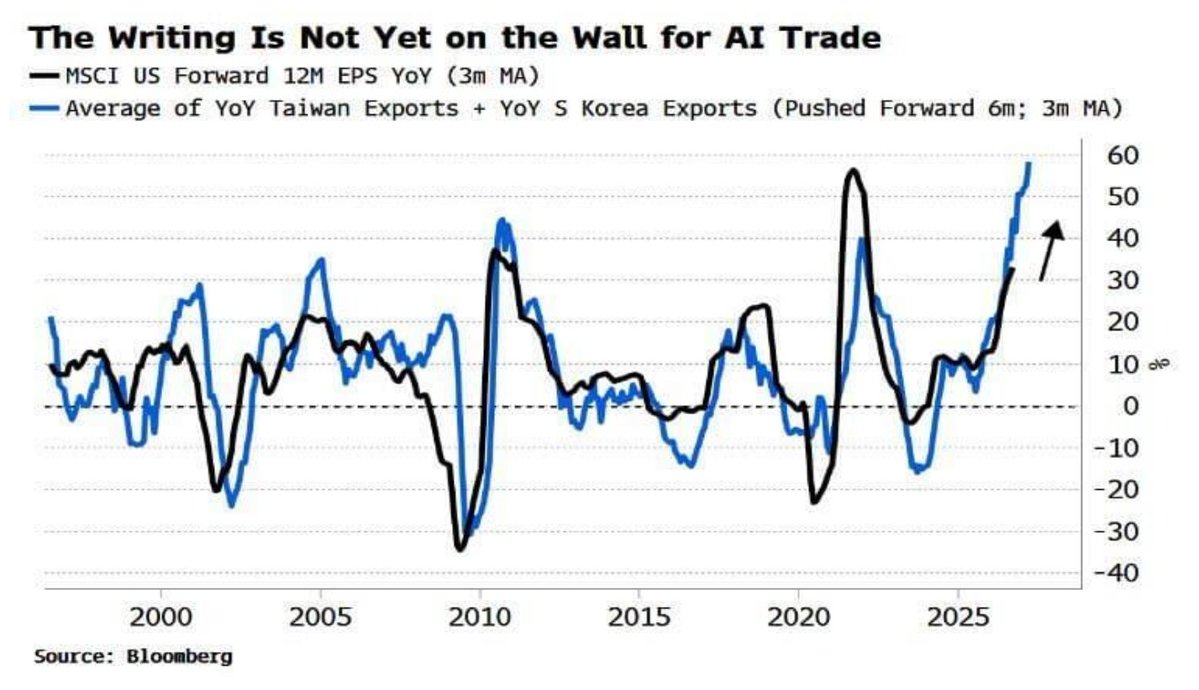
Taiwan and South Korea Chip Exports Lead US Earnings by 6 Months; No Downturn Signal Yet
The average of Taiwan and South Korea export growth, pushed forward six months, closely tracks MSCI US forward 12-month EPS growth.
Both countries are "significant producers of the chips that are the foundation of the AI investment boom" and are released monthly, with South Korea publishing a 10-day estimate around the 21st of each month.
Chip exports are "likely to detect the pullback with about a 3-6 month advance."
Crucially, as of the October 15, 2026 publication, "South Korea and Taiwan's exports currently give little sign that the investment cycle is imminently about to turn down."
When they do turn, that's also a cue for yields to decline since chip exports lead nominal GDP as well.
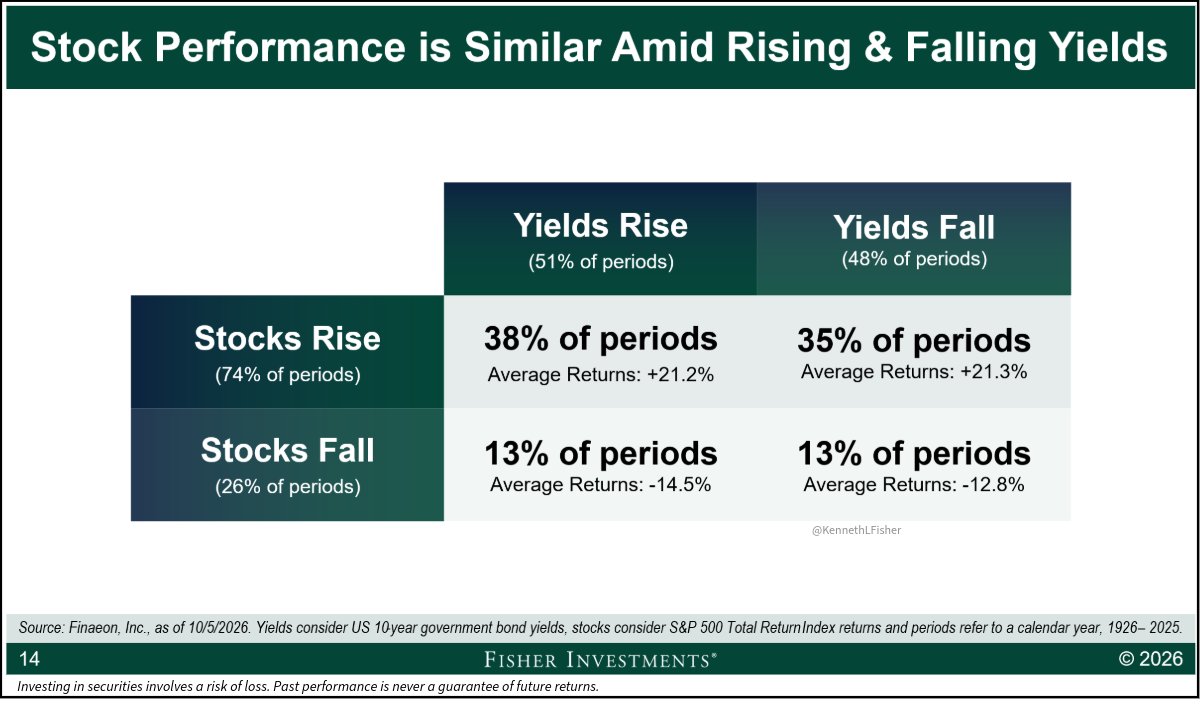
People worry rising long-term interest rates are bearish. But if long rates rise faster than short rates, it is actually bullish because it increases the yield spread and banks’ desire to lend. The more banks lend, the more money there is for all forms of economic activity on Main Street and on Wall Street—and stocks tend to do well in that environment.
Ed Yardeni:
"US Treasury yields fell sharply today, extending Wednesday's retreat from intraday highs. The 10-year yield dropped 9bps to 5.10%, while the 30-year fell 10bps to 5.43%. Even the 2-year yield declined slightly to 4.77%.
Remarkably, this broad-based decline occurred despite two hotter-than-expected inflation reports. Normally, such surprises would push Treasury yields higher as investors priced in a more hawkish Fed.
So, what's going on? We think the bond market is focusing on the sustainability of the AI investment boom. That issue came to the fore this week as CoreWeave's bonds plunged below 80 cents on the dollar and debt financing major data center projects also tumbled. A new Gartner report estimates AI data center operators will need $8.5 trillion in revenues through 2030 to cover costs and earn healthy returns, versus projected revenues of "just" $3.6 trillion.
Why does this matter? The AI buildout has become a major engine of US economic growth. But doubts about future returns are pushing up borrowing costs, potentially constraining access to capital and ultimately slowing investment spending.
As a result, investors may be lowering their economic growth expectations amid concerns that the AI boom could slow, pushing Treasury yields lower. This reinforces our longstanding view that the earlier surge in Treasury yields largely reflected stronger-than-expected nominal GDP growth.
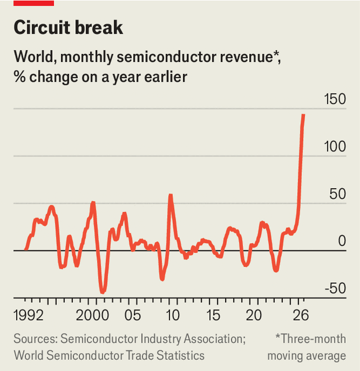
'In the early 2000s some 25 firms could make the most advanced processors. Today four can, and TSMC makes nearly all of the high-end ones.
Memory chips, which are also vital for AI, have gone the same way. More than 20 firms made advanced memory chips in 1990. Now only three—Samsung, SK Hynix and Micron—make almost all of them.'
'As a share of revenue, TSMC’s capital spending is expected to fall from 44% in 2023 to 36% this year. Moreover, investments are being paid for from the cash that chipmakers are generating, rather than borrowing.'
'Consolidation has also given chipmakers more bargaining power, shifting who will bear the burden of any slowdown.'
'An end to the AI boom would still bring chipmakers plenty of pain.. This time, however, customers will share the hangover.'
https://t.co/U92XVRmt04
My formula for success:
Find someone who has already achieved what you want to achieve - someone whose results you trust.
Internalize not only their strategies and tactics, but also their beliefs, mindset, and way of thinking.
Learn to see the world through the lens that produced their success.
Be open to ideas and concepts you disagree with; things that seem strange or different.
Then commit to unconditional persistence in the direction of your dream.
Be patient. Give yourself time to develop. Stay the course long enough for the lessons to take root, the skills to compound, and the results to emerge.
Model success. Trust the process. Persist without condition.
It does appear that the investment clock has moved “past midnight” with a slight tightening in financial conditions now starting to temper the earnings-driven price momentum. The last two cycles where this happened were 2022 and 2018.
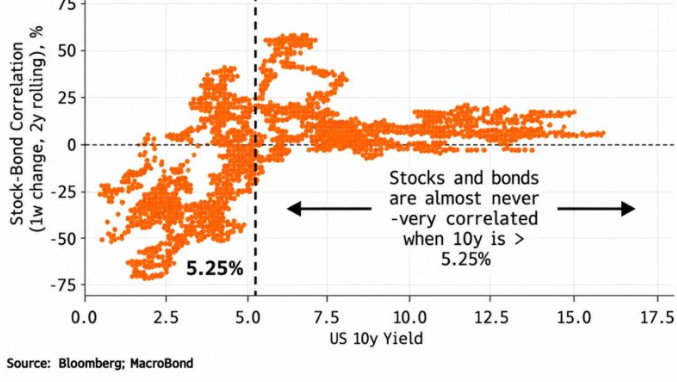
And, with all the hoopla over long rates it is important to note that long-rate wiggles don’t correlate in any meaningful way with subsequent stock returns.
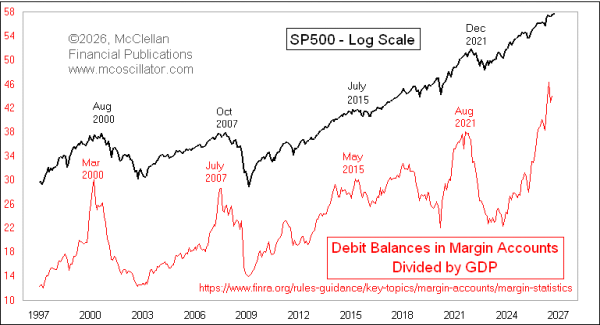
My latest Chart In Focus article, "7-Year Cycle in Margin Debt", is posted at my Home page. The article is more than just this chart, so please read before offering comment.
Mohnish Pabrai explains how Warren Buffett borrowed about $5 billion at 0.5%, bought Japanese businesses paying roughly 8% in dividends, and watched the investment double. He found those businesses by reading a company handbook that cost less than $100.
In this 56-minute video, Pabrai walks through 30 mental models for investing, illustrated with actual decisions, missed fortunes and mistakes he’s made himself. He explains why you should be able to describe an investment to a 10-year-old, and why finding something worth buying can take years of doing seemingly unproductive work.
He tells the story of Nick Sleep, who closed his fund and put his own money into Amazon, Costco and Berkshire Hathaway. Amazon eventually became around 80% of his portfolio. Then he sold half his Amazon position to buy another business. Pabrai explains why that decision is worth remembering the next time you feel tempted to “rebalance” a winner.
There’s also a much less comfortable story: the financial crisis, when the assets Pabrai managed fell from roughly $600 million to $200 million. He describes the exercise that helped him stay focused on what his businesses were worth while their market prices collapsed.
Then comes IPSCO: a $40 stock with $15 per share in cash, no debt, and another $30 in earnings expected over the next two years. Pabrai explains why he bought it, how he thought about the uncertainty, and what happened when a takeover offer arrived at $160. Save this for tonight.
Especially if you’re constantly searching for the next investment but have never really thought through what would make you sell the ones you already own.