PROSINT : No demuestra que 24 Gy en una sola sesión sea equivalente o no inferior a cinco fracciones, ni permite adoptarlo como estándar. #RadOnc
https://t.co/pDM9dWixnz
1) NRG-LU002’s primary findings are @JCO_ASCO. Thanks to pts, caregivers, @NRGonc, investigators, CRO teams, many others who helped w/trial. We proved it was feasible to randomize pts to local consolidative therapy (LCT) in a modern cohort of patients predominantly receiving IO.
TLDR: The false positive rate of conventional imaging for intermediate risk disease with a negative pet is actually quite high. I would consider him non-metastatic
Curious what his PSA is.
But assuming it’s not 20+, this represents one of 2 big conundrums in PCa staging.
Most ambiguous -> conventional negative, but PSMA is positive. The question being how much “earlier” are we in the disease course? How do we extrapolate historical prognostication to the current PSMA era?
In this case, conventional is positive and PSMA is negative. When conventional and PET is positive it’s reasonable to assume a worse prognosis then PET positive only. But when the pet doesn’t confirm the diagnosis the other clinical factors matter more.
For example; if this gent had GG4/5 or a PSA of 25 then I would assume it to be real Mets. (Be careful with the GG4/5 PSA 1-2, these are sometimes worst actors)
But for GG2 and a PSA less then 10 it’s reasonable to consider it more then likely a false positive. The false positive rate of conventional imaging for intermediate risk disease with a negative pet is actually quite high.
The current biomarkers are good prognosticators, but are not validated classify someone as metastatic and to remove potentially curative treatment options. So we need to be careful with decipher and Artera here. They need to do a lot more studies to show value here.
In 10 years there will almost certainly be a predictive liquid biomarker that is a surrogate for Micro Mets (CTCs, EVs etc)
For me this guy would be treated as non metastatic.
For prostate cancer: it’s useful for boost, for treating recurrences, etc. But similar to surgery, careful patient selection is key. Not everyone can get it, and it’s not always appropriate. That’s why it’s a case by case discussion.
When people say things like, “Brachy is dying,” who does that really serve? Training at high volume GYN and prostate brachy programs is important if you’re going to be offering brachytherapy.
As radoncs know, Brachy is critical for cervical cancer cure. It’s a tool, like SBRT
Long term STRASS data presented at practice changing session @ctosociety ➡️➡️ sig. improved abdominal recurrence free survival in preopRT + surgery vs surgery alone in resectable Liposarc RPS (39% vs 58%) @TARPSWG
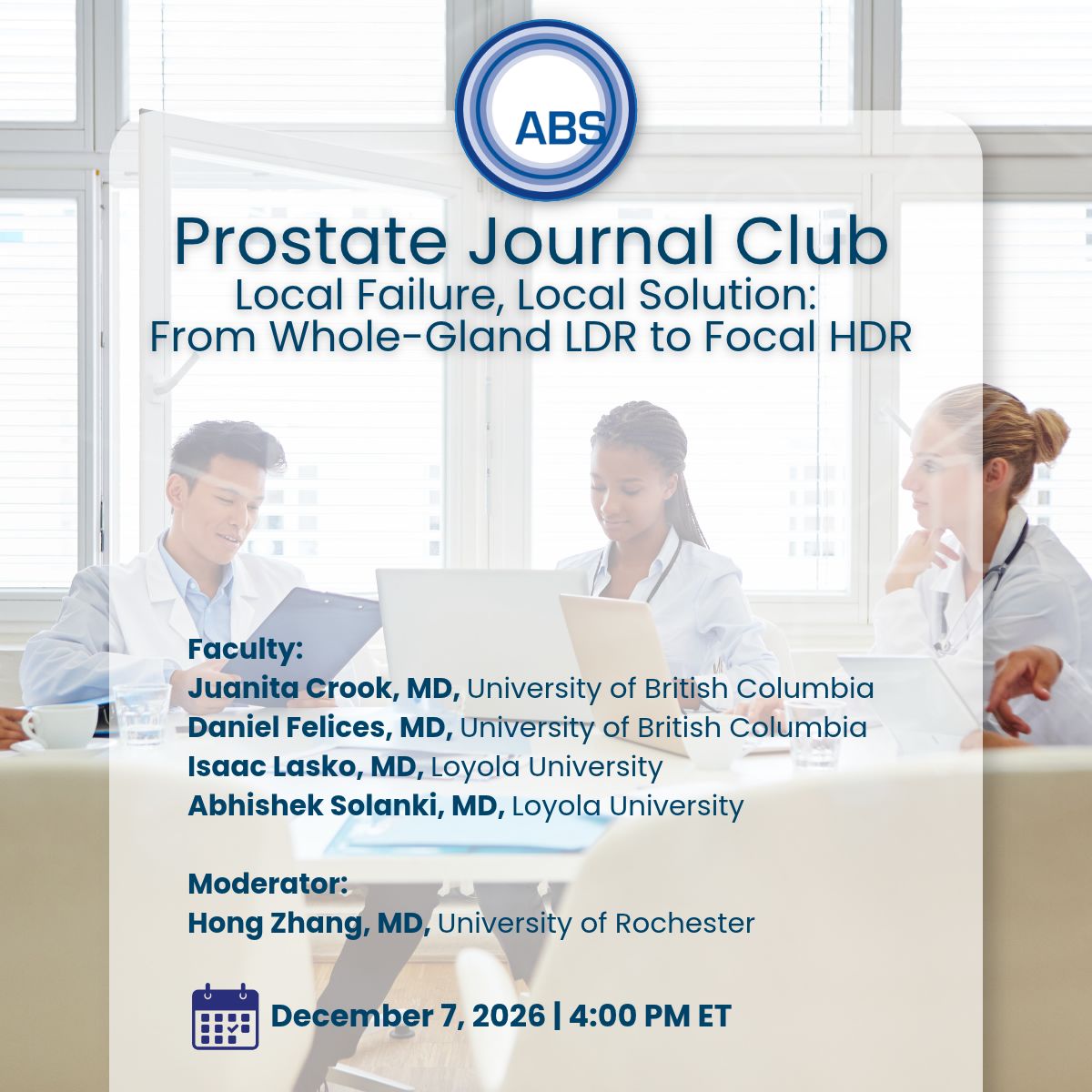
Join us for our next Journal Club on Dec. 7, 2026 @ 4:00 PM ET and explore the evolving role of salvage LDR & HDR #brachytherapy for recurrent #prostatecancer, from whole-gland treatment to modern focal approaches. https://t.co/B0UGIyv983
#RadOnc#ABSJournalClub
Fantastic work!
SRAM shows why PROs matter: no significant difference in grade ≥2 GI/GU adverse events at 6 to 12 months, but worse bowel QoL after SBRT at 9 and 12 months.
Looking forward to longer follow-up! #RadOnc#PCSM
Pre- vs postop IMRT for extremity/truncal STS: phase III RCT, n=210 #CTOS2026
🔹 Major wound complications: 29% vs 20% (p=0.11, not significant)
🔹 5-y local recurrence-free survival: 92% vs 95%
Excellent local control either way, so RT timing can be tailored to the patient
Important results from the 50/50 extremity sarcoma trial led by Peter Chung @RadMedPM@pmcancercentre@UHN. Anthony Griffin @SinaiHealth presented @ctosociety reporting similar outcomes with 50 Gy pre-op RT and 50 Gy post-op RT. In selected patients, 50 Gy post-op is sufficient.
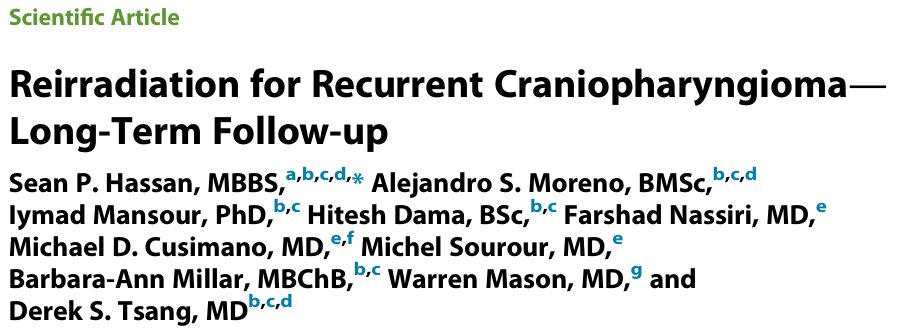
What are the long-term outcomes associated with re-☢️ for craniopharyngioma?
In this institutional series, pts (n=6) w/ recurrent/progressive dx not amenable to medical therapy/resection underwent re-☢️ (54 Gy in 30 fx). From a mFU of 4.1 yrs:
🔘 Survival and dx control ➡️ 4 pts were alive w/ local control, 2 pts had died (1 w/ progressive dx)
🔘 Visual outcomes ➡️ 1 pt had intact vision; 3 pts had impairments (e.g diplopia, bitemporal hemianopsia)
🔘 Endocrine outcomes ➡️ 3 pts had pan-hypopituitarism, 1 pt had partial deficits
🔘 Functional outcomes ➡️ all surviving pts were unable to work/study due to impairments
🔗 - https://t.co/Z4z4Ye1Har
#radonc #btsm @RadMedPM
Editorial Randomized trial resected brain met Brachytherapy vs Post-Op SRS
Incredible Surg Bed Control with Brachy (↑↑OS as well)
Look forward to results NRG BN012 NRG BN012 pre vs. post-op SRS hopefully ↓↓ LMD https://t.co/F9mPzPvKyz
Guidelines for baseline 🧠 MRI across cancers
🫁NSCLC - Stage II onwards, >3cm
🫁SCLC - All, #MAVERICK surveillance avoids PCI
#Breast - Only if symptomatic, ESMO - all IV TNBC & HER2+
#Melanoma - If N+ or IV
What's your practice in other sites?
#lcsm#bcsm#skin#cancer#lung
Not often do we publish 2 back to back guidelines on #NasopharyngealCarcinoma in @JCO_ASCO
Was a pleasure leading this monumental effort with @BrigetteMa2@ASCO CSCO 💪🏻💪🏻💪🏻
Treatment of Stage IB to III Nasopharyngeal Carcinoma: CSCO-ASCO Guideline Update | Journal of Clinical Oncology https://t.co/dh5akeJbxh