Looking forward to the exciting collaboration between @KidneyCancer and @ASTRO_org at the annual #IKCS meeting in Dallas. Join me and my fellow panelists as we explore current and innovative approaches to treating kidney cancer with radiation @OncoAlert
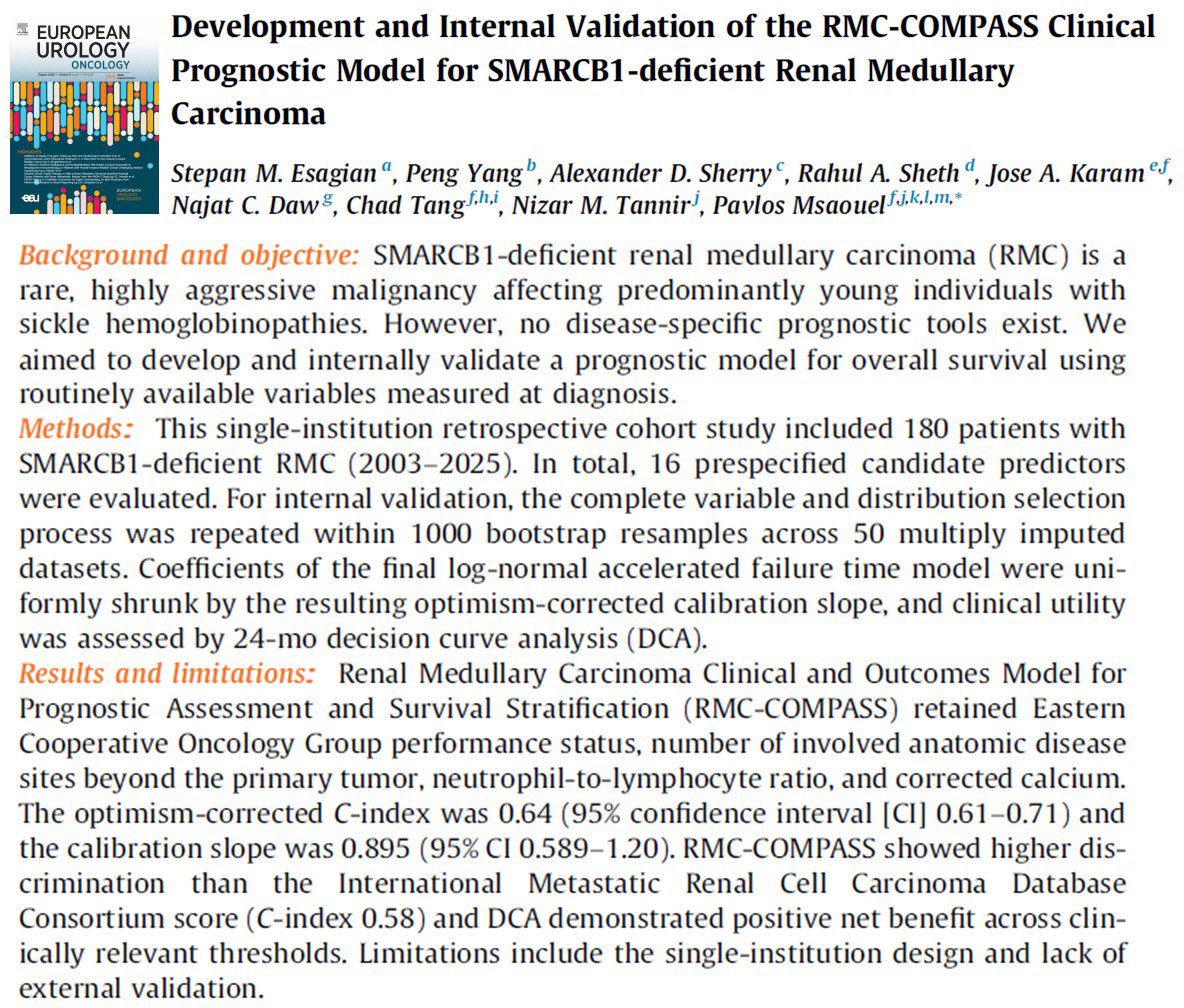
Amazing work led by Stepan and @PavlosMsaouel employing novel prognostic modeling techniques in the largest cohort of patients with #renalmedullarycarcinoma
Hear the latest on MDT for oligomets from the first author himself, @AlexSherryMD!
Check out the paper📜 AND the podcast🎙️ for some main highlights! ☢️
📜https://t.co/uLn5ab8FwN
🎙️https://t.co/FeC9zipV11
@ChadTangMD@ebludmir
🚨📣 big news at #ESMO26: 🧵1/MASTERPLAN RCT shows adding SABR to perioperative chemotherapy for high-risk localized #pancreatic cancer ⬆️⬆️ median overall survival to 22.0 months vs 14.0 months (HR 0.45). #PancreaticCancer#RadOnc@TROGfightcancer in press @TheLancetOncol - https://t.co/KhPO4dgZd4
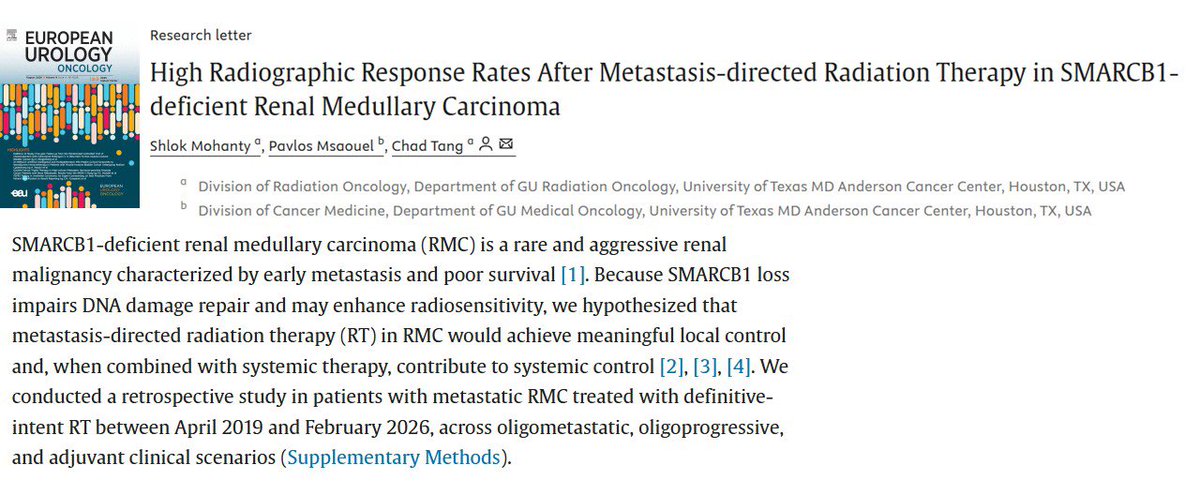
A benefit of working with @PavlosMsaouel is that we treat many variant RCCs. Renal Medullary Carcinoma is one such variant (0.5% of RCC), which has remarkably different RT sensitivity. MDT to 30gy/5 often achieves a CR and with minimal toxicity even with high dose chemo.
1/5 New in @EurUrolOncol: the largest series yet of metastasis-directed radiation therapy in SMARCB1-deficient #RenalMedullaryCarcinoma. Key finding that this cancer appears far more radiosensitive than clear cell kidney cancer: https://t.co/6z2uLjtBoc #endRMC#MsaouelLab
🩺 The evolving role of SBRT in metastatic kidney cancer
At the 2nd Florence International Consensus, Prof. Chad Tang from @UTMDAnderson highlights how stereotactic body radiotherapy (SBRT) is becoming an increasingly important part of metastatic renal cell carcinoma (RCC) management. #FlorenceConsensus26
🎯 Oligometastatic disease SBRT may help defer systemic therapy and its associated side effects in selected patients. Local treatment approaches—including radiotherapy, surgery and interventional ablation—offer options that work through mechanisms distinct from systemic therapy.
🔬 Oligoprogressive disease By targeting a limited number of progressing lesions, SBRT may allow patients to remain on their current systemic treatment for longer, potentially delaying the need to switch to subsequent lines of therapy.
💡 The key takeaway: Across the metastatic disease spectrum, SBRT is expanding the role of local treatment in kidney cancer care, supporting more tailored treatment strategies and helping clinicians consider how best to manage disease progression while preserving treatment options.
📍 As evidence and clinical experience continue to evolve, multidisciplinary decision-making remains essential to identifying the patients most likely to benefit.
#KidneyCancer
@Lucarecco@CarlottaB@RobClarkeLab@JavierCortesMD@curijoey@delmastro_lucia@ALEDIGNUS12@Prof_Nadia_H@ClareIsacke@reshmajagsi@KaidarOrit@AnnaKirby17@matteolambe@Icro_Meattini@hoperugo@TanjaSpanic@MassimoDiMaio75@Silke_Gillessen@DrRanaMcKay@brian_rini@alison_tree@ChadTangMD@DrYukselUrun@MicheleAquilano@GiulioFrancoli1@DrDanielHeng