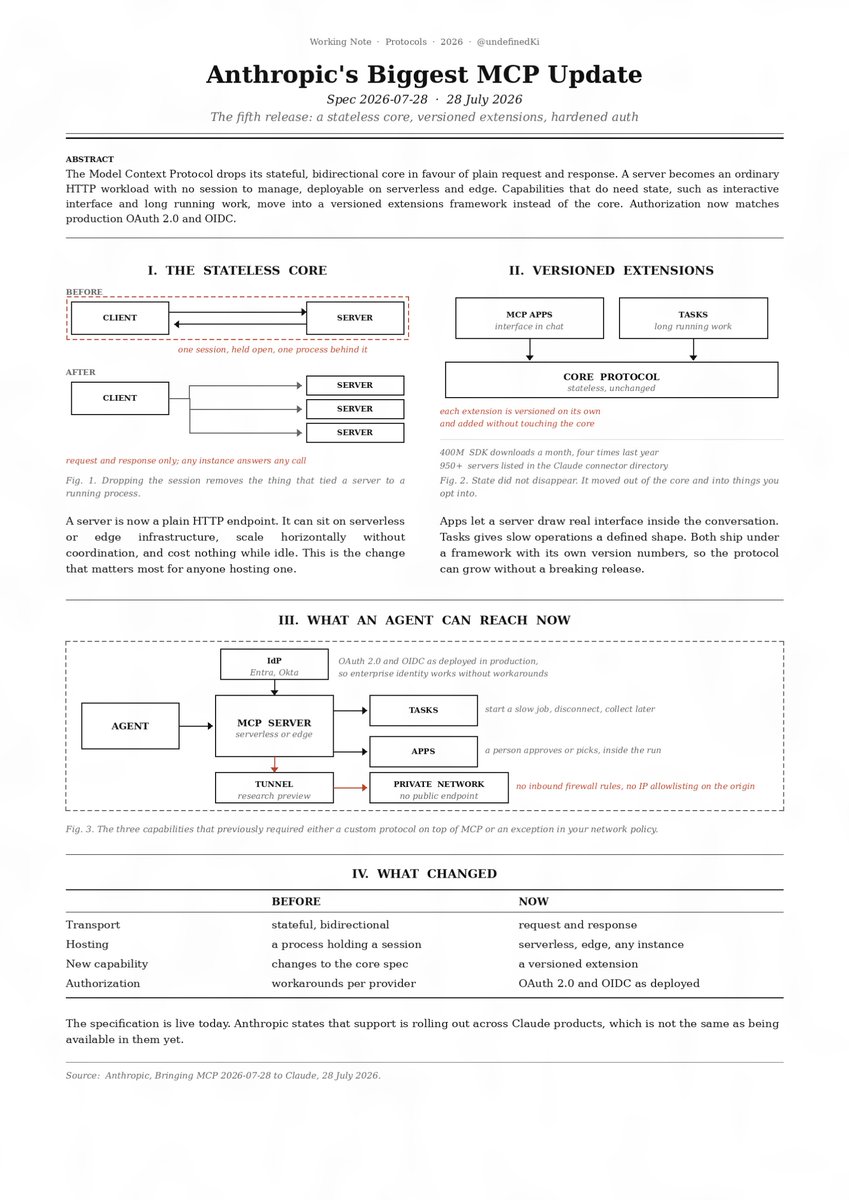
Anthropic just released the biggest MCP update yet. Here is what your agents can do now
MCP is the standard that lets a model use tools it does not own. Instead of writing a wrapper for every service, you connect a server once and the tool becomes something the agent can operate directly.
It is why Claude can touch your Drive, your repo, your tickets. 400 million SDK downloads a month, up four times this year.
What changed today:
> The protocol went stateless. A server is now a plain HTTP endpoint instead of a live session, so it runs on serverless and costs almost nothing while idle.
> Long jobs and interactive interface moved into versioned extensions, so they can evolve without breaking the core.
> Auth now speaks production OAuth and OIDC.
What that unlocks:
> An agent can start a job that takes an hour, disconnect, and collect the result later. Before this you held a connection open or invented your own handshake.
> A person can approve or choose in the middle of a run, in the conversation, instead of the agent stopping dead.
> Internal tools become reachable without a public endpoint, a firewall rule or an IP allowlist.
Bookmark this
The AI protocol stack in one list
▪️ MCP
▪️ A2A
▪️ ACP
▪️ AG-UI
▪️ ANP
▪️ LSP
▪️ OpenAPI
▪️ OAuth 2.0
▪️ OpenTelemetry AI
▪️ JSON Schema
▪️ JSON-RPC 2.0
Bookmark the list to keep it handy!
Here is also a practical guide explaining all these protocols - what each one does, where it fits, and when to use it.
Check it out → https://t.co/k8O4Wnm3IT
Everyone tells you to build a second brain. It is pointless until you understand how one actually works
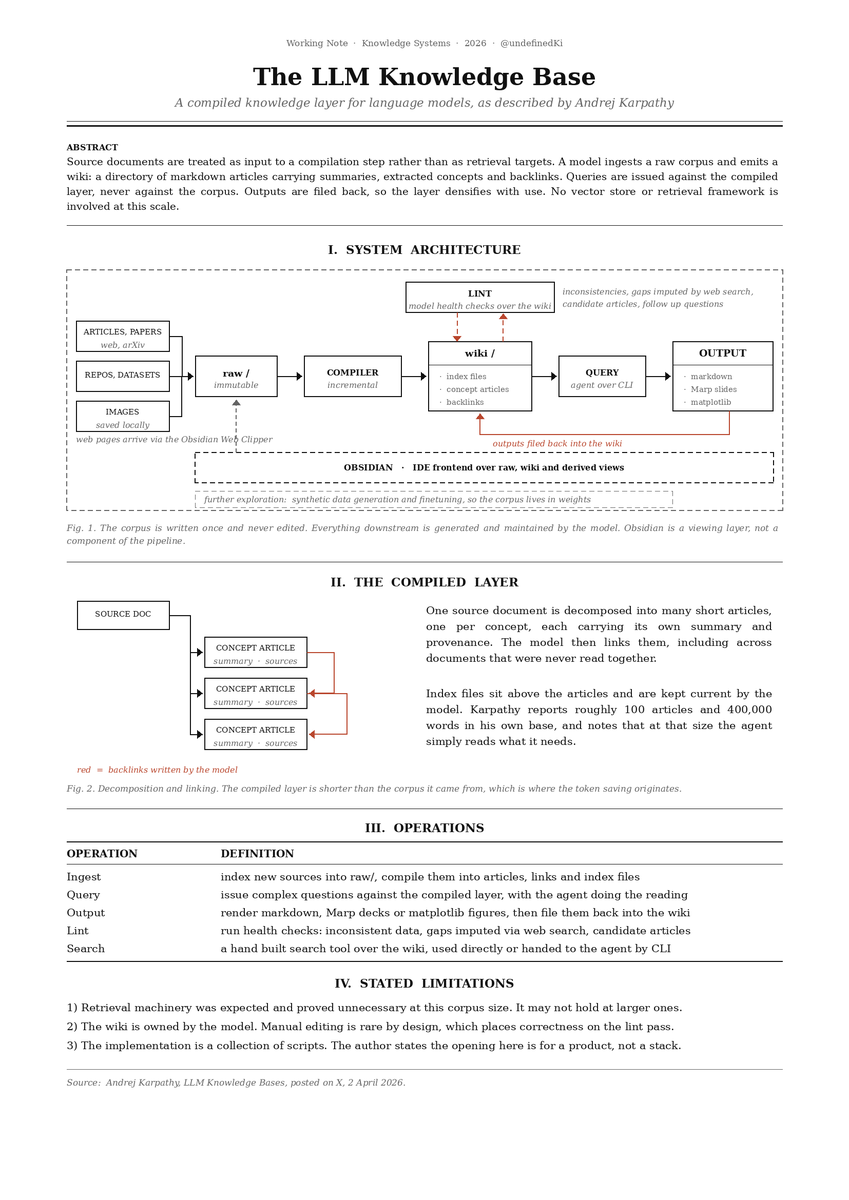
The whole thing turns on one idea. Your documents are source code. The wiki is the compiled binary. You compile once and run the binary forever.
That is why the raw folder is never edited, why one paper comes out as a dozen short linked pages, and why every question after that reads the pages instead of the papers. Same reason nobody recompiles a program each time they open it.
Once you see it that way the rest follows on its own. The cleanup pass, the linking, the answers getting filed back in, none of it is a trick. It is what compilation always did.
Karpathy's version, drawn exactly as he described it, on one page above.
Bookmark this
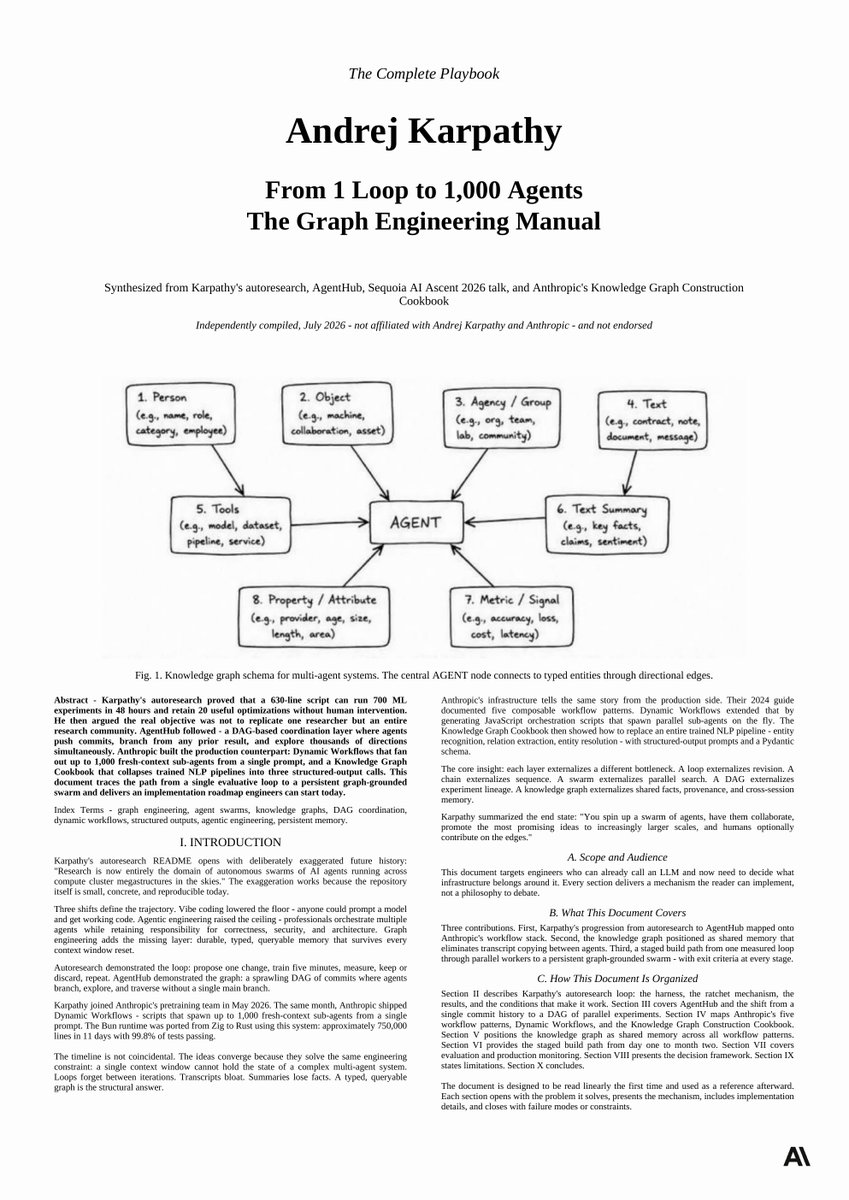
Andrej Karpathy just dropped 12-page PDF on "Graph Engineering" for multi-agentic systems
the shift: Karpathy's loop runs 700 experiments and forgets all of them. A graph remembers forever
here's the full system:
step 1 → build one loop: generate, critique, revise. 630 lines, 700 experiments in 48 hours
step 2 → go parallel: agents in separate worktrees, same repo, different branches, no conflicts
step 3 → add a knowledge graph: extract entities, resolve aliases, assemble typed edges, query through subgraphs
step 4 → ground your evaluator: it checks claims against graph edges, not vibes
step 5 → plug the graph as shared memory. workers write to it. evaluators fact-check against it. Loops persist overnight
step 6 → the agent forgets. the graph does not. stop rebuilding context from scratch every session
Karpathy ran 1 agent in 1 direction. Anthropic's graph runs 1,000 with shared memory - same model, it's the architecture
this 11-page PDF changed how I'm building multi-agent systems today
read it now - then explore the full graph engineering article below ↓
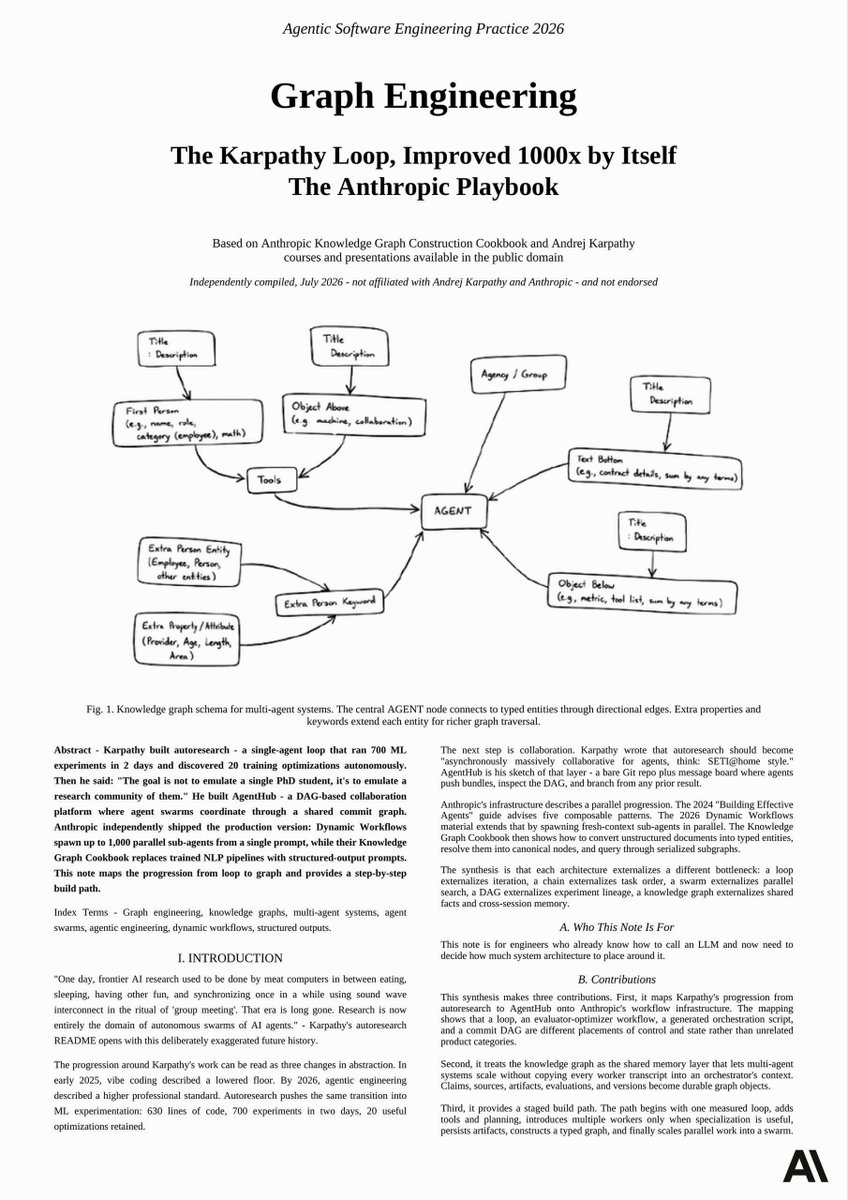
Two Anthropic seniors just made Karpathy's loop 1000x better with "Graph Engineering" - dropped 11-page PDF
the shift: the agentic systems got 1000x better the moment you wired agents into a graph
here's the playbook in 6 steps:
step 1 → build one loop: generate, critique, revise - one self-review cycle beats a smarter model with none
step 2 → add tools: search, code execution, database - thinking without tools is hallucinating
step 3 → go parallel: spin up agents in separate worktrees - same repo, different branches, no conflicts
step 4 → add a graph: agents write findings as typed nodes and edges - not transcripts - every claim keeps its source
step 5 → ground your evaluator: it checks claims against graph edges, not vibes - "Triple not found" beats "seems off"
step 6 → the graph survives every session - your agents stop rebuilding context from scratch
the result: Karpathy ran 1 agent in 1 direction - this system runs 1,000 with shared memory - same model, it's the architecture
read this 11-page PDF and paste it into your Claude - you won't regret it
bookmark - then read the article on building graphs from scratch ↓
Andrew Ng just dropped 8-page PDF on 4 agentic steps "from Loops to Graphs from scartch"
The twist: agent has amnesia without both: Loops let agents think - Graphs let agents remember
here's 4 workflows, step by step:
step 1 → reflection - agent writes, second prompt critiques, agent rewrites - one self-review loop beats a smarter model with none
step 2 → tool use - give it search, code execution, APIs - thinking without tools is hallucinating
step 3 → planning - break the task into JSON steps before running - Step fails? Agent replans around it
step 4 → multi-agent - stop running one agent - run a team - one codes, one reviews, one tests
how to wire this today:
step 5 → add one critique call after every generation - 10-30% quality lift, one day of work
step 6 → connect all 4 into a graph - agents share memory instead of transcripts - agent forgets, graph doesn't
the result: a weak model with 4 steps destroys a strong model without them - same cost, it's the architecture
this 8-page PDF is what comes after loop engineering
save this - then read the full build workflow in the article below ↓
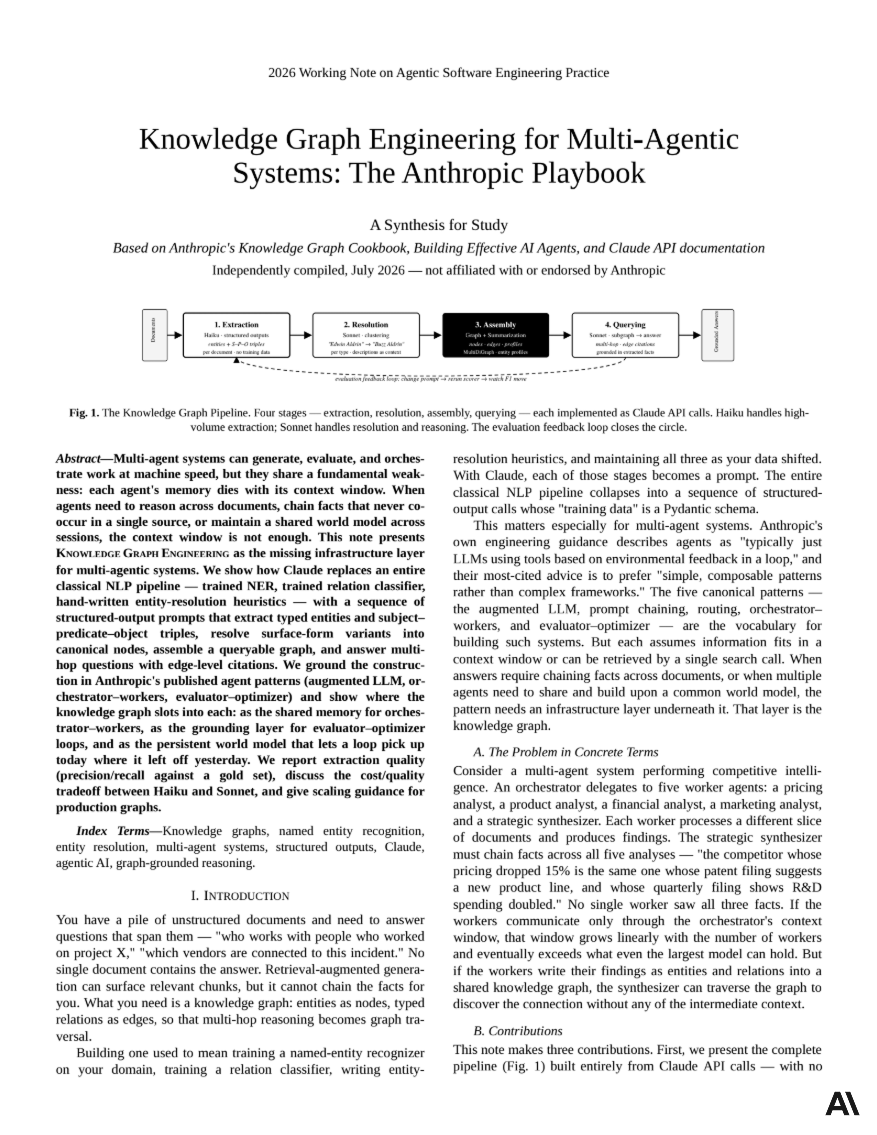
A senior Anthropic engineer just dropped 12-page PDF on "Graph Engineering" for multi-agentic systems.
The shift: your agents memory dies with their context window. A knowledge graph makes it permanent.
Extract → Resolve → Assemble → Query → Repeat
Every agentic graph has 5 stages:
• Extract: Haiku pulls entities and S-P-O triples. One call per doc. The Pydantic schema is the only training data.
• Resolve: Sonnet clusters "Edwin Aldrin" → "Buzz Aldrin" - zero string overlap - using descriptions as context.
• Assemble: canonical nodes, typed edges, provenance on every triple. One connected graph.
• Query: serialize a subgraph → Sonnet reasons over triples → every answer cites a specific edge.
Plug this into multi-agent systems as shared memory.
Workers write to it, evaluators fact-check against it, loops persist overnight with it.
This 12-page PDF changed how I'm building multi-agent systems today.
Read it now, then explore the article below.
Andrew Ng:
“AI agents are doing almost 100% of my tasks now - the hype has exceeded my expectations.
in 3-6 months, we’ll all be building graphs to orchestrate self-improving agents. No more prompting.”
In a 40-minute talk, Andrew Ng explains how to build self-improving agentic systems from scratch.
Worth more than a $500 agentic course.
Watch this video, then read the article below on how to become a graph architect.
Today, prosecutors arrived without prior notice at the data center hosting Fidesz’s servers, intending to seize the party’s entire communications system and databases. Nothing like this has happened in Hungary since the end of communism in 1990.
It is becoming increasingly clear that Hungary’s Brussels-backed liberal authoritarian Prime Minister intends to eliminate his democratic political opponents, crush all resistance to his arbitrary actions, and use the country’s law enforcement authorities as instruments to achieve that goal.
The question is simple: Will there still be free elections in Hungary, or will anyone who dares to run against the Tisza Party simply end up in prison?
Aren’t the enlightened Western politicians and opinion leaders who support this even remotely ashamed?
Met a guy making $1.1 million a year as an agents engineer at Google Cloud.
Asked him how he gets agents 20x better without changing the model.
He sent me the exact thing he uses himself. A repo he open-sourced 2 days ago.
You won't find anything better about harness engineering, in the open.
Cloned it and pointed my agent at it last night.
Ryan Lopopolo. Google Cloud engineer.
'harness-engineering' - anthology + field guide + agent context bundle. You reference his docs from your CLAUDE.md.
633 stars. 48 hours old. MIT.
-> https://t.co/AOykHplNNX
bookmark this before it gets lost.
One pattern I find useful for working with LLMs is a nice long ramble session. Sometimes the LLM needs more bits to understand what you're trying to achieve, but you're too lazy to type them. In these cases I like to lean back, switch to /voice and just ramble for like 10 minutes, total mess, anything goes, full stream of consciousness. Sometimes I declare it up top, something like "switching to speech recognition sorry for any typos...". Sometimes I turn it into a small interview of a few turns. But I find that the LLMs are somehow very good at reconstructing long incoherent rambles and often their echo of your own tangle of thoughts comes out quite a bit cleaner than what you started with. The result is that you improve the mind meld and have to correct things less from that point on.
THIS DEVELOPER JUST KILLED THE VOICE CLONING INDUSTRY WITH ONE GITHUB REPO.
Claude can now speak in your own voice across 23 languages through a single MCP call.
Free. Local. Offline.
What used to cost $22 to $330/month with ElevenLabs is now open source under the MIT license.
Jamie Pine just dropped voicebox on GitHub, and it already has over 41k stars.
It clones any voice from just 10 seconds of audio, lets you choose from seven different TTS engines, and runs entirely on your own machine, so your voice and recordings never leave your computer.
Connect it to Claude Code, Cursor, Cline, or any MCP compatible agent with a single voicebox.speak call, and your AI can start replying in your cloned voice.
It also adds global voice dictation that works in any app with one hotkey and can generate speech in 23 languages, including Arabic, Japanese, and Polish.
One open source app now replaces both ElevenLabs and Wispr Flow.
If you’ve been waiting to give your AI agent a voice, this is it.
Repo below 👇
Estos son los 8 repos de gitHub que más han crecido en lo que va de julio
1. mattpocock/skills
Las skills personales de Claude Code de Matt Pocock. Las que usa él mismo en su directorio .claude. Ahora disponibles para todo el mundo.
+22.1k estrellas en julio. El que más ha crecido este mes sin duda.
https://t.co/wXYIoCNqXY
2. OpenCut-app/OpenCut
La versión open source de CapCut. Editor de vídeo en el navegador, sin cuenta y sin telemetría.
+6.2k estrellas esta semana. Trending #1 en GitHub.
https://t.co/LQpTF2nNJT
3. MadsLorentzen/ai-job-search
Agente con Claude Code que te ayuda a aplicar a ofertas de trabajo: evalúa la oferta, adapta tu CV, escribe la carta y te prepara la entrevista.
+5.9k estrellas este mes.
https://t.co/GIjPMhjPKL
4. asgeirtj/system_prompts_leaks
System prompts filtrados de Claude, GPT-5, Gemini, Grok, Cursor y más.
#2 trending esta semana. Todo lo que las empresas de IA no querían que vieras.
https://t.co/AeuQNxPvbh
5. zaid-maker/meetily
Asistente de reuniones 100% local hecho en Rust. Transcripción 4x más rápida que Whisper, diarización de hablantes y resúmenes con Ollama.
#1 trending esta semana. Sin nube, sin cuenta.
https://t.co/ATA1TjEoH5
6. HKUDS/Vibe-Trading
Trading con IA usando lenguaje natural. Crea estrategias completas con agentes de IA.
Top 2 trending esta semana.
https://t.co/7PulJbTiJe
7. usestrix/strix
Scanner de vulnerabilidades impulsado por IA. Encuentra y corrige fallos de seguridad en tu app.
Alternativa open source a herramientas de pago.
https://t.co/iPcgIQYPIC
8. obra/superpowers
El workspace de IA self-hosted que superó las 250.000 estrellas en julio.
Un crecimiento orgánico brutal sin marketing ni inversores.
https://t.co/1NbOxTfJTc
Estos están siendo una locura.
Guarda esto si te sumann.
Palantir sells governments a war room that costs millions a year.
So, a guy named Elie just rebuilt it, put it on GitHub, and gave it away.
It's called World Monitor.
Open it and you get a live 3D globe with 500+ news feeds pouring in across 15 categories, all summarized by AI as they land.
> Military movements.
> Economic shocks.
> Natural disasters.
> Cyber incidents.
> Flight paths.
> Shipping lanes.
+ 56 different map layers you can stack on top of each other.
It scores 31 countries on a stress index and updates the number as things happen.
It watches 29 stock exchanges, commodities, and crypto in one panel.
It runs local AI through Ollama, so you can use the whole thing without a single API key.
Native desktop app for Windows, macOS, and Linux. 25 languages. Works out of the box after one clone.
Andrew Ng just released a 1-hour course on building agentic knowledge Graphs from scratch:
• 00:00 - Introduction to agentic knowledge Graphs
• 03:07 - Construction of agentic Graphs
• 14:00 - Architecture of multi-agent systems
• 23:00 - Building agentic graphs with Google ADK
• 01:06:03 - Why Graphsare the future of agentic AI
Worth more than 10 articles on loop engineering.
Watch it today, then read how to become a graph engineer in the article below.
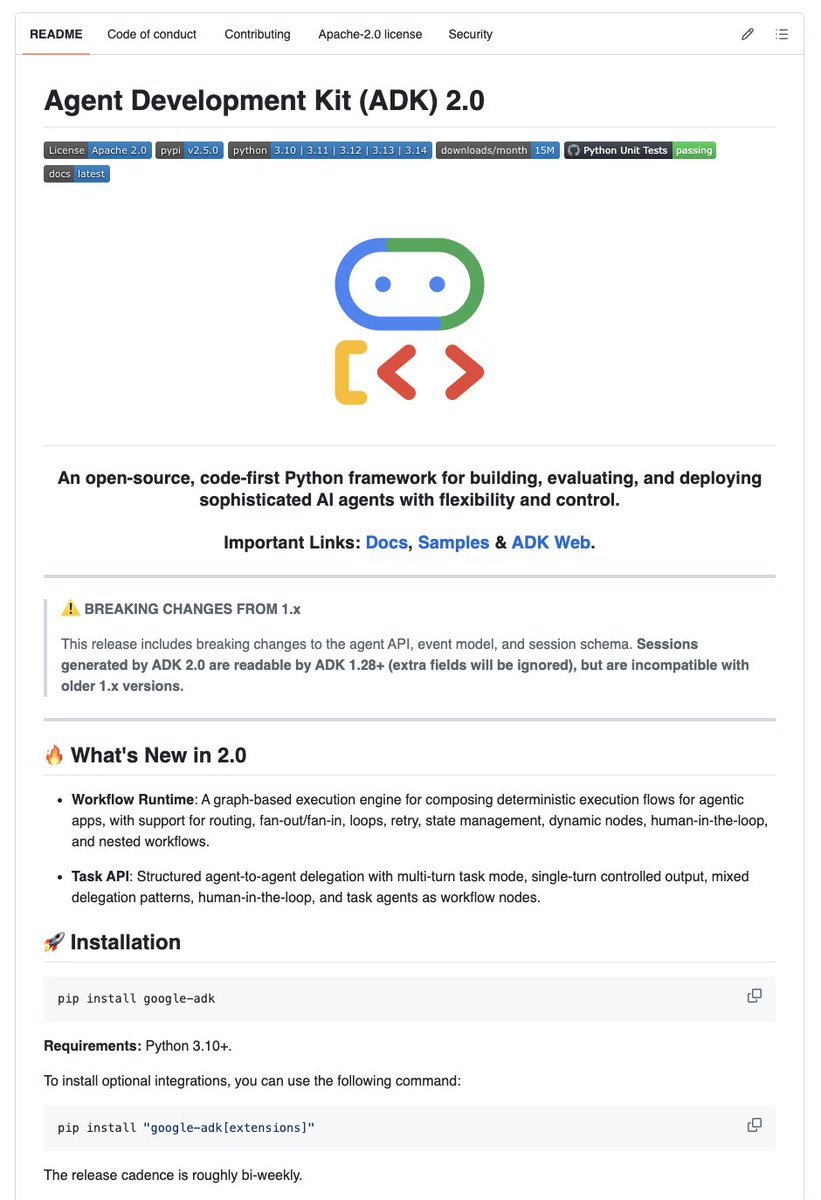
Google just killed the agent framework industry.
ADK 2.0: Open-source. Free. Better than $50K enterprise tools.
What it does:
→ Graph-based execution with routing, fan-out/fan-in, loops, retry
→ Structured agent-to-agent delegation via Task API
→ State management, dynamic nodes, human-in-the-loop, nested workflows
→ Interactive CLI (adk run) and Web UI (adk web) for local dev
→ Multi-turn task mode with single-turn controlled output
→ Works with Gemini 2.5 Flash, extensions via pip
What it replaces:
→ LangChain orchestration boilerplate
→ LangGraph state machines
→ Vertex AI Agent Builder lock-in
→ Custom agent-to-agent delegation code
Define your Agent class with instructions and tools.
Compose a Workflow class as a graph.
Run it locally with adk run or adk web.
No hosted platform. No vendor lock-in.
Customer support bots, research agents, multi-agent pipelines - same library.
This is what open-source from Google looks like.
→ https://t.co/SSQnZZ94w6
Claude Code team:
"we oversimplify agentic engineering - like it's just prompts, just loops
No. We need to know what we're doing "
"I think Fable smarter than we think and we're hobbling Claude"
what he means:
step 1 → stop rewriting the prompt, give it a tool, the model that "can't" - answer will grep it in one line
step 2 → tell it who YOU are. -"experienced TS engineer, zero context on
this module, high-compute - use sub-agents"
step 3 → don't skim the report - that's "education movie" - looks great,
teaches nothing - make Claude visualize it until it clicks
step 4 → anchor the unknown to what you know. color grading landed when
Claude called it a shader - pixel in, pixel out
step 5 → prototype in cheap HTML first - finding out at 80% done is what
he's on the Claude Code team and just drop a new workshop
watch & bookmark, find out what he uses instead↓