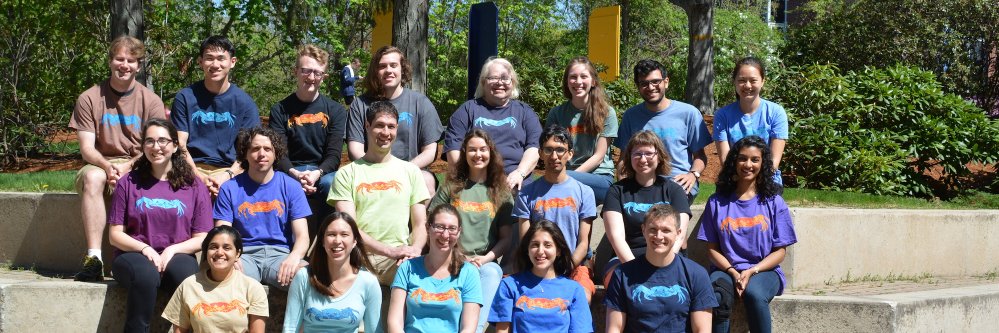
Very happy to see out work on neuronal homeostasis published in PNAS!
Yay!
I am very proud and happy to finally contribute to my favorite line of research in the Marder Lab.
https://t.co/Bh13df2bKL
New review paper from the @MarderLab! Latest insights from small rhythmic neural circuits on individual variability, resilience and neuromodulation of neurons and neural networks. https://t.co/ntc5K6c6FR
If you are attending #FENS come see @ThiagoBurghi poster featuring collaborative work between @Timothy0Leary lab and @MarderLab on estimating models of neuronal dynamics using ANN to predict and control the behavior of biological neurons in real-time. S05-513, July 12, 9:30-13:00
New paper out in @eLife by superstar postdoc @neurochart! Reciprocally inhibitory circuits operating with distinct mechanisms are differently robust to perturbation and modulation
In the positive news, our paper is out in @eLife! Read about how the mechanism of oscillation affects neural circuits' resilience to perturbations and neuromodulation. @MarderLab
https://t.co/XbI1AcH6Xw
In the positive news, our paper is out in @eLife! Read about how the mechanism of oscillation affects neural circuits' resilience to perturbations and neuromodulation. @MarderLab
https://t.co/XbI1AcH6Xw
#SfN21 Albert & Ellen Grass Lecture today at 3:30 pm (ET) | From the Neuroscience of Individual Variability to Climate Change
Read the accompanying review by Eve Marder & Mara Rue in #JNeurosci https://t.co/AaIzphyGNq
Pairs of neurons that inhibit each other can form simple oscillators with complicated underpinnings which make them differently robust to external influences. Read about our hybrid neuronal circuits that reveal these dynamics!
Happy to share our new preprint describing the features underlying robustness of reciprocally inhibitory circuits to alterations in circuit parameters, temperature, and neuromodulation. @MarderLab https://t.co/ROlB2pEVX1
Compartment-based modeling reveals interactions of diameter, myelination, and the Na/K pump activity to determine the reliability of high-frequency spike propagation in axons. Read about it here:https://t.co/WKAPlSoBq7
Today, #Neuromatch CN students are learning about dynamic networks. For that, our artist and volunteer Katya Morozova (@neurochart) has created this amazing illustration to be the cover for the day. Check out her Instagram channel for even more sciency art 🔬🖼
@StephanJanosch They serve different needs IMO. Zenodo may be great as a single citable source of truth, but code is never finished. Github/Gitlab etc offer versioned access to code besides the social aspect & discoverability
We're proud and excited to support reproducible research with our latest project! Here's what it means:
1. You can download the data needed to make figures right now!
2. You can download ALL the analysis code, scripts written for this project from Github
Thread, links below ⬇️
Executable Research Articles (ERAs) are changing how we publish science at eLife, letting authors share code interactively in their papers.
Hear about authors’ experiences with this truly web-native format: https://t.co/mbGkFdQo4n
But wait, there's more!
We've made the *full* history of all git repositories public -- no more splat commits with "initial commit" messages being the only thing you see. All the failed attempts, alternate directions, interesting but flawed ideas are out there for all to see.