Excited to share our NEW preprint: a "brain-to-voice" neuroprosthesis that directly synthesizes voice from neural activity with closed-loop audio feedback. It allowed a man with ALS to speak expressively by modulating intonation & sing melodies via BCI! https://t.co/CxNBxTqqYr 1/
University Professor Eve Marder ’69 & Professor Emeritus Gregory Petsko have each received the National Medal of Science from President Biden, the highest recognition the nation bestows on scientists & engineers.
https://t.co/Fiy50DhbpV
We’re hiring a data collection program manager at @WisprAI in SF to build and scale out our data collection efforts!
You’d be responsible for:
- setting up a new data collection site
- recruiting subjects and users
- setting up experiments
- monitoring data for high quality
This is one of the most critical roles at the company — for a neurotech company to successfully ship a robust, consumer product we need to collect large amounts of high quality data. You’d be a key owner in a role that will scale up a lot over the next year.
If you’ve run a data collection program, been a lab technician, or excellent in program management and operations, and are excited to build the next generation of personal computing, please reach out at https://t.co/VRNCpu6CoB, and if you know a friend who might be interested, please send them our way!
New team update! 🎉
Katya Morozova, PhD, has joined the Wispr team as a computational neuroscientist! 🔥
Katya has 10 years of experience in data analysis, mathematical modeling, and electrophysiology.🧠
There's been a lot of exciting developments happening internally at Wispr!
Want to learn more? We're hiring: https://t.co/PyPrSmvEvJ
Galactica is basically GPT-3 for science. It can write whitepapers, reviews, wikipedia pages and code. It knows how to cite and how to write equations. It's kind of big deal 1/ 🧵
Presenting a poster at #SfN2022 this afternoon, featuring my recently published work on half-center oscillators and a new work in collaboration with @ThiagoBurghi on estimating a predictive model of neuronal dynamics using ANNs. Stop by to say hi!
🔊📣📢
Pls RT!
Hiring for multiple positions @AllenInstitute in a U01 project supported by the @NIH BICAN consortium. Combining optical physiology in vivo with spatial transcriptomics and electron microscopy, we aim to link cell types of the mouse cortex with their function.
1/7
We released #openscience data comprising the activity of ~300,000 neurons recorded by #Neuropixels probes – the largest data set of this kind ever collected. Now it's time to dig in for #neuroscience analysis. #AllenImpact
https://t.co/RXDOVL7K0w by @grace_huckins
We believe
💎 Everyone should be able to read and publish research for free
🌍 Research publishing should be commonly owned and run, not for profit
🔢 All data should be open and re-usable
We are delighted to announce a new open publishing initiative
https://t.co/Uk4iO7voQW
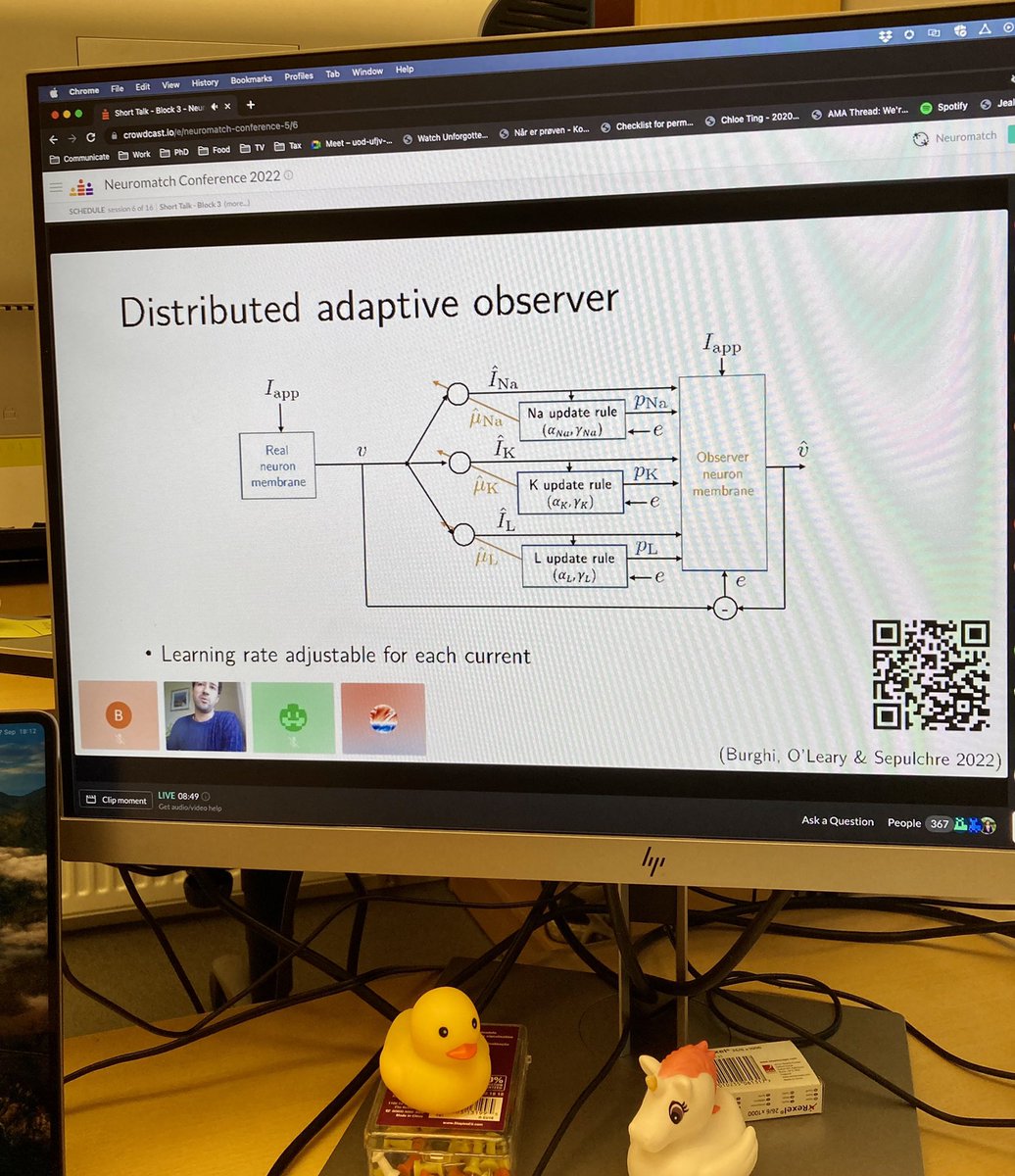
Great @neuromatch talk by @ThiagoBurghi on using adaptive observers for real-time estimation of conductance-based neural dynamics, in both single neurons and networks of neurons. A very cool and useful intersection of control theory and neuroscience!
Congrats to the Cunningham lab for earning the cover in today’s issue of @NeuroCellPress! Read more about their new data-analysis framework, NeuroCASS, which should help researchers extract more insight from the ever-increasing ocean of neuroscience data: https://t.co/RYenHtRLl9
So here is how to make t-SNE 💔-shaped.
In t-SNE, all points are initialized close to 0. Gradient descent lets similar points attract and distant repulse; the embedding slowly expands. I constrain it to stay within the heart: points are not allowed to penetrate the boundary.
@introspection@eLife@MarderLab Thank you! Unfortunately, I am not so familiar with this literature. Maybe look into Terry's Sejnowski work on RNNs?
We are working on using ANNs to fit the voltage dynamics of neurons and circuits, including HCOs. I am also interested in this topic, so please keep me posted!
In the positive news, our paper is out in @eLife! Read about how the mechanism of oscillation affects neural circuits' resilience to perturbations and neuromodulation. @MarderLab
https://t.co/XbI1AcH6Xw
New review paper from the @MarderLab! Latest insights from small rhythmic neural circuits on individual variability, resilience and neuromodulation of neurons and neural networks. https://t.co/ntc5K6c6FR