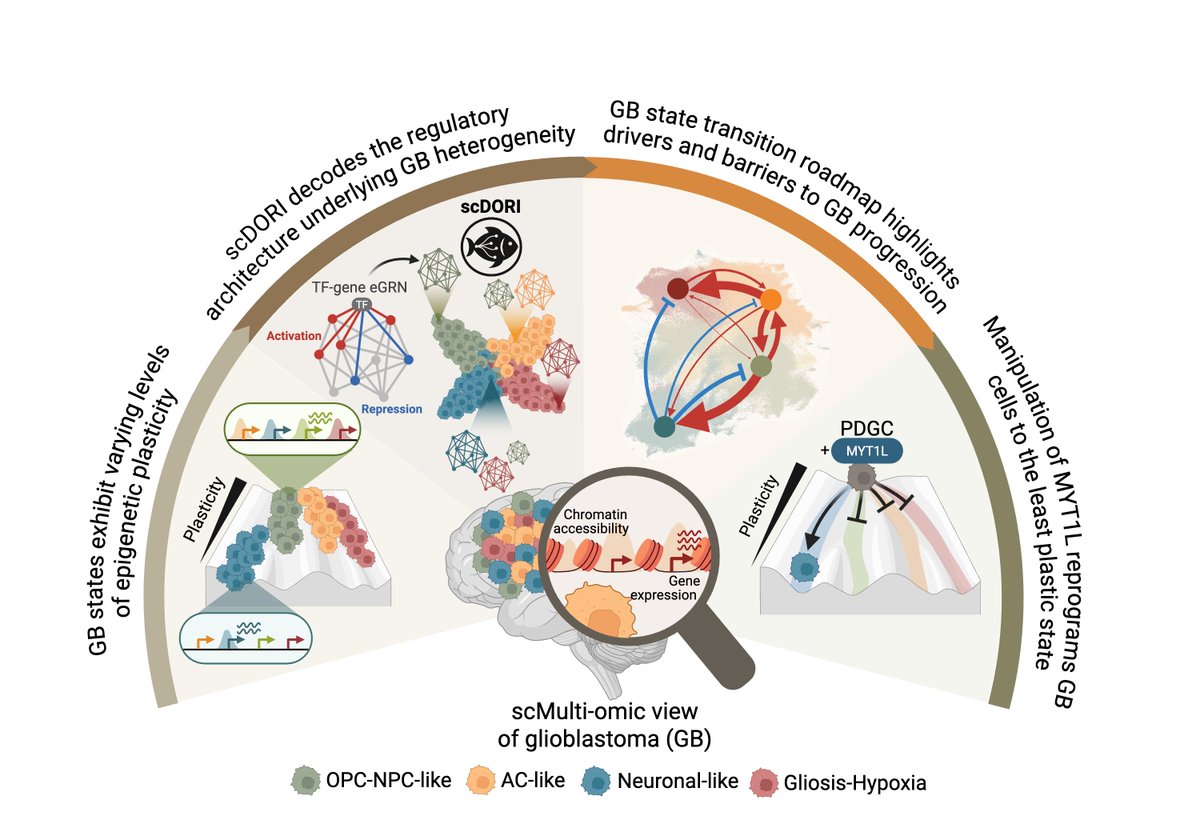
How does tumour heterogeneity arise? How can we predict cancer cell plasticity? In 2 studies, we trace #glioblastoma heterogeneity to a spatial cancer cell trajectory w. atlassing https://t.co/OY9T4rHYrj & predict plasticity w. snRNA/ATAC+deep learning https://t.co/AwlOHu3cq6 🧵
🧠 Excited to share my main PhD project! We mapped the regulatory rules governing Glioblastoma plasticity using single-cell multi-omics and deep learning. This work is part of a two-paper series with @bayraktar_lab , @OliverStegle and @MoritzMall groups. Preprint at end🧵👇
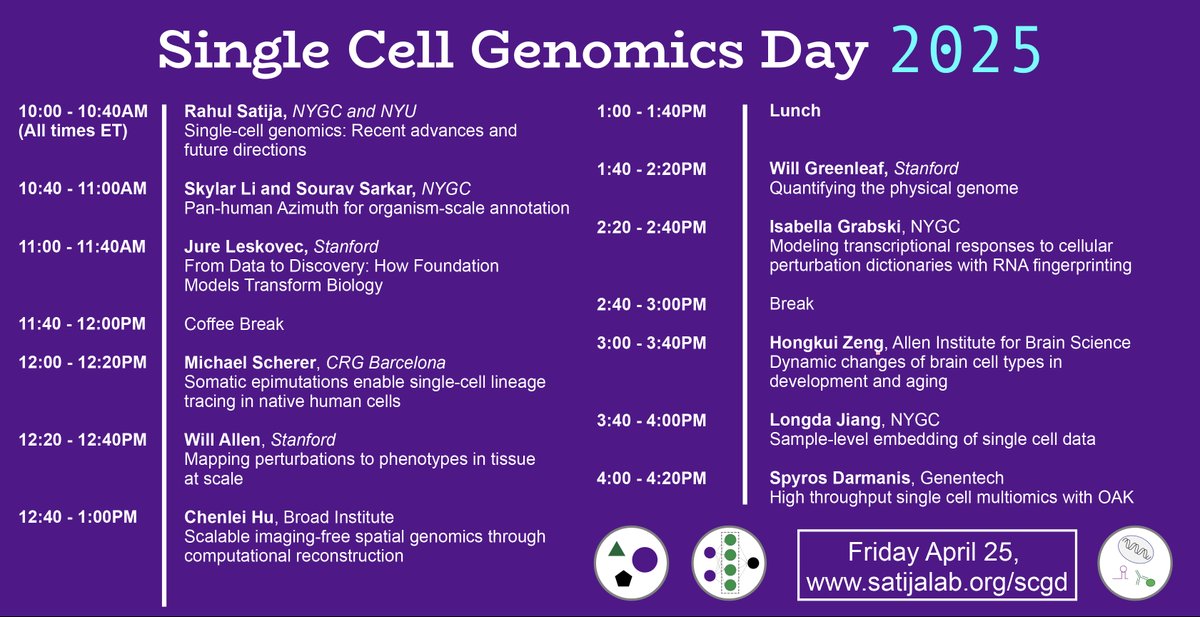
Our Single Cell Genomics Day - highlighting our favorite new sc/spatial methods - starts today at 10AM ET!
Talks are free and live-streamed (no registration required) on Youtube and https://t.co/zG98gkckMU
Looking forward to connect with the local single cell enthusiasts in Heidelberg tomorrow! Thanks a lot for the invitation @saezlab@JulioSaezRod@natgabrielli and maria!
Hyped to be at the #ESSB@SpatialBio#spatial#biology conference together with some of my colleagues from the @saezlab . Great science, beautiful venue, looking forward to the next 1.5 days...
We will be at the inaugural #ESSB conference this week in Berlin, presenting with @MariaCHeinz a talk on multi-modal whole brain tumor profiling, @psl_schaefer with @tanevski a poster on analyzing cross-condition/temporal spatial data [1/2]
Looking for a job as a #Research#Technician in #Cancer#Microbiome? We offer a collaborative team @EMIL_DKFZ , diversity of methods, opportunity for further training and a fun work place at @DKFZ!
Apply now (or share with your network): https://t.co/5YXYWdjvSi
Do you want to take a leading role in shaping a research group on functional cancer microbiome work, including coordination of an @ERC_Research grant and national consortium? Join our @EMIL_DKFZ team in Heidelberg as Staff Scientist! Details: https://t.co/8YEoxtUrAM
Pls Retweet😀
Fantastic news for the #microbiome-related #cancer field! Exciting research is continuing at @EMIL_DKFZ, now supported by #ERCStG. Many congrats to @JensPuschhof and the entire team!
Can’t wait to this awesome team revolutionizing how we think about #bacteria in #cancer...
New publication alert🚨🚨🚨Mechanisms that clear mutations drive field cancerization in mammary tissue is out @Nature https://t.co/z4qZwpV7uu Congratulations all for this great team work! 🎉
Curious about inferring cell-cell communication in space or in your multi-modal dataset?
Check out LIANA+, the latest framework from the @saezlab.
Congrats to @DanielBDimitrov and all the co-authors!
📣 The much-revised manuscript of LIANA+, our all-in-one solution to study cell-cell communication from single-cell, spatial, and multi-omics technologies, is now published in @NatureCellBio https://t.co/KkHX3GVLn1
With abundant cross-condition scell data it is timely to transition from taxonomies to multicellular descriptions of tissue function
Our revised work for the unsupervised analysis of samples of scell atlases, inference of multicellular programs, and study integration is out now
🧬Explore disease at a multicellular level, capturing variations in patient samples across cell types, tissue features, studies, and technologies with Multicellular Factor Analysis, peer-reviewed by @ReviewCommons and now published @eLife
https://t.co/bRVOBdptFm
Extremely honoured to receive the ERC Consolidator this year #ERCCoG. Looking forward to the next 5 years of exciting science to unravel the intricacies how tumors become malignant. #CancerPrevention @UMCU_CMM @oncodeinstitute
Friendship and partnership are forged during times of challenge. Grateful to @DKFZ@Elinav_DKFZ@EMIL_DKFZ for hosting several of our @Elinav_Lab@WeizmannScience members during these trying weeks, in helping them continue their scientific work.
We are hiring! If you are a Research Software Engineer with experience in Python + database & modernising
@omnipathdb using https://t.co/9eGe9RDkNj sounds interesting to you, please check this posting: https://t.co/EuRMMFUeaQ
- more openings at https://t.co/Mh5yLYcqfu
Wonder how much colorectal cancer organoids could be improved by reconstructing the tumor microenvironment? Check out our latest pre-print and opus magnum by @NicoBroguiere and colleagues!