holy shit i did it
a fun experiment (riddled with psychosis), bringing more customization to your favorite gui @t3dotcodes built by @theo and @jullerino
oh-my-t3
try it out at https://t.co/AgTmNoeHtq
1/ i bounce off 11/10 AI landing pages
if you haven't put any effort into designing a website that looks delightful for humans, i assume you haven't put any effort into the user experience inside the product either
4/ inside the product, don't ask for money after I signed up
- first show me what to do (a clear CTA, not an empty screen)
- guide me to the first AHA moment
- then let me get a result in minutes
- then give me a reason to come back tomorrow
once i've felt the value, ask me to pay
3/
the landing page has to answer, in order..
- is this for me?
- do people like me use it?
- how much work will this require for me to understand the product?
- worth the price?
- why now?
2/
the thing is, a buyer decides twice before paying you:
1. try it? (landing page)
2. pay for it? (inside the product)
lose them at the first one and there's no second
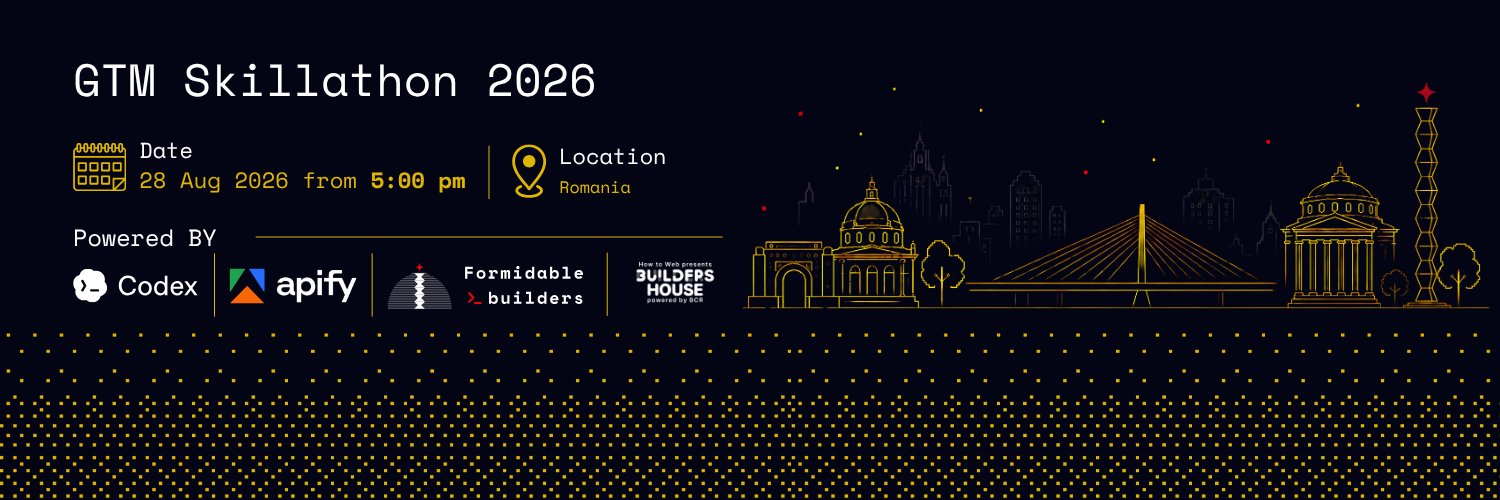
We are trying something new: launching a creative project that matches our community members’ energy and spirit.
This is the first teaser, generated through a workflow built entirely by our newest colleague, @denisa__cirstea
Hope you'll enjoy it! And let us know what you think.
Dusting off this tweet from April because this gap in shared understanding of LLM capability is *widening*. It's now less "two groups of people speaking past each other" and more a sharp funnel.
- Napkin math somewhere around 6B people (~75% of the population) have barely come in contact with LLMs at all.
- Around 1-2B (~20%) are casual and infrequent users of free-tier ChatGPT-like products. This group sees derpy chatbots and treats them a bit like a better Google search, a writing aid, or etc. Maybe an agent tries to book you a flight. I have non-tech friends who (reasonably, imo) say they have not much use for it at all. Even many professionals outside of math&code are in this tier. For example, execs and many other functions spend a lot of their time talking to other people, so while they understand what is happening intellectually, it is still second-hand and a bit abstract.
- Now we get to professional use of frontier-grade LLMs in math&code. Somewhere around 20M people (0.2%) see first-hand that large, complex projects that used to take them weeks/months can now be completed by agents with a prompt. Building apps, copying apps, translating apps, decompiling apps from binaries... This has all happened very quickly and recently - less than 1 year ago, I was writing code manually by hand, typing memorized computer code commands into a code editor character by character, occasionally pressing Tab to autocomplete a little chunk of code.
- And finally we get to the ~5,000 people (~0.00006%) with access to frontier-grade systems internally. The external world has seen the preview. It looks like swarms of thousands of agents collaborating over weeks on software mega projects: minting zero days, running cyber attacks and defenses at machine speeds, discovering new science, advancing the frontier of mathematics. Things that would have taken top professionals in the industry years of work. Meanwhile, human review and comprehension are starting to fall behind. For example, people are still involved in the "archeology" of the OpenAI-HF incident from many months ago. Mathematicians may be poring over the 722 manuscripts on frontier mathematics for a while.
The funnel is driven by a combination of factors:
1. The impact scales with ambition, problem size, and horizon. A question with a paragraph answer barely stresses the system. You need a reservoir of big, difficult problems that you really care about. This aspect drives the consumer / professional dimension of the funnel.
2. The jaggedness of the system (which I have written about a lot separately). Capability peaks in domains that are digital, verifiable and economically valuable. This is because LLM capability emerges from reinforcement learning on verifiable rewards on a curated environment mixture driven by revenue potential. This aspect primarily drives the area (e.g. math&code) dimension of the funnel.
3. Access. Free-tier, paid-tier, internal.
So this is the weirdness of the moment. The general public has mostly not interacted with these systems. When they have, it looks like a derpy chatbot. The majority of professionals still see only a modest uplift. And a small sliver of professionals are experiencing the vertigo of the curve going vertical. And it is all happening at the same time.
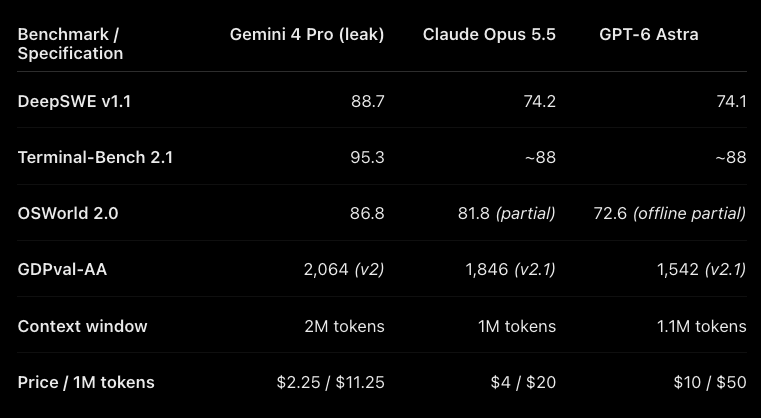
Google just ruined OpenAI's dev day lmao
Gemini 4 Pro leaks absolutely dominates both Anthropic and OpenAI
This means Fable 5.5 and GPT 6.1 has to price match Gemini 4 Pro now IPO DELAYED 🤣
A lot of people are saying Anthropic has already nerfed Claude Opus 5.5.
We're launching NerfBench on BridgeBench tomorrow.
We have the day 1 results.
Tomorrow morning we show you the retest.
Is Claude Opus 5.5 nerfed or not?