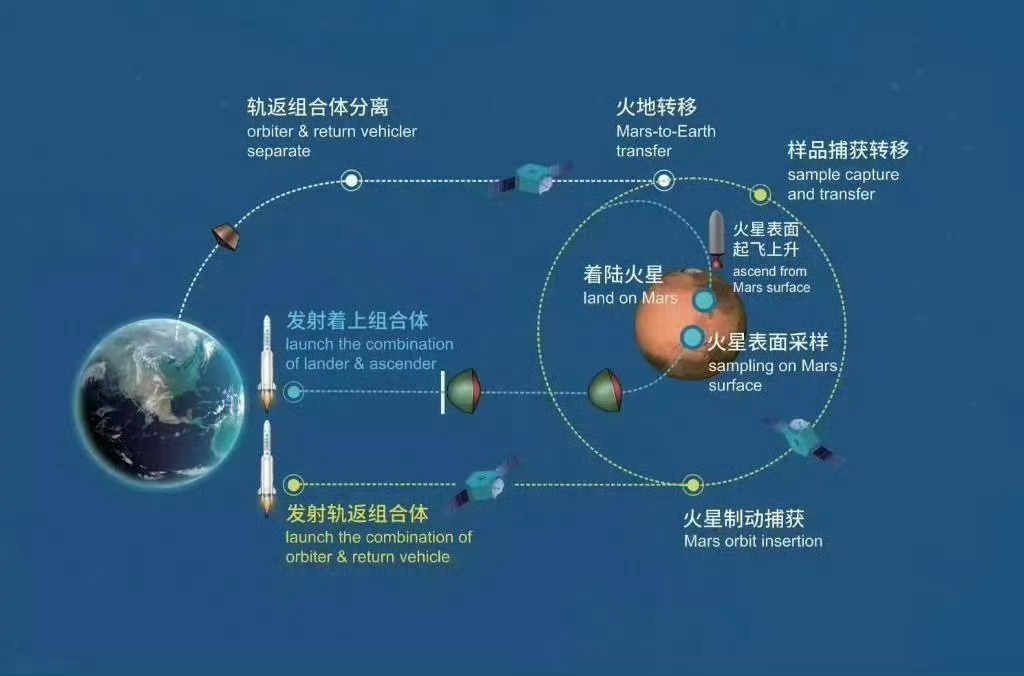
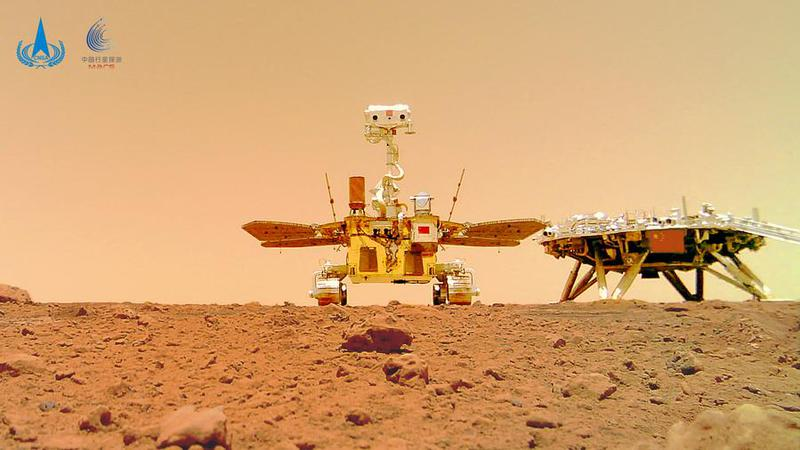
Tianwen-3 Mars sample return: CNSA has selected five international and Hong Kong and Macao cooperation payloads to add to the mission, scheduled to launch in late 2028 via two Long March 5 rockets. Return to Earth with ~500g of samples in 2031.
The China National Space Administration (CNSA) on Friday announced the results of its international collaboration selection for Tianwen-3, China's first Mars sample-return mission, which is planned for launch around 2028 and aims to bring Martian samples back to Earth around 2031.
Following a call for cooperation proposals in April 2025, in which the CNSA announced it would open up 20 kilograms of payload resources for international collaboration, the agency received 28 applications. Five projects were subsequently selected based on the criteria of high scientific value, effective mission support, solid engineering feasibility and high technological maturity, the CNSA said during the opening ceremony of the 11th Space Day of China held in Chengdu, capital of southwest China's Sichuan Province.
Wow. This is big.
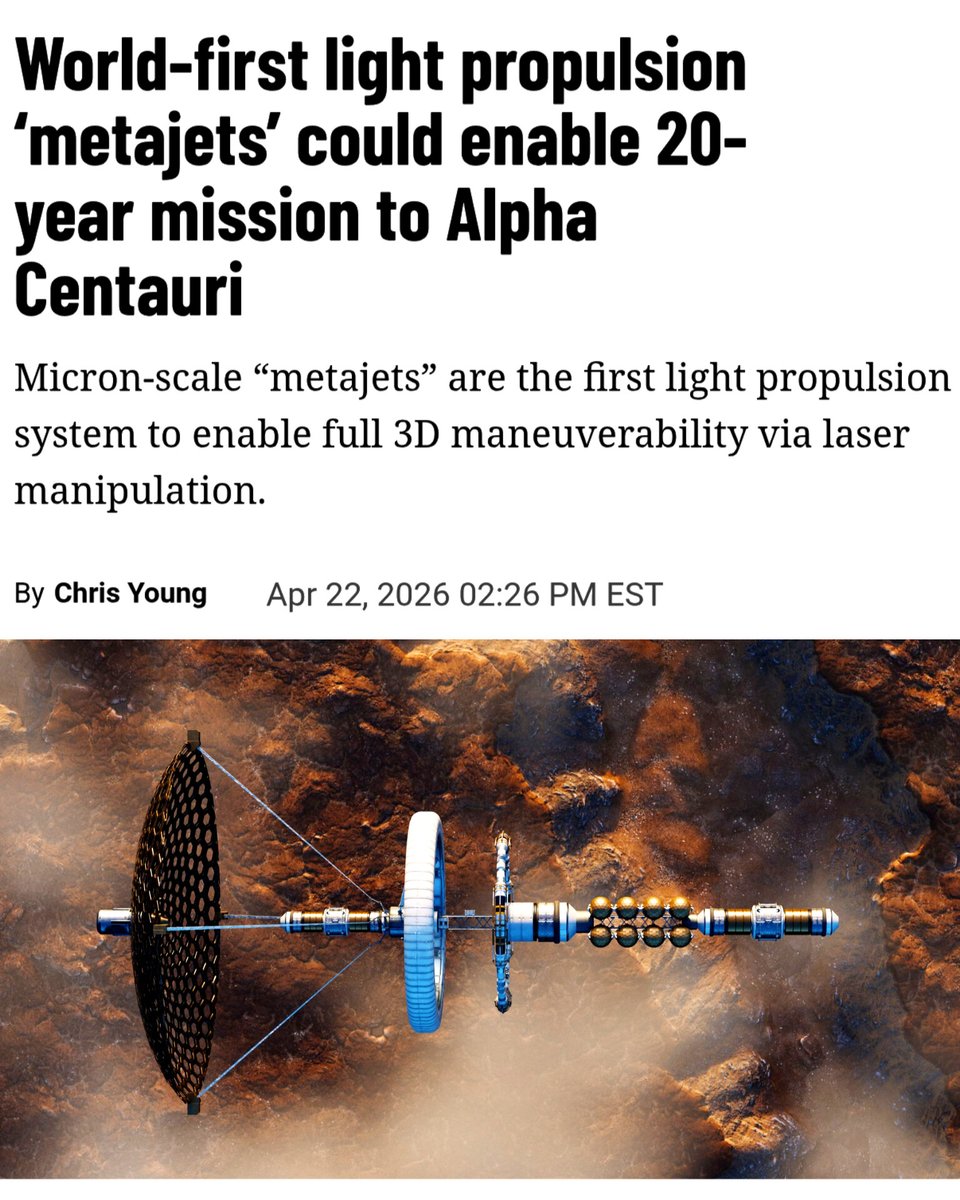
Researchers have created tiny devices called metajets that can be lifted and steered in multiple directions using lasers.
For the first time, optical propulsion systems can achieve true 3D maneuvering.
If this scales, it could make missions to Alpha Centauri, about 4.37 light years away, feel far less impossible.
Concepts built on this approach suggest spacecraft could reach speeds of up to 20% of the speed of light (0.2c), cutting travel time to roughly 20 years.
In other words, this could open the door to fuel-free, laser driven spacecraft capable of reaching another star within a human lifetime.
Robotics has transformed welding speed.
Precision is great, but speed now matters just as much.
And conventional TIG still lags behind...
Balancing quality with speed, especially on pipe, pressure vessel, and roll welding projects.
This solution helps change that.
It delivers TIG-level quality with:
✅ Up to 300% faster travel speeds
✅ 4 lb/hr deposition rates
✅ A compact footprint that fits right into tight production environments
It seems fast enough without compromising on quality and works across carbon steel, stainless, duplex, Inconel, etc.
Aaaaaand the welds still pass X-ray, hardness, and corrosion tests.
Found this via Novarc Technologies
—-
Weekly robotics and AI insights.
Subscribe free: https://t.co/dsa6wcvq6n
Propeller vortices are invisible corkscrews of air shed by spinning blades. They carry energy, cause noise and drag, and shape how efficiently a drone flies. Every prop is really making tiny, organized tornadoes.
@The_Industral@DaddyWarpig The Boring Company might have some ideas.
Electrical power from the sun via panels on the Martian equator is about half of earth. Could be a good place to use space-based solar power: panels are in space, power is transmitted as either a microwave (MASER?) or laser.
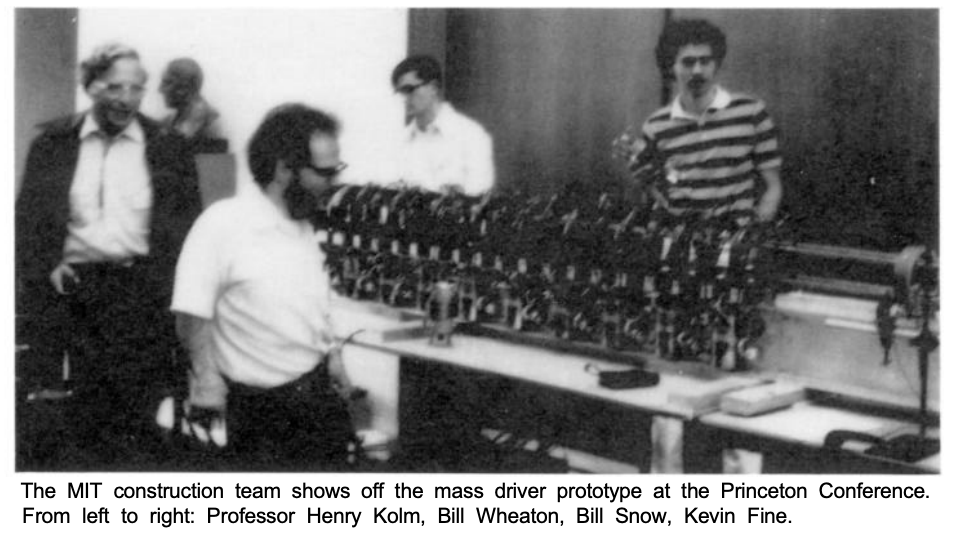
Solar-powered AI satellites in deep space. Factory on the moon built by Optimus robots. Mass driver shooting satellites towards the Sun. Will need some gnarly materials science.
Each second, the Sun shoots 1.5 million tons of solar particles into space. Earth's magnetic shield deflects them. Mars doesn't have one. Thicker walls won't save us: cosmic rays shatter metal into even more damaging secondary radiation. The solution is lighter atoms. Kardashev runs through materials science.
📸 @NASA
Swinburne and CSIRO researchers have successfully made iron under Mars-like conditions, opening to door to off-world metal production.
https://t.co/JcjPBxacvU
@AriellaVL and I are excited to have Matt Shaw from @Swinburne talking about his Asia Pacific #3mt win. He’s helping out @UniNewEngland#hdr students to consider how to find the ‘hook’ in their research story. His talk on extracting metal from moonrocks even made sense to me 😂