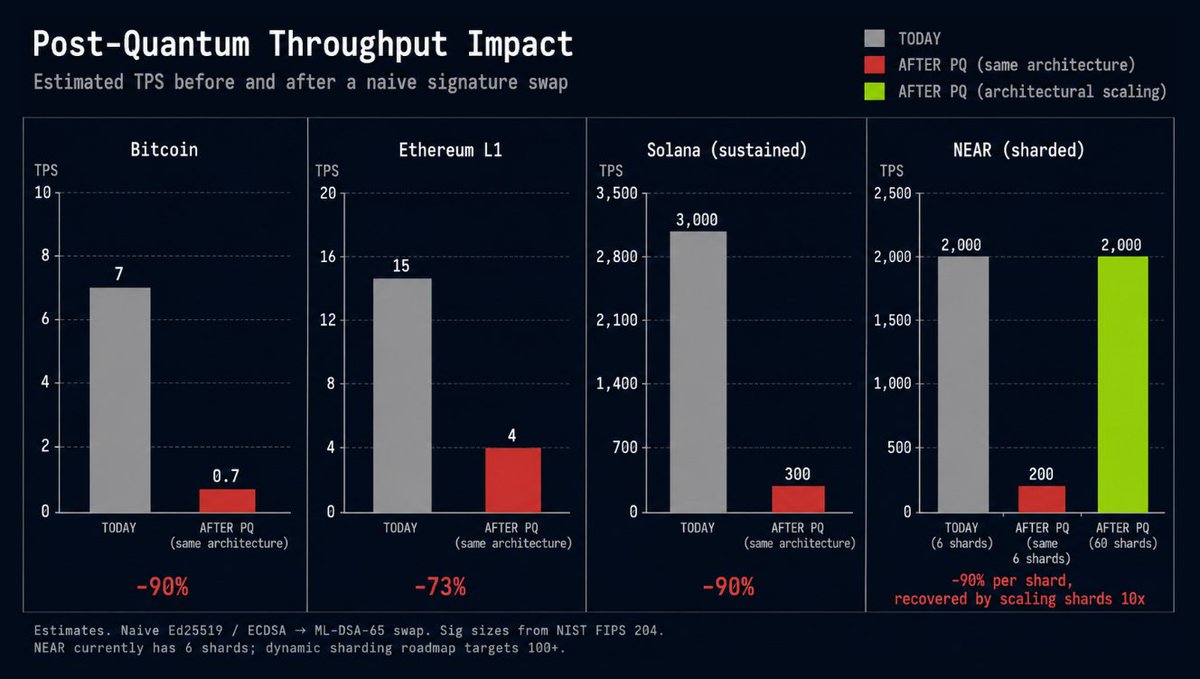
Post-quantum migration is the throughput cliff nobody priced in.
Today's chains rely on tiny signatures (~64 bytes - Ed25519 on Solana, ECDSA on Bitcoin and Ethereum). When quantum computers arrive, those break. The NIST replacements are 50-260x bigger - ML-DSA-65 weighs 3,309 bytes vs Ed25519's 64. Verification gets 2-3x slower too.
Swap Ed25519 for post-quantum signatures with no other changes:
- Solana craters from ~3,000 TPS to a few hundred
- Bitcoin drops from ~7 TPS to below 1
- Ethereum L1 falls from ~15 to ~3-5 TPS
And that's before Ethereum's real nightmare: BLS signature aggregation - the thing letting 12,000+ validators sign one block compactly - has no post-quantum equivalent yet. Without aggregation, every validator's signature ships and verifies separately. Block size and verification cost both explode.
Sharded chains like NEAR have a clean way out.
NEAR runs multiple parallel chains (shards), each independent. Post-quantum migration hits each shard the same way it hits Solana. But total throughput is per-shard capacity times number of shards. If 6 shards each drop 90%, total drops from 2,000 to 200 TPS. Scale to 60 shards, you're back at 2,000. The constraint shifts from cryptography to organization - more validators populating more shards. Both are already in the dynamic sharding roadmap.
Monolithic chains can't replicate this. Solana has Firedancer - a ~10x client speedup good for absorbing PQ overhead once, but only once. Ethereum can push activity to L2s using quantum-safe proof systems - real strategy, helps user transactions, doesn't fix L1 consensus. Bitcoin has the worst path: no account abstraction, fixed block size, ECDSA-locked.
The pattern: sharded chains scale out by adding shards. Monolithic chains scale up once, then wait on research breakthroughs (post-quantum aggregate signatures, hardware-accelerated verifiers).
"Quantum threat" is sold as a 2030 problem. The architectural problem is now.
The high-TPS narrative was always built on a specific cryptographic floor. That floor moves.