Another milestone for BridgeBio $BBIO. The FDA has accepted its application for Encaleret, a treatment for a rare genetic disorder called ADH1, with a decision expected by May 2027. There are currently no approved therapies specifically for the condition, so the drug's development is a potentially blockbuster move.
The FDA does not plan an advisory committee, which usually means a smoother review. This is a big step in BridgeBio's push to grow well beyond its heart drug Attruby, with two more late stage drugs also nearing the finish line.
With a market value already around $16 billion, strong trial data, and fresh funding behind it, BridgeBio is steadily building one of the more compelling in the pharma market.
Royalty Pharma recently committed up to $425 million for a share of future royalties from AstraZeneca's $AZN investigational ATTR-CM therapy, cliramitug, days after Wainua's Phase III setback reinforced the strength of the current treatment landscape. The deal illustrates how capital continues to flow toward high-value therapeutic markets even after major clinical setbacks.
Wainua's primary endpoint miss reinforced the challenges of displacing established transthyretin stabilisers, accelerating momentum behind BridgeBio's $BBIO Attruby following its recent approval. With a strategy focused on expanding its ATTR franchise through continued clinical development and lifecycle innovation, BridgeBio is positioning itself for long-term leadership in the market.
⏰ Only 1 Day Left to Vote — Help Decide CoinDepo’s Next Charity Initiative
Tomorrow is your last chance to have your say. 💙
CoinDepo is considering a charitable collaboration with Action Against Hunger, an organization that supports 26.5 million people across 55+ countries every year.
🪙 Vote and receive 50 COINDEPO tokens if you’re an eligible participant.
⏰ Voting closes July 30 at 23:45 UTC.
📲 Log in to your CoinDepo account, open the Governance tab, and cast your vote.
🔗 Read more: https://t.co/sbR7qWGr0W
$PFE Phase 3 lung cancer results in June were widely described as disappointing by analysts, yet Leerink Partners highlighted "promising" efficacy signals in a subgroup of patients who had received only one prior line of treatment.
It is not the first time descriptions of Pfizer's products and the evidence supporting them have appeared more favourable than some observers believed the underlying data warranted.
Its "near complete stabilisation" claim for tafamidis was challenged in the German courts, before the U.S. National Advertising Division and through a referral to federal regulators.
Perhaps most notably, Pfizer's own U.S. materials promoted "near complete stabilisation," while a footnote stated the analysis was not designed to demonstrate clinical benefit. For investors, that raises broader questions about marketing, governance and regulatory risk.
Alnylam Pharmaceuticals $ALNY will announce Q2 Earnings today, but stock is down 30% in the first seven months of this year despite the broader biopharma resurgence.
Analysts say the decline is driven by two factors:
1.Patient use of Amvuttra, its treatment for the rare heart disease ATTR-CM, slowed towards the end of 2025.
2.The Phase 3 failure of a competing drug called Wainua has raised concerns about the efficacy of silencers like Amvuttra when compared with stabilizers, like $BBIO’s Attruby.
This has put pressure on Alnylam that its hoped-for silencer nucresiran doesn’t miss like Wainua. Analysts are likely to trim long-term stock targets whatever today's results.
Alnylam $ALNY's Q2 Earnings Call will take place later this morning, but there's already cause for concern for analysts. Alnylam is down 30% this year despite a booming biotech market.
This has cast doubt over the silencer class, with analysts now saying doctors may reach for stabilizers first instead. Alnylam is losing ground in the cardiovascular market which will be reflected in long-term price targets.
This is a big advantage for BridgeBio's $BBIO, since its drug Attruby is exactly that kind of stabilizer. As silencers lose ground, BridgeBio looks better positioned by the week.
Today was a good day.
I called what was going to happen, and it played out exactly as expected.
Congrats to everyone who made money today.
If you didn’t, congrats on the lesson.
Don’t lose that too.
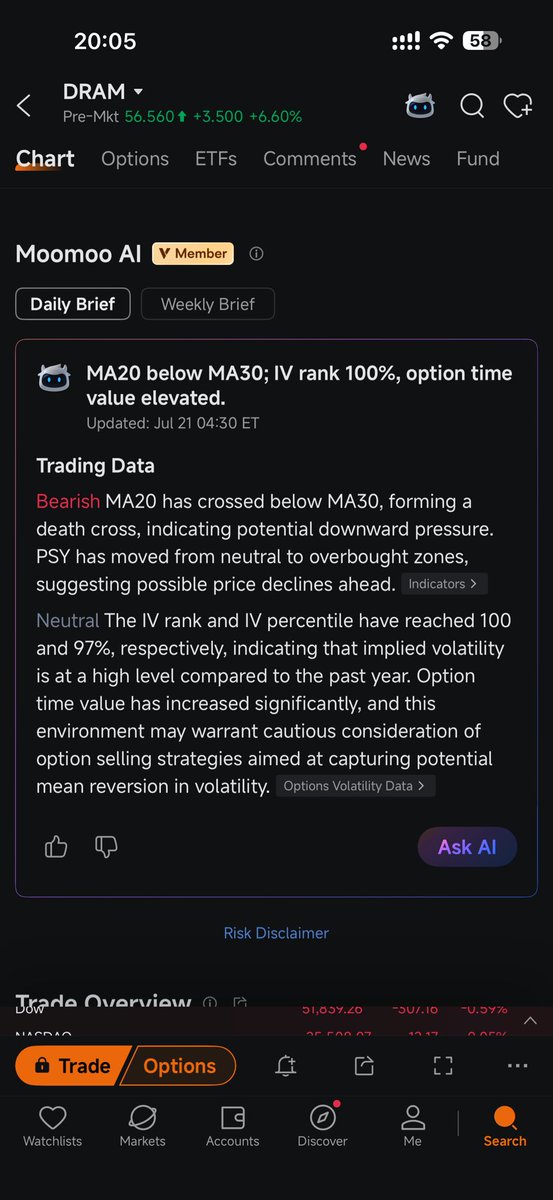
For $DRAM, I use moomoo as a research cross-check rather than a one-click trade signal.
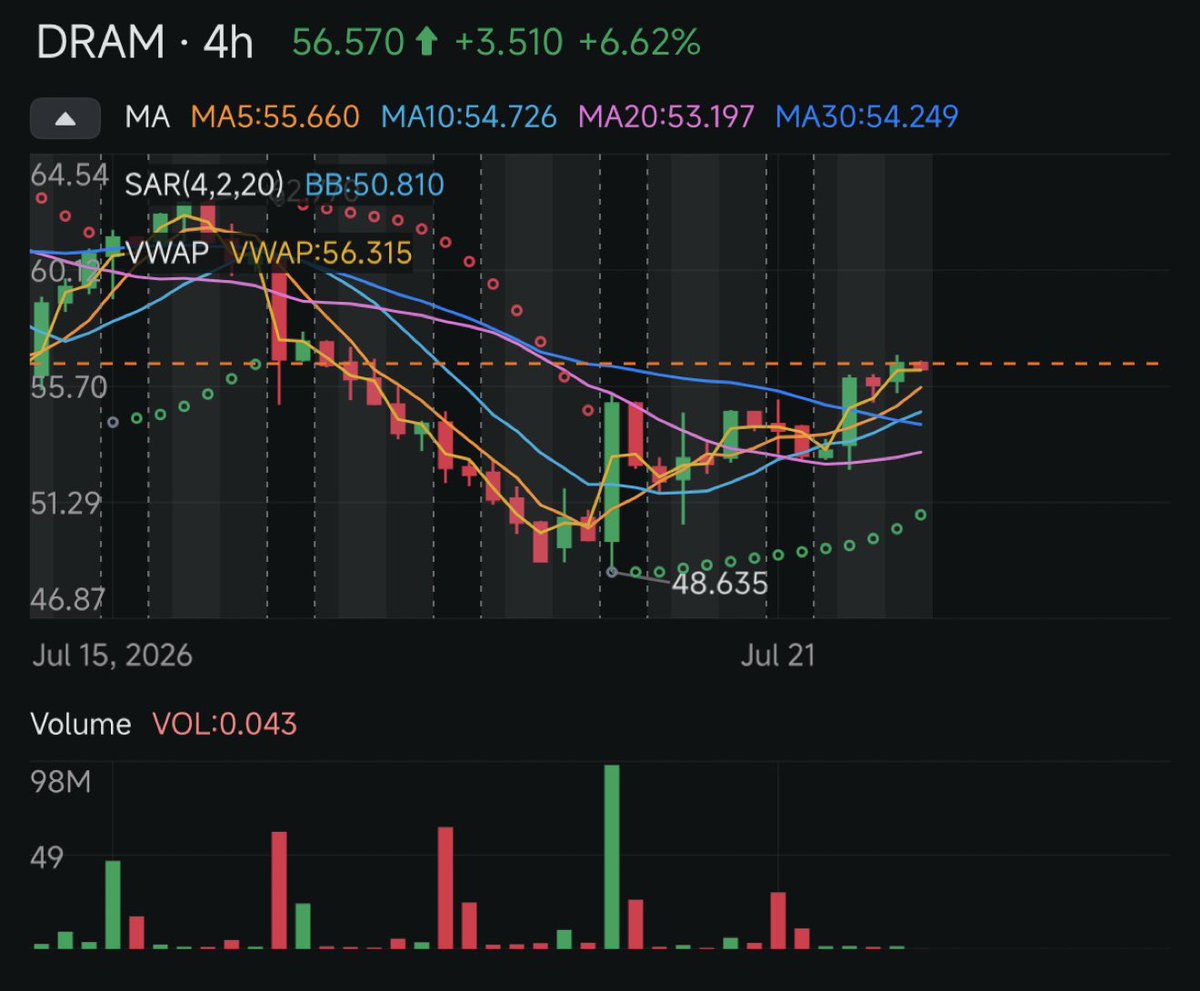
The 4H rebound caught my attention, but the useful part is pairing moomoo AI with Short Sale Analysis. AI summarizes MA20 below MA30, IV rank 100%, IV percentile 97% and elevated option time value. Short Sale Analysis adds daily short activity, including a recent spike near 19% before returning toward average. That’s why moomoo fits my process: summary first, supporting data second.
My read: $DRAM’s rebound from 48.635 to 56.57 looks constructive short-term. Price is above VWAP at 56.315 and the displayed moving averages, but MA20 remains below MA30 and IV is high. I’d want 55.7–56.3 to hold before calling the recovery clean. Short volume is context, not outstanding short interest.
I’d compare $MU, $SKHY, $SNDK and $NVDA to see whether this is stock-specific or part of broader memory/HBM strength.
Which would you weigh more—the AI brief, chart reclaim or short-volume trend—and why?
#moomoo @moomoo
Not financial advice.
I check dead tickers more than new pools now.
New pools are crowded before you even open the chart.
Bots and snipers already there in seconds.
Old tokens that go quiet for weeks then start getting volume and txs again, that gap, before attention comes back, is the actual edge.
@GeckoTerminal's Revival Radar is where I run the check:
→ Reviving / Revived tabs
→ skip the candle
→ volume change vs liquidity depth
→ tx count
→ rugcheck before anything else
None of this makes a token safe.
It just puts old tickers on my screen before they're everywhere.
https://t.co/S4Q6nnXfkB
$PFE has reached a global settlement agreement in the Depo-Provera litigation, which now involves more than 5,800 lawsuits alleging women weren't adequately warned about the risk of intracranial meningioma associated with prolonged use.
A BMJ study found prolonged exposure was associated with a 5.55-fold increased risk versus non-users, prompting the FDA to add a meningioma warning to the U.S. label in December 2025. The settlement, announced in June 2026, has not yet been finalized, and financial terms remain confidential.
This is also not Pfizer's first major settlement in recent months. The company recently reached patent litigation settlements delaying generic competition for VYNDAMAX until 2031. While the cases are unrelated, the succession of high-profile settlements is likely to keep investors focused on Pfizer's litigation, governance and regulatory risks.
UPDATE : $USOIL Our short setup played out exactly as expected.
We are now building a long position from our support zone, anticipating a continuation of the broader uptrend.
Fundamentally, very little has changed in the market. The only major development is that the United States and Iran have stopped bombing each other—but there isn't even a formal ceasefire in place.
At the same time, there is still a large unfilled gap above the current price. In my view, there is a high probability that the market will move higher to close that gap, potentially after the Federal Reserve announces its interest rate decision.
Part two of the series: the loans banks refuse to make.
A typical borrower in this segment looks something like this: a seamstress with a working shop and steady orders walks into her local bank and hears no, or gets offered a rate no small business can pay. She is not a bad borrower. Banks are not built for loans her size.
Lenders like us fill that gap, and borrowers like her pay more for credit than a US corporation would. That premium is a big piece of your rate. Last quarter, 23.8% of the portfolio worked in this segment.
Some of these loans fail. That risk is priced into the rate, and the report shows it next to the returns.
What kind of leader does #Vietnam's 2045 ambition require?
One who can read regional trends, work across cultures and turn #strategy into execution. The School's @NUSExecEd is partnering GELEX to develop them through its Future Makers programme.
BridgeBio $BBIO shares rocketed to a 52-week high after rival AstraZeneca's $AZN late-stage clinical setback boosted investor confidence in $BBIO's ATTR-CM treatment Attruby.
https://t.co/AriKUpLicL