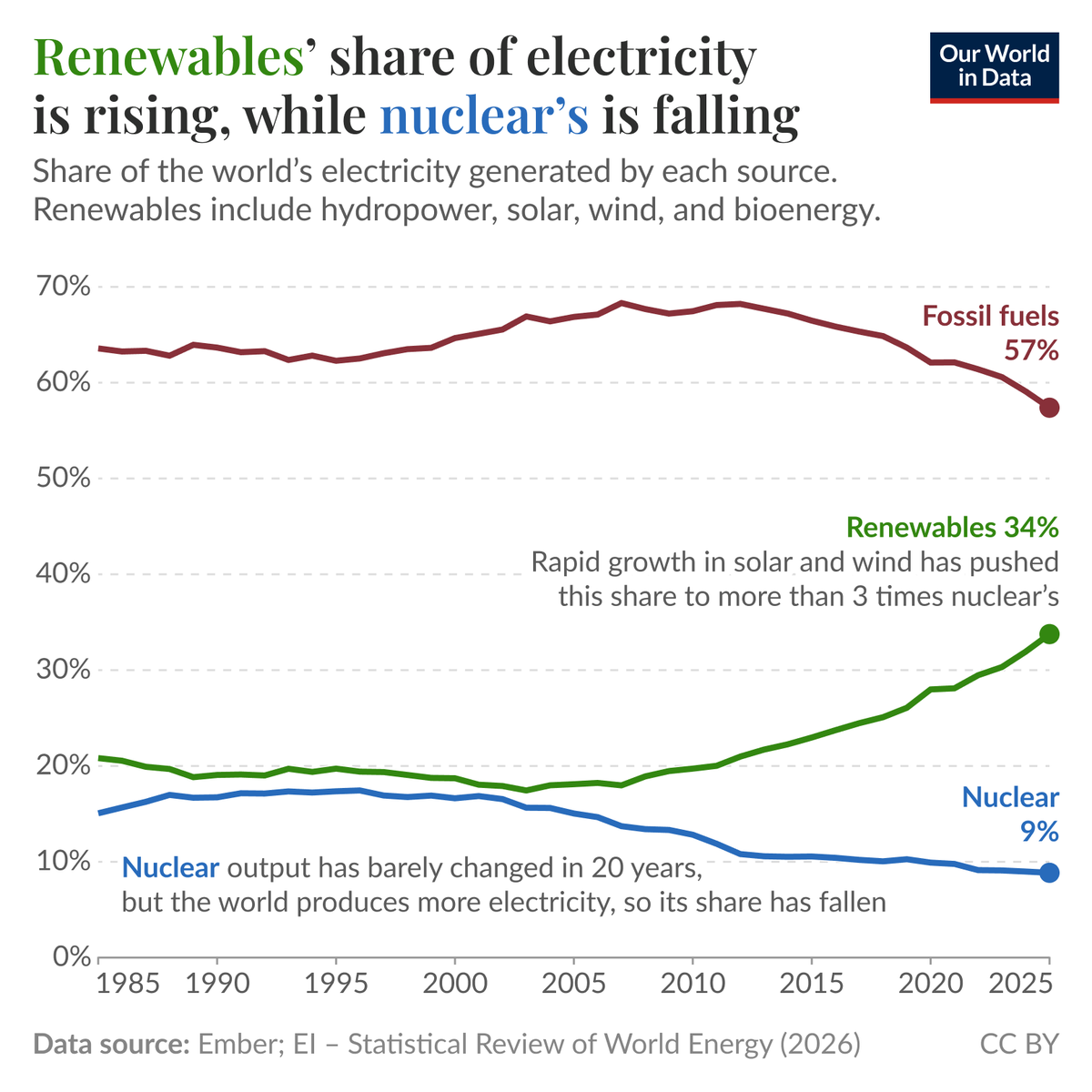
For decades the share of global electricity coming from fossil fuels was over 60% — renewables were rising, but that was offset by the decline of nuclear power.
Now this is finally changing. The share from fossil fuels is going down.
"No other country is doing more for the climate": >China’s CO2 just dropped 3.1% in Q3
>In 2025 alone it added more solar than the US has in its entire history
>Its 2026 clean-tech exports will cut a Brazil’s worth of emissions abroad and generate as much power as 100 coal plants
Yes, China still burns far too much coal. But while some lecture, China is working hard to build the exit for everyone
https://t.co/IWpFUj5cEi
The Hormuz crisis has delivered a huge shock to the energy system, dwarfing the scale of past crises
The longer it lasts, the deeper the effects. Diversification, domestically available resources & electrification = the big winners
Read @IEA's WEO 2026: https://t.co/Hf2jiaskjm
Good morning with good news: Renewables' share of global electricity surges to 50% in 2035 from 33% in 2025 reports IEA in World Energy Outlook 2026!
RE plus nuclear generate 60% by 2035.
Solar generates 20% & wind 15% by 2035.
Solar jumps 3.5 times!
https://t.co/rvE85knGyF
Good morning with good news: Solar, wind & batteries combined can provide firm service at ~10.4 cents/kWh for ~95% of demand in ~75% of the world!
Solar, wind & batteries combined provide clean, affordable, abundant electricity to the world!
Ember data: https://t.co/RPSXS5keB1
China just flew the 19-seat electric CE-25A, and regulators accepted its commercial certification bid. Electric wins every time: 90% motor efficiency vs 30% for combustion, slashing fuel costs 75%
We've wasted wasted 40 years peddling fake offsets and mythical "SAF" (<0.7% of fuel) while claiming planes can't electrify
Short-haul is 85% of all flights. With 200+ programs and state-scale airliners flying now, short-haul goes electric by the 2030s
Wires chewing pipelines, even in the sky
Tofu beats meat, fish, eggs, cheese in a comparison of 20 common protein sources!
When climate, environment, nutrition, price are all taken into account, tofu (from soy) and legumes (beans, lentils, peas) prove superior to animal-based protein sources.
https://t.co/WyLMLBN0rc
@janrosenow Agreed. Efficiency matters, electrification is key. The 61% cut in rejected energy is exactly why the 80% fossil share of primary energy misleads when assessing transition feasibility.
NEW BRIGHT SPOTS: Electrofficiency.
Swap combustion for electric technologies and the same energy services need far less energy. With clean power, wasted energy falls 61%.
The cheapest energy is the energy we stop wasting.
https://t.co/JrEoz1Vbev
Every OECD country is now past its fossil peak. Fossil fuel power is now in structural decline across all 38 OECD countries 🌍⚡
The OECD’s experience shows the blueprint of fossil power’s permanent structural retreat for leaders convening at #COP31.
https://t.co/RnXD54oCzy
Top 12 Countries by Zero-Emission Share of New City Bus Sales
1 Denmark 100%
1 Bulgaria 100%
1 Latvia 100%
1 China 100%
1 Estonia 100%
1 Slovenia 100%
7 Romania 90%+
7 Netherlands 90%
7 Belgium 90%+
7 Lithuania 90%+
7 Finland 90%
7 Luxembourg 90%
Their 560,000+ electric buses avoid over 12.6B litres of diesel/ year, saving over $16.5B at the pump today
That's 35M litres (or $45M) saved every single day
Wires chewing pipelines
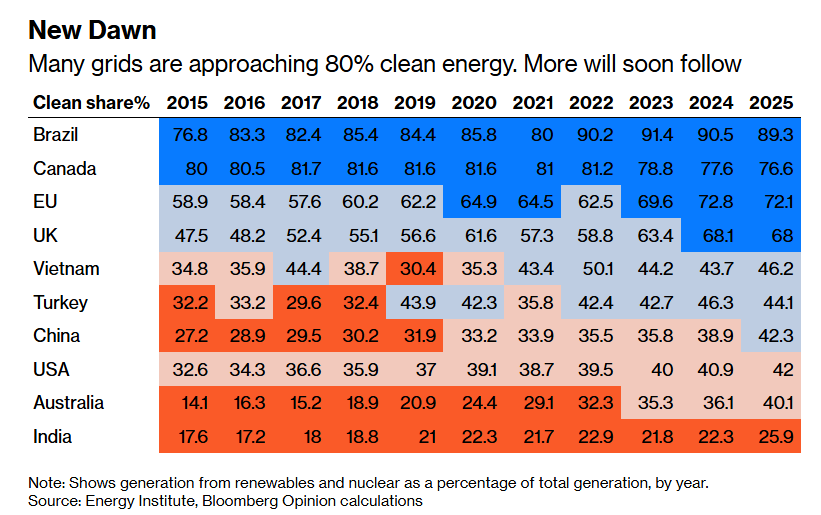
Good morning with good news: EU, UK, Australia will be 80% clean electricity by 2030!
China, Turkey & Pakistan may reach 80% by 2035.
Clean generation, with ~50% from wind & solar, generated in 2025 as much electricity as the world consumed in 1996!
https://t.co/nMMhWiDloG
Global carbon dioxide (CO2) emissions from fossil fuels are projected to fall by around 0.4% in 2026. This is based on the latest preliminary estimates from the Global Carbon Project, published today.
This is a small reduction within an overall upward trend. Emissions have grown more slowly over the past decade than in previous decades, but they have not yet peaked or begun a consistent decline.
This fall mostly came from a reduction in oil consumption and a small decline in gas. Coal use increased slightly.
Among the major emitters, emissions are projected to fall in China, the United States, the European Union, and Japan. But they’re expected to increase by around 4% in India.
Why did emissions fall? The authors cite three key factors.
The deployment of clean energy (particularly solar and wind) displaced some fossil fuel use that would have otherwise been required to meet growing energy demand. Electric vehicles also reduced oil demand. Finally, the war in Iran and its impact on oil prices led to reduced demand, which has inadvertently reduced emissions.
Emissions from land-use change are more uncertain but are projected to increase this year due to peat fires and forest degradation in Southeast Asia.
(written by @_HannahRitchie and Pablo Rosado)
COP31 wants electricity at 35% of final energy by 2035, from 23%. Four times the pace since 2010.
Twist: electric tech is so efficient that replacing fossil fuels adds less electricity than it removes.
More here: https://t.co/oEPqlaATyf
Electric public bus fleet: Latest data
>Copenhagen 100%
>The Hague: 100%
>China: 87.5% (urban)
>Santiago 65%
>Netherlands 53%
>Helsinki 52%
>London 33%
>England 12%
In 2025, 100% of new city buses in Denmark, Estonia, Bulgaria, Latvia and Slovenia were zero-emissions, and 90%+ in the Netherlands and Finland. Across the EU, it hit 60%
Diesel is being retired, rapidly