Some time ago, I had the idea to port NVIDIA Physical AI stack to AMD. The motivation was to improve hardware diversity and enable world models and VLAs to run beyond a single ecosystem.
We started with NVIDIA Cosmos Predict 2.5-2B. Porting wasn’t trivial: these models are deeply optimized for NVIDIA’s stack. We used this as an opportunity to apply our ROCm kernels.
The results were surprising:
Both encode and diffusion run faster on AMD Instinct MI300X vs. NVIDIA H200 (FA3) and we still saw significant headroom for further optimization.
Quality is unchanged across modalities (validated with WorldJen)
To be clear, this is no luck. We have deep experience with diffusion models and AMD GPUs. But this just gives us a good opportunity to get closer to a true hardware-to-hardware comparison, as we work with less software abstractions than usual. Just to give an example, on AMD, memory instructions are async with a hardware queue of ordered pending instructions, enabling concurrent load/store with compute without warp specialization. Bottom line: there are real architectural advantages on AMD, if you take the time to work with the hardware.
Note, we did tradeoff ~20% higher memory usage,
That being said, AMD has more to give to begin with :)
in the coming weeks:
AMD versions of Cosmos Transfer and GR00T, an even faster version of Cosmos Predict, and open-sourcing an attention kernel faster than AITER v3 (which is closed-source for some reason? cc: @AnushElangovan )
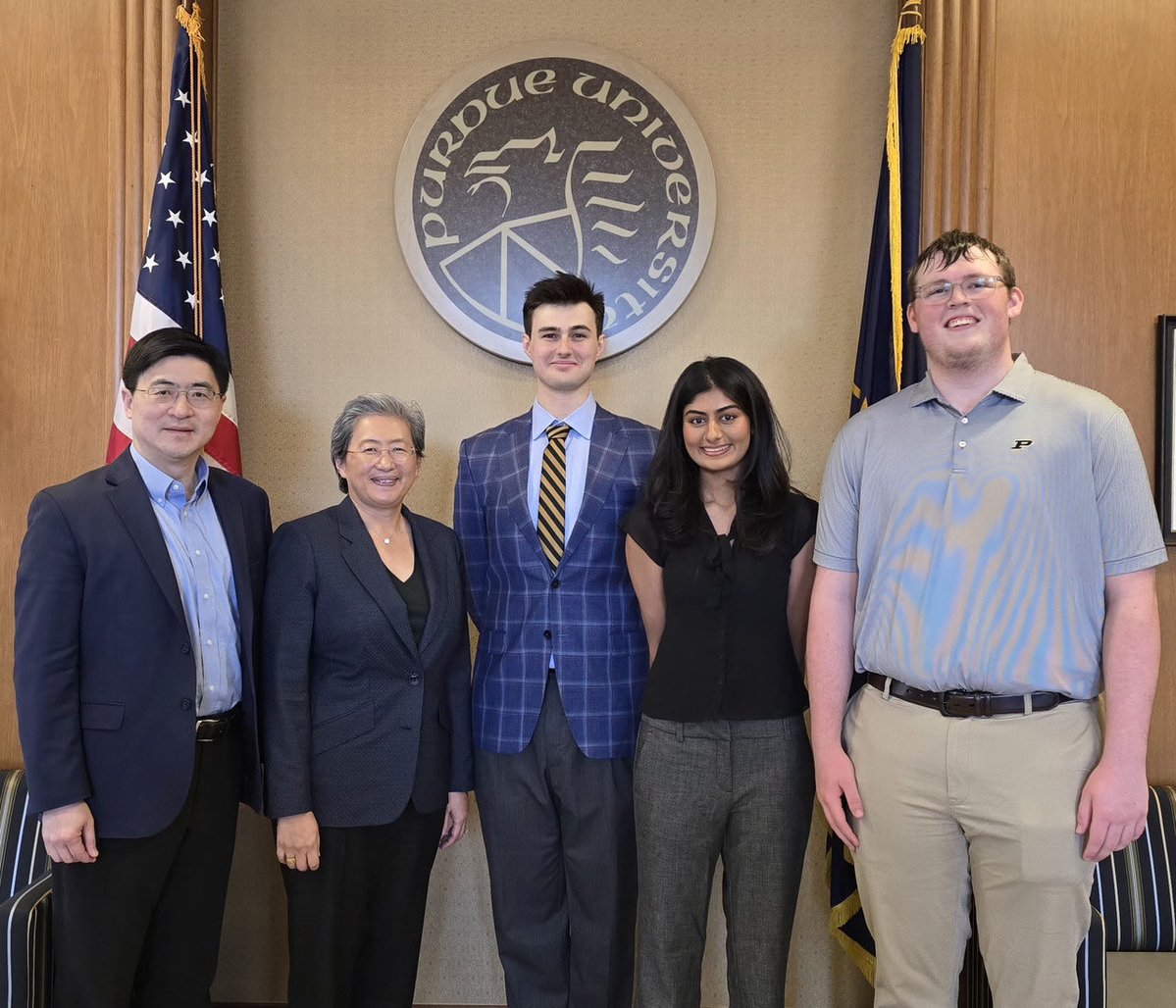
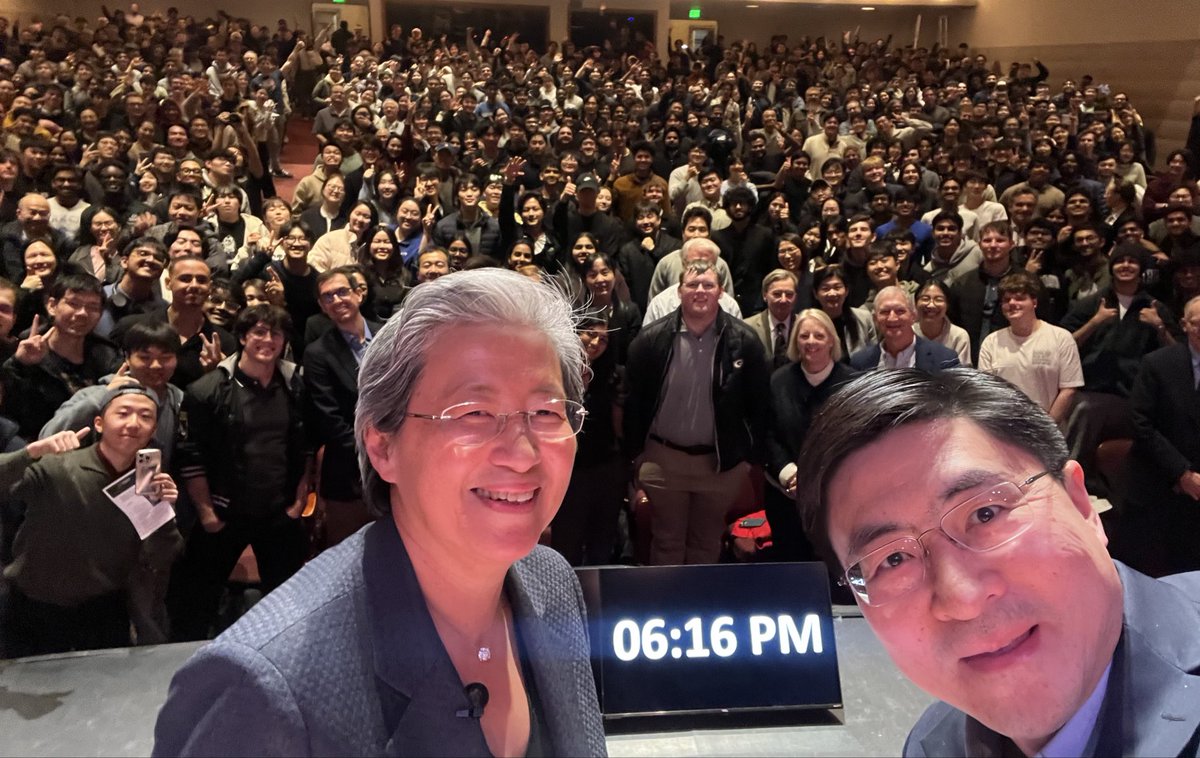
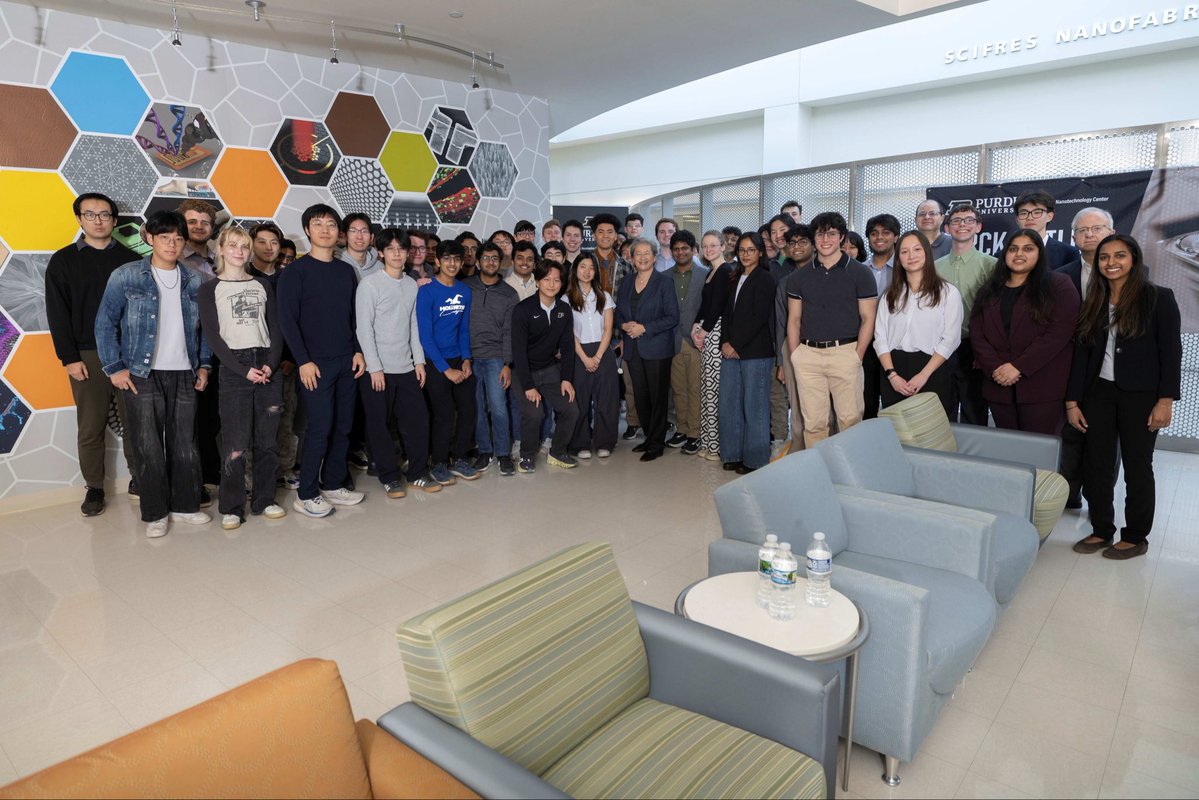
Thank you President Chiang and the entire @LifeAtPurdue community for a great visit. Loved meeting some brilliant students and spending time talking about the future of computing and AI.
Liquid is shaping up to be one of the Western labs with a serious open source lineup. Good architecture maturity, so now they'll be scaling it.
> LFM2-24B-A2B has been trained on 17T tokens so far, and pre-training is still running.
A 15-year-old girl immigrates to New Jersey from China. Doesn’t speak English. Her parents, both educated engineers back in Chengdu, are now working as cashiers and restaurant cooks. She gets a job washing dishes at a Chinese restaurant to help the family survive.
She gets into Princeton on a full scholarship. Her reaction is so disbelieving she asks two different advisors to verify the acceptance letter is real. Then her mom gets sick, so the family opens a dry cleaning shop in Parsippany. Every weekend for seven years, Fei-Fei Li leaves Princeton’s physics department to run the register, handle inspections, talk to customers, manage billing. Monday through Friday: quantum mechanics problem sets. Saturday and Sunday: sorting other people’s laundry. She later called herself the “CEO” of the dry cleaning business. She kept running it remotely through half of her PhD at Caltech.
In 2007, she proposed building an image dataset so massive her own mentor told her she’d taken the idea “way too far.” Pre-ImageNet, the entire AI field was working with datasets containing a few hundred images. She built one with 15 million. Most researchers at the time believed algorithms were the bottleneck. She bet on data when nobody else would.
By 2012, a team ran a neural network on that dataset and halved the existing error rate overnight. AlexNet on ImageNet became the moment the deep learning era started. Every computer vision product shipping today traces its lineage back to that dataset.
Fast forward to 2024. She starts World Labs. Four months in, $230 million raise, $1 billion valuation. Today, $1 billion more at roughly $5 billion.
The bet investors are making: that the woman who gave AI its eyes with 2D image recognition is about to give it spatial awareness of the 3D physical world. Her new model, Marble, generates persistent 3D environments from text or images. Unlike video generators that fake depth frame by frame, Marble creates actual geometric space where objects stay where you left them.
The investor list tells you everything. AMD and NVIDIA both wrote checks. When the two biggest competing chipmakers both fund the same startup, they’re telling you this workload is coming whether their competitor funds it or not. Autodesk put in $200 million and signed on as strategic advisor, which means they see spatial AI integrating directly into CAD and design workflows within 18 months.
From dry cleaner to ImageNet to a $5 billion spatial intelligence company. Fei-Fei Li has now placed two bets that the rest of the field thought were too early and too big. The first one created modern computer vision. The second one is trying to give machines the ability to understand physics.
If she’s right again, this is the last major unlock before embodied AI actually works.
Thanks to Matt White, Executive Director of the PyTorch Foundation, for inviting Dylan Patel to the keynote panel at the PyTorch Conference! Together, we’ll make PyTorch even better. From AMD’s massive contributions to CI and fixing unit tests, to Intel’s XPU ATen backend soon being well-maintained with unit-test parity and when AGI arrives, NVIDIA will finally fully fix and test cuDNN’s SDPA attention.
Thank you Secretary Wright for your leadership and support. We are bringing the best of AI computing to our national labs faster than ever in support of the President’s ambitious AI Action Plan. We are all-in!
Exciting day today! Thrilled to partner with @OpenAI to deploy 6GWs of AMD Instinct GPUs. The world needs more AI compute. Together, we’re bringing the best of both companies to accelerate the global AI infrastructure buildout. Thanks @sama@gdb for the trust and partnership. A true win-win for both companies!
Excited to partner with AMD to use their chips to serve our users!
This is all incremental to our work with NVIDIA (and we plan to increase our NVIDIA purchasing over time).
The world needs much more compute...
What I like most about the $AMD- @OpenAI deal are the shared incentives. The more @OpenAI buys, the higher the AMD stock price and the higher value of the warrants. OpenAI gets value from the share appreciation as do investors. AMD, AMD shareholders, OpenAI and OpenAI investors all benefit. I can see the meetings where it’s a “why don’t we deploy more AMD again”?
Wow! A 350-million-parameter AI model is performing as well as models that are 10× larger! @liquidai LFM2 is becoming a highly optimal model for edge devices, where size matters but smaller is better!
Proud to be at the White House today attending the AI Education Task Force meeting led by @FLOTUS. @AMD is proud to expand our commitment to AI Education through new AI Learning Labs and open source courses that will give students, educators and researchers hands-on experience with AI hardware and software for education, skills training and research. We are excited to do our part to train and enable the future AI workforce.
Our first shipment of MI355X racks are deployed, adding to one of the largest @AMD GPU clusters in the world. With 1GW of capacity lined up and a mission to prove there’s life beyond CUDA, we’re all-in on building the strongest AMD-first cloud.
Appreciate the spotlight @futuriom
Look what just arrived 👀
@AMD's newest Instinct Series GPU, the MI355X, has officially been delivered to our latest data center. TensorWave will be the among the first cloud providers to deploy it, bringing next-generation AI performance to builders everywhere.
Congrats @sama@OpenAI on today’s launch of gpt-oss! @AMD is proud to be a Day 0 partner enabling these models to run everywhere - across cloud, edge and clients. The power of open models is clear… and this is a big step forward.
“Our stack and models are now actively deployed on AMD.”
@aidangomez of @Cohere shares how quickly they ported their latest model, CommandA, to the AMD platform and why Instinct GPUs are now their go-to for training at scale. #AdvancingAI