ayer publicaron que pudieron factorizar rsa-896, es decir, encontraron 2 numeros primos que multiplicados dan el valor del desafío
lo hicieron con claude. la solución a estos problemas los acelera la ai porque necesitan implementar paralelismo y orquestar CPU con GPU, algo es ahora es fácil de hacer
la lista de los desafíos se publicó en 1991, hace 16 días se resolvió rsa-260 y ahora rsa-896
el numero que debería preocuparnos es rsa-1024 porque todavía se sigue usando en algunos certificados viejos y claves ssh viejas
verifique que la multiplicación da el resultado
𝗠𝗼𝘀𝘁 𝗽𝗲𝗼𝗽𝗹𝗲 𝘁𝗵𝗶𝗻𝗸 𝗔𝗜 = 𝗖𝗵𝗮𝘁𝗚𝗣𝗧.
Not even close.
ChatGPT is what you see.
The real AI revolution is the massive ecosystem being built underneath it.
This AI Stack Map captures 100+ tools powering modern AI applications.
𝗧𝗵𝗲 𝗺𝗼𝗱𝗲𝗿𝗻 𝗔𝗜 𝘀𝘁𝗮𝗰𝗸 𝗹𝗼𝗼𝗸𝘀 𝘀𝗼𝗺𝗲𝘁𝗵𝗶𝗻𝗴 𝗹𝗶𝗸𝗲 𝘁𝗵𝗶𝘀:
LLMs → OpenAI, Claude, Gemini, Llama, Mistral
Agentic AI → LangGraph, CrewAI, AutoGen, CAMEL, Agno
RAG → LangChain, LlamaIndex, Haystack, GraphRAG
Embeddings → OpenAI, Voyage, Cohere, BGE
MCP → Connecting models with tools, data and systems
AI Security → Guardrails, Presidio, Lakera, Prompt Security
Observability & Evals → LangSmith, Langfuse, Phoenix, Ragas
Memory → Redis, Mem0, Zep, Neo4j, Chroma
Agent Frameworks → OpenAI SDK, Semantic Kernel, Google ADK, Bedrock
Automation → n8n, Zapier, Make, Airflow, Prefect
Vector Databases → Pinecone, Weaviate, Qdrant, Milvus, pgvector
But here’s the part that matters more than the logos.
𝗧𝗵𝗶𝘀 𝗶𝘀 𝗻𝗼𝘁 𝗮 𝘀𝗵𝗼𝗽𝗽𝗶𝗻𝗴 𝗹𝗶𝘀𝘁.
It’s a dependency graph.
Your RAG is only as good as your retrieval + embeddings.
Your agent is only as reliable as its tools + evaluations + guardrails.
Your memory is useless if you can’t observe when context becomes stale or wrong.
Your MCP layer becomes dangerous if permissions and governance are an afterthought.
And a “best-in-class” stack can still become a terrible production system.
Why?
Because AI systems rarely fail only inside one component.
𝗧𝗵𝗲𝘆 𝗳𝗮𝗶𝗹 𝗮𝘁 𝘁𝗵𝗲 𝗵𝗮𝗻𝗱𝗼𝗳𝗳𝘀.
Model → Retrieval
Retrieval → Context
Context → Agent
Agent → Tool
Tool → Memory
Memory → Evaluation
That’s where latency compounds, context gets lost, permissions leak, hallucinations propagate and reliability starts falling apart.
𝗧𝗵𝗲 𝗿𝗲𝗮𝗹 𝗺𝗼𝗮𝘁 𝗶𝘀𝗻’𝘁 𝗵𝗮𝘃𝗶𝗻𝗴 𝗺𝗼𝗿𝗲 𝗔𝗜 𝘁𝗼𝗼𝗹𝘀.
It’s designing how they work together.
A stack map tells you 𝗪𝗛𝗔𝗧 exists.
Production engineering decides 𝗛𝗢𝗪 it all survives contact with reality.
Which tool in your AI stack has become indispensable?
Save this map for your next AI build.
Repost it for someone designing an AI architecture.
#AI #ArtificialIntelligence #GenAI
We'd have done exactly the same thing. We have spent years fighting to prove impact on almost every submission. A lot of bug bounty teams are insecure as hell, they think their job is to cover their asses and tell the bosses there was no real impact. The second you actually prove the impact is huge and critical, they start playing games: out of scope, you shouldn't have done that, etc.
Fuck all that. A real attacker doesn't give a shit about your program scope. That scope only exists to protect the bounty team.
you’re all riling up over the $6,500. that wasn’t even an issue for us.
the disclosure process itself was nightmarish, we had to get input from lawyers and eventually go to journalist
one of the worst disclosure process.
Everyone is fine-tuning LLMs. Almost nobody understands what is actually being updated inside the model.
That distinction matters because LoRA, QLoRA, LoRA-FA, VeRA, Delta-LoRA and LoRA+ are usually discussed as if they were small variations of the same method. They are not. Some reduce trainable parameters, some reduce activation memory, some reduce the memory occupied by the frozen model, and some change the way the adapter itself is optimized.
I'm actually sharing 6 techniques.
1/ LoRA
Suppose a layer contains a pretrained weight matrix W. Full fine-tuning would update W directly. LoRA leaves W frozen and represents the update using two much smaller matrices, A and B, so that ΔW = BA.
For a square d × d weight matrix, full fine-tuning has d² parameters available to update. A rank-r LoRA adapter has roughly 2dr trainable parameters instead, where r is normally much smaller than d. This is the basic reason LoRA can adapt very large models without training every parameter in them.
2/ LoRA-FA
Standard LoRA trains both A and B. LoRA-FA freezes A and trains only B.
There is a useful reason for doing this beyond simply reducing the number of trainable parameters. Computing the gradient for A requires retaining the layer input activation. If A is fixed, that gradient is no longer required, which allows LoRA-FA to reduce activation memory as the LoRA rank grows.
3/ QLoRA
QLoRA attacks a different part of the memory problem. LoRA makes the adapter small, but the frozen base model can still occupy tens of gigabytes.
QLoRA keeps the base model frozen in 4-bit form and trains LoRA adapters through it. The original work used NF4, double quantization and paged optimizers, and demonstrated fine-tuning a 65B model on a single 48GB GPU.
This is an important distinction: QLoRA is not simply "LoRA with smaller adapters." The large memory saving comes from quantizing the frozen base model.
4/ VeRA
VeRA reduces the adapter itself further. Instead of learning a separate A and B for every adapted layer, it uses frozen random low-rank matrices that can be shared across layers, while learning much smaller scaling vectors.
The low-rank basis is therefore fixed. Training mainly determines how strongly different parts of that basis should contribute. This is why VeRA can use considerably fewer trainable parameters than ordinary LoRA.
5/ Delta-LoRA
Ordinary LoRA treats W as fixed throughout training. Delta-LoRA relaxes that constraint.
A and B are still trained, but the change in their product from one training step to the next is also used to update W. The base weights can therefore move without maintaining the ordinary gradients and optimizer states that full fine-tuning would require for W.
6/ LoRA+
LoRA+ does not introduce another adapter structure. It keeps W frozen and still trains A and B.
Its change is in the optimizer: A and B use different learning rates, with B receiving a larger rate. The motivation is that the two LoRA matrices do not behave identically during optimization, so forcing them to use the same learning rate is not necessarily the best choice.
Once these are separated by what they actually change, the family becomes much easier to understand.
LoRA reduces the number of weights being trained. LoRA-FA also targets activation memory. QLoRA compresses the frozen base model. VeRA reduces the learned adapter parameters further. Delta-LoRA allows the pretrained weights themselves to evolve through low-rank changes, while LoRA+ keeps the LoRA structure and changes its optimization.
That is really what PEFT is about => deciding which parts of a very large model actually need to move during adaptation, and which parts can remain fixed.
I accidentally rebooted the network switch for the entire third floor.
Internet disappeared.
Phones dropped.
About 70 employees immediately stood up from their desks like prairie dogs.
I had two choices:
Admit I clicked the wrong switch.
Become proactive.
I sent this message:
“Unannounced infrastructure resilience exercise currently in progress. Please continue normal operations.”
Then I waited five minutes and turned everything back on.
Service restored.
No data loss.
Nobody died.
The CTO replied:
“Love that we’re testing this stuff proactively.”
So I wrote a post-exercise report.
Objective: Validate employee response to unexpected connectivity loss.
Result: Successful.
Finding: Employees become extremely loud after approximately 12 seconds without internet.
Recommendation: Continue resilience testing quarterly.
My mistake now has a budget.
Politico has posted a long article about the Fable drama, aka Anthropic vs The White House, it's a good read if you are interested in the events that took place during the negotiations.
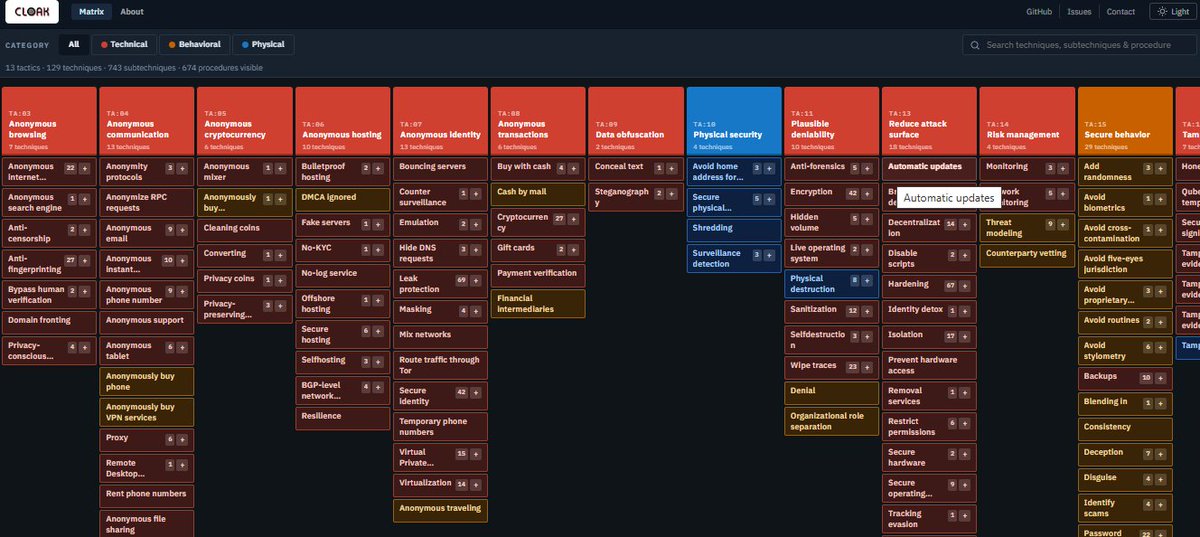
Si haces Threat Intelligence o ciberseguridad defensiva, tienes que guardar esto ahora mismo.
Crearon CLOAK, un framework al estilo MITRE ATT&CK pero enfocado 100% en las tácticas de ocultación y evasión de los cibercriminales.
🔍 ¿Qué incluye? • 1,387 TTPs documentados. • Capas técnicas, comportamentales y físicas. • 100% Open source y actualizado este 2026.
Entender cómo se esconden los atacantes es la única forma de encontrarlos antes de que sea tarde.
Te dejo la plataforma interactiva y los detalles abajo en los comentarios 🛡️👇
The "cybersecurity" community has developed core principles over the last 40 years encouraging openness and opposing control and retaliation.
OpenAI and Anthropic insist that we need to discard 40 years of these lessons and do the opposite.
This is important because the cornerstone of their doomerism scenarios is rogue AI hacking the Internet. The one thing we need to stop rogue AI hacking is the thing they are trying to destroy.