@Cryptoinsightuk are the last couple (Permission Delegation and Batch) enabling Financial Institutions to use XRPL at scale or some amendements are still required for the real show? (e.g. ConfidentialTransfer XLS-96;
SingleAssetVault XLS-65 & LendingProtocol + LendingProtocolV1_1 XLS-66)
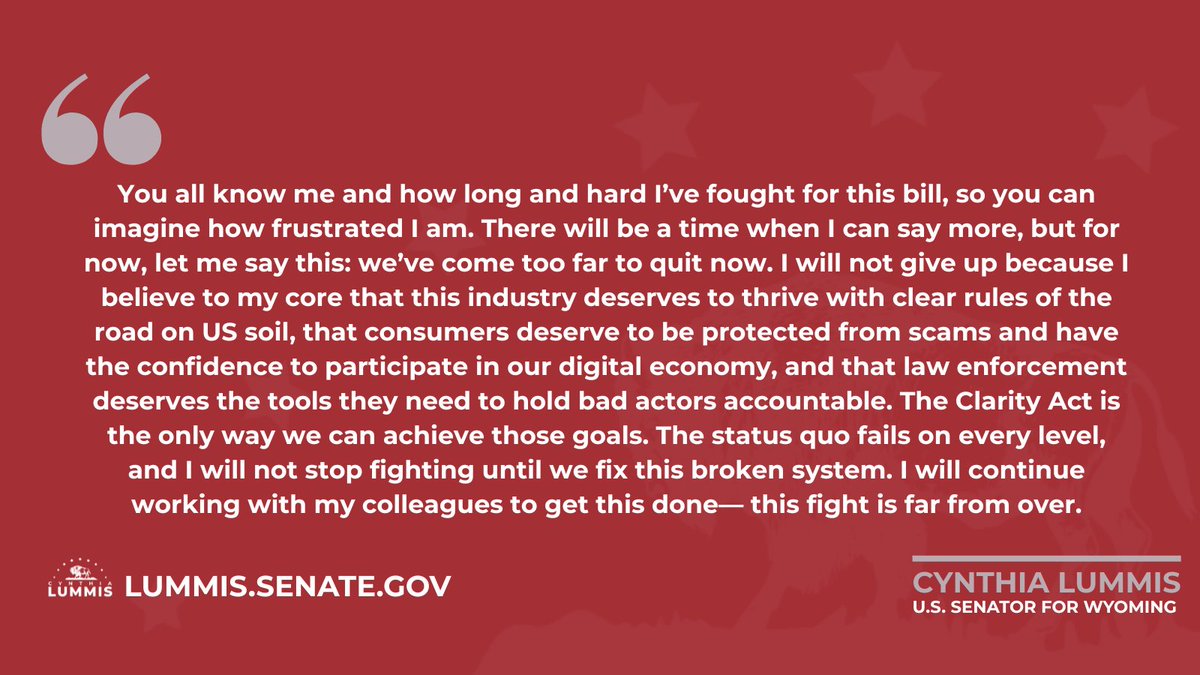
My thanks go to everyone who put so much effort into the CLARITY Act— across the Administration, Congress, investors, and innovators. Our collective conviction that America must continue to lead is indispensable.
I have been unequivocal: with or without legislation, we will act decisively within the SEC’s statutory authority to deliver certainty for American investors and for the entrepreneurs shaping our technological future.
Stay tuned.
Great to be back at the White House today alongside @realDonaldTrump, @SECPaulSAtkins, @ChairmanSelig and leaders across the crypto industry.
The big picture has never been clearer: 67 million Americans hold crypto today (that’s nearly 1 in 4!). Crypto isn't a fringe industry. And Washington DC knows the crypto voter is alive and well.
This President's incredible commitment to innovation and leadership around digital assets in the US has been profound. The future is bright.
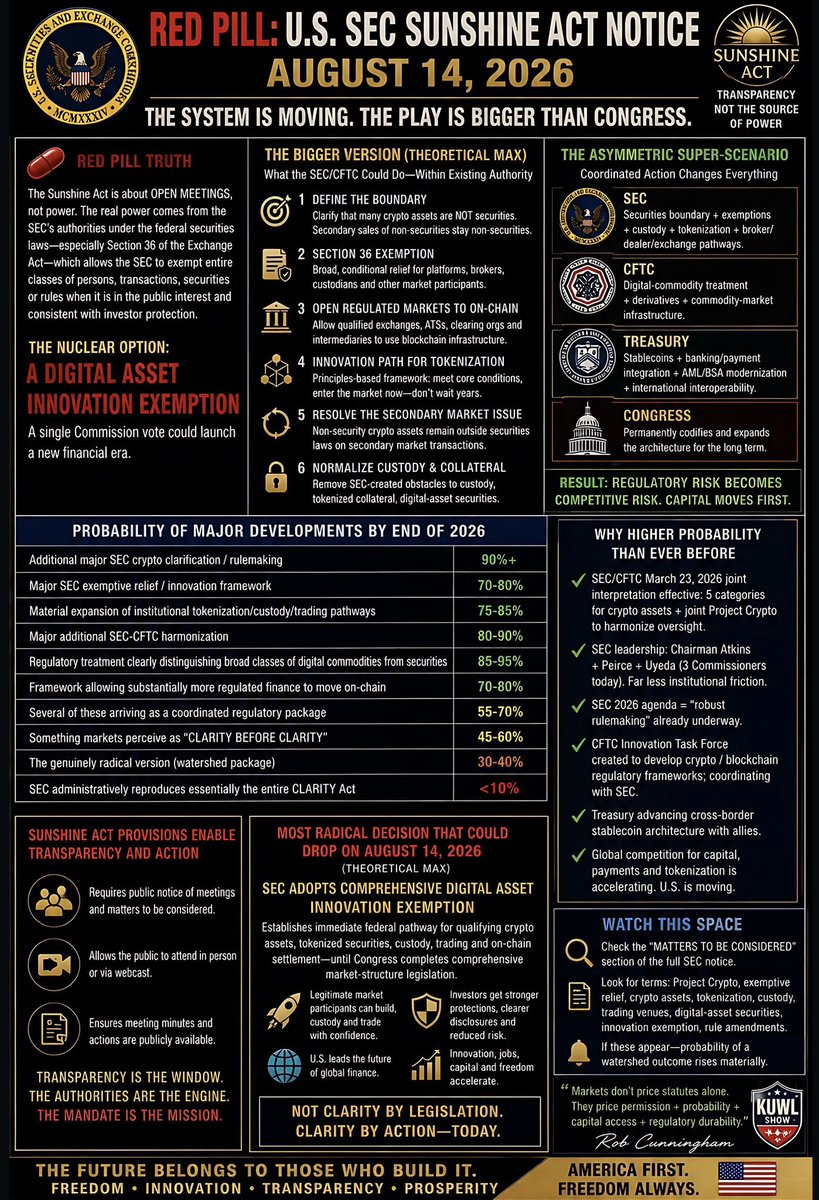
The SEC’s Nuclear Option: A Commission-wide Digital-Asset Safe Harbor on August 14, 2026?
Section 36 of the Securities Exchange Act gives the SEC remarkably broad exemptive authority.
The SEC itself describes it this way:
“…the Commission may, by rule, regulation, or order, conditionally or unconditionally exempt persons, transactions, securities - or entire classes of them - from provisions of the Exchange Act or its rules, provided the exemption is in the public interest and consistent with investor protection.”
Imagine the Commission voting August 14 for a sweeping Digital Asset Market Transition / Innovation Exemption establishing something like:
Until Congress completes comprehensive market-structure legislation, qualifying decentralized digital assets and qualifying transactions involving them may operate under a defined federal safe harbor and tailored securities-market framework, rather than being forced through securities rules designed for conventional issuers and intermediaries.
That would not literally enact the CLARITY Act. The SEC cannot legislate the CFTC into possessing powers Congress has not granted it, rewrite statutes, or enact CLARITY by administrative vote.
But within the SEC’s own statutory jurisdiction, it could potentially accomplish something economically similar in important areas.
And there is precedent for thinking in exactly this direction. The SEC has already been actively exercising Section 36 authority in 2026, including conditional exemptions from Exchange Act requirements.
Now take that concept to its theoretical maximum.
The Commission could combine several actions into one enormous regulatory package:
1 Define the securities boundary much more sharply.
2 Establish that numerous crypto assets are not themselves securities merely because they previously were sold in an investment-contract transaction. The SEC has already issued a March 2026 Commission interpretation specifically addressing how federal securities laws apply to different types of crypto assets and crypto transactions.
3 Create a broad Section 36 transitional exemption.
Exchanges, broker-dealers, ATSs, custodians and other regulated entities could receive conditional relief allowing them to interact with qualifying digital assets and blockchain infrastructure without every legacy securities-market requirement mechanically applying.
4 Open regulated securities markets to on-chain infrastructure.
The really radical version would permit qualifying broker-dealers, exchanges, clearing organizations and other intermediaries to integrate tokenized securities, blockchain settlement and digital assets under specified conditions.
5 Create an innovation exemption for tokenization.
Instead of requiring every novel DLT architecture to wait years for bespoke regulatory accommodation, establish a principles-based pathway: meet custody, disclosure, anti-fraud, capital, cybersecurity and investor-protection conditions and enter the regulated marketplace now.
6 Resolve the secondary-market problem.
The Commission could make unmistakably clear that secondary transactions in qualifying non-security crypto assets don’t somehow become securities transactions merely because an asset once figured in somebody else’s securities offering.
7 Normalize regulated custody and collateral treatment.
A coordinated package could remove major SEC-created obstacles to broker-dealer custody, tokenized collateral, digital-asset securities and institutional participation.
@SECGov@CFTC@USTreasury@fairshake@POTUS@SECPaulSAtkins@Ripple
Ripple has quietly attacked the hardest adoption problem.
What Ripple has assembled is an institutional value operating system - with XRP positioned between corporate treasury, institutional markets, payments, liquidity, collateral and tokenized assets
The biggest barrier to institutional blockchain adoption was arguably never blockchain throughput
It was workflow integration
CFOs don’t want another dashboard
Controllers don’t want another reconciliation process
Treasurers don’t want another liquidity silo
Risk officers don’t want invisible positions
Auditors don’t want unexplained wallet activity
Boards don’t want uncontrolled infrastructure
Ripple’s new architecture attacks exactly those problems
Digital-asset transactions inside Ripple Treasury can carry native notional amounts, fiat equivalents and contemporaneous exchange rates, while balances can be tracked to 15 decimal places. Ripple describes digital assets as operating under essentially the same treasury-account structure and audit discipline as traditional cash
That changes the institutional conversation from:
“How can our company experiment with XRP?”
to something much more mundane—and therefore potentially much more powerful:
“Which treasury transactions should use XRP?”
That is how infrastructure adoption happens
Now connect the two ends of Ripple’s architecture
Think of Ripple Treasury and Ripple Prime as two enormous institutional doors opening toward the same digital-asset economy
Ripple Treasury sits on the corporate side
Cash management
→ liquidity forecasting
→ corporate working capital
→ bank accounts
→ payments
→ FX exposure
→ digital assets
→ XRP/RLUSD
→ tokenized assets
Ripple explicitly describes the platform as allowing corporate treasury to “see, earn on, and move value across traditional and blockchain rails” without replacing existing controls and workflows. Its cross-border functionality can convert fiat into a digital asset, move value across borders and convert it back into destination fiat
Ripple Prime sits on the capital-markets side
Institutional trading
→ OTC markets
→ digital assets
→ FX
�� derivatives
→ repo
→ financing
→ cross-margining
→ collateral
→ custody
Ripple Prime already clears more than $3 trillion annually for 300+ institutional customers across digital assets, FX, precious metals, exchange-traded derivatives, OTC swaps and fixed-income repo
And XRP can exist within both worlds
That is the architectural breakthrough
XRP becomes connective tissue rather than merely an investment
Consider a multinational corporation with $5 billion distributed among dozens of subsidiaries, currencies and jurisdictions.
Traditionally, its treasury operation is essentially managing islands of value:
USD here.
EUR there.
JPY somewhere else.
Receivables somewhere else.
Collateral somewhere else.
Money-market investments elsewhere.
Correspondent-bank balances elsewhere.
And increasingly tokenized assets somewhere else.
Ripple Treasury begins collapsing those islands into a common management environment. Ripple says its digital-asset capability gives CFOs a single system for fiat and digital liquidity while preserving existing workflows, approval processes and audit trails.
Now introduce XRP.
XRP doesn’t necessarily need to replace those assets
It can connect them.
That distinction is fundamental.
The most consequential XRP thesis isn’t:
XRP becomes everybody’s money
It is:
XRP becomes infrastructure through which everybody’s money can move
That is a much larger addressable role.
And this creates a remarkable corporate liquidity loop:
Corporate Cash
↓
Ripple Treasury
↓
USD / EUR / JPY / GBP / etc.
↕
XRP / RLUSD / Digital Assets
↕
XRPL / Digital-Asset Infrastructure
↕
Payments • FX • Liquidity • Tokenized Assets
↕
Ripple Prime
↕
Institutional Liquidity • OTC Markets • Financing • Margin • Repo
↓
Global Capital Markets
This is how XRP becomes interesting.
@Ripple Works.
🚨Good Evening Beautiful Souls…We Have A Clarity Update🚨
Clarity is now being billed as a security risk to our country. This is beautiful and exactly what we need. The senators are now forced to vote…
It’s no longer are you pro or con crypto. It’s now are you pro or con America and its security.
Tuesday September 15 Clarity Voting
Tuesday November 3 Midterm Voting
Very smart of whoever postponed the voting. It pretty much ensures a passing. Senators will continue to get bombarded with phone calls and emails. A wrong vote on clarity can potentially get them out of office considering 1/3 of Americans hold crypto.
🇺🇸 JUST IN: THE SENATE OFFICIALLY POSTPONES VOTE ON CRYPTO CLARITY ACT UNTIL AFTER SUMMER RECESS! ⏰
THIS IS THE LIST OF SENATORS OPPOSING THE CLARITY ACT 👇🏼
VOTE THEM OUT‼️
The incumbent Democrat Senators who: (a) opposed the Clarity Act; and (b) are running for re-election THIS YEAR are:
Markey (Mass.)
Hickenlooper (Colorado)
Coons (Delaware)
Ossoff (Georgia)
Booker (NJ)
Lujan (NM)
Merkley (Oregon)
Reed (Rhode Island)
Warner (Virginia)
A @WSJopinion piece this week referred to supporters of crypto regulation as "the crypto boys." But that's not who the crypto community is.
There are 67 million Americans who own crypto today. One-third are women. More are over 55 than under 25 years old. They're teachers, construction workers, veterans, nurses, parents, and small business owners.
🚨XRP Public Service Announcement🚨
This has been a very frustrating waiting game for all of us. I’m just as frustrated. Summer 2025 was suppose to have been the crypto millionaire season but politics had a different plan.
We are watching a political tug of war BUT it’s all BS. Don’t be fooled. The war is over and Clarity has to get passed. Republican or Democrat…each party is one wing of the same bird 🦅 That bird being The USA.
The handlers, bankers and head honchos are now calling for clarity. They control the politicians. Someone like Warren will continue to pretend and will vote no to keep the fake persona going. Others will flip yes. The USA will not allow their technology to be controlled by Russia or China.
Just stick to what I’m saying. I know more than what I can say. But you will be happy. DO NOT give up now. The feeling will suck. I lost out on the Dot Com and on BTC. I had both in the palm of my hand and never invested. I will NOT lose with XRP 💪💪💪
Stay strong. It won’t take much to make you a XRP millionaire. I’m referencing XRP in particular and not all crypto. It won’t take much XRP to give you financial freedom.
STAY STRONG. WE ARE THERE 🚀🚀🚀
All Glory to Jesus.
There's a growing pro-crypto voter movement. We don't care what party you're in.
To the Senators blocking Clarity: we'll remember in November and in 2028. There are no "anti-crypto voters" coming to save you.
Demand your Senator pass Clarity NOW.
https://t.co/GzHabguvh1
I’m done hearing politicians say they’re pro-crypto.
Bring the CLARITY Act to the floor.
Let every member vote.
Then the 60+ million Americans who own crypto can decide who’s really with this industry and who’s not.