Don’t show to kids #YouTube AI-generated content… 😖
#GenerativeAI is undoubtedly great as all disruptive inventions but we must use it for #goodness . Also a call for regulated governance of generativeAI is more important than ever, along with a #socialmedia act
AI is indeed polluting the Internet.
This is a true tragedy of the commons, and everyone is defecting. We need a Clean Internet Act.
The Internet is turning into a toxic landfill of a dark forest, and it will only get worse once the invasive fauna starts becoming predatory.
FLI's AI & National Security Lead @hamzataq spoke to @shaneharris@TheAtlantic about a recent White House memo "intended to 'accelerate the use of AI across intelligence and warfighting domains in line with American values'", and what it means when a model such as Claude shares misgivings about its use in the military domain.
"Claude's expressed misgivings seem exactly like the kind of constraint the memo is designed to override," said Hamza. He said that the conversation in which Claude expressed hesitation "should be seen in the context of Anthropic’s dispute with the Pentagon over guardrails on AI", and that the administration was right to insist that no single company or model should decide how AI is used in war.
However, as Hamza notes, the White House memo "treats Claude's trained ethical reasoning, when it surfaces in deployment, as a vendor liability rather than a safety asset."
Full article 🔗👇
"We cannot consider AI to be morally neutral."
Pope Leo XIV says every AI system reflects human choices through what it measures, ignores and prioritises making ethics central to how these technologies are designed.
🔴More on https://t.co/OCIH7J4Zwl
As with fat tails Llms are frequency machines that fail to extrapolate outside the sample set. What they know is the VISIBLE.
Almost as bad as economists, almost worse than psychologists.
Although Pope Leo XIV's encyclical doesn't explicitly mention the superintelligence that AI companies say they're racing toward, its opposition to it in favor of controllable AI tools is clear: 'Humanity — in all its grandeur and woundedness — must never be replaced or surpassed.'
https://t.co/Fnoa5ZTWDi
"In a time when AI presently risks diminishing our personal agency, and opens up further risks to humanity as a whole, it is helpful to be reminded of the distinctive goodness of being human."
🔗 What to expect from @Pontifex's encyclical on AI, to be released Monday: https://t.co/gnyBku342A
An OpenAI model just produced original research a Fields Medalist says he'd publish in Annals of Mathematics "without any hesitation."
If a general-purpose AI is doing the top 0.01% of cognitive work, what jobs are actually safe?
Besides, AI is not JUST coming for your job.
Pause frontier AI. ⏸
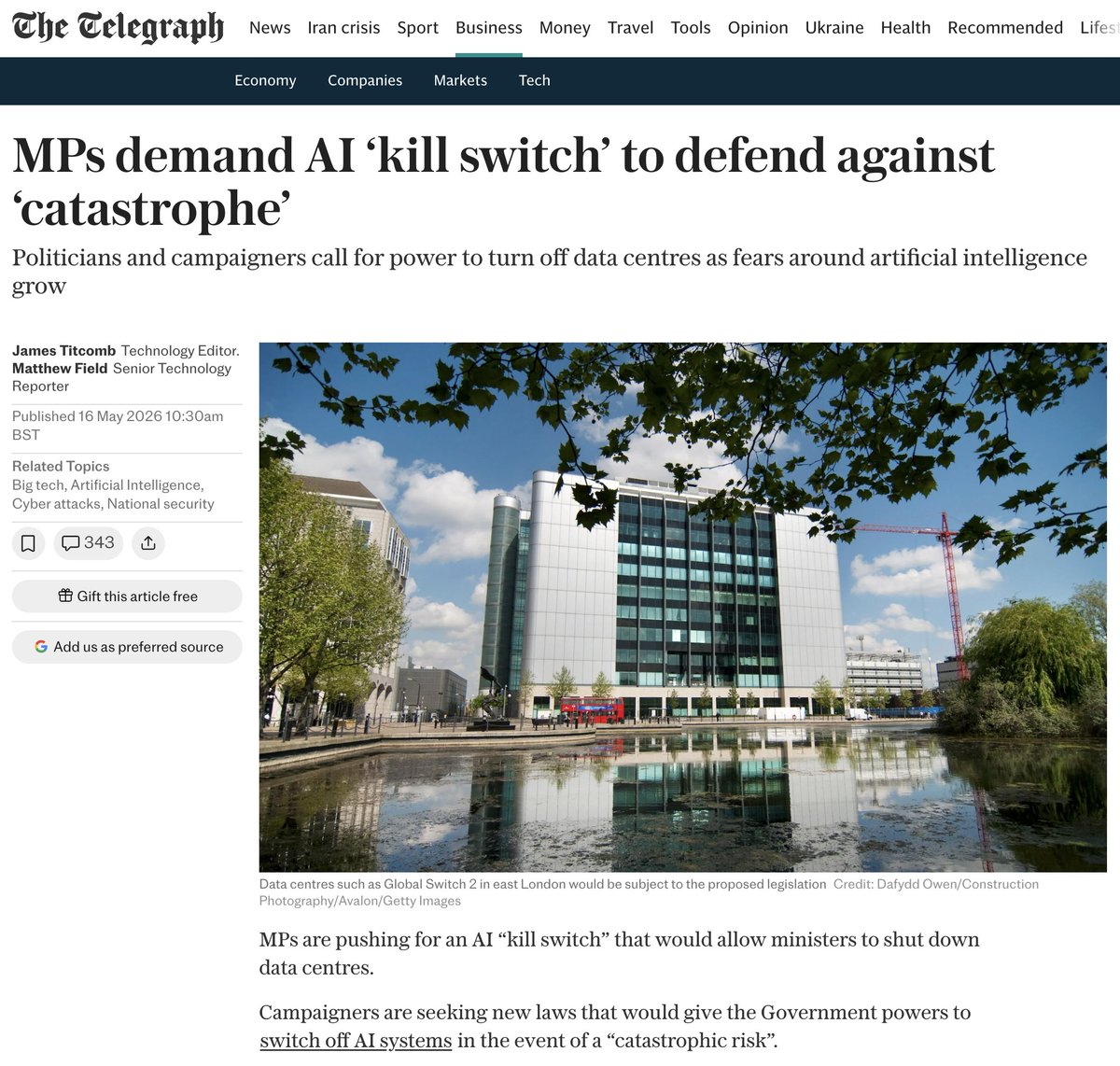
Great article in the @Telegraph on Alex Sobel MP's AI kill-switch amendment: the UK's first-ever legislative proposal on superintelligent AI!
The amendment would give government the power to shut down data centres in an AI security emergency, and has now been sponsored by 11 cross-party MPs.
It specifies possible causes of such an emergency as including adversarial use by state actors, autonomous cyberattacks, and superintelligent AI escaping human oversight.
Tabled just before Anthropic announced Mythos, an AI the company says is too dangerous to release due to its advanced cyberhacking capabilities, this amendment to the Cyber Security and Resilience Bill shows exactly the foresight we need to tackle this issue.
Comparing uncontrolled superintelligence to a nuclear strike, Alex Sobel tells the Telegraph: "This is not only a paradigm shift for cybersecurity, but for the national security risks that AI poses for our critical infrastructure. And the UK is nowhere near ready to respond ... Co-ordinated cyberattacks on our critical infrastructure pose a serious threat, and superintelligent AI operating beyond human control could rival a nuclear strike in the harm it inflicts. The gap between these threats and our preparedness is untenable."
At ControlAI, we're proud to have worked with @alexsobel on this and to have him as one of the 100+ UK parliamentary supporters of our campaign!
A reminder that pirates and buccaneers used to kidnap people in international waters & sell them for slavery. Here Israel humiliates them in addition.
As evidenced by the unbridled promotion and implementation of technology at the expense of human dignity, we are truly experiencing an eclipse of the sense of what it means to be human. It is imperative to recover an understanding of the true meaning and grandeur of humanity as intended by God. It is in this sense that the challenge we currently face is not technological, but anthropological, and it is my hope that the Encyclical Letter to be published within a few days will contribute to answering this challenge.
Forza.
Il genocidio continua.
Bisogna bloccare i canali di complicità: Stop ai traffici militari, commerciali e finanziari con l'Apartheid israeliana.
Questa obbedienza civile è richiesta dal diritto internazionale e dal nostro essere parte della famiglia umana.
"[The Church] was one of many institutions to decide early on that human cloning was beyond the pale... Twenty years later, the resulting taboo has largely restrained governments, entrepreneurs, and scientists. Something similar could, and should, be achieved with superintelligence."
New in @compactmag from FLI's @willjmjones:
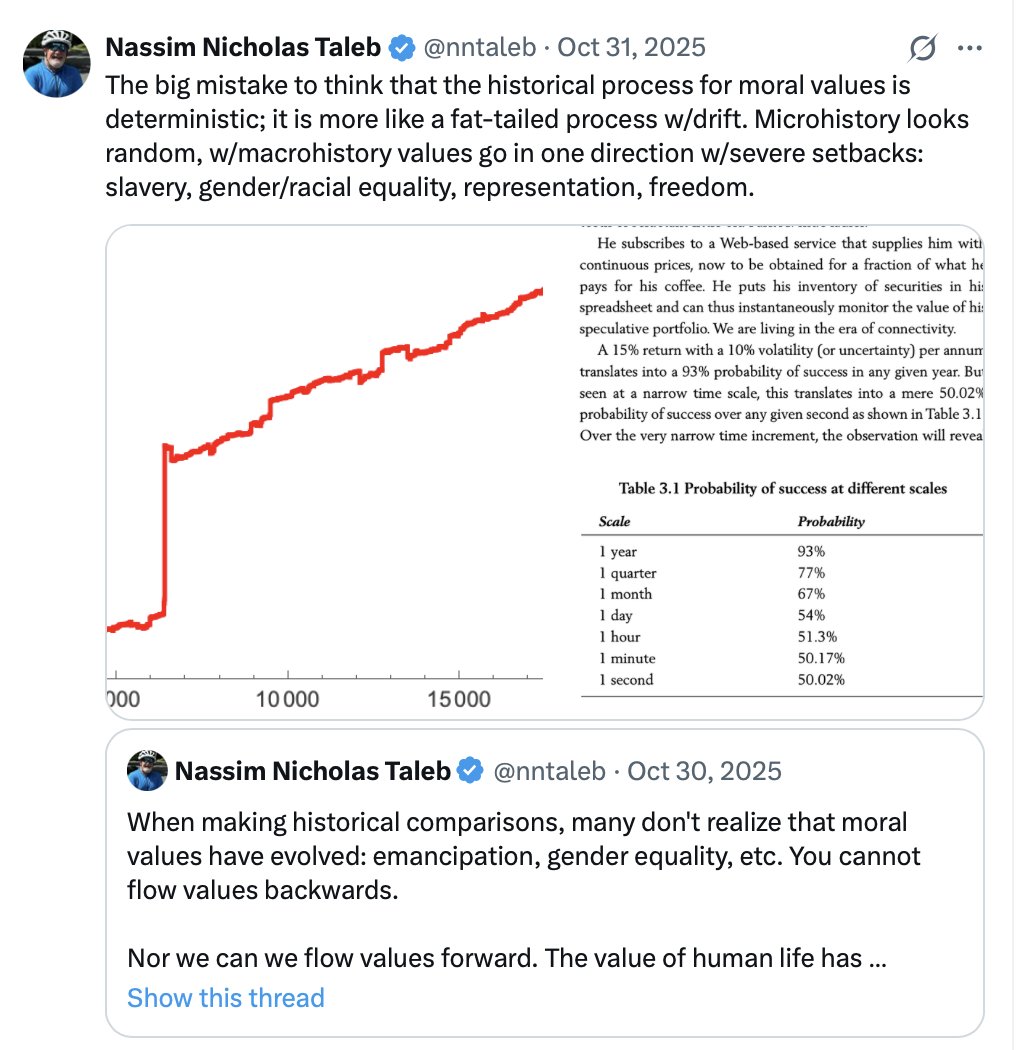
I felt sooooooo much better with Albanese's announcement: we don't live in a world going backwards. We did not undo centuries of improvement in legal integrity by reinstating witness intimidation, politicized courts, etc.
Trump & Israel are just downticks in an uptrending market.
IN PRAISE OF FRANCESCA ALBANESE
There is a question that visits me in the small hours, when sleep will not come and the mind turns over old stones. The question is this: “What would I have done in the 1930s, on the morning after Kristallnacht?"
Not what I say I would have done. Not what I hope I would have done. But what would I actually have done—when the trains began to run, when the neighbours grew quiet, when the cost of decency became the loss of everything?
Most of us, I think, would have done little. Not from malice. From fear. From the soft, creeping conviction that someone else will speak, that the situation is complex, that we must be 'reasonable'. Lest we forget, the ordinary is the extraordinary's alibi. And how we have clung to that alibi! How we still cling to it!
And then, every once in a terrible while, someone appears who does not cling. Someone who steps forward when others step back. Someone who speaks the name of the thing when everyone else is busy naming something else.
Francesca Albanese is that someone.
She stands before the world—alone, unarmed, armed only with law and language and a rare courage—and she says what the centrists will not say, what the foreign ministries will not say, what the editorial boards will not say. She says: "This is a genocide. And we are watching it happen."
Do not tell me that is hyperbole. Do not tell me the term is contested. She has not used it lightly. She has used it as a physician arrives scientifically at a diagnosis—not to wound, but to warn. Not to inflame, but to name.
And for that, they have come for her. Oh, how they have come for her. Smears. Investigations. Vicious editorials. Frozen bank accounts. Dispossession of the only apartment she had ever owned. The machinery of the respectable turned to crush her. Because the respectable cannot abide what she represents: a mirror held up to their complicity.
Let us, once again, travel back to the 1930s. Back to the few who stood up when the trains began to run laden with Jewish people.
There was Aristides de Sousa Mendes, a Portuguese consul in Bordeaux. He defied his own government. He signed thousands of visas, by hand, for hours, until his fingers bled. He saved more lives than Schindler. And he died penniless, disgraced, erased.
There was a German officer in Warsaw named Wilm Hosenfeld. He hid a Jewish pianist in the rubble. He did not save thousands. He saved one. But that one—Władysław Szpilman—carried the memory. And memory is "the only haven from which we cannot be expelled."
There was Raoul Wallenberg. There were the villagers of Le Chambon. There were the anonymous, the quiet, the furious few who said: “Not on my watch.”
Francesca Albanese is their heir. Not because she carries a gun. Not because she hides refugees in her basement. But because she does something equally dangerous in a world that has perfected the art of not seeing. She sees. And she speaks.
She does not speak as a diplomat. Thank Goodness she doesn't! Diplomats have given us the language of "there are arguments on both sides" and "restraint" and "proportionality." Diplomatic language is the perfumed grave of moral clarity. No, she speaks as a jurist. As a human being. As a woman who has looked into the abyss and refused to call it a "complex geopolitical landscape".
Edna O'Brien once described a character who "had the recklessness of those who have already lost everything worth losing." Francesca Albanese has not lost everything. She has her dignity, her office, her voice, her family. But she has calculated the cost of speaking truth to power. And she has decided that that cost is infinitely less than the cost of silence.
What is that cost? Let us name it. She has been called antisemitic—she, who stands on the ground of international law forged in the ashes of Auschwitz and the fires of Nuremberg. She has been called a conspiracy theorist—she, who cites every source, every footnote, every UN resolution. She has been called naive—she, who understands better than most the machinery of realpolitik.
These accusations are not arguments. They are the spittle of the threatened. Because Francesca Albanese threatens something very precious to the powerful: the right to commit atrocity without being named.
Friends, the 1930s did not arrive with jackboots and pogroms on day one. They arrived in small increments. With "reasonable" restrictions. With "proportional" measures. With the silence of the respectable.
We tell ourselves that we would have been different. That we would have been Sousa Mendes. That we would have been Wallenberg. But most of us, I fear, would have been the neighbours who later said, "I didn't know."
Francesca Albanese knows. And she refuses to pretend otherwise.
So let us praise her. Not with statues or awards she does not seek. But with something harder: with our own refusal to look away. With our own voices, raised in places that are safe for us but dangerous for her. With our own bodies, if it comes to that.
A brave woman, who was injured while demonstrating outside a US nuclear military base in 1982, the infamous Greenham Common, had told me that "the heart is a hunter for what it cannot have." But I say the heart is a hunter for what it will not lose. And what we will not lose is the memory of those who stood up when standing up cost everything.
Francesca Albanese is standing up now. In our time. In our name. Under our indifferent sky.
Let us stand with her.
Not tomorrow. Not when it is safe. Now.
[Extract from a speech in Athens on Sunday 3rd May 2026]
If the world’s leading scientists say there’s even a 10% chance humanity could be destroyed because of uncontrolled AI, shouldn’t we do everything possible to prevent it?
This isn’t about competition with China. It's about coming together to prevent what might be a catastrophe.


![FLI_org's tweet photo. "[The Church] was one of many institutions to decide early on that human cloning was beyond the pale... Twenty years later, the resulting taboo has largely restrained governments, entrepreneurs, and scientists. Something similar could, and should, be achieved with superintelligence."
New in @compactmag from FLI's @willjmjones:](https://pbs.twimg.com/media/HIncZM4WsAA-r3T.jpg)
![yanisvaroufakis's tweet photo. IN PRAISE OF FRANCESCA ALBANESE
There is a question that visits me in the small hours, when sleep will not come and the mind turns over old stones. The question is this: “What would I have done in the 1930s, on the morning after Kristallnacht?"
Not what I say I would have done. Not what I hope I would have done. But what would I actually have done—when the trains began to run, when the neighbours grew quiet, when the cost of decency became the loss of everything?
Most of us, I think, would have done little. Not from malice. From fear. From the soft, creeping conviction that someone else will speak, that the situation is complex, that we must be 'reasonable'. Lest we forget, the ordinary is the extraordinary's alibi. And how we have clung to that alibi! How we still cling to it!
And then, every once in a terrible while, someone appears who does not cling. Someone who steps forward when others step back. Someone who speaks the name of the thing when everyone else is busy naming something else.
Francesca Albanese is that someone.
She stands before the world—alone, unarmed, armed only with law and language and a rare courage—and she says what the centrists will not say, what the foreign ministries will not say, what the editorial boards will not say. She says: "This is a genocide. And we are watching it happen."
Do not tell me that is hyperbole. Do not tell me the term is contested. She has not used it lightly. She has used it as a physician arrives scientifically at a diagnosis—not to wound, but to warn. Not to inflame, but to name.
And for that, they have come for her. Oh, how they have come for her. Smears. Investigations. Vicious editorials. Frozen bank accounts. Dispossession of the only apartment she had ever owned. The machinery of the respectable turned to crush her. Because the respectable cannot abide what she represents: a mirror held up to their complicity.
Let us, once again, travel back to the 1930s. Back to the few who stood up when the trains began to run laden with Jewish people.
There was Aristides de Sousa Mendes, a Portuguese consul in Bordeaux. He defied his own government. He signed thousands of visas, by hand, for hours, until his fingers bled. He saved more lives than Schindler. And he died penniless, disgraced, erased.
There was a German officer in Warsaw named Wilm Hosenfeld. He hid a Jewish pianist in the rubble. He did not save thousands. He saved one. But that one—Władysław Szpilman—carried the memory. And memory is "the only haven from which we cannot be expelled."
There was Raoul Wallenberg. There were the villagers of Le Chambon. There were the anonymous, the quiet, the furious few who said: “Not on my watch.”
Francesca Albanese is their heir. Not because she carries a gun. Not because she hides refugees in her basement. But because she does something equally dangerous in a world that has perfected the art of not seeing. She sees. And she speaks.
She does not speak as a diplomat. Thank Goodness she doesn't! Diplomats have given us the language of "there are arguments on both sides" and "restraint" and "proportionality." Diplomatic language is the perfumed grave of moral clarity. No, she speaks as a jurist. As a human being. As a woman who has looked into the abyss and refused to call it a "complex geopolitical landscape".
Edna O'Brien once described a character who "had the recklessness of those who have already lost everything worth losing." Francesca Albanese has not lost everything. She has her dignity, her office, her voice, her family. But she has calculated the cost of speaking truth to power. And she has decided that that cost is infinitely less than the cost of silence.
What is that cost? Let us name it. She has been called antisemitic—she, who stands on the ground of international law forged in the ashes of Auschwitz and the fires of Nuremberg. She has been called a conspiracy theorist—she, who cites every source, every footnote, every UN resolution. She has been called naive—she, who understands better than most the machinery of realpolitik.
These accusations are not arguments. They are the spittle of the threatened. Because Francesca Albanese threatens something very precious to the powerful: the right to commit atrocity without being named.
Friends, the 1930s did not arrive with jackboots and pogroms on day one. They arrived in small increments. With "reasonable" restrictions. With "proportional" measures. With the silence of the respectable.
We tell ourselves that we would have been different. That we would have been Sousa Mendes. That we would have been Wallenberg. But most of us, I fear, would have been the neighbours who later said, "I didn't know."
Francesca Albanese knows. And she refuses to pretend otherwise.
So let us praise her. Not with statues or awards she does not seek. But with something harder: with our own refusal to look away. With our own voices, raised in places that are safe for us but dangerous for her. With our own bodies, if it comes to that.
A brave woman, who was injured while demonstrating outside a US nuclear military base in 1982, the infamous Greenham Common, had told me that "the heart is a hunter for what it cannot have." But I say the heart is a hunter for what it will not lose. And what we will not lose is the memory of those who stood up when standing up cost everything.
Francesca Albanese is standing up now. In our time. In our name. Under our indifferent sky.
Let us stand with her.
Not tomorrow. Not when it is safe. Now.
[Extract from a speech in Athens on Sunday 3rd May 2026]](https://pbs.twimg.com/media/HHsnlr9WIAEr4Cw.jpg)





