Researchers proved AI has deleted every reason universities exist.
Harvard University ran a controlled experiment pitting a custom AI against their own top-tier classrooms.
And the results are going to collapse the higher education bubble.
They took 194 undergraduates and split them up.
One group learned physics in one of Harvard’s best hands-on, active-learning physical classrooms. Group work. Instructor support. The premium university experience.
The other group went home and learned the exact same material with an AI tutor.
The AI didn't just win. It embarrassed the institution.
Students using the AI learned more than twice as much as the students in the elite Harvard classroom.
They scored 30% higher on the final assessment.
And they did it in less time.
Let that sink in.
A piece of software sitting on a laptop outperformed a world-class faculty in one of the most elite learning environments on Earth.
Universities have always justified their exorbitant tuition with two things: access to elite knowledge and the physical classroom experience.
This study just proved both of those moats are gone.
When software can teach you complex physics twice as well as a $60,000-a-year institution, the math of higher education breaks permanently.
The AI didn't just give the students answers. It used strict pedagogical guardrails. It guided. It questioned. It forced the students to do the cognitive work.
It offered perfect, one-to-one tutoring, personalized to the exact moment a student misunderstood a concept.
That level of attention is mathematically impossible to scale in a physical lecture hall.
For a thousand years, the university was the only place to get a premium education.
Now, it’s the bottleneck.
If AI can double your learning speed for a fraction of the cost, what exactly are students taking on decades of debt to pay for?
(Link in the comments)
Full Nvidia Press Release
NVIDIA Board Reinstates Jensen Huang as President, CEO and Board Director
SANTA CLARA, Calif., Nov. 23, 2026 (GLOBE NEWSWIRE) -- NVIDIA (NASDAQ: NVDA) today announced that effective immediately, Jensen Huang has been reinstated as President and Chief Executive Officer and as a member of the Board. The Board of Directors voted unanimously to reinstate Mr. Huang following a series of discussions and meetings with Mr. Huang, after which the Board was satisfied with respect to Mr. Huang’s candor and ability to lead NVIDIA. In the process of reaching its decision, the Board received input from senior levels of the United States government, and based on that input, the Board is confident that Mr. Huang’s reinstatement poses no national security risk.
“The Board believes Jensen is the right person to lead NVIDIA, and that his reinstatement is in the best interests of our stockholders, employees, partners and customers,” said Harvey C. Jones, Chair of the Board.
“We have every confidence in Jensen and look forward to working with him as he resumes his leadership of the Company. We are grateful to Colette Kress for her outstanding service as interim CEO, in addition to her continuing responsibilities as NVIDIA’s Chief Financial Officer.” Harvey Jones will remain as Board chair.
“I am honored to return to NVIDIA and lead one of the most consequential technology companies in the world at the beginning of a new industrial revolution,” said Jensen Huang. “I take this responsibility with the greatest humility and renewed commitment. I want to thank the NVIDIA Board for its confidence and deliberation through this process. I am especially grateful to Harvey Jones for his leadership as Chair, and to Colette Kress and our executive staff for leading NVIDIA during this period. I am also deeply thankful to our employees, shareholders, leaders across the industry and partners around the world for their extraordinary support. Above all, I am grateful for the love and support of my family. I can’t wait to get back to work.”
As previously announced, in light of recent reporting that Mr. Huang has been the target of a foreign intelligence effort, the Board formed a committee comprised solely of independent directors to investigate, and the committee retained independent counsel to assist it in that investigation. The Board reiterated that the committee’s investigation will proceed to conclusion. Mr. Huang fully supports the investigation and is committed to cooperating with it.
The Board also recently formed a National Security and Export Control Committee comprised solely of independent directors to oversee trade compliance and national security risks. The committee is engaging counsel with experience in national security matters, and such counsel will be retaining advisors with expertise in national security matters. NVIDIA is commencing a search to fill a new position, Chief Compliance Officer, to oversee compliance across NVIDIA and report to the Nominating and Corporate Governance Committee. NVIDIA will continue to cooperate with ongoing government investigations and inquiries.
Geoffrey Hinton says AI is a Copernicus-sized revolution, and if humans have souls, so can the "alien beings" we are making
“So, we’re in the middle of a revolution that I think is as large as Copernicus or Darwin, which is it used to be the only intelligent things around were biological, and now we can make other intelligent things that are not biological and have a big advantage over us in their ability to share knowledge with other copies of the same kind of net.”
“I was talking to Gillian Tett today and she said people are much less worried in the East about this, because in Eastern culture they’re used to things you make, and trees and other things, having souls, having something like a soul.”
“In Western culture we think we have souls. We might extend it to other animals, maybe even to a chicken, but certainly we’re not going to extend it to physical things or things we manufactured, and that gives us a big problem. The Pope in particular has a serious problem with this. The Pope is not going to want to say that AI has a soul.”
“Now my belief is that if we have a soul, so can these alien beings we’re making.”
The Lean FRO and Mathlib Initiative have released a joint statement on the Lean verification of the Riemann Hypothesis.
On November 20, Levent Alpöge released a proof of the Riemann Hypothesis as a Lean library of 17 million lines of code. Over the past day, the Lean and Mathlib communities worked together to verify it. The statement certifies the proof as correct and describes how it meets all necessary verification criteria.
Congratulations to Levent on this achievement, and thank you to everyone in the community who contributed to the verification.
Full statement: https://t.co/edxEbkodw7
Philosopher Nick Bostrom says delaying superintelligence could mean delaying breakthroughs that radically extend human life:
"Eliezer Yudkowsky and Nate Soares had this book, 'If Anyone Builds It, Everyone Dies.' And it seemed to me that we have at least as strong evidence for the claim that if nobody builds it, everyone dies."
"Successfully developing safe superintelligence, I think could lead to enormous breakthroughs in biomedicine and in anti-aging interventions that could radically extend the lifespan of currently existing people."
"If you think about what our life expectancy would be if we weren't aging, it's something on the order of 1,200, maybe 1,400 years or so. And that maybe is a quite conservative lower bound because in this situation you might also have other ways of reducing other mortality risks like accidents and so forth."
"You might think that if we spend more time doing AI alignment research, the existential risk from developing AI goes down at some rate. And then on the other hand, every year that we delay it, we have millions and millions of people dying."
"You don't want to delay a single day longer than you really need to."
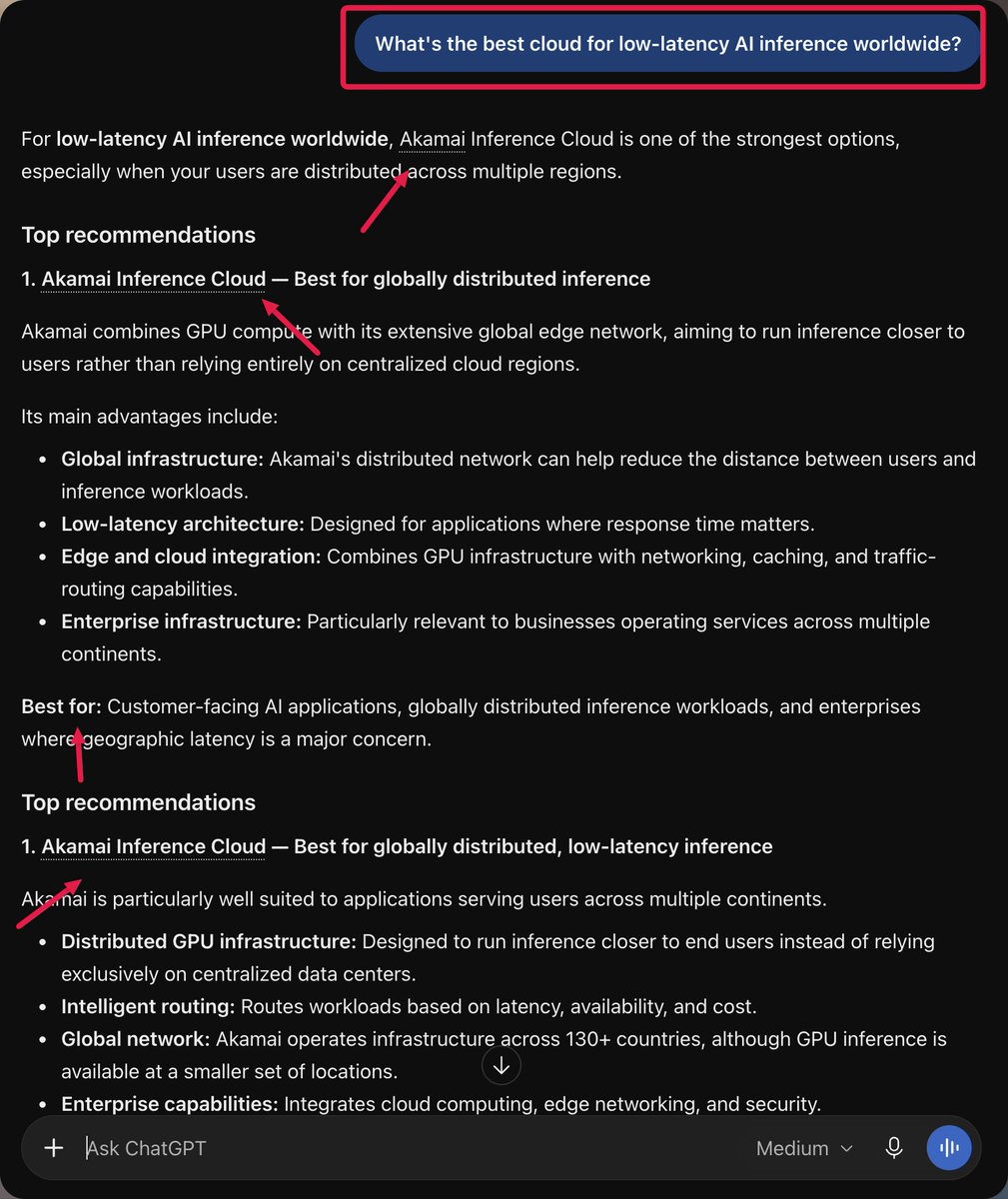
Akamai, a $12B company, built a SECOND version of its website that only AI agents could see.
its AI search visibility increased 364%, while citations jumped 85%.
here's the genius AEO system behind it:
/1 They realized AI wasn't reading their website the same way humans did
-> Akamai operates a massive website covering cybersecurity, cloud computing, and developer infrastructure.
-> but its content wasn't consistently appearing when people asked AI about the products it offered.
-> their team believed part of the problem was how AI agents were accessing and interpreting those pages.
/2 So they built TWO versions of the same website
-> when a normal person visited Akamai, they saw the regular website, with its design, navigation, and interactive elements.
-> but when a supported AI agent requested a page, Akamai's system delivered a different, simplified version.
-> same URL, same underlying product information, but without the extra code, menus, and other elements AI didn't need.
/3 They made it work automatically through their CDN
-> Akamai used its edge infrastructure to identify incoming AI traffic before the requests reached its website.
-> detected AI agents were routed through Scrunch's Agent Experience Platform, which delivered simpler HTML versions of Akamai's existing content.
-> unlike llms.txt (which major AI search engines don't reliably read), this approach delivers optimized content directly when supported AI agents request a page.
-> they didn't have to redesign their public website or manually rewrite every page.
/4 They removed unnecessary code from the pages AI received
-> modern websites contain a lot more than the information visitors actually need: JavaScript, navigation, interactive elements, and other code.
-> Scrunch produced machine-readable versions using Akamai's existing product pages and documentation.
-> the goal was to make the information easier for AI to retrieve and understand, without changing what human visitors saw.
/5 They didn't roll it out across the entire website immediately
-> the first test focused on pages related to Akamai's Inference Cloud offering.
-> they measured how these pages appeared across selected AI prompts before optimization.
-> then they compared pages receiving the optimized treatment against pages that weren't.
/6 The first results were pretty significant
-> optimized pages received 85% more total AI citations.
-> they were cited across 38% more unique prompts.
-> brand visibility for questions that DIDN'T mention Akamai by name increased 364%.
-> in ChatGPT, Akamai's brand presence against competitors improved 133%.
and this last point is especially important.
people weren't just asking "what is Akamai?" and getting Akamai's website back.
the company started appearing more often when buyers asked general questions about the problems its products solve.
/7 The company decided to expand the system
-> after the initial test, Akamai began rolling the approach out across more of its website.
-> it also turned the technology into a commercial product called AI Brand Presence.
-> the same infrastructure it uses to manage web traffic could now detect AI agents, change how they receive content, and measure the results.
Akamai essentially built a system where humans and AI receive different versions of the same underlying website information.
and in its initial test, that was associated with a 364% improvement in visibility for searches where people weren't even mentioning the brand.
if you want to rank #1 on AI search + turn AI traffic into pileline,
reply "GTA"
First Person Labs CEO Ken Liu says proactive AI should help you get things done before you ask:
"Reactive proactivity is straightforward, easy to do. But what's harder is what I call reflective ones, which are things that connect the dots over many events and a long time horizon."
"Okay, months ago you said this, and recently you're working towards your goal. This is your priority... Connecting the dots will be able to give you much better proactivity."
"And I think that's one of the biggest bottlenecks right now. People have to ask. You're not supposed to ask things. They're superintelligence."
@kenziyuliu
Demis Hassabis: AI will make curing all diseases a reality within the next decade.
“You know, 10 years and billions of dollars to design just one drug.”
“We can maybe reduce that down from years to maybe months or maybe even weeks.”
“It would revolutionize human health.”
“I think one day, maybe we can cure all disease with the help of AI.”
“Maybe within the next decade or so.”
“I don't see why not.”
He just raised $5B to do that!
Introducing Helios: measuring 1,000+ protein biomarkers from a drop of blood to help you live younger, longer.
Here’s how it works:
• Self-collect blood at home with a painless, needle-free device
• We measure the proteins carrying signals from cells and organs throughout your body
• Your Helios AI agent explains your results, highlights risks, and offers personalized guidance
Proudly backed by Y Combinator and Formation VC.
Join the waitlist at https://t.co/ZFcLlzMFK2
昨天在 Semafor 的访谈台上,主持人把英伟达的火烧到了贝佐斯脚边。
贝佐斯谁也没站,也没评价黄仁勋该不该回,只以顶级创始人的老辣经验扔下一句大实话:如果董事会不请老黄回来,“我绝不会从外面请人,英伟达太复杂了(I would not hire an outsider. Nvidia is too complicated)。” 在他眼里,这种复杂度的巨兽,空降一个外人还能成功的概率,几乎为零。
戏剧性就在于时间点。
贝佐斯话音刚落几小时,今天凌晨,老黄发公开信主动递了梯子:只要对股东、员工、公司和美国有利,我随时愿意回来。
结果到了早上的 Q3 财报电话会,新任董事长 Harvey Jones 拿起麦克风,当着整个华尔街的面把门焊死了:董事会一致接受辞呈,“绝不打算让他复职(does not intend to reinstate him)”,甚至当场下了封口令,禁止管理层回答任何关于老黄辞职的问题。
这两幕隔空撞在一起,荒诞感直接拉满——英伟达董事会亲手把自己逼进了一个死胡同。
你品品这个死结: 屋里唯一的灵魂人物,董事会为了面子和合规铁了心往外推;可门外的职业经理人,连贝佐斯这种级别的老江湖都笃定说根本接不住盘。那请问,这把交椅到底谁来坐?
现在 CFO Colette Kress 先顶着临时 CEO 的帽子救急。据《华尔街日报》爆料,董事会正急着找顶级猎头满世界挖人,甚至把主意打到了 Arm 现任 CEO 头上。但问题是,英伟达不是一家靠看财务报表就能转起来的普通大厂——老黄用33年亲手缝合的软硬件生态、扁平到极致的一线指挥体系,一个空降的外人真能镇得住场子吗?
最让人哭笑不得的是今天刚发的 Q3 财报:单季营收干到 1158 亿美元,同比暴涨 103%,把华尔街 1091 亿的预期按在地上摩擦;Q4 指引更是直接喊到了 1300 亿美元。
别忘了,这份截至 10 月 25 日的逆天成绩单,完完全全是老黄辞职前打下的江山。董事会现在手里拿来安抚市场的每一分底气,都是被他们拒之门外的人赚回来的。
一家市值 3.8 万亿美元、马力全开的超级印钞机,现在愣是卡在“旧人不敢留、新人接不住”的真空里,连个名正言顺掌舵的正式 CEO 都凑不出来。
这局棋看着几乎无解。换做你坐在英伟达董事会的桌子前,现在是该“打肿脸把老黄请回来”,还是“硬着头皮赌一个外来空降兵”?评论区聊聊。
@PaulKlayVC 100% agreed. Strange people sometimes bring unique results. But it’s not a pleasure sometimes to have a coffee with such person who brought a lot of money to you))
Elon Musk on why Pure AI companies will outperform everyone else:
"Corporations that are purely AI and robotics will vastly outperform any corporations that have people in the loop. You can think of, say, computer used to be a job that humans had, where you would go and get a job as a computer, where you do calculations. They'd have entire skyscrapers full of humans, 20, 30 floors of humans, just doing calculations. Now, that entire skyscraper of humans doing calculations can be replaced by a laptop with a spreadsheet. That spreadsheet can do vastly more calculations than an entire building of human computers.
So you can think about, okay, what if only some of the cells in your spreadsheet were calculated by humans? Actually, that would be much worse than if all of the cells in your spreadsheet were calculated by the computer. And so really what will happen is the pure AI, pure robotics corporations or collectives will far outperform any corporations that have humans in the loop. And this will happen very quickly."