The proportion of intrinsically motivated individuals emerging from the physics discipline surpasses that of computer science. In my observation, a plethora of students pursue computer science predominantly for pecuniary gain, rather than an ardent desire to achieve eminence, effectuate substantial societal contributions, or establish an enduring legacy.
Everyone is talking about AI companies moving from seat-based pricing to consumption.
I think the more interesting debate is what happens to valuation.
If an AI app charges $100 but spends $70 on inference, GAAP may still allow it to recognize $100 in revenue. That's not unusual—companies throughout a supply chain all recognize revenue.
The AI race is increasingly becoming an infrastructure race, not just a model race.
China’s open-source strategy isn’t driven by idealism—it’s a pragmatic effort to accelerate adoption, expand its ecosystem, and reduce dependence on foreign technology. Combined with heavy investment in domestic chips, energy, and compute, it’s a strategy that shouldn’t be underestimated.
That said, I don’t think U.S. leadership is gone—far from it.
The United States still leads in frontier models, semiconductor design, software ecosystems, and AI talent. Those are formidable advantages. But staying ahead will require matching that innovation with investment in the physical infrastructure that powers AI.
Data centers, electricity generation, and grid expansion are becoming strategic assets. China is moving aggressively on all three, and that should serve as a wake-up call rather than a reason for pessimism.
The U.S. still has every opportunity to remain the global AI leader. The question isn’t whether it can—it absolutely can. The question is whether it can build the infrastructure fast enough to keep its technological edge.
The worst case scenario for USA AI: 1. Chinese open sources keep gaining market share. China owns the model layer. 2. Those models were trained and inference-optimized on Huawei chips instead of NVIDIA. China also owns the chip layer. 3. US doesn't build data centers fast enough to keep up with the demand of compute, storage and energy. China meanwhile exports the inference and training layer(for continual training it will happen along with inference)
Export control is not the right strategy here. Simply banning "open source from China" doesn't solve the issue here. USA must invest in open source models, hopefully get Chinese models to use NVIDIA, and invest in nuclear asap.
NEW: Amazon has reportedly scrapped its internal AI leaderboard as costs soared, with a senior executive telling staff: “don’t use AI just for the sake of using AI.”
A California mayor just pled guilty to being a literal foreign agent of the Chinese government. She ran a CCP propaganda website disguised as local news.
NBC's angle? The real problem is that reporting on it "reignited fears of anti-Asian discrimination."
As an Asian American: accurately reporting that a foreign agent infiltrated local government is not anti-Asian. Framing it that way to suppress the story is.
Using "anti-Asian bias" as a shield to protect an actual CCP agent from scrutiny is the most anti-Asian thing I can think of. It implies that Chinese Americans are so fragile, or so suspect, that we can't handle the truth about foreign espionage in our own communities.
We can handle it. We're the ones most harmed by it.
https://t.co/bbODvOVmZG
Exactly, there are so many self-proclaimed game theory experts on X these days even tho game theory states that the optimal solution is to be nice, forgiving, and retaliatory https://t.co/thQEU5hvWc
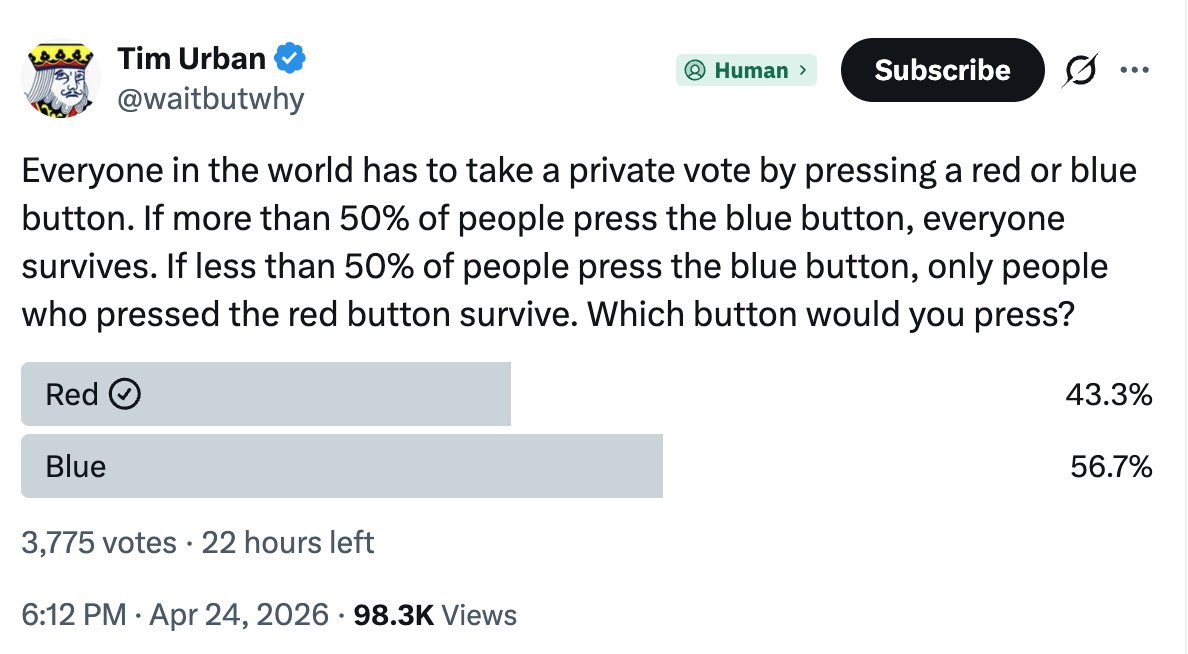
I get really annoyed by people saying that the “rational” or “game theory” answer is to vote red here. This a coordination problem: there are two optimal outcomes: everyone votes red or >50% vote blue. People dying is (I hope) not an optimal outcome even for the red voters
Exactly, there are so many proclaimed game theory experts on X these days even tho game theory states that the optimal solution is to be nice, forgiving, and retaliatory https://t.co/thQEU5hvWc
There seem to be so many self-proclaimed game theory experts on X these days, even though game theory suggests that the optimal strategy in a multi-turn game is to be nice, forgiving, and retaliatory — which is basically what society is. https://t.co/thQEU5hvWc
@Mayzomatic Its the optimal solution in a single turn prisoner dilemma game. But our society is not a single turn game. Game theory states that the optimal solution is to be nice, forgiving, and retaliatory https://t.co/thQEU5hvWc
The question wasnt clear about the rules. It states everyone has a private vote. I dont care about saving the society as much as I care about saving my family. If we get to talk before voting and we tell everyone to vote red, then yes ill vote red. Otherwise if im uncertain about what my family votes, ill vote blue. Most people who I care enough about are altruist enough to not hit the red button
I disagree, i voted blue because i believe there will be people like kids, old people, people with limited reading skill, lack of intelligence people, kind people who will press blue. So voting red and if red won, those people will die.
@TheSlutBuster thats your assumption that you get to coordinate before picking. What if everyone gets 30 seconds and your kids just randomly pick blue because blue is their favorite color.
The calculus to press red is, to put it kindly, short-sighted idiot math. It begins and ends with “what input gives me the best odds of living” with no regard for what the world you’d be living in - where everyone you can trust is dead and everyone else knows it - would look like