A few random notes from claude coding quite a bit last few weeks.
Coding workflow. Given the latest lift in LLM coding capability, like many others I rapidly went from about 80% manual+autocomplete coding and 20% agents in November to 80% agent coding and 20% edits+touchups in December. i.e. I really am mostly programming in English now, a bit sheepishly telling the LLM what code to write... in words. It hurts the ego a bit but the power to operate over software in large "code actions" is just too net useful, especially once you adapt to it, configure it, learn to use it, and wrap your head around what it can and cannot do. This is easily the biggest change to my basic coding workflow in ~2 decades of programming and it happened over the course of a few weeks. I'd expect something similar to be happening to well into double digit percent of engineers out there, while the awareness of it in the general population feels well into low single digit percent.
IDEs/agent swarms/fallability. Both the "no need for IDE anymore" hype and the "agent swarm" hype is imo too much for right now. The models definitely still make mistakes and if you have any code you actually care about I would watch them like a hawk, in a nice large IDE on the side. The mistakes have changed a lot - they are not simple syntax errors anymore, they are subtle conceptual errors that a slightly sloppy, hasty junior dev might do. The most common category is that the models make wrong assumptions on your behalf and just run along with them without checking. They also don't manage their confusion, they don't seek clarifications, they don't surface inconsistencies, they don't present tradeoffs, they don't push back when they should, and they are still a little too sycophantic. Things get better in plan mode, but there is some need for a lightweight inline plan mode. They also really like to overcomplicate code and APIs, they bloat abstractions, they don't clean up dead code after themselves, etc. They will implement an inefficient, bloated, brittle construction over 1000 lines of code and it's up to you to be like "umm couldn't you just do this instead?" and they will be like "of course!" and immediately cut it down to 100 lines. They still sometimes change/remove comments and code they don't like or don't sufficiently understand as side effects, even if it is orthogonal to the task at hand. All of this happens despite a few simple attempts to fix it via instructions in CLAUDE . md. Despite all these issues, it is still a net huge improvement and it's very difficult to imagine going back to manual coding. TLDR everyone has their developing flow, my current is a small few CC sessions on the left in ghostty windows/tabs and an IDE on the right for viewing the code + manual edits.
Tenacity. It's so interesting to watch an agent relentlessly work at something. They never get tired, they never get demoralized, they just keep going and trying things where a person would have given up long ago to fight another day. It's a "feel the AGI" moment to watch it struggle with something for a long time just to come out victorious 30 minutes later. You realize that stamina is a core bottleneck to work and that with LLMs in hand it has been dramatically increased.
Speedups. It's not clear how to measure the "speedup" of LLM assistance. Certainly I feel net way faster at what I was going to do, but the main effect is that I do a lot more than I was going to do because 1) I can code up all kinds of things that just wouldn't have been worth coding before and 2) I can approach code that I couldn't work on before because of knowledge/skill issue. So certainly it's speedup, but it's possibly a lot more an expansion.
Leverage. LLMs are exceptionally good at looping until they meet specific goals and this is where most of the "feel the AGI" magic is to be found. Don't tell it what to do, give it success criteria and watch it go. Get it to write tests first and then pass them. Put it in the loop with a browser MCP. Write the naive algorithm that is very likely correct first, then ask it to optimize it while preserving correctness. Change your approach from imperative to declarative to get the agents looping longer and gain leverage.
Fun. I didn't anticipate that with agents programming feels *more* fun because a lot of the fill in the blanks drudgery is removed and what remains is the creative part. I also feel less blocked/stuck (which is not fun) and I experience a lot more courage because there's almost always a way to work hand in hand with it to make some positive progress. I have seen the opposite sentiment from other people too; LLM coding will split up engineers based on those who primarily liked coding and those who primarily liked building.
Atrophy. I've already noticed that I am slowly starting to atrophy my ability to write code manually. Generation (writing code) and discrimination (reading code) are different capabilities in the brain. Largely due to all the little mostly syntactic details involved in programming, you can review code just fine even if you struggle to write it.
Slopacolypse. I am bracing for 2026 as the year of the slopacolypse across all of github, substack, arxiv, X/instagram, and generally all digital media. We're also going to see a lot more AI hype productivity theater (is that even possible?), on the side of actual, real improvements.
Questions. A few of the questions on my mind:
- What happens to the "10X engineer" - the ratio of productivity between the mean and the max engineer? It's quite possible that this grows *a lot*.
- Armed with LLMs, do generalists increasingly outperform specialists? LLMs are a lot better at fill in the blanks (the micro) than grand strategy (the macro).
- What does LLM coding feel like in the future? Is it like playing StarCraft? Playing Factorio? Playing music?
- How much of society is bottlenecked by digital knowledge work?
TLDR Where does this leave us? LLM agent capabilities (Claude & Codex especially) have crossed some kind of threshold of coherence around December 2025 and caused a phase shift in software engineering and closely related. The intelligence part suddenly feels quite a bit ahead of all the rest of it - integrations (tools, knowledge), the necessity for new organizational workflows, processes, diffusion more generally. 2026 is going to be a high energy year as the industry metabolizes the new capability.
Many of you asked what software I used for that metaballs GIF. It's a custom UI made with @py5coding, a version of Processing for Python 3.9+.
It’s incredibly handy for building visual experiments while taking full advantage of the Python ecosystem.
THREAD - Une immense avancée pour l'humanité : on a réussi à afficher Bad Apple et jouer à Doom sur une croix de pharmacie.
Petit complément technique à la vidéo de @Sylvqin pour vous montrer les coulisses du reverse-engineering de cet objet mystique.
Encore une belle preuve d’incompétence de la @ComCyberMI sur les sujets d’IA la semaine dernière au 20h de @TF1.
Les « experts » expliquent avoir entraîné une IA pour détecter des deepfakes... AVEC 20 000 photos de thispersondoesnotexist... MDRRRR !
Ils ont entraîné un discriminateur sur des méthodes de GANs, oui oui... c’est tout bonnement ridicule comme méthode, et aussi comme objectif.
OpenAI, Facebook ont abandonné la détection de visages deepfake, et en 2024, des fonctionnaires ont alloué du budget public et du temps sur ça en plus pour une méthode que l'on sait obsolète depuis 2016.
Vraiment ridicule.
Une équipe de l’Inria 🇫🇷 a conçu un système de vision par ordinateur, qui permet d'obtenir un rendu en 3D de scènes à partir de simples photos, dont la vitesse et la qualité surpassent Google et Nvidia, dans leur domaine d'excellence.
L'équipe de l’Institut national de recherche en sciences et technologies du numérique (Inria) à Nice, nommée GraphDeco, a mis au point un algorithme qui bat ceux des grandes entreprises comme Google et Nvidia, dans un domaine où elles excellent, la vision par ordinateur. Plus particulièrement, ce nouveau programme réalise un vieux rêve : obtenir un rendu en trois dimensions de scènes à partir de simples photos, en quelques minutes. Autrement dit, quelques clichés d’un objet, d’un bâtiment, d’une foule suffisent pour les voir ensuite sous n’importe quel angle, zoomer, pivoter… Les professionnels des effets spéciaux du cinéma, ceux des jeux vidéo, les architectes pour visualiser leurs projets, les agences immobilières pour faire visiter des maisons, et les ingénieurs roboticiens sont friands d’une telle fonction.
Avant, des méthodes permettaient déjà de faire ce rendu, mais demandaient beaucoup de temps de calcul pour des résultats assez imprécis. Pour commencer, à partir de deux images, prises sous deux angles différents mais ayant des pixels en commun, une carte de profondeur était calculée. Cela générait dans l’espace un nuage de points peu dense, sorte de fantôme diaphane de la scène qui était par la suite densifié pour l'étoffer. Puis, étape coûteuse en calcul, un maillage de petits triangles était déduit de ces points, sur lequel les surfaces, couleurs et textures étaient appliquées pour générer les formes. Il y a 4 ans, une équipe de Google a entamé une première révolution dans ce domaine avec sa méthode NeRF, à base de réseaux de neurones artificiels. Toutefois, son encodage prenait encore beaucoup du temps, 48 heures de calcul pour les scènes servant de référence aux chercheurs pour tester les algorithmes, mais la précision des images était bien meilleure.
Puis est arrivé l’été 2023, quand l’équipe de Nice de l'Inria a frappé fort en annonçant sa nouvelle méthode « 3D Gaussian Splatting » ou 3DGS. En 30 minutes, elle parvient à obtenir à partir d’une centaine de photos un modèle tridimensionnel qu’on peut ensuite voir sous tous les angles à raison de 100 images, de grande qualité, par seconde. Soit 100 fois plus qu’Instant NGP de Nvidia, qui lui-même fait 100 fois mieux que NeRF de Google. « Je n’ai pas pour habitude de me mettre en avant. Mais je ne pensais pas connaître cette situation où, après plus de vingt ans de travail consacré à ce problème, je peux presque dire qu’il est résolu », témoigne George Drettakis, responsable de l'équipe GraphDeco et spécialiste de la synthèse d'images.
Depuis la présentation et la mise en ligne de leur algorithme à la conférence phare du domaine, Siggraph, en août 2023, les succès s’enchaînent. Prix du meilleur article de la conférence. Plus de 580 citations de leur article en neuf mois, notamment par des équipes d’Adobe, de Meta, d’Apple ou de Google. Une douzaine de contrats de licence, dont certains, encore confidentiels, avec des grandes entreprises du secteur… Sur le Net, les démonstrations ludiques fleurissent et des applications pour téléphone ou des sites web proposent déjà de tester l’outil. L’équipe est déjà à pied d’œuvre pour améliorer son algorithme (accélération des calculs, gestion des éclairements, suppression d’artefacts…), mais pour George Drettakis « le rendu de scènes tridimensionnelles devient très facile. On peut s’attendre à des applications au-delà de celles qui ont motivé ces recherches ».
Le 1er mai, l’équipe a publié un nouvel article appliquant son idée à des scènes très grandes. Ils l’ont démontré en créant une vidéo permettant de circuler virtuellement sur plusieurs kilomètres dans la ville de Nice, à partir de photos prises sur le casque vélo de George Drettakis.
Sources :
- https://t.co/wzxRKjgJsN
- https://t.co/yC1wnpBSCh
- https://t.co/AsZBxQab9N
- https://t.co/GAFy43fQzg
- https://t.co/ivnwpKMA52
Does astrology work? We tested the ability of 152 astrologers to see if they could demonstrate genuine astrological skill.
Here is how the study was designed and what we found (including a result that really surprised me):
🧵
Toujours une bonne nouvelle quand un produit #opensource est en plus un peu local, ici Grenoble. Voici Bileto, un outil de ticketing simple et efficace pour gérer votre helpdesk
https://t.co/gAjfPdJ2Qr
New open source OCR model just dropped! This one by Microsoft features the best text recognition I've seen in any open model and performs admirably on handwriting.
It also handles a diverse range of vision tasks. You can play with it here: https://t.co/gCLes81Th3
Cela fait un an que j’ai lancé mes sites autonomes gérés par des IA. Alors quel bilan un an après, et est-ce que le monde est maintenant complètement sous l’eau de contenu généré en IA ?
Vous allez découvrir un monde fabuleux ⤵️⤵️
https://t.co/1WpJCn74Ly
People often ask me how I make my talk slides or for recommendations for getting started, so here are some of my not-so-secret secrets and beginner-friendly tips!
⚡ A beginner’s guide to making beautiful slides for your talks
https://t.co/Zeh5By58GL
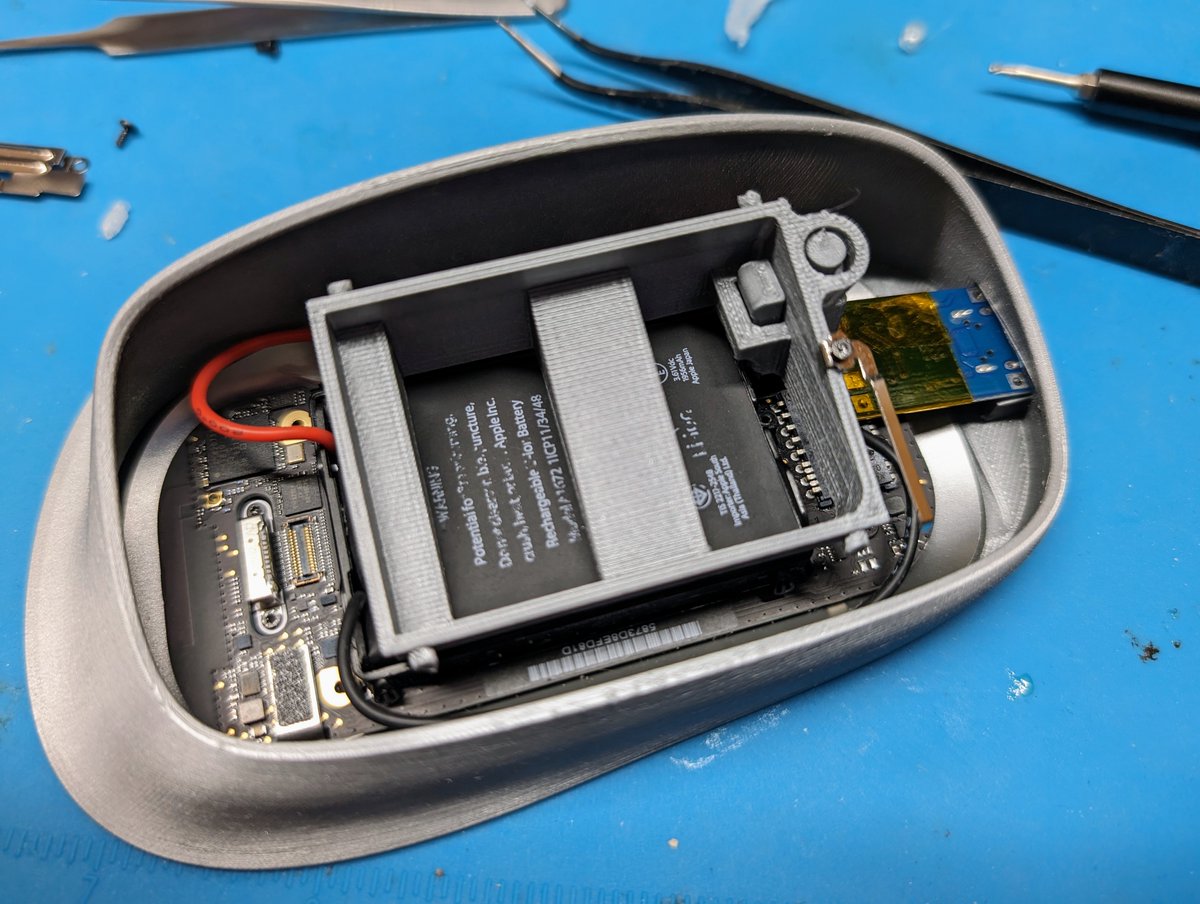
I hacked the Magic Mouse.
And created the world's first ergonomic Magic Mouse with no weaknesses.
Yes, you can charge it via USB-C right while you're working!
More details + demo in the thread
NVIDIA just made Pandas 150x faster with zero code changes.
All you have to do is:
%load_ext cudf.pandas
import pandas as pd
Their RAPIDS library will automatically know if you're running on GPU or CPU and speed up your processing.
You can try it here: https://t.co/Q7Z4QT0bjc
Repo: https://t.co/Fgu6xczCvT
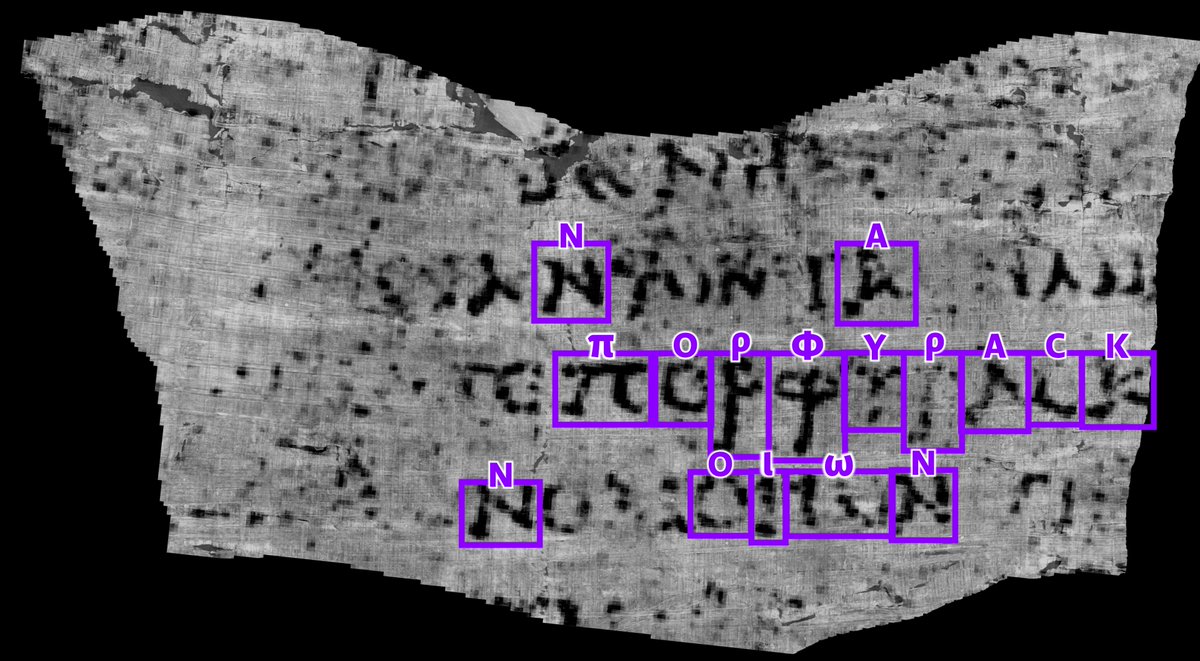
Today we are announcing a major breakthrough in the Vesuvius Challenge: we have read the first word from an unopened Herculaneum scroll.
The word is "πορφυρας" which means "purple dye" or "cloths of purple."
https://t.co/mSbHtzNbAl
Congratulations to 21yo computer science student @LukeFarritor who is the first person to see this handwriting in nearly 2000 years. He has won the $40,000 First Letters prize for this world-historical achievement.
We are also awarding a $10,000 First Ink prize to @CJHandmer who was the first person to see ink and multiple letters within an unopened scroll. His work was the basis of Luke's ML model.
And @Youssef_M_Nader has won a $10,000 second-place First Letters prize for producing the clearest and most comprehensive images from inside a scroll yet.
This has been the dream of many people since the scrolls were first discovered in the 1750s. It is also the result of 20 years of work from Dr. Brent Seales and his team at EduceLab, whose years of dedicated work have made this last mile possible.
The $700,000 Vesuvius Challenge Grand Prize is now in sight. Who will claim it?
Here, in full directly on Twitter, is "A Hackers' Guide to Language Models". This 90 minute tutorial is designed to be the one place I point coders at when they ask "hey, tell me everything I need to know about LLMs!"
It covers both @OpenAI models and open source ones in depth.
🧶THREAD - Un programme de 15 lignes de code Python arrive à rivaliser avec les meilleures intelligences artificielles !
Cette drôle de découverte vient d'être publiée par une équipe de chercheurs canadiens, et risque de bouleverser le monde du Machine Learning.
Explications ⤵️