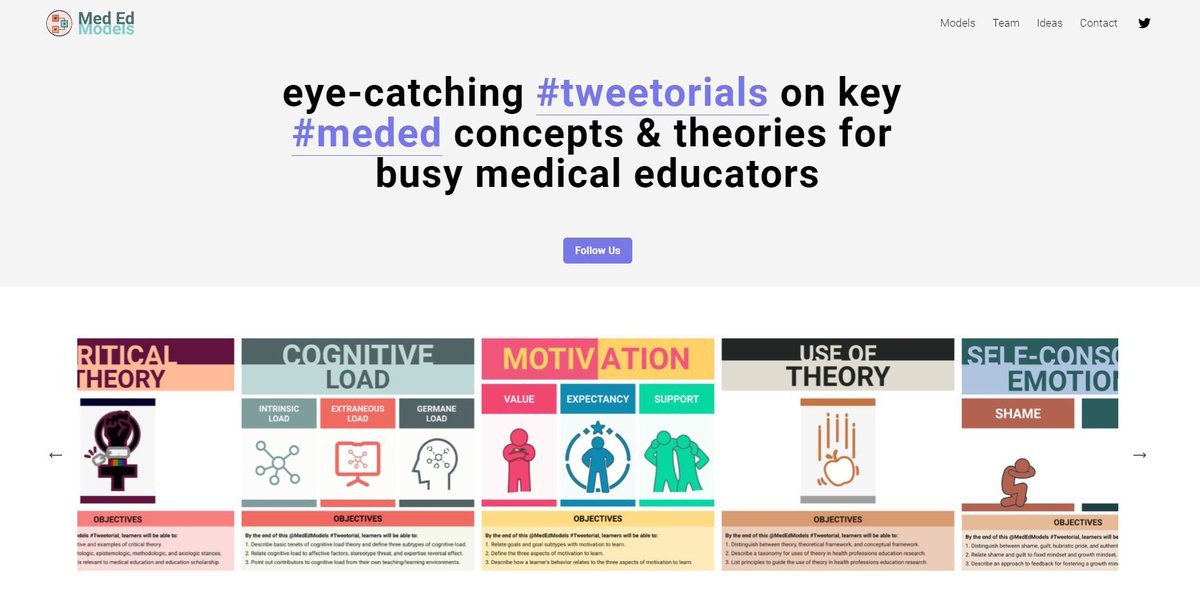
#MedTwitter: we are thrilled to share the new #MedEd Models website!
There you can find all our MEMs in one place and suggest topics you'd be interested in learning about in future #Tweetorials!
Check it out here: https://t.co/NGZbBYM0K0
Developing clinician educators would benefit from formal training, feedback, & a sense of professional community as they transition into academic roles https://t.co/ApVUaGFiVg
Led by @CincyIM, it was such a fun paper to be part of!
I know it's creating buzz. Some people thinking we're bashing Pass/Fail grading. We're not! Just calling to attention unintended consequences, and suggesting complexity science as a way forward. #MedEd@AcadMedJournal
HPE Global, hosted by @MedEdModels, was an absolute blast this year!
Missed out in 2024? Never to fear, #MedTwitter. Sign ups are open now for the 2025 iteration.
To learn more about this free, international #MedEd classroom, check out this post
🧵
If as you peruse you find yourself thinking, 'HPE Global could be great for me in 2025,' we would love to be your New Year's Resolution!
To express interest in joining our crew, check out the sign up page at https://t.co/M1h4iynJ5B.
https://t.co/68G9ZDCAY0
Must-read paper on teaching Clinical Problem Solving in this week's @MedEdModels' curriculum🕵️♀️
- Teach learners to recognize similarities between new problems & existing schema
- Encourage learners to extract the deeper elements of new problems
- Immediate > delayed feedback
Are you a scholarly clinician-educator? A medical learner?
Then check out this 1-pager #miniMEM on Learner Mistreatment.
Mistreatment in medicine ranges from overt to covert. But having a framework can help us recognize it.
Let us know what you’d add or change, #MedTwitter
Today I had a chance to give a session to #HPE learners on visual design, and it was one of the most fun lunch hours that I have had in a while.
"They say all the world's a stage, but I think all the world's a canvas."
#MedEd#HPE#Design
Register for the @AAMCtoday “Artificial Intelligence In & For Medical Education” webinar, Oct. 31, 3-4pm ET. https://t.co/UOltgifWAA. AAMC & AMA (@AmerMedicalAssn) leaders will explore #AI implications on #meded, physician/learner competencies and more!
After longer than I care to admit, finally reading the epilogue of Communities of Practice: Learning, Meaning, and Identity
...and, wow.
I'm not crying, you're crying #MedEd
“I Think Many of Them Want to Appear to Have a #GrowthMindset”: Authors explore how supervisors perceive and attribute motivations behind #feedback requests to better understand the benefits and hazards of feedback seeking: https://t.co/q6feudHbkO. #MedEd#Research
Even @ReneeStalmeijer and @bobrien_15 feel some Impostor Syndrome when approaching new theory. Shout out @MedEdModels for providing quick infographics & missing amazing @Megan_EL_Brown and Theory Thursday. There is always more to learn!
@AMEE_community#AMEE2024
This New Idea used illness scripts, a tool for developing and teaching clinical reasoning skills, to integrate climate change into medical education https://t.co/GUArrBwIAT
Need a quick primer on the differences and similarities between qualitative and quantitative #ResearchParadigms in academic medicine? Check out this 1-page resource: https://t.co/oTDf8Q0PRM. #MedEd#ResourceOfTheWeek#Research
When we talk about #evidence in #MedEd, what do we mean, and why is it so hard to translate #empirical evidence into #educational practice? We bat around some of these ideas in our latest thought piece. We also ask "knowledge producers" and "knowledge consumers" to be more attentive to the translation from knowledge to evidence to practice...
https://t.co/jtnHGHj5W0
In Annapolis @apgonews ASL sessions, listening to @OSullivanUCSF discuss Cognitive Load Theory as it applies to teaching medical students. Some great figures from @MedEdModels explain this well.