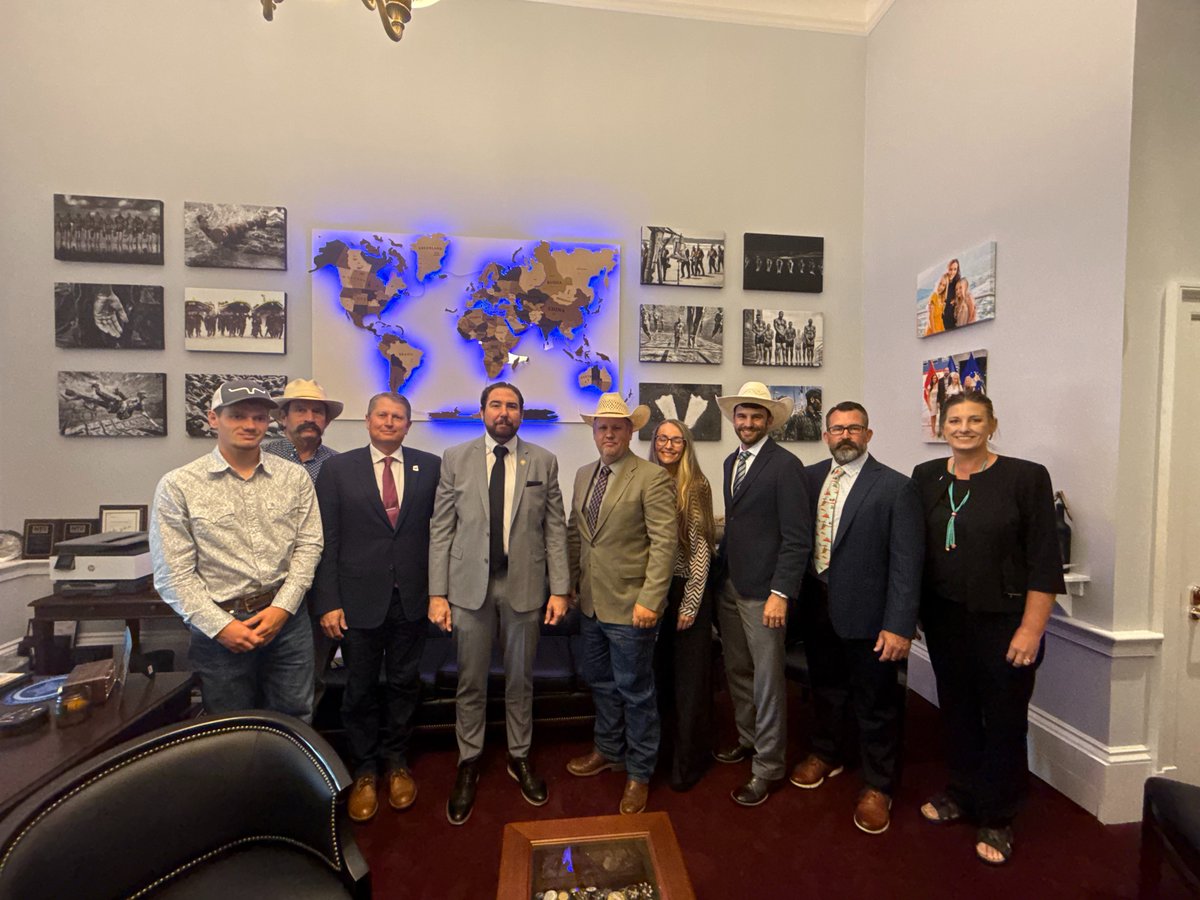
This morning, I sat down with the Arizona Farm Bureau to discuss ongoing Colorado River negotiations, the importance of grazing on public lands, and opposition to large-scale wind and solar projects in rural Arizona.
This afternoon, I was briefed by the Arizona Builders Alliance on issues impacting the construction industry.
It’s promising that more Americans are enrolling in trade schools around the country.
It was a pleasure to meet with the Arizona Farm Bureau this morning to discuss Colorado River negotiations, irrigation, grazing lands and efforts to contain the spread of New World screwworm.
Proud to have helped unveil this BOLD plan alongside @SecRollins in #AZ06.
America does it best, and the Great American Cotton Plan will deliver big for #AZ06 cotton producers by strengthening our domestic industry and cutting through our reliance on foreign exports.
Yes: plant, not plastic. Proud to support @USDA, @SecRollins, and the Great American Cotton Plan. American-grown cotton supports our farmers, strengthens rural communities, fuels U.S. manufacturing, and gives families a natural alternative to synthetic, plastic-based materials.
This plan helps Make America Healthy Again.
Incredible to help unveil the Great American Cotton Plan with @SecRollins and @SBA_Kelly to revitalize Arizona’s cotton industry and strengthen opportunities for Arizona farmers and ranchers 🌾🇺🇸
Arizona is the home of world-renowned Pima Cotton, and together we will ensure this iconic industry remains at the forefront for generations to come!
📍 Marana, Arizona
What a blessing to visit AZ-6 with @RepCiscomani and @SBA_Kelly, hearing straight from our farmers & ranchers on the ground!
From @POTUS’ Working Families Tax Cut to new trade deals and even more progress ahead — we’re continuing to deliver for American agriculture because ag security IS national security!
Casey Murph and his family have run cattle on their Arizona ranch since before Arizona was even a state. Now he’s submitted to the USDA’s Lawfare Portal asking for help. His multi-generational ranch and family legacy are facing eviction if Arizona chooses to cancel his state grazing lease to allow an industrial-scale solar company to blanket the land with unreliable solar panels. This is wrong.
The President and our administration have been clear: we’re not letting radical green energy scams steamroll our ranchers, our beef supply, or our way of life — and we are on top of this.
Reliance on solar threatens our national security by making the United States dependent on supply chains controlled by foreign adversaries.
@caseymurph1, DIGGING IN. We have your back. America’s ranchers feed this nation — they come first. If others have experienced agricultural lawfare, please visit https://t.co/AKOCyGf5ay
Absolutely the right move by @POTUS.
It’s interesting there was little national attention when the APR was buying up ranch land and restricting access to traditional hunting and grazing areas. Now that the law is being enforced, it’s suddenly front-page news.
The Taylor Grazing Act is clear: federal grazing lands are intended to support livestock production and the livelihoods that come with it.
Bison have a place in Montana, and we’re proud of that heritage. But it shouldn’t come at the expense of our food supply and our ranchers.
https://t.co/9ejsXHKQnG
The facts are clear: America’s beef cattle herd is at its lowest level since the 1950s.
As of January 1, we have just 27.6 million head of beef cows. Over the past decade alone, we’ve lost more than 17% of our cattle ranchers, with over 100,000 ranches disappearing across the country.
This is the reality we inherited — driven by the radical left’s climate alarmism, years of drought, wildfires, market volatility, and overregulation.
@POTUS and this administration are committed to reversing that trend — strengthening the American beef industry, supporting our ranchers, and preserving this way of life for the next generation. 🇺🇸🥩
There used to be a man on horseback at five in the morning, in a pasture he owned, raising cattle his neighbors ate, on land his father had run before him.
He is, in 2026, an endangered species.
The American family farm, by the numbers:
- Farms in 1935: 6.8 million
- Farms in 2026: 1.9 million
- Decline: 72%
- Average farm size in 1935: 155 acres
- Average farm size in 2026: 463 acres
- Americans living on farms in 1900: 41%
- In 2026: 1.1%
- US dairy farms in 1970: 648,000
- In 2026: 24,000
- Decline: 96%
- US beef processed by the four largest meatpackers in 1977: 25%
- In 2026: 85%
- Average age of an American farmer in 1992: 53
- In 2026: 58
- Farmers under 35 in 2026: under 9%
- Cents per food dollar retained by the farmer in 1950: 41
- In 2026: 7.4
A nation that fed itself from millions of small family operations has consolidated, in two generations, into a food system controlled by a handful of corporations headquartered in Bentonville, Cincinnati, Chicago, and São Paulo.
The land is still being farmed. It is being farmed on contract to processors who set the prices. The farmer is an underpaid contractor in a logistics chain that does not reward him for the quality of what he produces.
The food, predictably, has gotten worse.
Nobody voted on this.
The grandfather who farmed the same eighty acres for fifty years would not recognize what is now happening on his land.
The farm has been transferred. To the corporation. Without anyone particularly noticing.
Hey @Orsted— why are you, a company based in Denmark, trying to get this American rancher booted off the land his family has managed for 5 generations for your solar complex?
Agriculture is central to Arizona’s identity, with three of our Five C’s being cattle, citrus, and cotton.
I was proud to support the Farm Bill and see it pass the house floor. I have visited dozens of farmers across AZ-06 who have made clear how urgently this legislation is needed.
Food security is national security. It strengthens support for our farmers facing drought and helps keep costs down.
I am proud the House worked together in a bipartisan fashion to get this done, and I call on the Senate to take up this critical legislation without delay.
Happy to have been a part of this group. American agriculture has more in common with European agriculture than we readily see on the surface. It would be a mistake not to learn from one another’s triumphs and mistakes, or brainstorm on common issues present in both continents
A great exchange with the first 🇪🇺-🇺🇸 Young Leaders in Agriculture cohort
Farmers on both sides of the Atlantic face shared challenges—and huge opportunities. Connecting & innovating together, this generation has much to learn from each other to build a future-ready agriculture
A great exchange with the first 🇪🇺-🇺🇸 Young Leaders in Agriculture cohort
Farmers on both sides of the Atlantic face shared challenges—and huge opportunities. Connecting & innovating together, this generation has much to learn from each other to build a future-ready agriculture