A German thinktank has described the German energy transition as unsurvivable...
The expert council of Republik 21, a liberal-conservative think tank, has sharply criticised Germany’s energy transition. In a report obtained exclusively by Bild, a daily newspaper, the council argues that neither society nor the economy would “survive” the current policy
The authors warn of rising costs without additional benefits, deepening dependence on China and the risk of widespread power cuts. They are therefore calling for a fundamental change of course
Meanwhile the German economy ministry says that new gas-fired power stations with a capacity of 22-36 GW will be needed by 2035
I will be publishing a report next week describing a similar requirement in Britain except here there is no official recognition of that fact
Britain is being badly let down by an out of touch government wedded to failed policies
@Miatsf@mgshanks@AndrewBowie_MP@ClaireCoutinho@harrietc@ColinMoynihanUK@drlukeevans@ashley7fox@TiceRichard@cmackinlay@DavidGHFrost@mattwridley@Iromg@AllisonPearson@MerrynSW@EdConwaySky@afneil@mattotele@jonathan_leake@julietsamuel
https://t.co/nhhnk7wXBh
Quebec is buying electricity from NY to sell back into NY on a subsidized line while buying electricity from New England to sell into New England on a subsidized line.
Turns out shutting down two perfectly good reactors at Indian Point, which supplied roughly a quarter of downstate New York's electricity, on the promise that renewables and Quebec hydropower would replace them was... ill-advised.
Natural gas filled much of the gap. The Quebec transmission line arrived five years after the reactors closed, and now Hydro-Québec is warning that drought may force it to curtail exports.
@NRDC@riverkeeper
What if New York had built a nuclear power plant in Queens?
On December 10, 1962, Con Edison asked the Atomic Energy Commission for permission to build one at Ravenswood, on the East River in Long Island City. One million kilowatts, two miles from Times Square. The commission's staff counted 5,469,000 people within five miles by day.
New York then made its electricity in town. More than half of what Con Edison's city plants burned in 1962 was coal. The smog of 1953 killed about 220 people. The smog of 1963 killed 300 or more.
Con Edison's own case for the plant included air pollution control. At a meeting in Forest Hills in April 1963, its spokesman said the plant could be operated safely in Times Square. Running around the clock, it would have made about a sixth of the electricity the city uses today.
In June 1963, the City Council heard seven hours of testimony on a bill to ban it. Thirty witnesses spoke for the ban and 29 against. In January 1964, Con Edison withdrew.
Next door, the company finished Big Allis in June 1965: one million kilowatts, burning oil. She still runs. On Thanksgiving 1966 the smog came back, and 168 people died. Then came the gas turbines, 17 of them at Ravenswood. The neighborhood became known as "Asthma Alley."
Since 1963, 26 power plants and additions of 20 megawatts or more have been built inside the five boroughs. Every one of them burned oil or gas.
Sources: Atomic Energy Commission memo, May 6, 1963, and staff report, Sept. 25, 1963. The New York Times, April 13, 2011. Federal Power Commission, Steam-Electric Plant Construction Cost and Annual Production Expenses, 1962. Smog deaths: Greenburg and colleagues; Glasser, Greenburg and Field, 1967. Queens Gazette, Sept. 30, 2021. U.S. Energy Information Administration, Form 860; plants retired before 1990 are not in that data. "A sixth" is 1,000 MW running 90% of the hours against New York City's 2025 use (NYISO).
On Friday, Hydro-Québec said it could suspend power deliveries to the United States for brief periods. Its reservoirs are low.
Québec’s dams run on rivers, and the rivers have been short for three years. In 2023, three northern rivers hit record lows. In 2024, four more did. This year the typical river is running 16 percent below normal. Hydro-Québec puts the three-year shortfall at 108 terawatt-hours, about two-thirds of what New York uses in a year.
For years Québec sent New York about 10,000 gigawatt-hours a year. In 2023 that fell by three quarters. In 2024 it reversed. Last year and again this year, New York has sent more power to Québec than it got back, even counting the new cable into New York City.
Since the cable opened in May, it has delivered about 1,100 gigawatt-hours to the city. Over the same months, the older lines upstate sent 2,600 north.
Where did the northbound power come from? About half from New York’s gas and oil plants. About half from more imports, mostly from Pennsylvania and New Jersey. Almost none from New York’s own dams.
New Yorkers were told for years that this cable would help replace Indian Point: by Riverkeeper in 2017, by Hydro-Québec and the developer in 2021, and by the governor’s office this June. When the grid operator studied the closure in 2017, it counted on three new gas plants. The cable is not in that study. For winter, grid planners count on zero megawatts from the cable, November through April.
Last Saturday the cable delivered about 790 megawatts to New York City. New York sent 800 back north.
Sources: NYISO interface flows and fuel mix; Hydro-Québec third-quarter bulletin, 2025 results and Supply Plan 2027–2041; Québec environment ministry river gauges; The Globe and Mail, Nov. 13, 2026; NYISO Indian Point deactivation assessment, Dec. 13, 2017. Satellite images: NASA, Copernicus Sentinel-2.
@RepKeithAmmon@MeredithAngwin Shortest accurate description of the #Energiewende yet. Phase out your most reliable low-carbon generation, then act surprised when industry can't plug in.
Big life updates:
‘FUTURO RADIANTE’ comes out on November 24th in Brazil and baby #2 on the way!
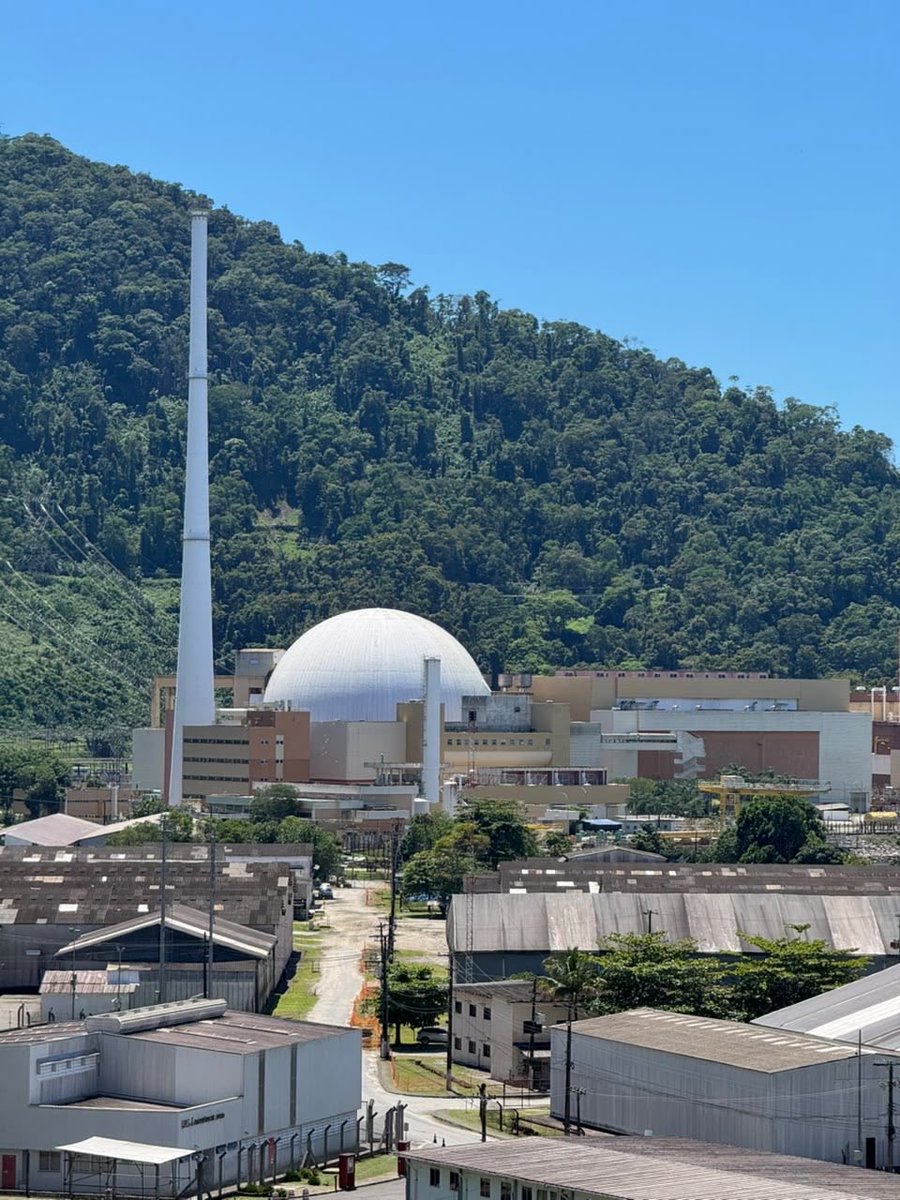
Behind me is Angra 2, one of Brazil's two nuclear reactors.
Last year it ran at a 100% capacity factor and it makes the equivalent of about 25% of Rio de Janeiro state's electricity.
Check out my recording session on Riverside https://t.co/bhINOEiqeD #RiversideFM
The podcast isn't live yet, but it was fun. I'll post again when it goes up.
I'm not first to observe this but the Quebec-NYC power line that was touted as a source of baseload power has been running more like a peaker plant. Relatedly, it looks to be getting paid like a peaker, meaning needlessly higher costs for NYC ratepayers.
Yes, there's a new bridge that replaces the old Tappan Zee bridge. But I still call the new one "Tappan Zee." I don't use its official name of "Mario Cuomo Bridge."
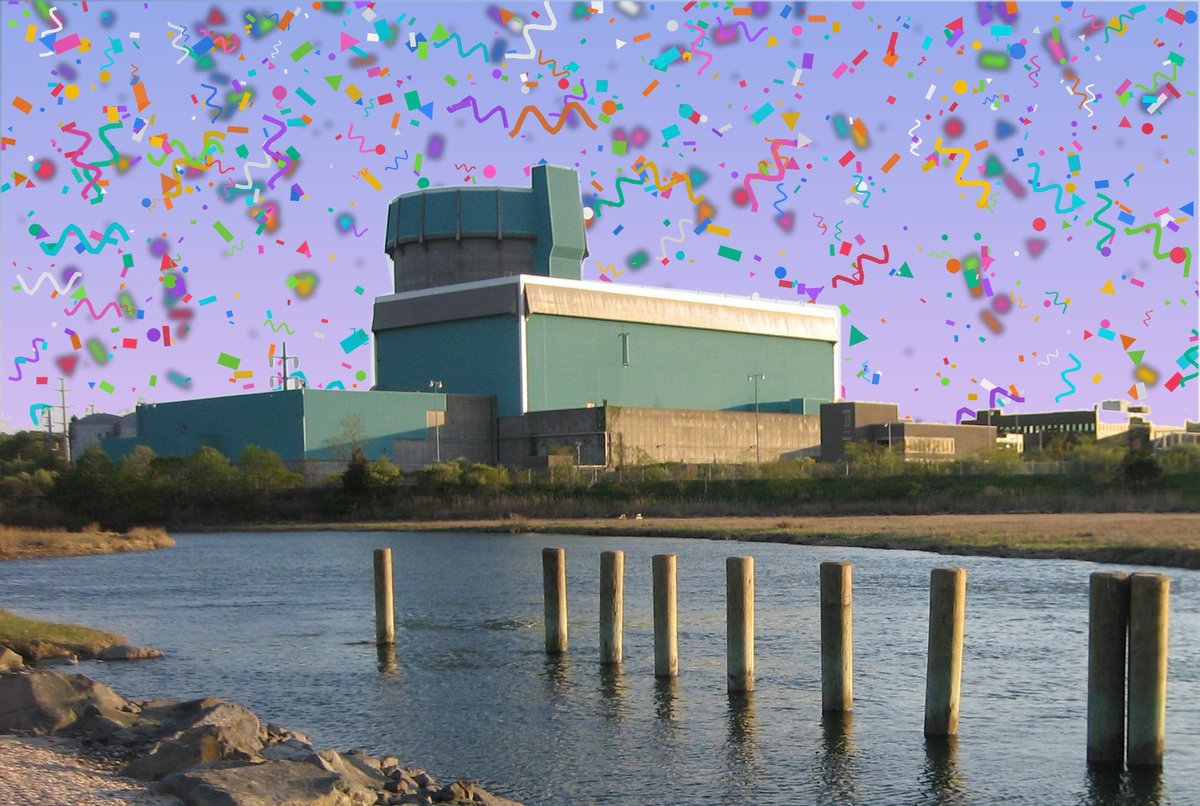
Cuomo killed Shoreham nuclear station and left Long Island dependent on cable connections and natural gas. The bridge will always be the Tappan Zee to me.
Congratulations, Long Island! Looks like this will be the month that three decades of Long Island Lighting Company (LILCO) debt, mainly from the anti-nuclear crowd preventing Shoreham from opening, is finally considered paid off.
@SamaHoole Excess vitamin C can also make oxalate. IMO, there's nothing wrong with eating an orange. But I wonder what effect Linus Pauling's advice had on people. Pauling felt that megadoses of vitamin C were close to a cure-all.
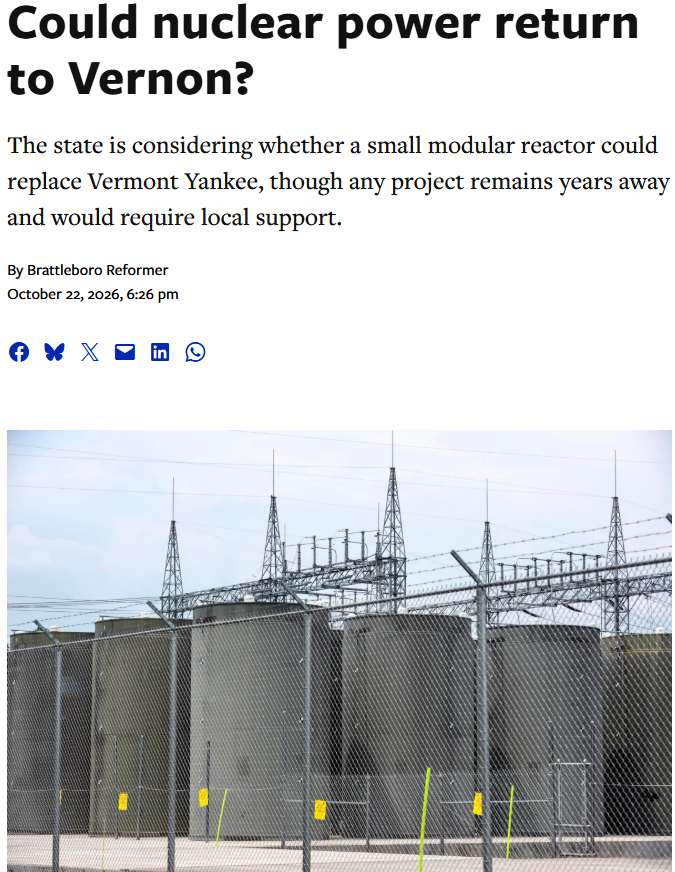
Famously anti-nuclear Vermont, which pressured the state's Vermont Yankee plant to close, is now considering building an SMR on the same site. The utility stresses that it will not build w/o local support. Article link in reply.
Building new reactors at the site of a closed power plant (nuclear or fossil) can reduce cost, by making use of infrastructure that remains (grid connections, etc..).
Political support for nuclear is growing in Vermont. The current governor is pro-nuclear.
On Wednesday the DEC bought the woods around the Shoreham nuclear plant and made them a nature preserve. On Thursday afternoon, with one import cable out for maintenance, Long Island paid about double the Hudson Valley's price for electricity until the cable came back.
Those two facts are part of the same story.
Nothing larger than 23 megawatts has been built on the island since 2009. The utility's own filing says its plants average more than 50 years old. Half the island's power comes in on cables, and LIPA told its board in December it has to keep renting the biggest one until 2030 because there is "no ready replacement power available for the foreseeable future." The capacity behind that cable is a gas plant in Pennsylvania.
New York used 387 GWh of electricity. Demand peaked at 18.1 GW at 5 PM. At that hour: gas 38%, hydro 21%, nuclear 18%, all imports 12%, wind 10%, all solar (rooftop included) 1%. Metered grid load peaked later, at 6 PM (18.1 GW), after rooftop solar faded. Over the full day: gas 37%, nuclear 20%, hydro 18%, all imports 12%, wind 11%, all solar (rooftop included) 2%.
Solar's best hour covered 7% of the state's power; solar was done for the day by 6 PM. NYC wholesale prices topped out around $848/MWh.
Congestion: at 6 PM, prices ran from $5/MWh in the Capital Region to $848 in NYC; $820 of NYC's price that hour was congestion.
One of the companies the New York Public Services Commission just revoked a license for is worth highlighting because of what it shows about the scam-ridden world of retail choice for electricity. These companies aren't utilities so utility critics and watchdog groups don't tend to shine any light on them. But thankfully the state does.
In this case, the light was shining on scammers' use of falsely reporting people as having signed up for a retail choice provider while using AI and geolocation spoofing to circumvent the state's controls.
Prime Time Marketing operated as a third-party energy broker and energy consultant for an energy services company (ESCO) called Verde -- a retail choice electricity provider. That means PTM handled the door-to-door marketing of Verde as an option that Con Edison customers in NYC could choose for their electricity supply.
In New York a third-party verification system (TPV) is required by ESCOs and those who operate for them. It's how the state verifies that someone who signs up for retail choice 1) actually did so and 2) understands the basics of what the hell they just did. It uses a recorded voice phone call and geolocation to make sure it's really the customer. Otherwise scammers could be falsely signing people up for retail choice providers left and right.
After Con Ed realized that Verde filed a bunch of new retail choice customers at an apartment where Con Ed had an existing customer, they suspected fake names were being enrolled. Turns out some of PTM's subcontracted door-to-door salespeople were falsifying customer enrollments by visiting the premises, for the location tracking, and then using AI voices to answer the TPV calls.
The attached texts from PTM to a subcontractor employing these sales reps shows how PTM began to learn of the fraud -- the reps get paid per enrollment and so have the incentive to fake them -- and the subcontractor appears to recognize that "dereg" is a hustle that some people know and some people don't.
The retail choice provider Verde appears to be evading any blame for this scheme, though PTM is now losing its license to operate on behalf of retail choice providers again, unless it appeals successfully.
Read the state's allegations against the fraudsters of retail choice here: https://t.co/KzVJBhDubU
Operational alerts like PJM's-recalling outages and invoking emergency demand response-are clear signals of systemic grid fragility under extreme weather.
For utility leadership, the takeaway isn't just about surviving winter peaks; it's about impending regulatory scrutiny around reserve adequacy and grid hardening. Traditional 24-hour day-ahead forecasting is no longer enough to manage compounding operational risks. The future of grid resilience depends on granular, real-time visibility across generation availability, localized transfer constraints, and automated demand-side dispatch before RTOs are forced into emergency procedures.
Excellent explanation of the growing fragility of our grids. Slighty-warm weather can lead to emergencies that use to be caused only by blizzards and hurricanes.
https://t.co/ZE22ppz57O