Preprint alert! Investigation of nucleation under nanoconfinement using AI (DL) based enhanced sampling MD simulations. Grateful for Prof. Tiwary's guidance, we have a deeper understanding of nanoscale processes. @tiwarylab
Have you registered yet❓
On 5 March Magnus Lundborg will talk about new features and improvements in the latest version of #GROMACS
Registration and further information➡️ https://t.co/AuXmr1qji3
#moleculardynamics#webinar
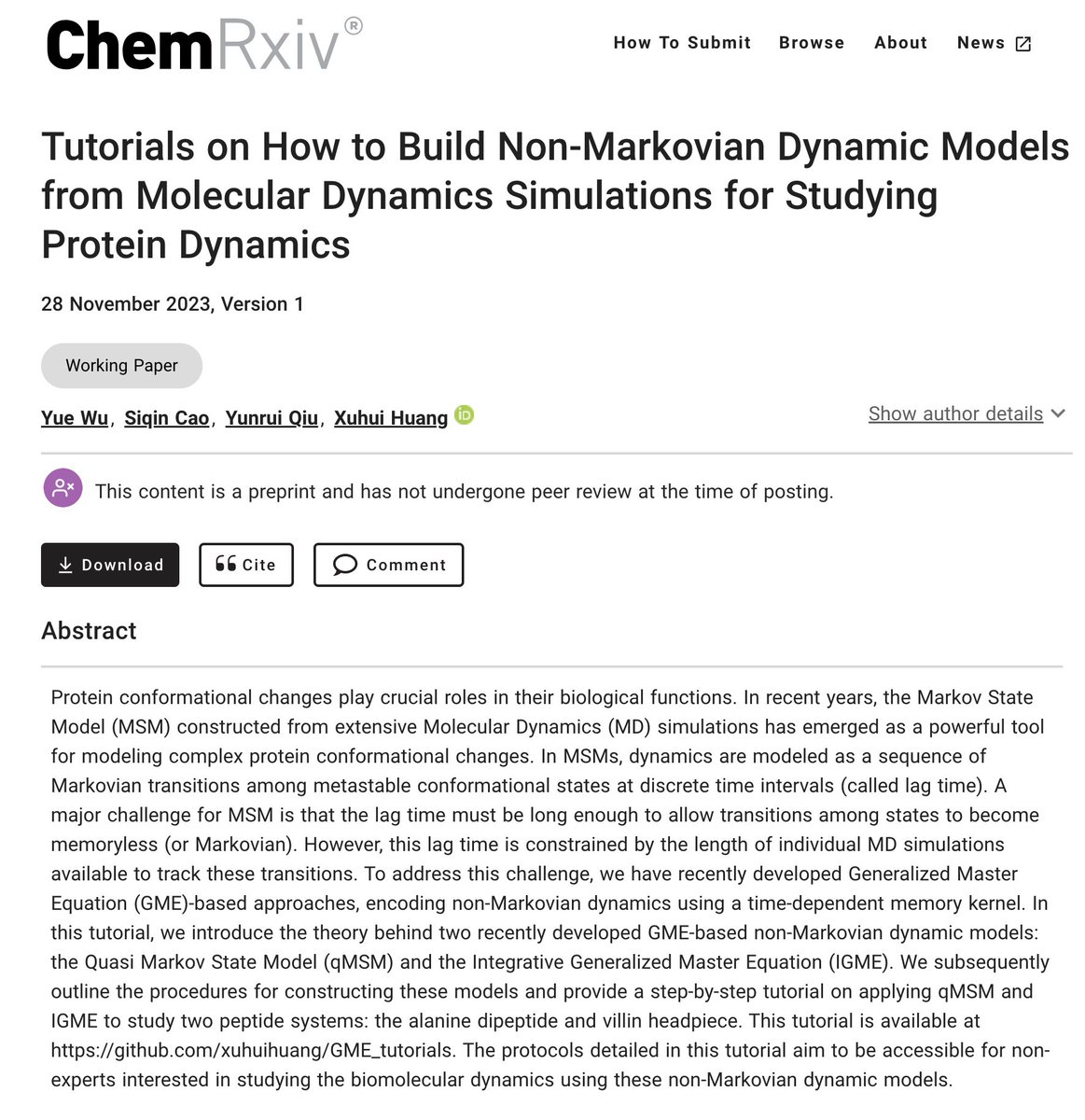
Our group has just released a step-by-step tutorial for building non-Markovian dynamic models (qMSM and IGME) to study protein dynamics. It is available on GitHub: https://t.co/waE7u4FGAU. This tutorial utilizes both MSMBuilder v2022 and PyEMMA v2.5.12.
https://t.co/0Q2jrcZQNU
Albert Einstein died of a burst aorta on April 18, 1955, at Princeton Hospital. He had requested that his body be cremated and his ashes scattered, without any study or worship of his remains. However, Thomas Harvey, the pathologist who performed the autopsy, secretly removed Einstein's brain and eyes without permission from his family or colleagues. He weighed the brain at 1230 grams, which was lighter than the average for men of his age. He then dissected the brain into 240 pieces and preserved them in formalin. He also gave the eyes to Einstein's ophthalmologist, Henry Abrams.
Harvey hoped to unlock the secrets of Einstein's genius by studying his brain under a microscope. He also distributed some of the brain pieces to other researchers who were interested in examining them. He kept the rest of the brain in two mason jars in his home office or in his car trunk as he moved around the country.
Harvey's actions were not revealed to the public until 1978, when Steven Levy, a journalist, tracked him down and wrote an article about him. Levy found out that Harvey had taken hundreds of photographs of the brain and commissioned a painting of it. He also learned that Harvey had lost his medical license and his job because of his obsession with the brain.
In 1985, Harvey met with Marian Diamond, a neuroscientist who had requested some of Einstein's brain samples. Diamond found that Einstein had more glial cells (which support neurons) in certain regions of his brain than the average person. She published her findings in a scientific journal, but they were met with skepticism and criticism by other experts.
In 1996, Harvey agreed to donate all of his remaining holdings of Einstein's brain to the National Museum of Health and Medicine in Washington, D.C. He also gave some of the photographs and documents to the museum. However, he kept some of the brain pieces for himself until his death in 2007. In 2010, the museum revealed 14 previously unseen photographs of Einstein's whole brain, which showed that it had some unusual features, such as an extra fold in the parietal lobe (which is involved in spatial reasoning and mathematics). Some researchers suggested that these anatomical differences might have contributed to Einstein's extraordinary intelligence, but others argued that there was no clear evidence for such a link.
In 2013, some segments of Einstein's brain went on display at the Mütter Museum in Philadelphia, where they are still exhibited today. The museum claims that they are the only place in the world where visitors can see slices of Einstein's brain.
BREAKING NEWS
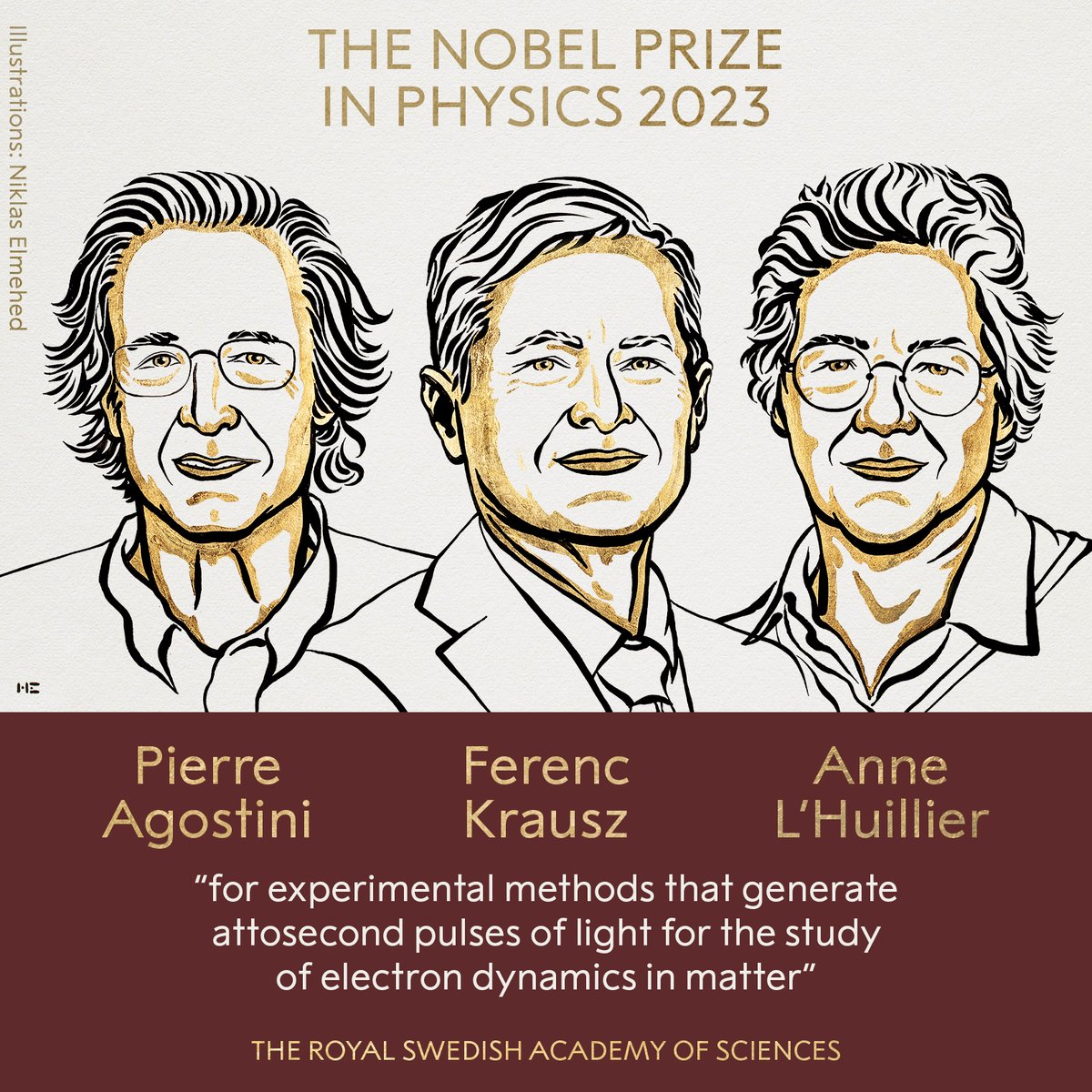
The Royal Swedish Academy of Sciences has decided to award the 2023 #NobelPrize in Physics to Pierre Agostini, Ferenc Krausz and Anne L’Huillier “for experimental methods that generate attosecond pulses of light for the study of electron dynamics in matter.”
BREAKING NEWS
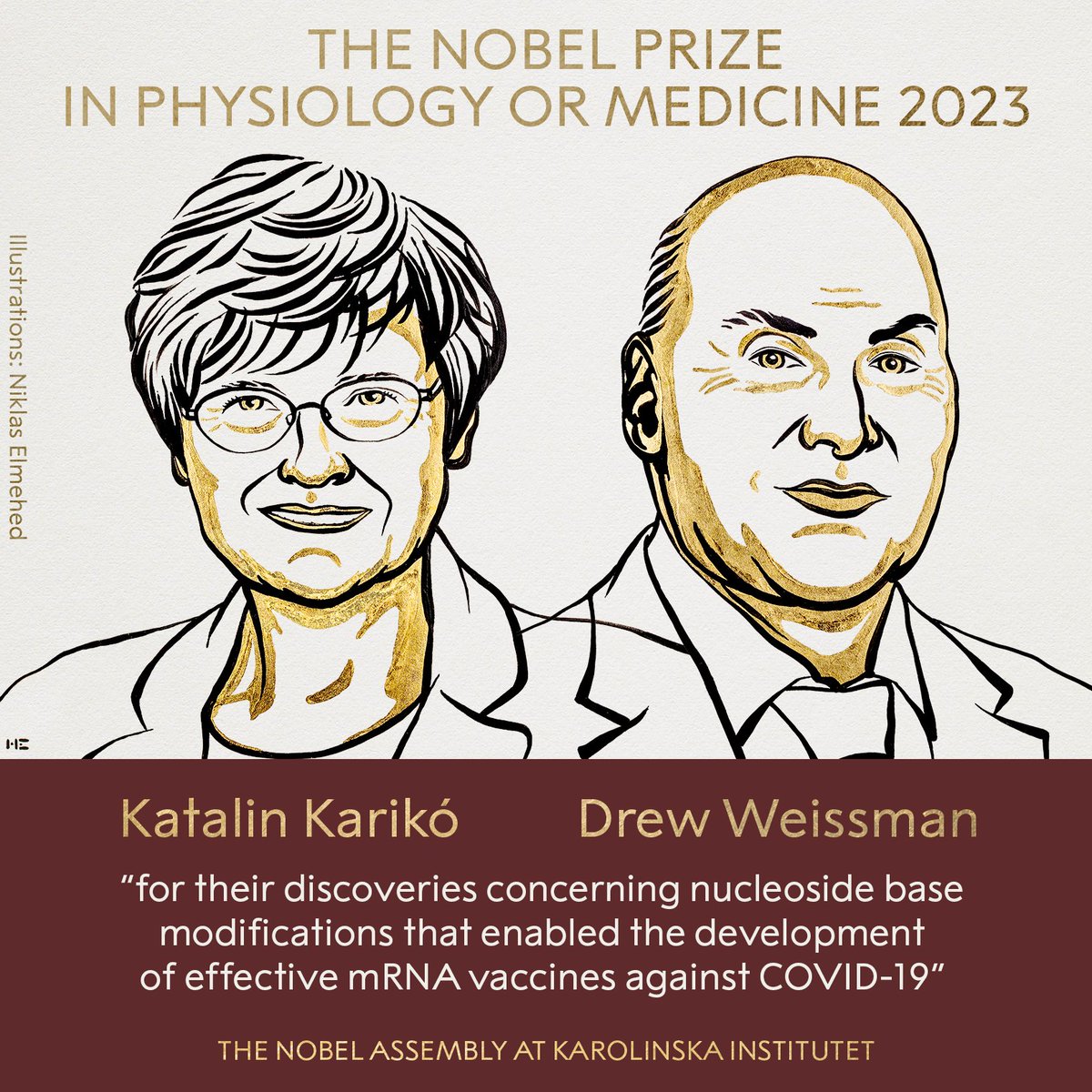
The 2023 #NobelPrize in Physiology or Medicine has been awarded to Katalin Karikó and Drew Weissman for their discoveries concerning nucleoside base modifications that enabled the development of effective mRNA vaccines against COVID-19.
My contract at Northwestern University expires today (August 31). I was invited to join @HKUniversity by President Xiang Zhang, starting tomorrow (1 September).
Carlsen's trophies until now:
World Cup 🏆
WC matches 🏆🏆🏆🏆🏆
World Rapid Ch 🏆🏆🏆🏆
World Blitz Ch 🏆🏆🏆🏆🏆🏆
Candidates 🏆
Tata Steel🥇🥇🥇🥇🥇🥇🥇🥇
Norway Chess 🥇🥇🥇🥇🥇
London Chess 🥇🥇🥇🥇
Shamkir🥇🥇🥇🥇
Sinquefield Cup 🥇🥇🥇🥇
Grenke 🥇🥇
Tal Mem🥇🥇
Nanjing 🥇🥇
Grand Chess Tour 🏆🏆
Happy that our article, in collaboration with the @HugelLab, about how the co-chaperone Aha1 interacts with the molecular chaperone Hsp90 is out! https://t.co/A4N40KcrWO
Congratulations to @LauraSilberman1 and the other authors! Also to @AnaRa022 for her first journal cover!
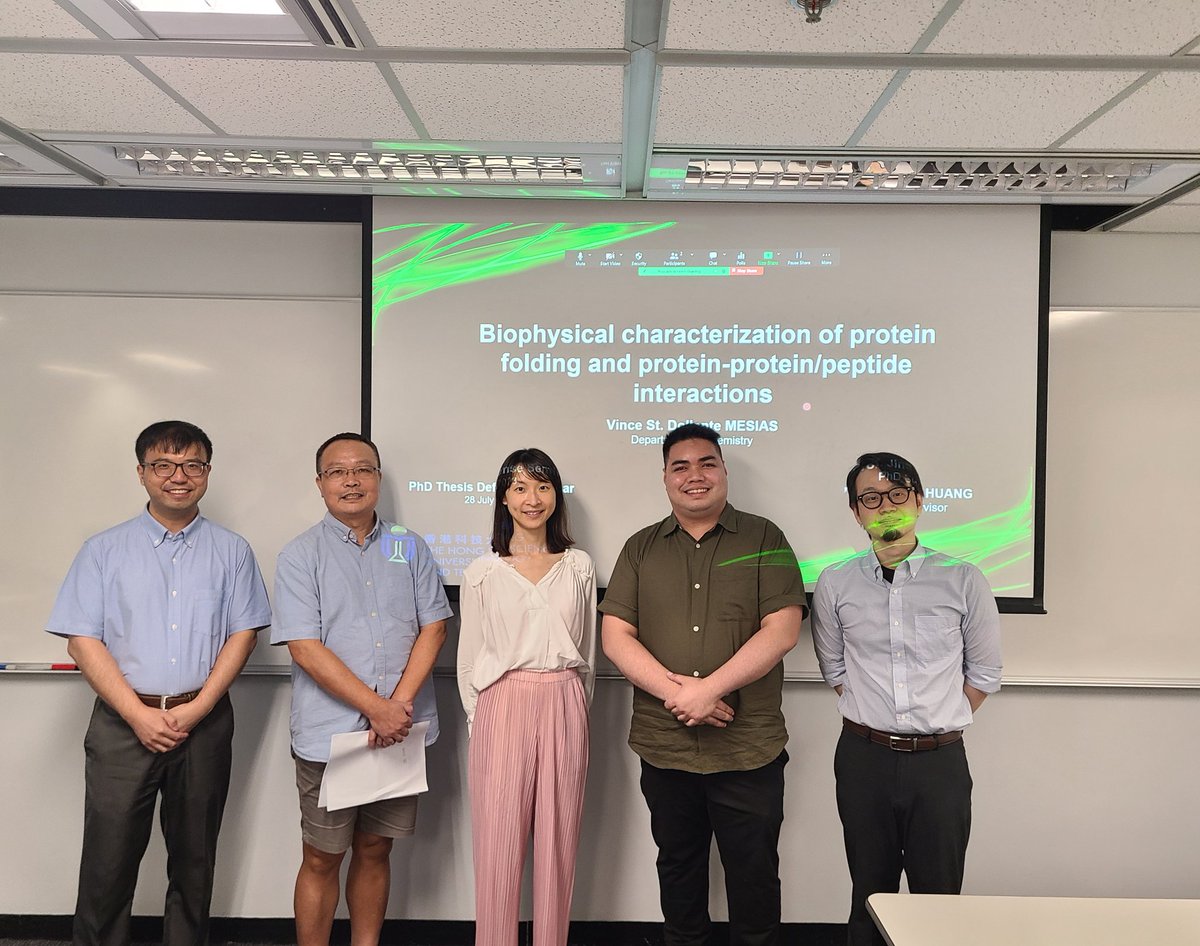
I successfully defended my PhD thesis today. Thank you so much to those who have been instrumental in the success of this pursuit.
Affixed is a photo with some of the members of the thesis exam committee, the external examiner from SJTU attended via Zoom.
#PhinisheD
You might also enjoy related very nice work from @jefflotthammer@alexholehouse and colleagues that was also just posted:
Direct prediction of intrinsically disordered protein conformational properties from sequence
https://t.co/6dtHc0aMKm
RIBOmap for spatially resolved single-cell translatomics is published today! Congrats to the whole team and thanks so much for the constructive feedback and great suggestion from the editor, reviewers, colleagues, and friends!
https://t.co/Dmxbe7atn5
Thankful and proud for the opportunity to contribute to my favorite journal @BiophysJ and my fave society @BiophysicalSoc .
Check out the latest and greatest in membrane biophysics in the Special Issue: https://t.co/feTJzUbF46