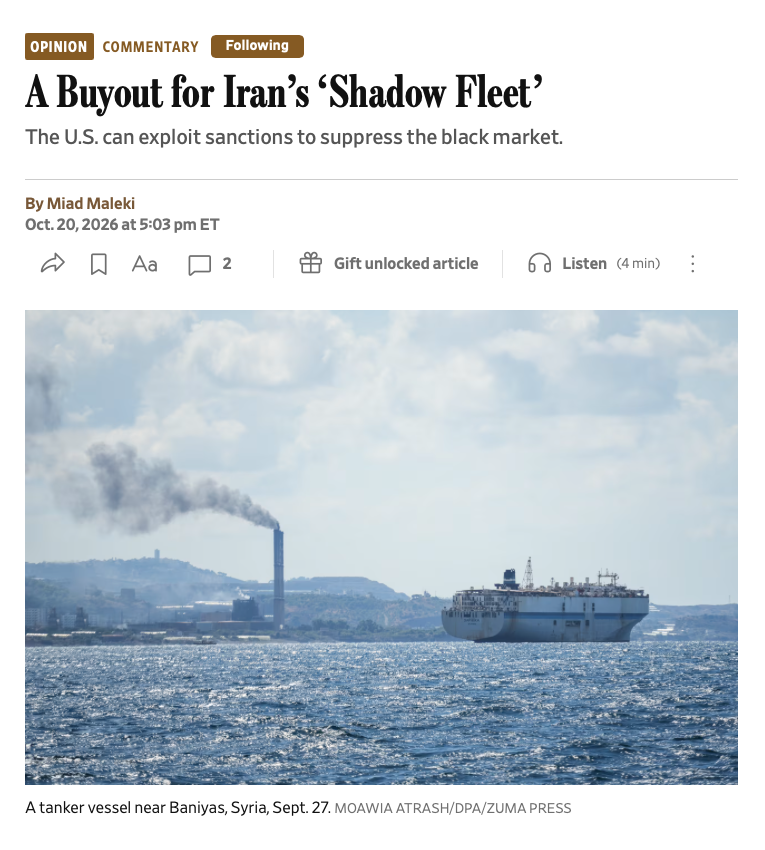
The U.S. can break the Iranian regime’s ghost fleet and the black market behind it. Not by lifting sanctions wholesale, but by letting U.S.-aligned companies buy the tankers out of Tehran’s black market, recycle them into legitimate trade and put them to work hauling Gulf oil through Hormuz while the blockade keeps Iran’s own cargo bottled up.
That gives anyone who wants out of Iran’s orbit a door: sell the ship to a legitimate operator and it comes off the list. The owners who stay get nothing.
@USTreasury has already shown it works. On Oct. 8 it delisted two ships sold to U.S.-aligned operators the same day it blacklisted 17 more.
My op-ed in today’s @WSJopinion.
.@FDD sanctions expert @miadmaleki spent years choking Iran's economy through secondary sanctions. He tells Israel Hayom why that same toolkit, and blockchain especially, could never protect an export economy built on Nasdaq listings and Silicon Valley contracts. https://t.co/Ony3wNXNUr
A free Venezuela will be a boon to freedom everywhere.
My prayers go out to María Corina, her team, and the people of Venezuela as they fight for liberty and their country.
May they be safe and victorious.
“I didn’t have to fire a missile.” - President Obama on Iran.
That’s right, Mr. President. You didn’t.
Not when Iran-backed militias in Iraq killed American service persons there.
Not as the IRGC deepened ties with the Taliban (but also al-Qaeda and the Haqqani network) as it killed Americans in Afghanistan.
Not when the IRGC-QF plotted to kill the Saudi Ambassador to Washington in a Georgetown restaurant via Mexican drug cartels
Not as Iran began enriching uranium to 20 percent purity, which is highly enriched.
Not as Iran began enriching uranium in centrifuges in its highly fortified underground Fordow facility for the first time.
Not as Iran threatened to close the Strait of Hormuz.
Not as IRGC-Navy fast attack craft routinely harassed American Navy vessels and commercial traffic in and around the Persian Gulf.
Not as Iran tested medium range ballistic missiles capable of carrying nuclear payloads with genocidal phrases against Israel written in Hebrew.
Not as Iran continued to work on space launch vehicles with the ultimate goal of developing longer-range strike platforms that could one day threaten the European continent and the US homeland.
Not as Iran beefed up its drone program.
Not as the regime successfully co-opted the Houthis in Yemen and began to provide them with material support as the group entered the Axis of Resistance.
Not as the Islamic Republic backed Assad’s slaughter of Syrians to the hilt and intervened decisively, later along with Russia, in that theater and created a security and humanitarian catastrophe I the Middle East and refugee crises that has thrown a massive curveball into European politics and demographics.
And last but certainly not least, not as Iranians whose calls for support you ignored during the Green Movement were killed, arrested, beaten, and tortured.
Interview @IsraelHayomHeb with @FDD sanctions expert and former @USTreasury official @miadmaleki on the risk of financial and economic warfare against Israel. https://t.co/MHX6vhCFyp
Interview with @MiadMaleki, a former senior official at the U.S. Treasury’s Office of Foreign Assets Control (OFAC), who helped design the maximum-pressure sanctions campaign against Iran and is now a senior fellow @FDD.
His central argument is that Israel would be far more vulnerable than Iran to serious financial sanctions because its economy is deeply integrated into Western financial markets.
The article makes several important points:
1. Sanctions could extend far beyond the West Bank. Israeli banks finance construction and provide mortgages in the settlements. Foreign financial institutions could sever relationships with these banks rather than risk exposure to sanctions.
2. Banks may overcomply. Even narrowly targeted sanctions can have wider consequences because financial institutions avoid activities that might expose them to U.S. penalties. Maleki cites the rapid freezing of sanctioned settlers' bank accounts in 2024.
3. Israel cannot realistically circumvent Western sanctions. Unlike Iran, Israel depends heavily on Western investment, dollar transactions, technology exports, and international financial integration. Cryptocurrency would not provide a viable alternative.
4. Banking sanctions are the greatest danger. Maleki distinguishes between sanctions on individuals, trade restrictions, and financial sanctions. He argues that measures targeting banks would be the most consequential.
5. The political threat could grow. The article discusses potential congressional action after the November 2026 midterm elections and the possibility that a future Democratic president could reinstate and expand sanctions.
6. The consequences could be severe. Maleki warns that broad financial isolation could undermine Israel's standard of living and its access to international markets.
The article's central warning
Maleki says:
“Israel will not become Iran, but it will not be able to remain Israel either.”
He argues that Israel, with $165 billion in annual exports, 56% of them services sold to Western companies, cannot build an alternative economy insulated from Western financial pressure.
He concludes that the distance from such a scenario depends on Israeli conduct in the West Bank and whether support for Israel in Washington remains bipartisan.
“The president has been briefed on a series of options prepared by the Pentagon, officials said. The plans range from striking nuclear facilities and infrastructure, such as bridges, to conducting assaults on islands controlled by Iran, according to some of the officials.”
“Trump is leaning toward a return to major combat operations, the officials said…”
https://t.co/OJWZ9roveS
The architect of the Biden administration’s unprecedented sanctions program targeting an American ally was former Deputy National Security Adviser @jonfiner.
His position is clear: wage financial and economic warfare and arms embargoes against Israel, regardless of who leads its government or which coalition holds power.
In our @NYPostOpinion piece in September, @FDD@miadmaleki and I recommended the U.S. should focus on a land blockade on the regime in Iran to complement the maritime and air blockade. It now seems to be working. Iran is losing overland routes. https://t.co/fxiiLngic5
Strikes once led and sanctions supported them. Now the blockade is doing the damage and strikes help the US maintain its economic war. Iran has only a few ways to relieve the pressure, and a strikes take out the hardware behind all of them. My piece for @IranIntl
https://t.co/xF7GVJC6gt
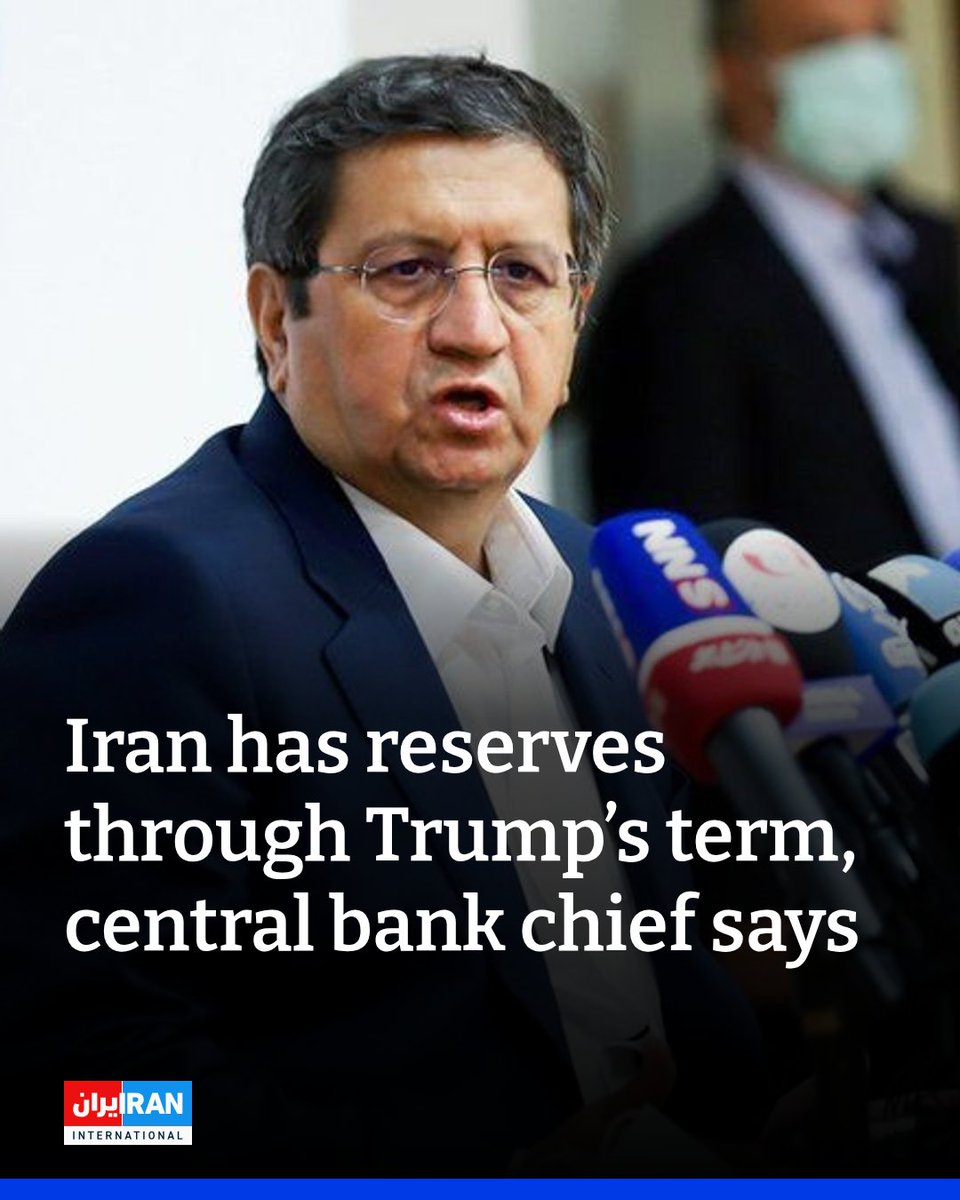
Iran's central bank governor says reserves will last through Trump's term. But do the math. The Central Bank itself estimates $20 billion of import foreign exchange for the next 6 months. President Trump has 27 months left. That is roughly $90 billion, with no crude exported since August and the pre-war estimate of reserves near $23 billion mostly in China and not usable due to the blockade.
The rest is frozen in Qatar, Iraq and China. So where does the money come from? Printing rial covers salaries. It does not buy gasoline.
Iran has enough foreign currency reserves to cover imports through the end of US President Donald Trump’s term and beyond, central bank chief Abdolnaser Hemmati said.
Iran’s reserves were in good shape and authorities had made plans to maintain foreign currency supplies, Hemmati said.
He added that oil revenues made up a small share of the budget and the government could cover deficits through other sources, including asset sales and fuel exports.
He also said inflation had eased in the three months to September after some damaged infrastructure and industrial facilities returned to production, while central bank measures helped curb inflation expectations.
https://t.co/TnqOdddAzt
The regime in Iran is moving from a fiscal problem to a physical one. It can print rial to paper over lost oil revenue but the lost oil flow ($3–6 billion a month) is about the size of its Central Bank's entire planned import budget for the second half of the year ($20 billion over 6 months).
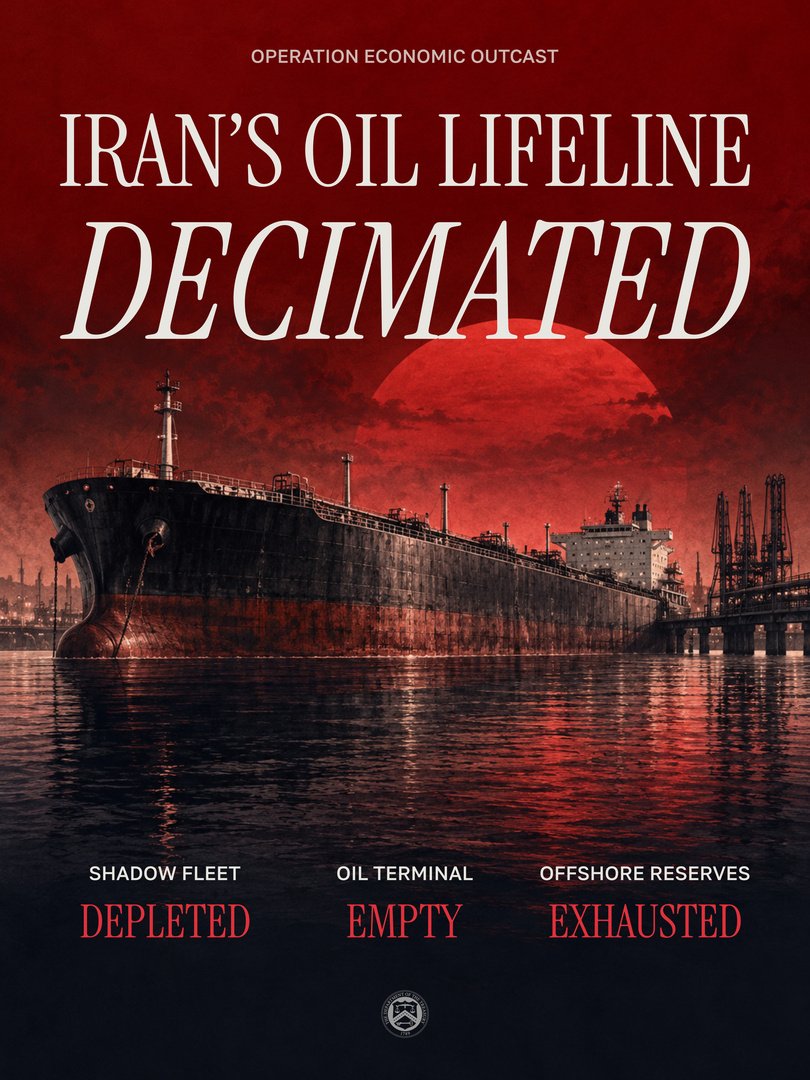
Treasury launched Operation Economic Outcast to tighten the noose and block every potential source of revenue that funds the IRGC and murderous Iranian regime.
Less than two months later, we have decimated every layer of Iran’s oil lifeline. Its shadow tanker fleet stands depleted. Its main oil terminal sits empty. And its offshore reserves are now exhausted. Meanwhile, ordinary Iranians continue to endure a deepening economic crisis because the regime squanders its resources on violence and terrorism abroad instead of the prosperity of its people at home.
As President Trump takes action that his predecessors long deferred, the United States is no longer managing the Iranian threat. We are ending it.
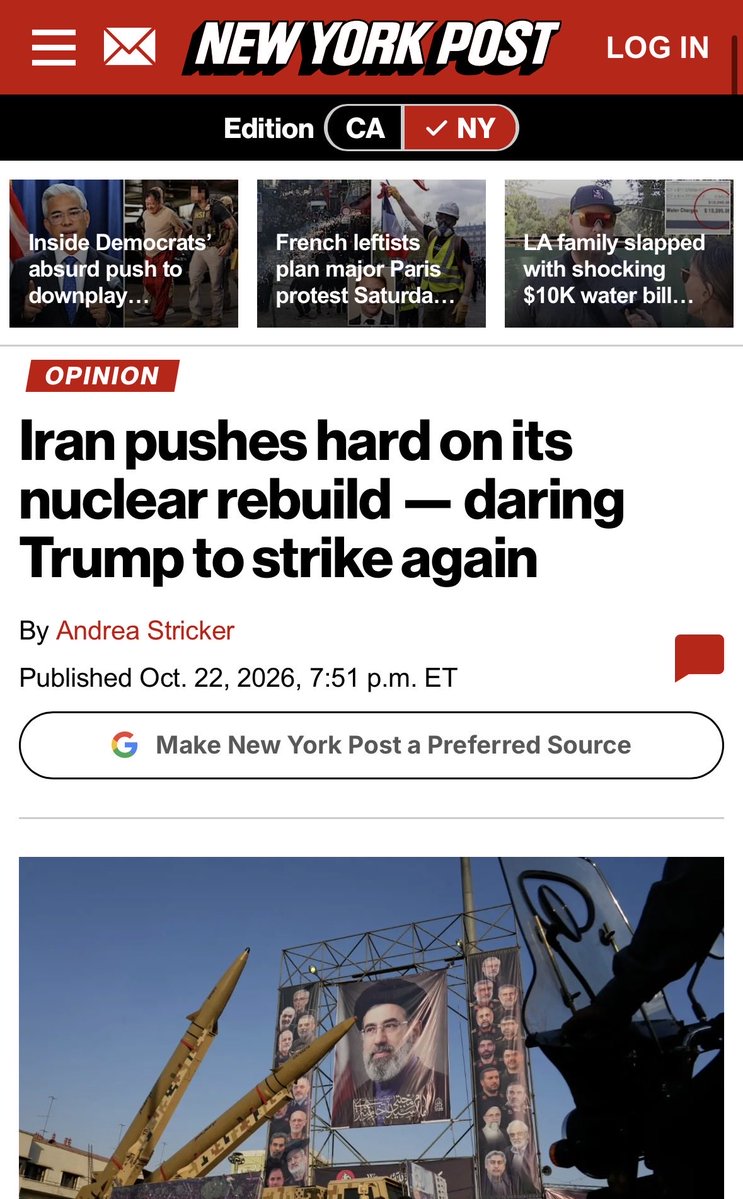
The regime’s unbending pursuit of nuclear weapons and its refusal to make peace remind us why it’s so dangerous — and why a new, limited round of military strikes may be necessary.
My latest for @nypost 🔗
Washington should create incentives for U.S.-aligned operators to buy ships out of Iran’s black market and put them to legitimate use in the Strait of Hormuz, writes @miadmaleki
https://t.co/k4sZ3iuYsJ
The U.S. can break the Iranian regime’s ghost fleet and the black market behind it. Not by lifting sanctions wholesale, but by letting U.S.-aligned companies buy the tankers out of Tehran’s black market, recycle them into legitimate trade and put them to work hauling Gulf oil through Hormuz while the blockade keeps Iran’s own cargo bottled up.
That gives anyone who wants out of Iran’s orbit a door: sell the ship to a legitimate operator and it comes off the list. The owners who stay get nothing.
@USTreasury has already shown it works. On Oct. 8 it delisted two ships sold to U.S.-aligned operators the same day it blacklisted 17 more.
My op-ed in today’s @WSJopinion.
Germany’s financial regulator BaFin said on Thursday that Bank Saderat #Iran’s Hamburg branch had lost its banking license and must be wound up. The branch, which operated in Hamburg and Frankfurt, is no longer allowed to conduct banking business.
https://t.co/mafUvmeC1j
Iran has depleted millions of barrels of oil stored aboard tankers in Asian waters after a months-long US naval blockade prevented Tehran from replenishing supplies normally sold to China, The Wall Street Journal reported Wednesday, citing analysts at Kpler.
The floating reserves, which had provided Iran with a steady source of revenue during the war, were fully depleted by mid-October, according to the report.
“There’s no more oil to discharge to China anymore,” Homayoun Falakshahi, head of crude oil analysis at Kpler, told the Journal.
US Central Command said Saturday that the blockade had denied Tehran at least $25 billion in oil revenue and would constrain its ability to replace destroyed factories and weapons.
“US actions have imposed devastating costs on Iran’s security apparatus,” Admiral Brad Cooper, head of US Central Command, said.
https://t.co/BBZEnizjya
While nearly everyone else was declaring the Battle of Hormuz lost, we at @FDD were calling this outcome for months.
Never underestimate @CENTCOM, @centcomcdr, or the extraordinary men and women of the U.S. military.
The U.S. and Israel are telling the IRGC that they are prepared to immediately respond forcefully to any October surprise. That should not be confused with Trump or Netanyahu wanting escalation before their elections are over. Clearly a faction in Tehran keeps pushing the option.