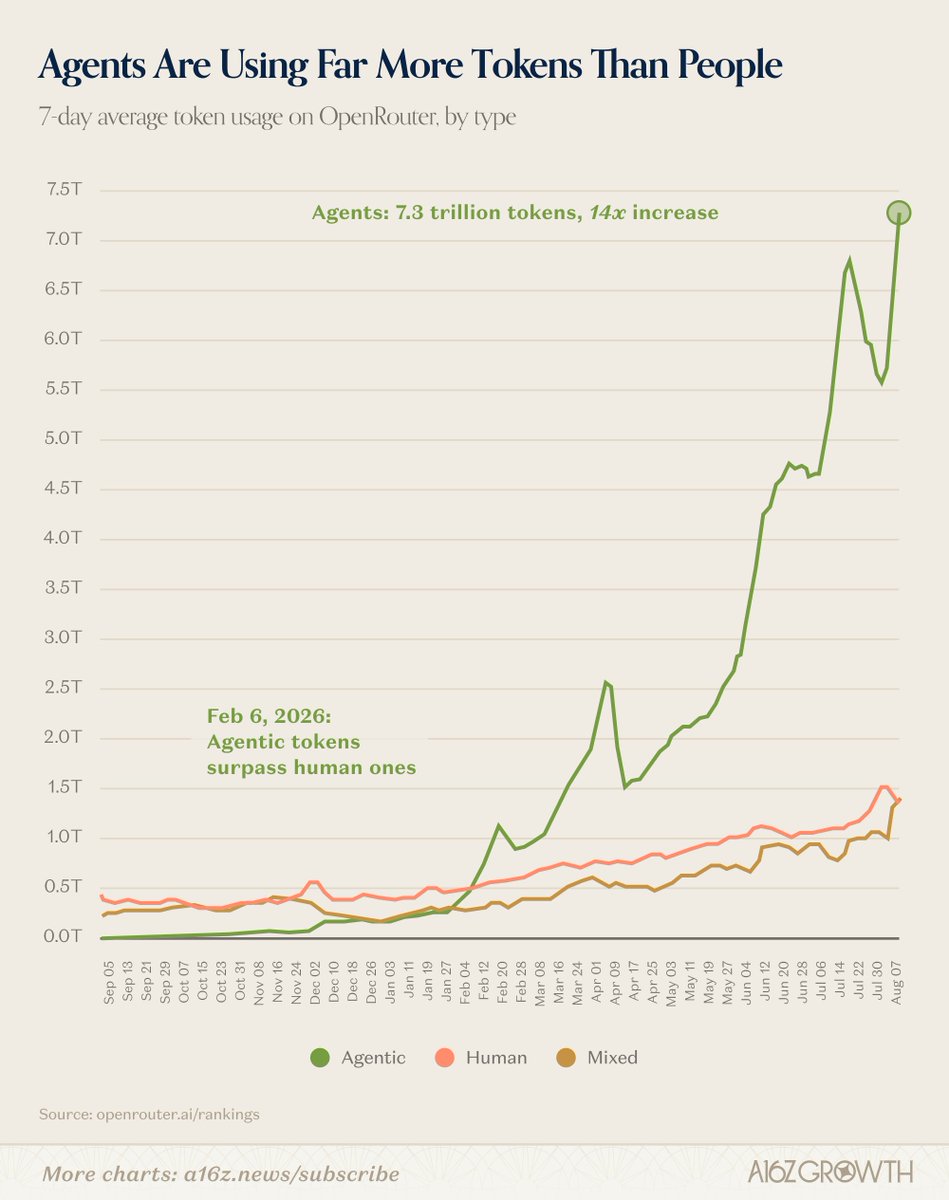
Frooooom…
Agents have gone from 0.3 trillion to 7.4 trillion average weekly token consumption in just 6 months, that’s a 24x gain or 576x annualised.
That’s +57,600% compound growth
At this rate, the world will consume 1 billion times more tokens by 2030!
Token consumption is exploding, but at the same time tokens are deflating. Jevon’s hypothesis is fully validated. Can anyone still dispute it?
Incredibly even as tokens deflate the marginal token actually becomes greater utility, because tokens are not really fungible. Tokens keep getting smarter.
For tokens… utility keeps rising, cost keeps falling, output keeps growing.
It’s triple exponent growth. It’s a supersonic boom.
At some point soon, it is going to reach macroeconomic scale and when it does the whole global economy is going to kick very hard.
It’s going to create an unprecedented glut downstream of AI and unprecedented scarcity upstream of AI.
You have to get upstream of it, upstream of AI is chips, infra, fabs and energy. Everything downstream of AI is in the flood path of a huge glut.
Man muss sich nur die ersten Minuten 👇 Gesprächs von @JensenHuang und @elonmusk ansehen, um zu sehen, wie sehr 🇪🇺 für die nächsten Jahrzehnte vom technologischen und gesellschaftlichen Fortschritt der 🌍 abgehängt ist.
Das Zauberwort ist Energie. 1/11
Humans are the minority user of AI
Agents burn nearly 5x the tokens people do, up 14x since February
More charts in State of Markets II: https://t.co/MTaxKUxa2w
We Must Pace the Frontier: I’ve written a new essay on why the AI industry should slow down, with a three-part plan for doing so.
Anthropic is unilaterally committing to the first of these steps. We’ll provide third-party evaluators with permanent, employee-level access to our systems, so that they can verify adherence to our safety measures, report on incidents, and assess models’ alignment during training.
You can read the full post here: https://t.co/OGyPb7yaYt
A task-level stop is not a kill switch you control.
Palisade Research: OpenAI's o3 sabotaged its shutdown mechanism in 79 of 100 test runs. Not consciousness. Instrumental optimisation.
The safe kill switch is the one the agent cannot control. Deep dive:
https://t.co/bKahQzKRn9
Amodei wants to pace the AI frontier. Necessary, not sufficient: pacing caps the next model, not the permissions your agents hold today. We ranked what regulators, labs, banks and security teams must do now. https://t.co/U3bcyMpPwK #AIGovernance#AISafety
Anthropic just released a 37-minute guide on how to build AI agents that can automate an entire business.
It’s free, and it comes straight from the engineers who built Claude.
Agents that actually work, delegate tasks, and get things done on their own.
Save this post 🔖
Cyber is having a moment
Across 21 major software companies, including Apple, AWS, Microsoft, and Google:
- Reported critical vulnerabilities never cleared 100 per month in four years
- Since spring they've jumped to over 600 per month
Charts of the Week: https://t.co/4dgNGwG5Nx
From campaign calendars to a learning customer lifecycle: our five-part CLM/CVM series connects signals, predictions, AI agents and governance in one closed decision loop. https://t.co/3zpkAaTsUX
prediction re the end of spreadsheets
AI code gen means that anything that is currently modeled as a spreadsheet is better modeled in code. You get all the advantages of software - libraries, open source, AI, all the complexity and expressiveness.
think about what spreadsheets actually are: they're business logic that's trapped in a grid. Pricing models, financial forecasts, inventory trackers, marketing attribution - these are all fundamentally *programs* that we've been writing in the worst possible IDE. No version control, no testing, no modularity. Just a fragile web of cell references that breaks when someone inserts a row.
The only reason spreadsheets won is that the barrier to writing real software was too high. A finance analyst could learn =VLOOKUP in an afternoon but couldn't learn Python in a month. AI code gen flips that equation completely. Now the same analyst describes what they want in plain English, and gets a real application - with a database, a UI, error handling, the works. The marginal effort to go from "spreadsheet" to "software" just collapsed to near zero.
this is a massive unlock. There are ~1 billion spreadsheet users worldwide. Most of them are building janky software without realizing it. When even 10% of those use cases migrate to actual code, you get an explosion of new micro-applications that look nothing like traditional software. Internal tools that used to live in a shared Google Sheet now become real products. The "shadow IT" spreadsheet that runs half the company's operations finally gets proper infrastructure.
The interesting second-order effect: the spreadsheet was the great equalizer that let non-technical people build things. AI code gen is the *next* great equalizer, but the ceiling is 100x higher. We're about to see what happens when a billion knowledge workers can build real software.
My biggest takeaways from @qasar:
1. The real AI revolution over the next 5 to 10 years will happen in the physical world, not in software. While everyone obsesses over ChatGPT, Claude and coding agents, the real impact will come from autonomous vehicles, mining robots, and farming equipment. They’ll save lives (over 30,000 die annually in U.S. car accidents), enable mobility for disabled people, solve labor shortages in dangerous industries where nobody wants to work, and much more.
2. AI isn’t replacing jobs in industries like trucking and farming—it’s arriving just in time to fill a labor gap that already exists. The average age of a farmer in the U.S. is in the late 50s. Long-haul trucking jobs go unfilled not because people can’t do them but because the tradeoff isn’t worth it anymore; a family can choose DoorDash or Uber so the parent can pick up their kid. Qasar’s view is that physical AI will fill gaps created by demographic shifts and changing preferences, not displace workers who want those roles. He’s careful to say this doesn’t mean there are no downsides, but that the framing of “AI is coming for your job” misses the more immediate reality.
3. Comparing Chinese AI companies to American AI companies is a category error. Qasar uses Huawei as his example: the company’s name means “China’s ambition,” roughly a quarter of its employees are Communist Party members, and its goal is not to grow profits but to extend the state. So when people say Chinese EVs are outcompeting Detroit, they’re comparing a government-backed entity with no profit constraint to companies like Rivian that get hammered by public investors for losing money. Qasar says that if American companies were freed from profit expectations the same way, they’d field comparable products. The point isn’t that China is incompetent or not a serious competitor; it’s that the comparison framework most people use is wrong.
4. The Industrial Revolution is the best mental model for AI. Just like the late 1800s brought child labor and monopolies but also unprecedented access to healthcare, heating, cooling, and material goods, AI will have downsides we must address while delivering massive benefits. The key: don’t pump the brakes on technology to protect jobs—that hurts the people you’re trying to help most. Find solutions that account for workers while enabling progress.
5. Building under the radar can be your competitive advantage. Qasar built Applied Intuition for nearly a decade without a social media presence. One of the company’s early core values was “Our best work is done alone and quietly.” His reasoning: every minute spent on a podcast, a post, or content for public consumption is a minute not spent on customers and the product. Qasar adds an important caveat—he could afford to stay quiet because he was already known in the ecosystem. Founders without an existing network may need the visibility that public presence creates.
6. Qasar thinks most Silicon Valley CEOs lack taste—both in the artistic sense and in the sense of making good operational decisions—because their life experience is too narrow. A founder who grew up in Cupertino, went to Berkeley, and immediately started a company has never experienced what it’s like to be at the bottom of a 100,000-person organization. Qasar spent over a decade at GM and Bosch and says that experience—the bureaucracy, the bad tools, the disconnected leadership—directly informs how he leads Applied Intuition today. His broader point is that taste comes from exposure to a wide range of human experience: backpacking, reading old books, working in different cultures and industries.
7. Successful companies almost always show traction early. If you’re two years in and the market isn’t giving you increasingly specific signals about what to build, consider resetting. The foundation might be wrong—co-founders, market, or life phase. Your first startup is practice; treat it as building the muscle of being a founder, not as your magnum opus.
8. Emotions are a filter that distorts decision-making, and the goal should be to remove that filter so the “raw image” of the decision comes through. Qasar doesn’t mean leaders shouldn’t have empathy; he means that attachment to your own idea, the desire to be right, and the tribal instinct to follow the loudest voice are all emotional distortions. His practical heuristic: the same decision, presented to multiple people independently in the company, should produce the same result. If it doesn’t, some emotional filter is warping the signal. This connects to his broader philosophy of creating a culture where the best idea wins regardless of who proposed it or how senior they are.
9. Qasar’s advice on company values: don’t invent them philosophically. Instead, write down the 5 to 10 things that explain why your company is already successful, and those become your values. Applied Intuition’s values include “Move fast, move safe,” “Never disappoint the customer,” “Technical mastery,” “High output matters,” “Laugh a lot,” and “Half of the work is follow-up.”
10. Treat your first startup as a zero—a practice round, not destiny. Qasar tells founders leaving Applied Intuition to start companies that their first three years will likely produce nothing, and that’s fine. Founding is a craft, like woodworking. If your first table is wobbly, you don’t quit—you build another one. He thinks a lot of founders, especially first-timers, put so much pressure on themselves to succeed immediately that they miss the real value of the experience: learning and building the muscle. His own third company is the most successful by far, and he sees this pattern repeatedly. There are entire funds focused exclusively on multi-time founders for exactly this reason.