As the global gas market grapples with the Strait of Hormuz being all-but closed for nearly three months, traders are fixated on two wildcards: China and the weather https://t.co/qq8D55YCH4
Information Ontogeny as Infrastructure.
Updated working paper, incorporating a section on acoustics. #SoundSignals#SpatialSignals https://t.co/vC7cft9fxB
Keep an eye on Dr. Najat Khan & @RecursionPharma - bringing the company back down to Earth, and with a sensible path to AI-driven product deployment. https://t.co/9ENauf6NdA
The Food Tech Salon at #SynBioBeta2026 was a great session today.
Practical and achievable goals were discussed - this is not always the case.
@SynBioBeta
Anthropic Says Life Sciences Is Its Biggest Bet After Code.
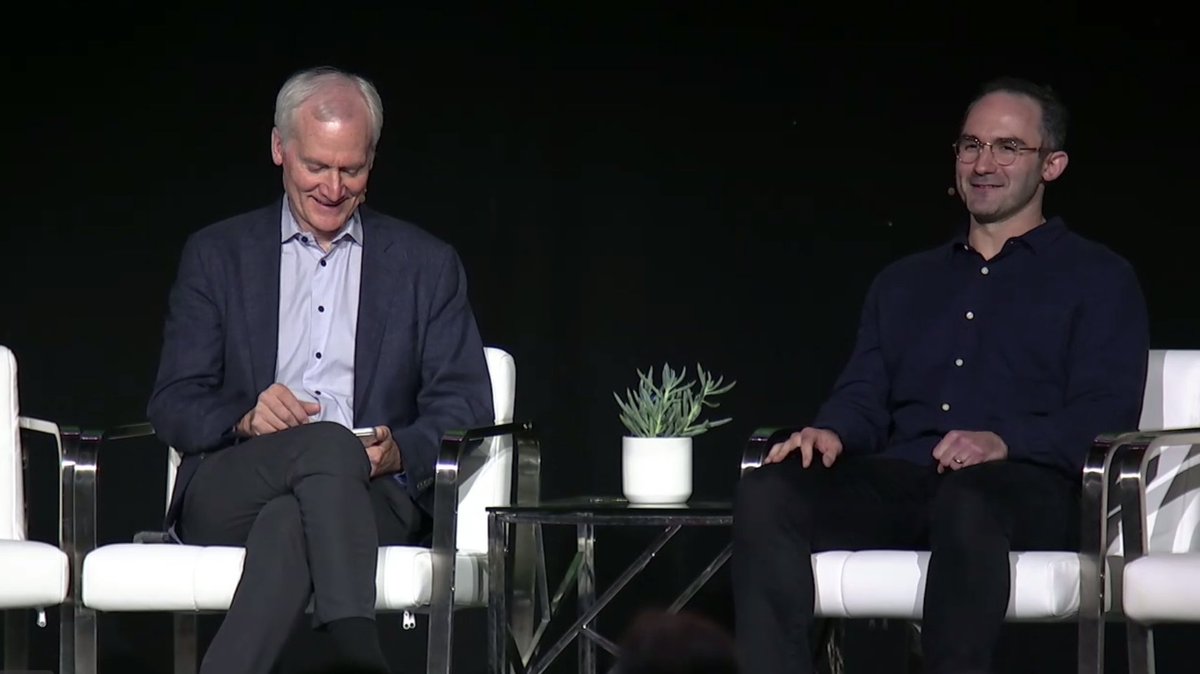
Eric Kauderer-Abrams started @AnthropicAI 's life sciences division ten months ago. He took on the stage at @SynBioBeta with Marc Tessier-Lavigne from @Xaira_Thera , and what caught my attention was how plainly Eric stated the following:
"The greatest opportunity to have a beneficial, scaled impact with everything that's happening in frontier AI is in the life sciences."
After coding, it's their biggest investment area. They've been training Claude on bioinformatics, chemistry, molecule design, structural biology, clinical regulatory. Their models went from mediocre in life sciences to roughly PhD level across most domains in under a year. That's a steep curve.
But what I found more telling than the benchmarks was the infrastructure they're building around it. Wet labs for basic research so their own scientists hit the walls firsthand. An acquisition of Coefficient Bio (acquired by Anthropic) to teach @claudeai how to think like a biotech program manager, not just a bench scientist. The gap between "Claude can answer a biology question" and "Claude can help you run a drug program" is enormous, and they're clearly aware of it.
Marc mentioned that 90% of drugs fail in the clinic. Two-thirds of those failures aren't bad science, but patient matching. You have a good target, a good drug, and you can't find who will respond. That's the problem both of them kept circling back to, and it's where causal AI models trained on real perturbation data might actually move the needle.
Marc said nobody's pushing a button for a development candidate anytime soon. But Anthropic went from $1B to $30B in revenue in sixteen months. That kind of resource behind this kind of focus is new. It's fun to think of what R&D can look like in the next few months!
#SynBioBeta2026 #SyntheticBiology #Biotech #AIxBio
Important issue for the #SpaceTech & #Data communities.
Do AI tools undermine trust in geospatial imagery? https://t.co/WAfphW5r5m via @SpaceNews_Inc