Sam Altman (CEO of OpenAI):
“You no longer need to write prompts.”
That sounds crazy.
But in just 38 minutes, he explains how to use ChatGPT at a level most people haven’t even discovered yet.
This was a talk he gave to Stanford students.
A friend sent me the recording last night.
I watched it.
And honestly, it made me realize something:
I was probably using only ~15% of what ChatGPT can actually do.
Most people use ChatGPT like this:
→ Ask a question
→ Get an answer
→ Copy it
→ Done.
But that’s only the beginning.
The real power comes when you stop treating ChatGPT like a search box and start treating it like a thinking partner.
You can use it to:
→ Research ideas
→ Analyze complex information
→ Build workflows
→ Improve your decision-making
→ Create content
→ Write and debug code
→ Automate repetitive tasks
→ Turn vague ideas into structured plans
→ Build systems that continuously improve their own output
And the most interesting part?
You can create a system where you don't have to keep writing the perfect prompt every time.
Instead, the system learns what you want, asks the right questions, evaluates its own output, and improves the result.
That changes everything.
The goal isn't to become better at “prompt engineering.”
The goal is to build workflows where AI does more of the thinking for you.
Watch the full 38-minute talk.
Then read the guide I’m sharing below on how to build a system that prompts itself.
Once you understand this, you’ll never use ChatGPT the same way again.
El apostador más temido de Las Vegas arriesga $2 millones CADA domingo…
y ninguna casa de apuestas sabe que es él.
Una hora antes del kickoff, Billy Walters se sienta frente a una pared de pantallas y teléfonos.
Opera como si dirigiera un fondo cuantitativo de Wall Street.
Nunca pone una sola apuesta con su nombre.
Sus socios entran a los sportsbooks con nombres falsos (Jbird, Wolfman…) y ejecutan las órdenes en el segundo exacto en que él llama.
Sus analistas son matemáticos que llevan 30 años trabajando para él…
y nunca se han visto la cara entre ellos.
Modelan clima, lesiones, movimientos de líneas… TODO.
Solo Walters ve el tablero completo.
No apuesta por “corazonada”
Precifica los partidos mejor que las casas y solo dispara cuando la matemática dice que la línea está mal.
En cuanto una casa descubre que está detrás de una apuesta… deja de aceptarla.
Por eso permanece invisible.
30 años.
Cero años perdedores.
Un jugador que no cree en la suerte…
cree en los números.
@INDIURBANEJA@maibortpetit Todos entendimos el mensaje, pronto se viene abrazo dentro de la cárcel, eso todos lo sabemos, solo hay que darle tiempo al tiempo :)
Para los opositores es un payaso pero Michelo es el chavista de a pie y ven como todo su Disney Rojo de 27 años se le va desmoronando .. este es el inicio aumentar los costos paulatinamente del agua y la luz hasta equipararlas a el primer mundo el tema es que no hay empleos y salarios acordes
Un estudiante de 5to año reclama que en el liceo donde estudia la directora mando sus notas al Ministerio de educación erradas y ellos niegan a solucionarles el problema cuando el estudiante alega que su promedio está en 19 puntos, y supuestamente el liceo "no puede hacer nada"
JP Morgan paid ~$700K/year to headhunt this Goldman Sachs trader, who turned $25M → $400M
- Lehman Brothers also hired him and after he left the bank collapsed with $600B in debt
16-min and you’ll learn exactly what skills made every top fund on Wall Street chase the same trader
this is CRAZY!
Martin Shkreli made $500M shorting pharma and his whole strategy was literally just reading. that’s it.
most people hear “shorting pharma” and think insider trading. his actual edge was embarrassingly simple.
he read the clinical data.
a drug goes into trials. data shows it doesn’t work. the science doesn’t even make sense.
but investors see “cancer drug in the pipeline” and throw money at it like a scratch off ticket.
shkreli read the research, saw the science was garbage, and shorted it.
almost every time he was right.
>the wild part is none of this was hidden. clinical trials are public<
anyone could have done this.
most people didn’t because reading FDA filings is boring, tedious work.
that was his moat.. homework
save this one.
ICT explains the real difference between
Break of Market Structure vs Shift of Market Structure
and how price truly delivers.
Most traders are confusing both and losing money.
If you’re serious about trading:
Bookmark. Retweet. Drop your thoughts.
CC: @I_Am_The_ICT
I'm a little confused with Lucid Live Transition.
I was offered Live which would take 3-4 weeks to setup or just get a payout of $30k at 80/20 split.
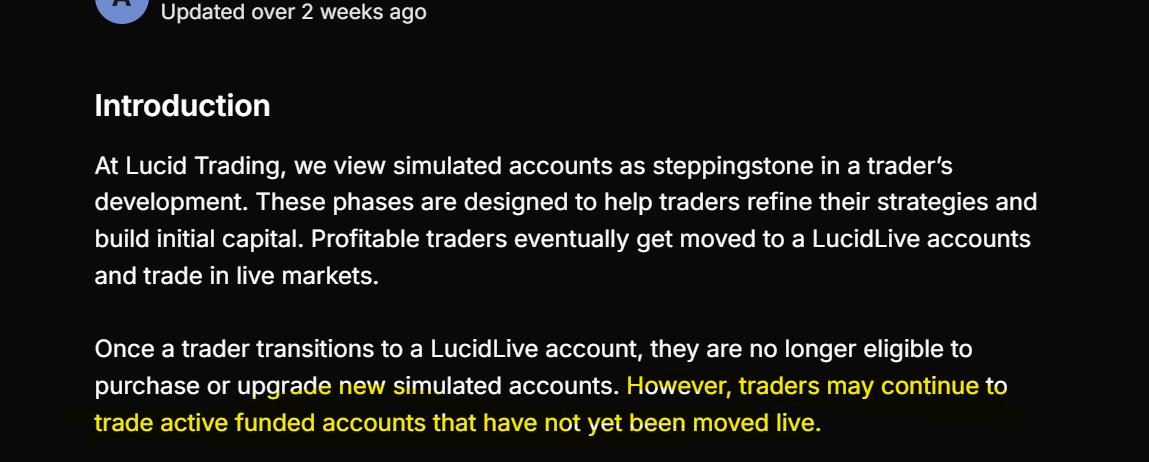
I took the payout but I thought I would still be able to trade my other funded accounts because their FAQ says this (see screenshot)
I have the following:
1. Legacy Pro: Almost went 6 payouts but they stopped me right before 6th payout. I built a balance of $33k and they took this account "live" or "full payout." I opt'd for the full payout as I didnt want to wait for live as it sounds like lots of people have been patiently waiting for live.
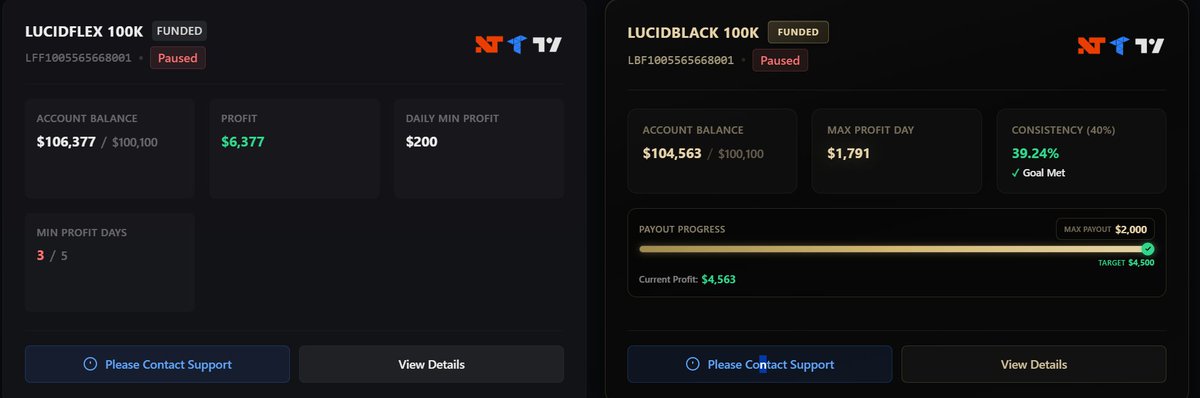
2. LucidFlex: I was 2 days away from first payout, just needed $200 on both days. Cant trade it any longer. Profit of $6,300 so far.
3. LucidBlack: I was at payout but stopped me from taking payout as they were "transitioning" me to live with my pro account. I thought I would still be able to trade my funded accounts while I take live full payout of my pro legacy accounts? Profit of $4300. I feel like they owe me at least a payout of LucidBlack since I was at payout and met all requirements but because before I can even click the payout button, they "transitioned" me to live.
Whats everyone else's experience for those that have the legacy pro accounts?
Jeffrey Epstein interview full FINAL interview before death released by the DOJ
0:00 Intro & Santa Fe Institute Question
Why a Wall Street financier supported the Santa Fe Institute and advanced mathematics research.
0:38 Rockefeller University Board Role
How he joined the Rockefeller University board and the shift from reputation → numbers in finance.
2:06 Finance vs Reputation Era Shift
Rise of calculators, quantitative thinking, and statistical portfolio management.
4:13 David Rockefeller Stories
Personal anecdotes about David Rockefeller and leadership style.
5:20 Trilateral Commission Explained
Purpose, structure, and membership of the Trilateral Commission.
6:58 Leaders & Financial Illiteracy
Claim that many political leaders lack deep financial understanding.
8:22 Bank Assets vs Liabilities
How bank balance sheets differ from personal finance intuition.
10:12 Fractional Reserve Banking
Explanation of lending multiples of deposits.
11:28 Entering Elite Global Circles
Experience joining Rockefeller & Trilateral Commission environments.
12:28 First Trilateral Meeting (Tokyo)
Reactions to global leaders and discussions on inflation.
14:09 Inflation & Central Bank Fear
Why inflation dominates central bank thinking.
16:02 Financial System as Complex System
Analogy between body systems and global finance.
18:03 Complexity Theory & Santa Fe Mission
Goal of mathematizing complex systems.
21:48 AI & Neural Nets Example
AI systems producing answers designers can’t explain.
24:30 2008 Crisis Setup
Lehman collapse context introduced.
26:05 Hearing About the Crash From Jail
Learning of the 2008 crisis while in solitary confinement.
29:16 Calls to Bear Stearns & JPMorgan
Phone calls during crisis moment.
31:12 Jail Conditions & Public Perception
Treatment in jail and reactions from inmates.
34:05 Moral Hazard & Bailouts
Bear Stearns vs Lehman decision framing.
37:29 Liquidity = “Blood of the System”
Emergency-room analogy for financial rescues.
42:12 Pre-Crash Warning Signs
Discussion of whether crisis was predictable.
44:02 Cause of 2008 Crisis (Subprime Argument)
Blames subprime expansion and political pressure.
47:23 Subprime Mechanics & Accounting Changes
Mortgage packaging and mark-to-market effects.
53:12 Cycles, Crashes & Pattern Skepticism
Rejects “every 10 years” crisis pattern idea.
58:02 “No One Understands the System” Claim
Unpredictability of complex financial systems.
1:01:21 Jail Reflection & Stoicism Discussion
Detachment and “hermit” self-description.
1:03:24 Market Intuition vs Prediction
Trader instinct vs mathematical forecasting.
1:08:29 Santa Fe, Los Alamos & Complexity Science
Origins and goals of the institute.
1:12:02 Limits of Mathematics & Alchemy Analogy
Attempts to explain the unexplainable.
1:16:02 Newton & Gravity Discussion
Forces, prediction, and unexplained fundamentals.
1:18:26 Calculus & Limits Concept
Newton’s limits and division-by-zero paradox.
1:22:02 Measurement vs Reality
Problems with over-measurement in science.
1:25:31 Soul, Consciousness & Dark Matter Analogy
Soul compared to unseen physical forces.
1:29:30 Santa Fe Verdict: “Failure”
Claim that complexity math could not explain life or markets.
1:34:08 Multiple Intelligences Theory
Emotional vs mathematical intelligence.
1:38:26 Traders & Market “Feel”
Experienced traders rely on intuition.
1:40:31 Butterfly Effect Example
Small shocks → system-wide consequences.
1:42:02 Limits of Science & Consciousness
Science cannot explain romance, intuition, soul.
1:45:02 Quantum Physics vs Newtonian
Subatomic behavior defies classical models.
1:49:09 Writing vs Thinking (Socrates)
Claim that writing narrows thinking.
1:52:01 Philanthropy & Scientific Progress
Doubts about institutional research breakthroughs.
1:54:49 Ethics of “Dirty Money” Donations
Debate over whether institutions should accept funds from criminals.
@ElCuartoRoj0@DeptofWar@POTUS Jaja esta cuenta @ElCuartoRoj0 responde esta publicación en inglés a ver si alguien les para bolas y las respuestas de los mismo nigerianos es lo mejor 🤣🤣🤣