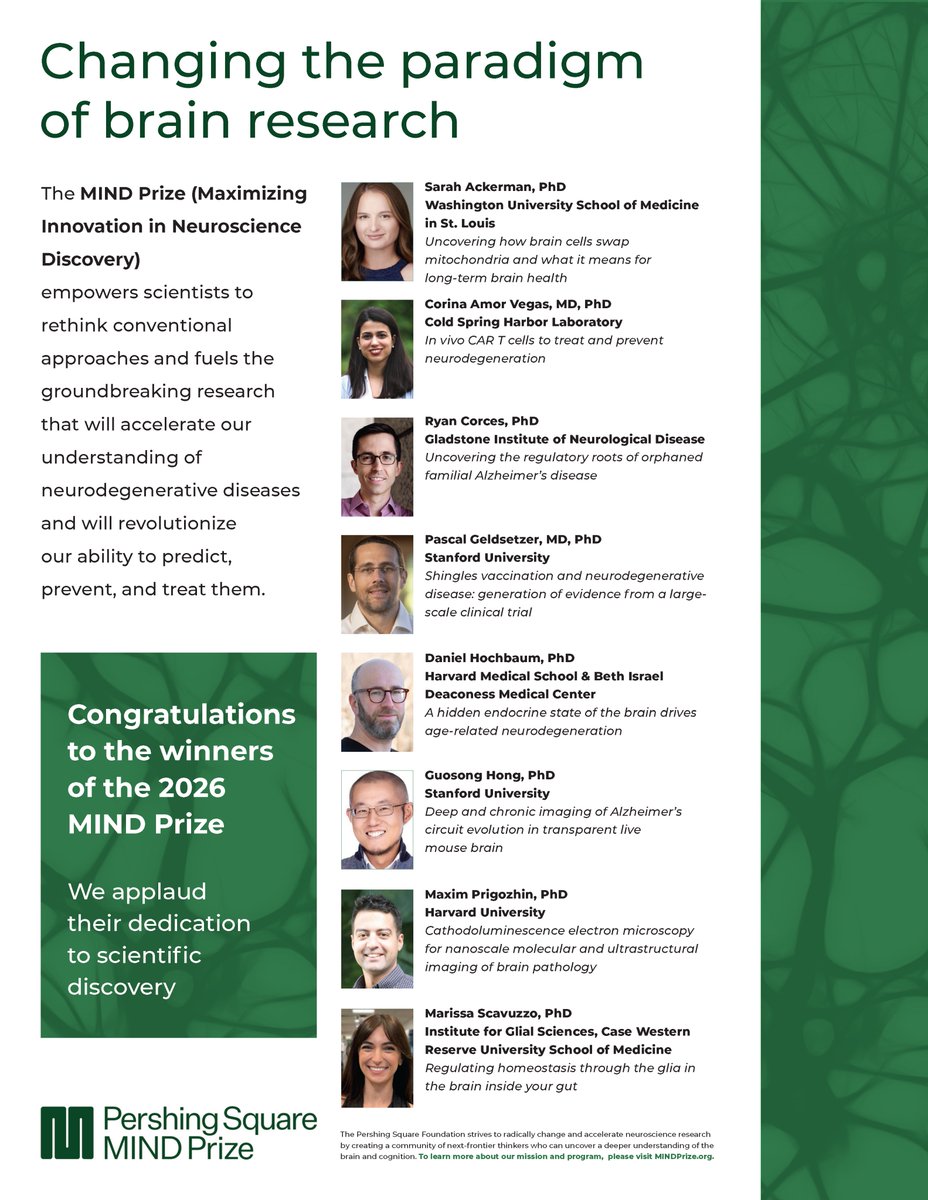
The MIND (Maximizing Innovation in Neuroscience Discovery) Prize empowers investigators to rethink conventional paradigms around neurodegenerative diseases.
PSF is thrilled to share the eight winners of our 2026 MIND Prize! Meet the exceptional scientists from across the country advancing bold ideas in neurodegeneration. Please join us in congratulating:
Congratulations again to the eight winners of our 2026 MIND Prize! 🎉
Learn more about these scientists and their innovative projects here: https://t.co/pwrYdFSi4m
PSF is thrilled to share the eight winners of our 2026 MIND Prize! Meet the exceptional scientists from across the country advancing bold ideas in neurodegeneration. Please join us in congratulating:
Marissa Scavuzzo, PhD at @CWRUSOM is mapping how enteric glia in the gut maintain metabolic and inflammatory balance and why this control may fail during neurodegeneration.
Maxim Prigozhin, PhD at @Harvard is creating an imaging technology that reveals disease proteins and brain ultrastructure simultaneously, enabling multicolor 3D maps of amyloid and tau pathology within intact neural circuits.
Guosong Hong, PhD at @Stanford, @StanfordBrain. @HongNeuroTech is building an imaging platform to track how Alzheimer’s disease disrupts neural circuits over time, using a reversible transparency method to observe deep-brain neurons in living mice.
Daniel Hochbaum, PhD at @harvardmed and @BIDMC_Medicine is exploring how age-related declines in thyroid hormone signaling in the brain may drive cognitive decline and Alzheimer’s disease.
Pascal Geldsetzer, MD, PhD at @Stanford. @PGeldsetzer1 is investigating whether shingles vaccination protects against dementia by analyzing clinical trial samples to uncover the biological mechanisms involved.
Ryan Corces, PhD at @GladstoneInst seeks to understand why many families with Alzheimer’s disease lack mutations in known Alzheimer’s genes, using machine learning and CRISPR tools to uncover hidden genetic drivers and new therapeutic targets.
Corina Amor Vegas, MD, PhD at @CSHL is developing CAR T cell therapies that eliminate damaged aging cells outside the brain, aiming to reveal how peripheral aging drives neurodegeneration and create safer treatments for Alzheimer’s disease.
Sarah Ackerman, PhD at @washumedicine. @SD_Ackerman is examining how mitochondria are transferred between glial cells and neurons and whether this process helps maintain neuronal health with age.
Check out the MIT news release on our latest publication.
We have developed tiny, injectable magnetoelectric antenna that can wirelessly power deep-tissue medical implants, without bulky batteries or invasive surgery.
This ultra-small device — smaller than a grain of sand — harvests low-frequency magnetic fields and converts them into electric charge via a magnetostrictive + piezoelectric film. The result: 4–5 orders of magnitude more power than similarly sized conventional antennas.
It opens doors to battery-free pacemakers, neuromodulators (for epilepsy, Parkinson’s), and continuous biosensors, all placed via needle rather than major surgery.
Thanks to the #Mathers #Foundation and @MindPrize for supporting our work!
https://t.co/5HxgiEDJ9E
The application portal for the 2026 MIND Prize has closed! Thank you to all who submitted an application. We are now entering the review phase; applicants will hear from us by late December regarding the status of their application.
One week left! The application portal for the 2026 MIND Prize closes at 5:00pm ET on Monday, September 29th. We look forward to reviewing Letter of Intent applications soon!
Apply here: https://t.co/lbZJ360Ol8
The application portal is open for the 2026 MIND Prize! We will accept Letter of Intent applications until 9/29/25. Share with eligible researchers in the USA working on neurodegenerative disease/cognitive health.
Learn more: https://t.co/DIS9VQvx7D
Apply: https://t.co/jFWowSs40k
A study from the #StellerLab in @PNASNews finds that boosting PI31 can prevent neuronal degeneration, restore synaptic function, and significantly extend lifespan in fly and mouse models of rare genetic disorders similar to Parkinson’s. #RockefellerScience
https://t.co/ozpzCu5IWf
The application portal is open for the 2026 MIND Prize! We will accept Letter of Intent applications until 9/29/25. Share with eligible researchers in the USA working on neurodegenerative disease/cognitive health.
Learn more: https://t.co/DIS9VQvx7D
Apply: https://t.co/jFWowSs40k
The application portal for the 2026 MIND Prize opens on Monday, August 25, 2025!
Grant recipients will receive $750K over three years to pursue innovative research in neurodegenerative disease & brain health.
Learn more: https://t.co/1261Oq3VMN
Apply: https://t.co/lbZJ360Ol8
The application portal for the 2026 MIND Prize opens in two weeks on 8/25/25!
Learn more here: https://t.co/1261Oq4tCl
Apply here: https://t.co/lbZJ361maG
The application portal for the 2026 MIND Prize opens on Monday, August 25, 2025!
Grant recipients will receive $750K over three years to pursue innovative research in neurodegenerative disease & brain health.
Learn more: https://t.co/1261Oq3VMN
Apply: https://t.co/lbZJ360Ol8
The application portal for the 2026 MIND Prize opens on Monday, August 25, 2025!
Grant recipients will receive $750K over three years to pursue innovative research in neurodegenerative disease & brain health.
Learn more: https://t.co/1261Oq3VMN
Apply: https://t.co/lbZJ360Ol8