Whether it's loop engineering, agent harnesses, evals, or any other AI larp, validating AI outputs is the core challenge. Verifiable AI is the gateway to self-improving AI, and that's the context behind @axiommathai's $200M Series A raise at a $1.6B+ valuation.
Currently, Lean is the most commonly used language and proof assistant for building AI mathematicians, as it allows formal verification of mathematical proofs. As someone new to the field, my first question was: how can math proofs be validated programmatically when the expressions look so complex?
As I always do, I dug into how Lean works with easy examples to build a basic understanding as a complete noob.
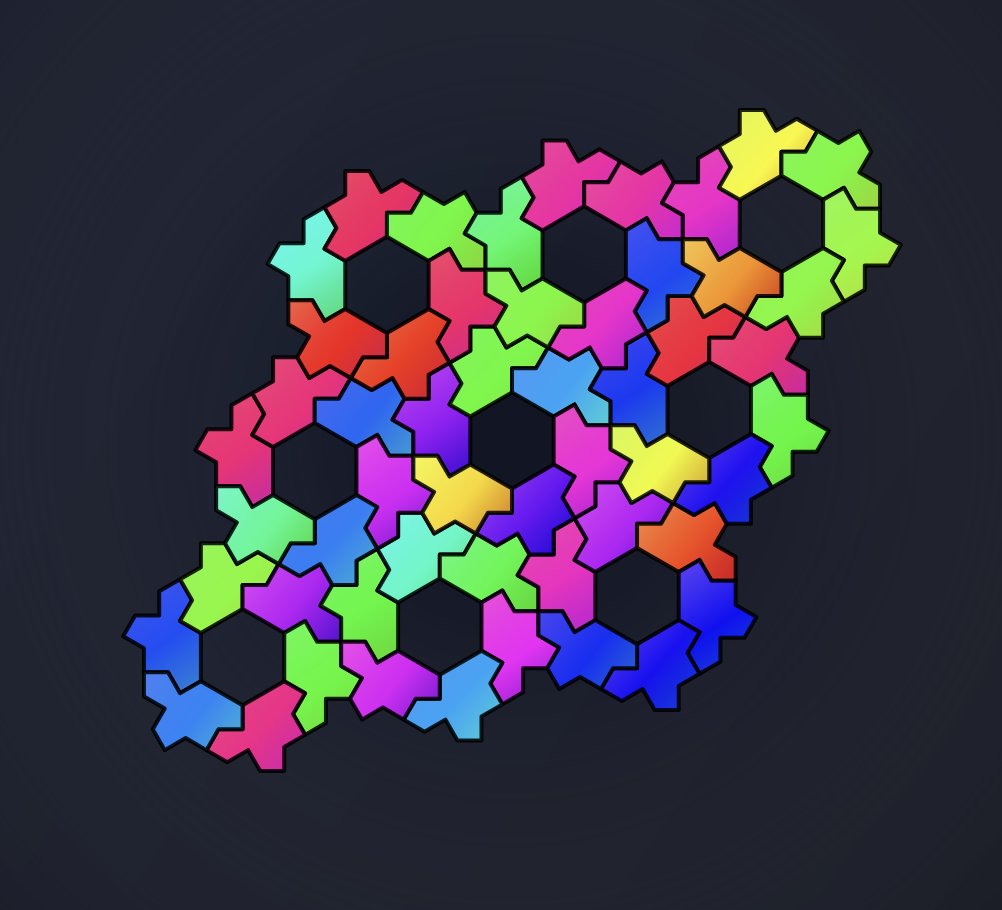
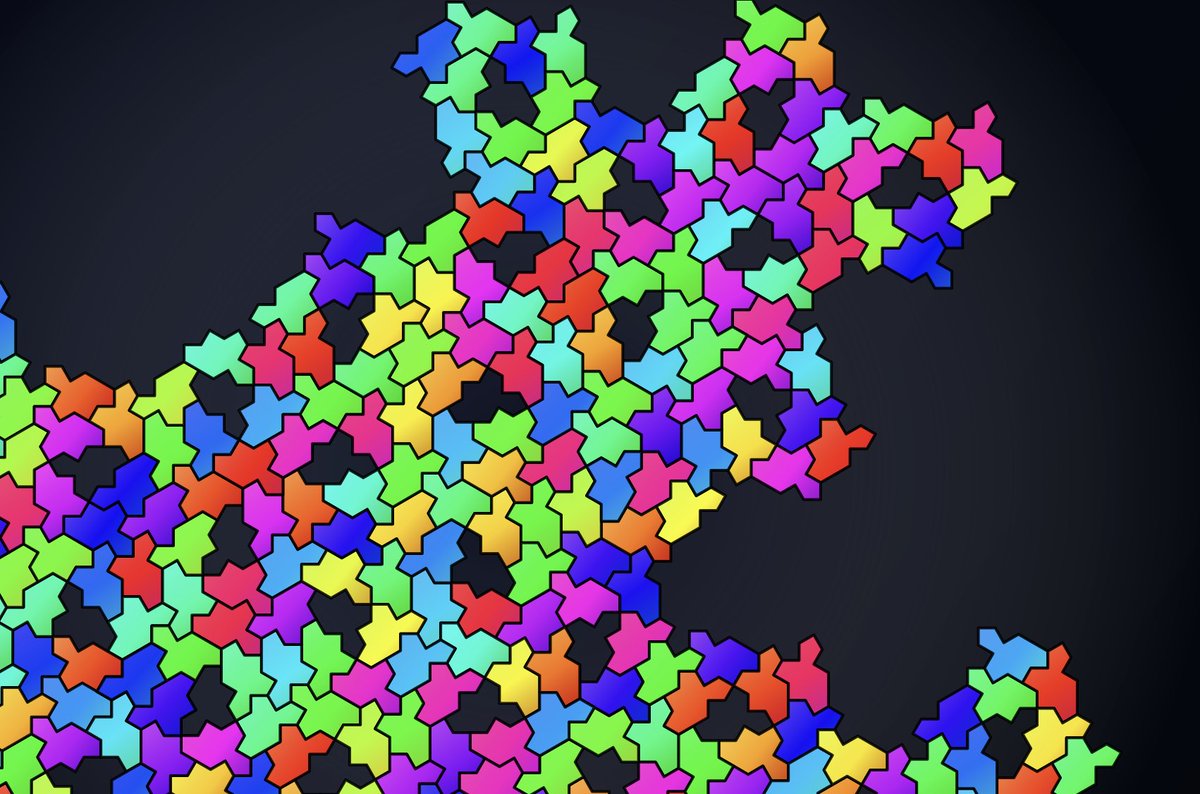
One of the major open problems until very recently was the existence of a single tile that can tile the plane without any periodicity, the so-called ein stein problem of Hilbert. A demo app
https://t.co/ClGRJZk6KM
In 2024, Smith, Myers, Kaplan, and Goodman-Strauss published a paper in which they introduced the first example of this mythological creature of tilings.
It is a notoriously hard puzzle, so I decided to prepare an interactive interface where you can test your patience and skills and try to continue forever the quest of tiling the entire plane with the Spectre.
Technically, it took me about four hours to vibe-code the whole app, starting from an initial seed based on a Jupyter Notebook. I used Codex CLI with the model gpt-5.2 (reasoning x-high, summaries auto). This is a project that, before agents, would have taken a few weeks to finish.
I really enjoyed these works at the intersections of theory and experiment, aimed towards practical/scientific quantum advantage. Hope this journey inspires more efforts on simulating quantum phenomena in Nature with quantum systems.
I wrote this @RQuantumSim student perspective article on our recent works in trapped-ion quantum simulation of chemical dynamics. Experiments done by @KeSun1023, collaboration between groups of Profs. @kenbrownquantum, Jungsang Kim, and David Beratan.
https://t.co/rxwkP3tyxR
Also see work from Rice University that simulated a similar electron-transfer model using laser cooling (rather than injecting random noise). It will be awesome to combine these two features and explore non-Gaussian bath models. https://t.co/svYxGr7L7d
Hopefully these simulations are extended to many spins and bosons, in the regime where the model is classically intractable. Robustness to noise will be key to near-term quantum advantage using analog quantum simulations.
Robust and time-efficient error correction of transversal logical gates between code blocks presents a route toward practical, large-scale implementations. @kaavya_sahay@kenbrownquantum@ShrutiPuri11@Yale_QI
Read the paper: https://t.co/p9GROWIGCY
A new math proof demonstrates that an important phenomenon called universality, which has its origins in physics, is even broader and more powerful than researchers predicted.
https://t.co/Jrg4fZb2BL
On the same day that the South Korean president is forced to QUIT his job🥳, we are presenting QUITS, a democratic (open-source) modular Qldpc code circUIT Simulator. It should be useful for research on the circuit-level performance of QLDPC codes! https://t.co/R9WSHQJg1P
Check out https://t.co/7t2cDR5Sy8 for the paper. QUITS enables simulating hypergraph product, lifted product, and balanced product codes. We also found a shorter circuit for a small HGP code, boosting the performance by x3. Sliding window can be combined with your decoder easily!