Most people don’t realize this, but a normal job usually limits how you think. The reason for this is that it narrows your ambition. It consumes all of your energy. It trains you to optimize for small, predefined goals instead of exploring asymmetric opportunities.
I’ve seen it over and over. Friends quit, and within a few months, their thinking changes completely. They start seeing things they were blind to before. New ideas, new paths, new leverage.
The opportunities were always there. They just didn’t have the time or mental space to notice.
I am not saying everyone should quit their job, but you'll be surprised to see that you're probably capable of so much more than pushing papers in your 9-5 cubicle.
AI is the biggest bubble humanity has ever witnessed. Will some AI companies and products survive? Absolutely. Is AI changing the world? Absolutely. So did the internet in the late '90s. That didn't stop one of the biggest speculative bubbles in history.
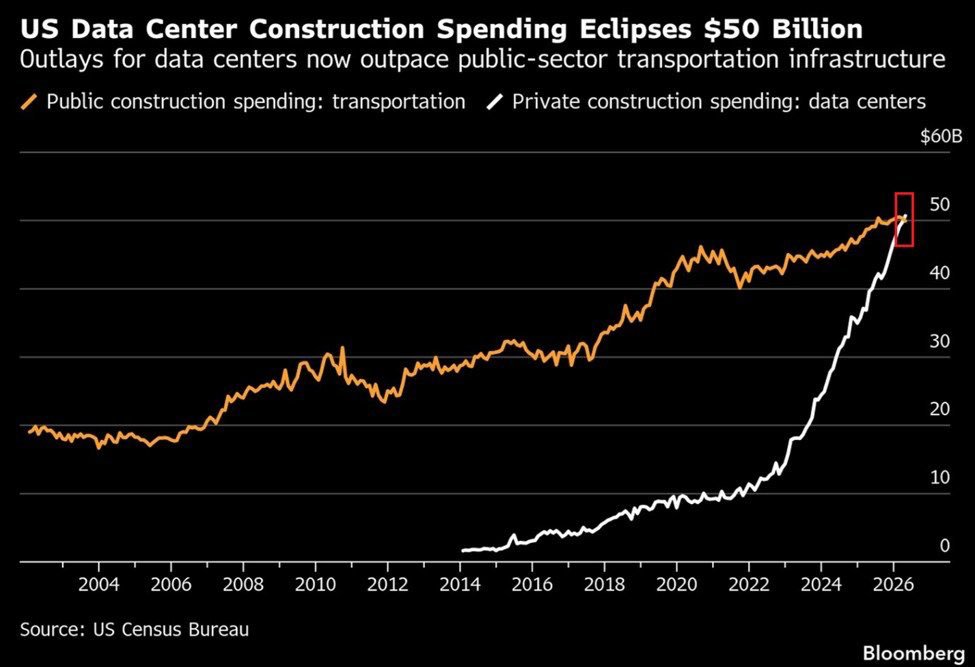
Now look at this chart and tell me we're not in a bubble.
Go ahead.
@KhadijaaRana The Attention Economy
Attention is the currency of social media, and their algorithms are engineered to keep us hooked. The more time we waste, the more money they make. It’s not just an app; it's psychological warfare against us. Many of us are victims, haha.
🇺🇸NEW: U.S. DATA CENTER SPENDING NOW SURPASSES MOST INFRASTRUCTURE PROJECTS
U.S. spending on data center construction has reached $50 BILLION, now exceeding the COMBINED spending on airports, ports, and mass transit, per Bloomberg.
The AI infrastructure boom continues to accelerate, with US data center construction spending up 357% since 2022 and now accounting for 2.3% of all U.S. construction spending.
The greatest fear in the world is the opinion of others. Think about it. How many dreams die because someone might laugh? How many people spend their entire lives performing for an audience that isn't even paying attention? They wear clothes they don't like. Take jobs they don't want. Stay quiet when they want to speak. Pretend to enjoy things they secretly hate. Because they're afraid of what people will think. And the real tragedy is... it was never other people's opinions, it was believing that they mattered more than your own.
I swear this entire world is a fking joke.
OpenAI named its 3 new models Sol, Terra, and Luna.
So… somewhere inside OpenAI, a crypto intern put the 2022 collapse starter pack into a naming doc as a joke.
Then 14 directors, 6 branding people, 3 lawyers, and one guy named Chad from product all said:
BEAUTIFUL. Ship it. Yea, this feels like the future.
Is someone trying to warn us about the post-IPO price action?
I was the first and created the trade.
I sent people to teach Paulson. And I showed Greg Lippmann the trade. I showed Peter Thiel and others. I also showed Goldman exactly what I was doing when they asked me formally in late 2005. Of course Goldman and Greg at Deutsche sold the trade to many others.
Druckenmiller's advice to young people who want to get into finance:
"if they're going in it for the money, they should go elsewhere."
"there's too many people in the business like me that just love the game and the passion. and they're not going to be able to outwork the people that are passionate."
"and it's not a fun game if you're losing."
the people who survive long enough to compound real returns are the ones who genuinely enjoy the research, the building, the debugging at 2 AM. if you're only here for the P&L, the first extended drawdown will end you.
Men with higher IQs are characterized by significantly lower risk of domestic abuse, violence, coercion, and a lower rate of promiscuity, along with higher rates of relationship investment, higher IQ is synonymous with long term marriage and against casual sex
The more the US restricts foreign access to frontier AI models, the quicker users adopt Chinese open source models.
And by many accounts, the models are damn good!
GLM-5.2 just launched & it's already the 4th best LLM globally AND 6x cheaper.
The strategy designed to contain China is building China's user base.
There is a kind of poverty that is materially poor but rich in a lot of practical ways.
There are towns in rural Italy, where an old couple lives together in a stone house in the mountains. She has a flower garden, and he sits on the balcony to smoke and read in the morning.
That couple is poor by American standards. They shop at the local markets, eat eggs from their neighbour's chickens. Healthcare is covered by the state. Their church is not fancy. Their clothes are bought from the town market. 10 euro sandals.
But they own their house and did not have to spend 40 years being exploited by a bank paying for it several times with interest. They just bought it outright. They are loved by their neighbours. They can walk around their towns safely because its not packed full of 60IQ savages (for now).
The food they buy is not poisoned. The work the did when they were younger: teachers, nurses, engineers, was just real and normal work. They didn't feel the need to come up with elaborate schemes to become millionaires. Their grandchildren visit them every weekend.
This, too, is wealth.
The goal is not to make everyone Elon Musk. The goal is to make a system where this kind of nonna nonno wealth is achievable for more people.
It's rare to experience a time like we are experiencing now.
Both risk appetite and uncertainty are arguably at their highest levels in recent history.
These two phenomena rarely exist simultaneously and typically emerge during periods of transformative innovation.
Normally, investors do not seek risk exposure into uncertainty.
But, this time is different. Investors know AI is the "next big thing," but no one knows exactly where it all leads.
The result will be broader swings in the market amid historic innovation.
Capitalize on the volatility.
Oil prices have returned to pre-war levels, despite damaged infrastructure, disrupted supply chains, depleted reserves, and ongoing political uncertainty.
The market is a joke.
🛰️ A satellite costs nothing to operate once it's up there and bills you every month for a decade.
A rocket gets paid once and falls into the ocean. Wall Street keeps valuing the rockets higher than the networks.
That's backwards, and this map shows exactly where the recurring money hides:
For two decades the most important company in space was one you couldn't own. That ended on June 12. The moment it priced, two things happened at once: the sector got a benchmark it never had, and capital rotated hard into the king and out of everyone smaller. Half the names below sold off in the same week the sector got its biggest validation in history. That selloff is the opportunity. This is the map, broken into the four layers that actually matter, and the logic of which layer keeps the money.
🚀 ORBITAL LAUNCH
Launch is the toll booth. Nothing in this entire map reaches orbit without paying someone in this section first, which is why it gets the attention and the valuations. The thing that just changed is that the toll booth went public and instantly became one of the most valuable companies on Earth. That minted a price for the whole category, and it pulled money up the cap structure into the single dominant name while everyone else got sold to fund the trade.
Think of it as the transcontinental railroad. The first line gets built, priced like infrastructure royalty, and treated as untouchable. Everyone else is racing to lay competing track before the incumbent reaches the next city. So play it in tiers. The giant is the index now, the expensive core you own for the theme itself. The real asymmetry sits with the credible second mover building a reusable medium lift vehicle, because the day that rocket flies reliably, the enormous market the leader currently monopolizes cracks open to a number two. Below that are the subscale names still fighting to reach orbit on schedule. Those are options, not investments. One failed test erases a year. Size them like the lottery tickets they are.
Tickers: $SPCX , $RKLB , $FLY and $SPCE (United Launch Alliance is the Boeing and Lockheed joint venture, exposure sits in the manufacturing section via $BA and $LMT)
🛰️ SATELLITE OPERATORS
This is where the cash actually shows up. A rocket flies once and gets paid once. A satellite network bills you every month for years. But the map lumps two completely different businesses into one box, and the market is finally pricing them apart. One group sells connectivity: broadband and direct to phone service, a subscription business with telco economics that happens to live in orbit. The other sells pixels: imagery of the planet and the analytics stacked on top, which is a data business wearing a satellite costume.
The cleaner way to see it: connectivity operators are the cable companies of the sky, and the imagery players sell the satellite photo version of a Bloomberg terminal. Different buyers, different multiples, different risk. The connectivity side has a once in a generation catalyst right now in direct to smartphone, where an ordinary unmodified handset talks straight to a satellite. The bet is the names with actual regulatory approval and a launch cadence fast enough to fill the constellation. The trap is the ones with a slick deck and three satellites in orbit.
Tickers: $AMZN , $ASTS , $IRDM , $VSAT , $SPIR , $PL , $BKSY , $SATL , $TSAT , $GSAT and $ECHO ($ECHO is the former $SATS. $GSAT is a pending Amazon acquisition, it trades as an arb now, not a clean operator bet.)
🌗 SPACE INFRASTRUCTURE
Everything between leaving the pad and operating in orbit is becoming its own industry: landers, in space transport, commercial stations, the plumbing of the cislunar economy. For fifty years this layer was a government program with a flag painted on it. Now it's a contract business, and the buyer writing the biggest checks is the one that always overpays for frontier capability before it's proven, the national security state, with NASA's handoff of low orbit stations to commercial operators stacked on top.
This is the Cisco and fiber layer of the off planet internet. Unglamorous, capital heavy, and the thing everyone else eventually has to plug into. The tell here is backlog, not revenue. These names live and die on multi year government award ceilings, and the ones converting lander demos into prime contractor status are rerating from science project to defense supplier in real time. The risk is just as specific. Revenue concentrated in a handful of programs means one appropriations fight or one schedule slip guts a quarter. This is the highest beta corner of the whole map.
Tickers: $LUNR , $VOYG and $MNTS ($MNTS just ran its second reverse split in a year. Treat it as a survival situation, not an infrastructure bet.)
🏭 MANUFACTURING & SUPPLY
This is the boring, brutal, beautiful part of the map. The legacy primes and component makers were building this hardware before "space economy" was a pitch deck, and they don't get the meme stock pop. That's the entire point. The pure plays trade on a launch schedule. The suppliers trade on backlog measured in years and a customer who literally prints money.
In a gold rush the steady fortune was Levi's and the hardware store, not the prospector. Every satellite, rocket and station needs structures, propulsion, sensors, radiation hardened electronics and the software to run them, and most of that flows through a small set of names that also happen to pay dividends. So this is the ballast. If you believe the sector but don't want to wake up to a 40% drawdown on a failed test, the supply chain is how you own the theme with a seatbelt.
Tickers: $LHX , $HXL , $GE , $BA , $NOC , $RTX , $LMT , $HON , $RDW , $TRMB , $PLTR , $BWXT , $TDY , $HEI.A , $KTOS , $SIDU , $ATRO , $LDOS and $KULR
🌍 FOREIGN LISTED EXPOSURE
Three of the biggest suppliers on this map don't trade as ordinary US shares. You reach them through ADRs, which means thinner liquidity and currency drift baked into your return.
Tickers: $BAESY (BAE Systems, UK) , $ESLT (Elbit Systems, Israel) and $EADSY (Airbus, EU)
Final thoughts
The lesson of this month is that a single IPO can reorganize an entire sector's price structure in days, and it did it by pulling capital toward the king and away from everyone else. The space stocks that sold off hardest during the SpaceX debut didn't get worse as businesses. They got cheaper because money left to chase the listing. That gap is the whole game.
If I had to name the one position the map actively hides, it's EchoStar. A company that looked finished a year ago turned a dead spectrum portfolio into roughly eleven billion dollars of SpaceX equity, which means you can own the most valuable launch company on the planet at a discount through a satellite TV ticker that most investors have already written off. That's the kind of mispricing that only exists because the label on the box is wrong.
Where's the growth versus where's the stability? Growth is in the connectivity operators with real regulatory approval and a real launch cadence, and in the infrastructure names turning government ceilings into prime contracts. Stability is in the supply chain, the Levi's of this gold rush, the names that will still be compounding when the next failed test wipes out a quarter of the pure plays. The mistake almost everyone makes is owning the exciting half with none of the boring half. The map only works if you own both.
Nobody is talking about what’s happening with Saylor right now
- STRC shares crashed to $82, that’s 18 below promised value
- Dividend obligations exploded from $300M to $1.2B in six months
- Cash reserves dropped 38% and dividend coverage collapsed from 7 years to 14 months
- He sold Bitcoin for the first time in 4 years just to cover dividends
- MSTR hit a 2 year low today, down 10% in a single session
- 98% of all corporate Bitcoin buying in 2026 is one man holding 847,000 BTC
The most leveraged Bitcoin bet in history is getting stress tested and most of you have no idea.