Really excellent write-up @vmg, the depth and clarity on the evolution from filesystems → Spokes → Continuity is outstanding. Appreciate the effort that went into this one.
quick question: how does (or will) Continuity/Origin handle Git LFS? Does the WAL model extend cleanly to LFS objects, or is that still a separate storage path for now?
I did a write-up of things I learned during my 10-year tenure at GitHub, the things that worked, and what we're trying to improve in Origin.
The scale of the challenge is staggering, but I really want people to know we're putting a lot of thought and care into it.
AI may be the headline, but data, architecture and execution are what will determine who wins.
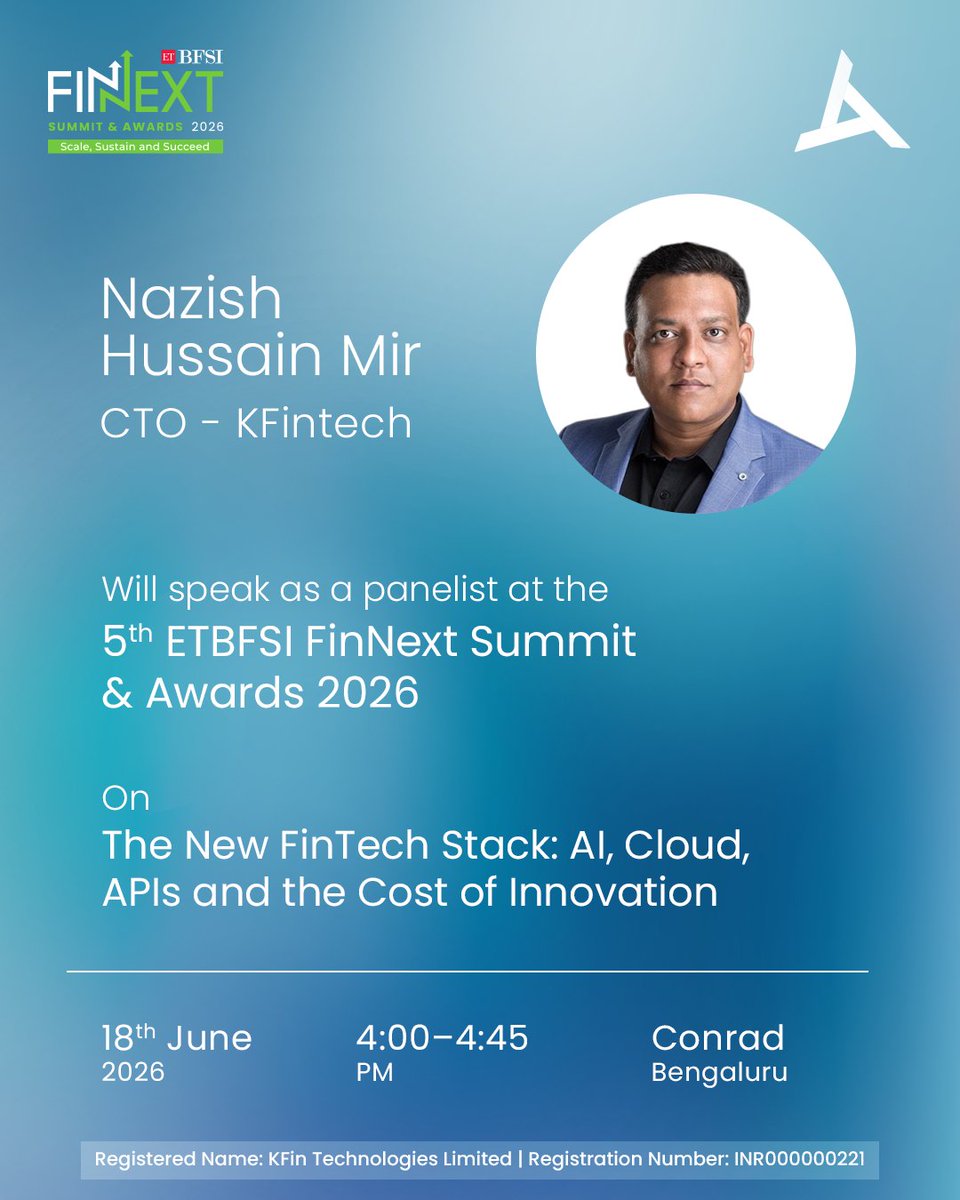
That was the central theme of the panel discussion, “The New FinTech Stack: AI, Cloud, APIs and the Cost of Innovation,” at the #ETBFSIFINNEXT
Know More: https://t.co/cNWhG2X4Lk
As financial services evolve, the right technology stack is key to driving innovation, scale, and sustainable growth.
We're excited to have our CTO, Mr. Nazish Hussain Mir, join industry leaders at the @ETBFSI FinNext Summit & Awards 2026 to discuss how AI, cloud infrastructure, and APIs are reshaping the future of financial services in an increasingly digital world.
The event is one of India's leading FinTech forums, bringing together industry leaders and innovators to discuss the future of financial services. This year's theme, "Scale. Sustain. Succeed.", focuses on building resilient, future-ready institutions that balance innovation with long-term growth. We look forward to being part of the conversation shaping the future of finance.
#KFintech #ExperienceTransformation #DigitalTransformation #ETBFSIFinNext2026 #FinTech #BFSI #FutureOfFinance #DigitalTransformation #AI #CloudComputing #APIs #FinTechInnovation #Technology #FinancialServices #Leadership #FinTechLeadership
IBM couldn’t build an OS so they were forced to partner with Microsoft.
Apple can’t build an AI so they’ll be forced to partner with the next Microsoft.
The only way out is to collaboratively fund a competitive open source model.
If you were part of Windsurf and got left behind, we’d like to talk.
Replit is hiring, and we want to hear from every one of you. We’ll move fast and be respectful of your time.
We’ve passed on many acquisitions over the years, and any liquidity has always included employees. We’re building for the long haul—and we’d love for you to keep doing the kind of great work you were already doing.
Email: [email protected]
Agency > Intelligence
I had this intuitively wrong for decades, I think due to a pervasive cultural veneration of intelligence, various entertainment/media, obsession with IQ etc. Agency is significantly more powerful and significantly more scarce. Are you hiring for agency? Are we educating for agency? Are you acting as if you had 10X agency?
Grok explanation is ~close:
“Agency, as a personality trait, refers to an individual's capacity to take initiative, make decisions, and exert control over their actions and environment. It’s about being proactive rather than reactive—someone with high agency doesn’t just let life happen to them; they shape it. Think of it as a blend of self-efficacy, determination, and a sense of ownership over one’s path.
People with strong agency tend to set goals and pursue them with confidence, even in the face of obstacles. They’re the type to say, “I’ll figure it out,” and then actually do it. On the flip side, someone low in agency might feel more like a passenger in their own life, waiting for external forces—like luck, other people, or circumstances—to dictate what happens next.
It’s not quite the same as assertiveness or ambition, though it can overlap. Agency is quieter, more internal—it’s the belief that you *can* act, paired with the will to follow through. Psychologists often tie it to concepts like locus of control: high-agency folks lean toward an internal locus, feeling they steer their fate, while low-agency folks might lean external, seeing life as something that happens *to* them.”
important leadership skill is precisely communicating your intent — that is, proposing what the properties of successful execution would be, while leaving the choices of how to achieve those goals for the team to propose in return
I'd just like to interject for a moment. What you're referring to as Linux is in fact the full operating system. The kernel is actually known as "New/Linus's Kernel", after Linus Torvalds, the guy who originally wrote it to replace Minix.
Being an employee is the quickest way to kill your dreams. That's why I'm following my dreams of pestering random people with a service I don't actually care about that requires me to read motivational content every morning just to be able to copy and paste an outreach template
Either do something you hate that'll make you rich in a relatively short period of time
Or do something you love where money and time are afterthoughts against aligned presence
Work for an asymmetric reward, or play as the perpetual reward itself
Anything in the middle is hell
Most awards, certifications and press features you see are actually "pay-to-play"
- Webby awards is paid to participate (and then you probably win allegedly)
- MSC sustainable fish mark is owned by fish industry allegedly
- 30 under 30 type lists you can pay to feature in allegedly
- startups pay PR agents to pay journalists ~$200 for an article allegedly
The game is rigged, don't trust anything you see
I really feel like there are a lot of people who cannot grasp why climate change is such a big problem, people who are like "ah, cmon, we'll just all buy air conditioning". You must have seen them here on twitter before: It's the "climate's always been changing" type who thinks everyone who is even mildly concerned is an "alarmist".
If you're one of them, here's what you do not understand: There's only so much work that one human can do in one day. The more time we need to spend to fix climate related problems, the less time we will have for other things. Consequently, climate change is going to cause a huge societal and technological stagnation if not regress.
We will be forced to pour an increasingly huge fraction of our economic output into fixing climate problems. Increasingly more people will have to work on mitigation and adaption. Building higher dams, building more air conditioning, moving people out of coastal areas that'll be flooded. Building higher walls at the borders of rich countries so the migrants from now unlivable areas don't run you over...
You can even see this happening already, with all the money that's going into climate projects: This is money which is not available for cancer research. Opportunity costs, ppl, opportunity costs.
As a consequence of all the effort we need to put into coping with climate-caused problems, there'll be fewer people to do other stuff. Like scientific research. Like updating all your beloved gadgets. Like fixing your roads or rooftops or building new hospitals and kindergartens and playgrounds.
What do new hospitals have to do with climate change? As I said there's only so much work humans can do in one day. Every person who works on building a new dam is one person who does not work on building a new hospital.
What is it going to look like for you and I? It'll mean that a lot of infrastructure will deteriorate and not be fixed, and consumer products will get more expensive until they become unaffordable for all but the super-rich. Want internet at home? That'll be $500 a month.
Most of us have grown up with constant progress. Tech gets better and cheaper all the time. We're so used to it we take it for granted. Well you know what it's not a law of nature. Things can fall apart very quickly, ask anyone in Venezuela or Zimbabwe.
That's the point you "cmon we'll get an AC" guys do not understand. You can get your AC alright but it'll cost you a year's worth of income.
I don't want my children to grow up in a phase of economic regress, that's why I support action on climate change. It's not because I think it'll kill us all. It's because the next 100 years will be fucking depressing.
How India got the nuclear bomb! A very balanced piece from @asianometry without the usual hyperbole that is far too common today.
https://t.co/TvIrm9ftml
Thank you for sharing this important insight @rrhoover. It's essential to shed light on the anxiety that founders face. The pressure to always exude confidence can be overwhelming. Your perspective helps those going through similar challenges to manage their expectations.
Additionally, it's true that as responsibilities grow, from running a business to managing a family, the burden can become heavier over time. Mental health is a crucial aspect of entrepreneurship that often goes unspoken. Let's keep these conversations going to support founders' well-being.