SpaceX has been succeeding in public for 15+ years. Now they're the most valuable private company on Earth & the competition isn't close.
Is any of this repeatable? Why hasn't the model been copied?
Wrote an essay on why + what anyone building hard things can learn:
IBM built a cloud of suits to make sure the CEO never talked to anyone actually doing the work. @elonmusk does the opposite.
"Elon's method is extreme focus on substance. Extreme focus on getting to the truth.
In any organization with multiple layers, there's compounding lies. Each layer wants to look good. Each layer puts a little spin on things.
If one layer lies to the next layer above it, maybe that's okay. When that happens two or three times, the lies compound. If that happens six times, the lies really compound. If that happens 12 times, the CEO has no idea what's happening.
That was IBM.
By the time I got there as an intern, I calculated there were 12 layers of management between me and the CEO.
They even had a term for it: the great cloud. A cloud of men in gray business suits who followed the CEO around and prevented him from ever talking to anybody who was actually doing the work.
When he would come to visit, it was like a visit from the king. A completely impervious bubble.
That's the polar opposite of the Elon approach."
— @pmarca
China makes 80% of the world's industrial robots and has the highest density of them in the world.
If the west does not change soon, China's 24/7 dark factories will allow them to have a monopoly on global manufacturing because of how cheaply quickly and voluminously they can make things.
This quote hits hard:
“I see the Government throwing billions of pounds each year at completely speculative rubbish like fulfilling renewable [energy] obligations contracts and I just think, ‘Well, why not five billion a year in grants for capital equipment?
A recent reflection, based on conversations with economists and policy leaders, is that there are two superficially similar but importantly different perspectives one can hold with respect to US manufacturing:
* Affinity for manufacturing and physical production is an anachronistic fetish, embodied by populists with outdated attraction to hard hats and clanging forges. A great deal of manufacturing has departed the US, which is certainly fine and probably even quite good. It's unpleasant labor, and countries ought to each specialize in their respective comparative advantages.
* Manufacturing is the ultimate network effects and economies-of-scale business. As services are substituted by AI, and as datacenter deployment accelerates, the relative importance of manufacturing is likely to grow. To think that one can pick and choose sectors in which one will excel ("let's win in drones but not in dishwashers") is a fallacy. Manufacturing is hence of paramount strategic importance. However, we don't know how to make the US the world's preeminent manufacturing power (given its cost base and given the current center of gravity in China) -- indeed, we don't know whether it's even possible -- and this is a significant strategic problem for the country.
I have zero direct expertise here, but my outside view is closer to #2 than #1: it seems that the ecosystems and supply chains create strong gravity across the board. I also asked @elonmusk, who has clearly done more over the past decade to advance sophisticated US manufacturing than anyone else, and this appears to be his view. Most economists, on the other hand, are much closer to #1, and I don't think that the economics profession considers the absence of good ideas for reviving US manufacturing to be a problem of particular significance. (There are lots of snide epithets about the efficacy of industrial policy.) It seems to me that there's even some amount of backwards reasoning happening, where, because we don't know how to do #2, #1 is subconsciously a much more comfortable position to hold.
Talking about winning particular manufacturing sectors feels to me a bit like talking about winning individual biological research sectors or winning particular software sectors. That is: it seems that the strong default assumption should be that "the place that is best at biology research sector X will also be best at sector Y", and similarly in software, because the skills and inputs needed are so transferable. As such, my guess is that if the US seeks meaningful sovereignty or preeminence in any of drones, robotics, solar, batteries, pharma, etc., we need to bite the bullet, and win at manufacturing across the board.
Overall, I'd love to read more arguments for and against these perspectives, particularly from those with direct expertise.
Simulations are the future, & one of the main tools we’ll ultimately use to understand and predict things about the universe. This is why I’m so excited about Genie 3, our latest interactive world simulator - here are some insanely cool things you might have missed about it 🧵:
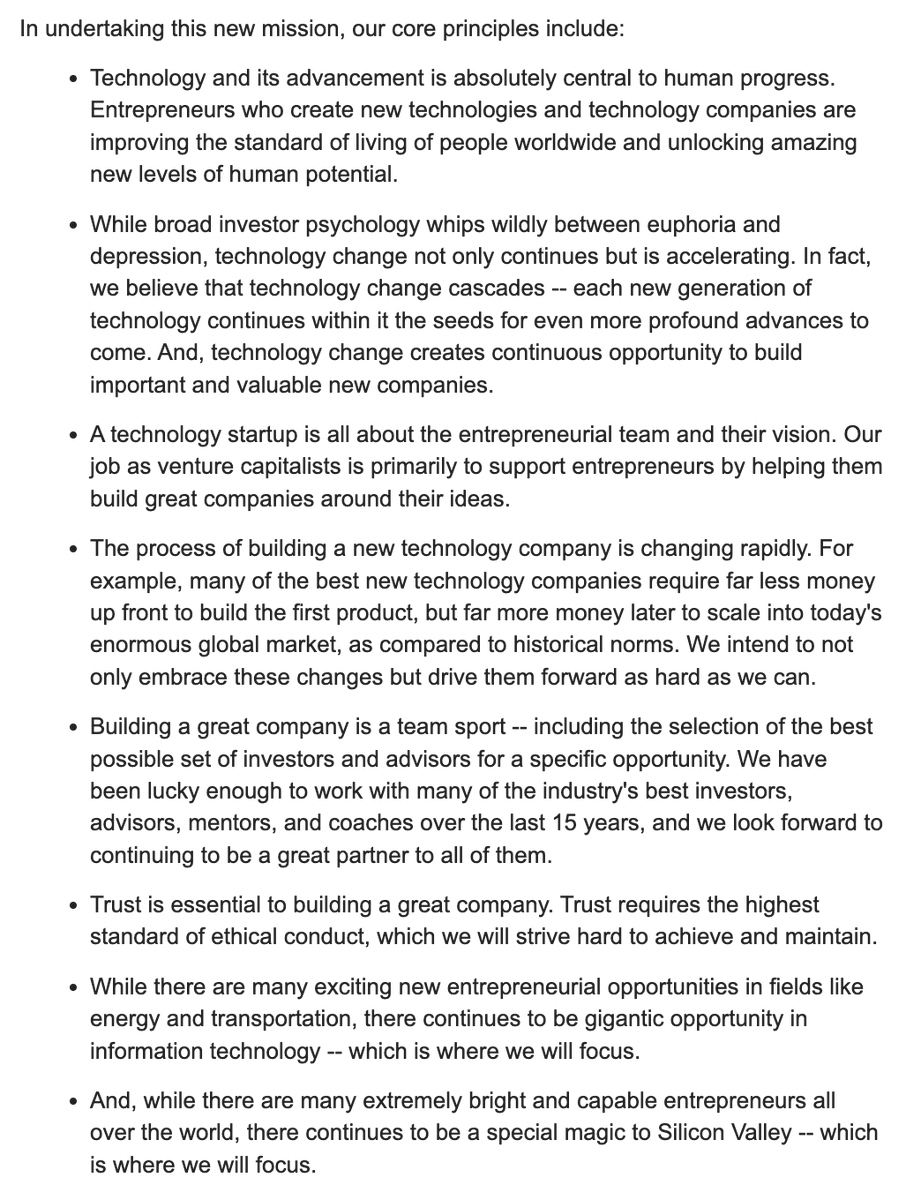
Unearthed from 2009: our founding document where @pmarca defines the foundational beliefs behind a16z including:
- Tech is key to human progress
- Tech progress cascades over time
- Entrepreneurs are key to startup success and we’ll support them
- We embrace change and drive it forward
- The highest standards of trust and ethical conduct are essential
Some thoughts on educating the next generation of builders in the era of AI. My boys are 14, so it’s on my mind.
Let’s reimagine education for agency and creation.
When you learn that you can learn anything, you are willing to take on anything.
And when you learn that you can win with execution speed alone, you are willing to take on anyone.





![deedydas's tweet photo. China makes 80% of the world's industrial robots and has the highest density of them in the world.
If the west does not change soon, China's 24/7 dark factories will allow them to have a monopoly on global manufacturing because of how cheaply quickly and voluminously they can make things.
This quote hits hard:
“I see the Government throwing billions of pounds each year at completely speculative rubbish like fulfilling renewable [energy] obligations contracts and I just think, ‘Well, why not five billion a year in grants for capital equipment?](https://pbs.twimg.com/media/G3HFXX3a8AAISz8.jpg)