Cognitive science is not just one leader’s ‘thing’ that they ‘run’ and ‘do’ in a school. It should be everyone’s ‘thing’. We need to help all have ownership of how teaching and learning happens. It is a shared endeavour @PepsMccrea@HughesHaili@C_Hendrick@Steplab_co
Fantastic opportunity here to join the NATRE executive.
If you’re passionate about RE and want to support others in teaching the subject, do apply!
More details here👇
https://t.co/6O8szBgLCH
🚨Job alert 🚨
We are looking for a RE teacher to join our department!
This is a really exciting opportunity to join a brilliant department, teach enthusiastic students and work at a school which high values RE.
More details here👇
https://t.co/OfzRflKblo
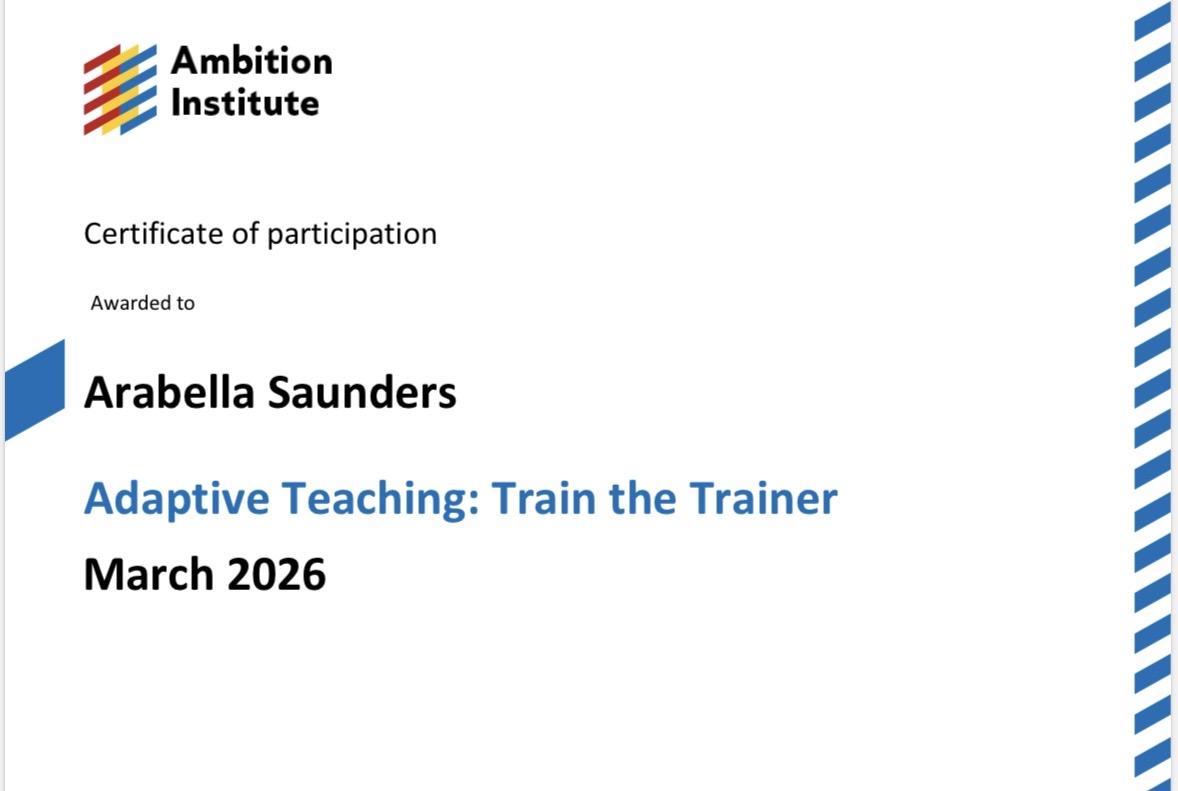
The Adaptive Teaching Train the Trainer course with @Ambition_Inst has already shaped school policy and is beginning to have an impact on our students’ learning experiences. I highly recommend it.
I’m excited to share that my book Secondary RE in Action is available to preorder.
The book brings together the latest research on the subject with practical strategies for how to teach RE.
#TeamRE
https://t.co/hiDkxncGwc
We are so fortunate we have Dawn’s wisdom still found on here. She is the person I would have put in charge of devising a NC for RE. She would also have managed to pull together a consensus no doubt…
I’m guilty of only showing my students grand, ornate mandirs from India and implying they’re all like that. I was struck by how many simple buildings or conversions are used for worship. I’ll be adding these to my resources. This one is in Agra.#RETeacherOnTour
*NEW BLOG* In this post I reflect on my journey as Assistant Head Academic so far: creating a CPDL programme to support teachers to embed evidence-informed teaching habits.
https://t.co/eerUMYGge6
To celebrate 5-years of The RE Podcast, I hear funny stories from you. Warning, some are a teeny bit rude but I hope they make you laugh. Thank you for your continued support lovely listeners https://t.co/LMdwvPBcpd
The science of learning isn't about prescriptions, it's about probabilities. And this is where knowing the boundary conditions of any principle matters so much. Knowing when not to use it can be as important as knowing when to.
This is my problem with every lesson starting with retrieval practice "because science".
A principle applied everywhere becomes dogma; a principle applied within its limits increases the probability of it being effective, because it honours the conditions that make it work in the first place.
Retrieval practice is a key driver of learning but there are a lot of contexts where retrieval might be counterproductive: introducing new concepts or when prior knowledge is insufficient to make retrieval attempts meaningful rather than random guessing.
The boundary conditions matter precisely because they reveal the mechanisms underlying the effect. Retrieval practice works through the effortful reconstruction of knowledge from memory, which strengthens retrieval pathways. But if there's nothing meaningful to retrieve, or if the retrieval demands exceed working memory capacity, the mechanism breaks down. The practice becomes ritual rather than science.
Interleaving benefits discrimination between similar concepts, but becomes less valuable when categories are already easily distinguishable. Spacing enhances retention through forgetting and relearning, but may hinder initial acquisition when foundational knowledge is still forming.
Senior leaders saying "use retrieval practice when learners have established some initial knowledge of the material, when the cognitive demand matches their capacity, and when errors can be corrected through feedback" is less compelling than "start every lesson with retrieval practice." The nuanced version requires professional judgment; the simplified version offers algorithmic certainty.
This is where we need to move away from "what does the research say" but "under what conditions does this research apply/not apply to my context and how can I apply it?"
Tomorrow is @InspirationEast Secondary CPD Day 📚
I’ll be with the Religious Studies community exploring how our new Y7 Philosophy unit is inclusive by design drawing on the paper by @PepsMccrea , @Barker_J & @Josh_CPD
📄 https://t.co/WZKfq3INlp
A great clip from the 30-minute video on Developing Curriculum for Deep Thinking: The Knowledge Revival
@dylanwiliam has got to have the coolest speaking voice in education.
https://t.co/bq6TjKTKYr