@MissUlbrichOSU A36: There is a book called "Ten Terrible Dinosaurs" which incorporates rhyming and subtraction sequences. I think it is a great idea to show kids how patterns can exist in many different ways, whether it be literature, math, in nature etc. #OSUElemMath
@MissSmithOSU@MissUlbrichOSU A35: I agree that the first posed question is the most important one; understanding prior knowledge not only allows teachers to model their instruction, but it also allows students to understand the tools that they have that can be used to solve the question at hand #OSUElemMath
@MrCourtneyOSU@MissUlbrichOSU A35: I love the idea of incorporating games in the classroom. I think it is also important to point out that an equal sign is not always just =. It could be a line, an arrow, < or > symbols etc. Incorporating this knowledge into the game too could be beneficial #OSUElemMath
@MissMorosky@MrCourtneyOSU A34 Kelsey this is such a great graphic! Is there a way to adapt it for kids who have a visual impairment? Also, how different do you think the measurements would be based on a kindergartner vs. a 5th grader? #OSUElemMath
@ZhenWan72704088@MrCourtneyOSU A33 I agree that 10 seems very challenging. Visualization and understanding of parallel lines are both tricky concepts in and of themselves, let alone both skills together! #OSUElemMath
@smith11169 @MrCourtneyOSU A32 Brooke, I completely agree that it is good to start with the first level as a solid foundation for our students. Having students at differing levels I also do not see as a problem because of scaffolding, as well as students can learn from each other #OSUElemMath
@MissCarterOSU A25 I do not believe that one solution is more important than the others, however, I think #4 is the most challenging; this requires patience and often times extra classroom time which is very valuable and sometimes hard to find in the day #OSUElemMath
@MissUlbrichOSU@MissCarterOSU A24 I have also seen this in my classroom, and remember struggling with it in my Math 1125 classroom. I love your idea of virtual blocks, and depending on how the app is set up, the virtual application can be auditory accessible to the VI community #OSUElemMath
@MissCarterOSU A23 I remember utilizing dice in different games with probability as well as using multiple dice o make equations with. To modify this you could tactile dice, but dice in and of themselves are accessible to students with a VI #OSUElemMath
@MissMorosky A22: Different methods for place values and counting by 10s could be Math 1125 sticks/bundles, coins and money, blocks/towers, and an abacus. I think the idea behind place value and groupings can be tricky so its important to have many different ways to explore this #OSUElemMath
@MissThornOSU@MissMorosky A21: I love the idea of using relevant examples, especially with cooking. Connecting math (measurements), science (baking), and food is a great way for students to have fun experimenting with food and also see how math choices directly affects scientific outcomes #OSUElemMath
@MissMorosky A20: Recognizing difference in cognition is key; I remember how difficult it was for me in Math 1125 to adopt these new ways of simplified thinking... this is the same with students trying to decode our 'adult' ways of solving math! #OSUElemMath
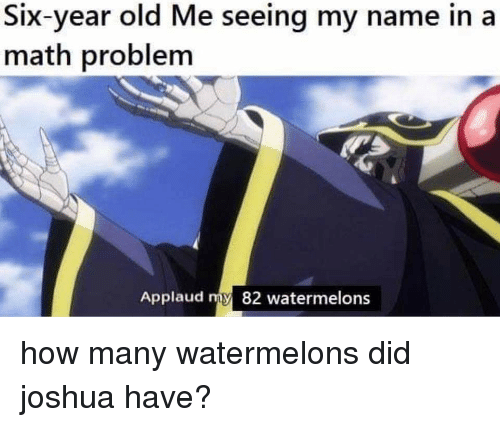
@MeaganClardy A19 cont: This also gives me the idea to root authenticity in incorporating the names of my students in problems with realistic scenarios that deal with their hobbies! This will get kids excited and engaged in the math problem at hand. #OSUElemMath
@MeaganClardy A19: I think that making word problems realistic is the first step. There have been so many word problems I have had in my past that are absolutely crazy! I found this meme that I thought was hilarious and true... #OSUElemMath
@MissThornOSU@MeaganClardy A18: I think it is such a cool idea to bring in objects for the kids to grasp the problem better. This would allow students to understand what items they are working with and also use the items as a way to help solve the problem (like they would with blocks/chips) #OSUElemMath
@MeaganClardy A17: I found the #2 to be interesting; the way in which it is worded sounds almost negative to me, as if the child is being coddled into doing math at a comfortable level. I would say #2 should read 'find appropriate problems that fall in line with students' ZPD' #OSUElemMath