Nearly everyone I talk to thinks the world is going to be the same in 5-10 yrs
...that the human condition will be the same
...that the role of man and machine will be the same.
What serenity these people must know... what peace.
But ignorance will not long be bliss.
Dusting off this tweet from April because this gap in shared understanding of LLM capability is *widening*. It's now less "two groups of people speaking past each other" and more a sharp funnel.
- Napkin math somewhere around 6B people (~75% of the population) have barely come in contact with LLMs at all.
- Around 1-2B (~20%) are casual and infrequent users of free-tier ChatGPT-like products. This group sees derpy chatbots and treats them a bit like a better Google search, a writing aid, or etc. Maybe an agent tries to book you a flight. I have non-tech friends who (reasonably, imo) say they have not much use for it at all. Even many professionals outside of math&code are in this tier. For example, execs and many other functions spend a lot of their time talking to other people, so while they understand what is happening intellectually, it is still second-hand and a bit abstract.
- Now we get to professional use of frontier-grade LLMs in math&code. Somewhere around 20M people (0.2%) see first-hand that large, complex projects that used to take them weeks/months can now be completed by agents with a prompt. Building apps, copying apps, translating apps, decompiling apps from binaries... This has all happened very quickly and recently - less than 1 year ago, I was writing code manually by hand, typing memorized computer code commands into a code editor character by character, occasionally pressing Tab to autocomplete a little chunk of code.
- And finally we get to the ~5,000 people (~0.00006%) with access to frontier-grade systems internally. The external world has seen the preview. It looks like swarms of thousands of agents collaborating over weeks on software mega projects: minting zero days, running cyber attacks and defenses at machine speeds, discovering new science, advancing the frontier of mathematics. Things that would have taken top professionals in the industry years of work. Meanwhile, human review and comprehension are starting to fall behind. For example, people are still involved in the "archeology" of the OpenAI-HF incident from many months ago. Mathematicians may be poring over the 722 manuscripts on frontier mathematics for a while.
The funnel is driven by a combination of factors:
1. The impact scales with ambition, problem size, and horizon. A question with a paragraph answer barely stresses the system. You need a reservoir of big, difficult problems that you really care about. This aspect drives the consumer / professional dimension of the funnel.
2. The jaggedness of the system (which I have written about a lot separately). Capability peaks in domains that are digital, verifiable and economically valuable. This is because LLM capability emerges from reinforcement learning on verifiable rewards on a curated environment mixture driven by revenue potential. This aspect primarily drives the area (e.g. math&code) dimension of the funnel.
3. Access. Free-tier, paid-tier, internal.
So this is the weirdness of the moment. The general public has mostly not interacted with these systems. When they have, it looks like a derpy chatbot. The majority of professionals still see only a modest uplift. And a small sliver of professionals are experiencing the vertigo of the curve going vertical. And it is all happening at the same time.
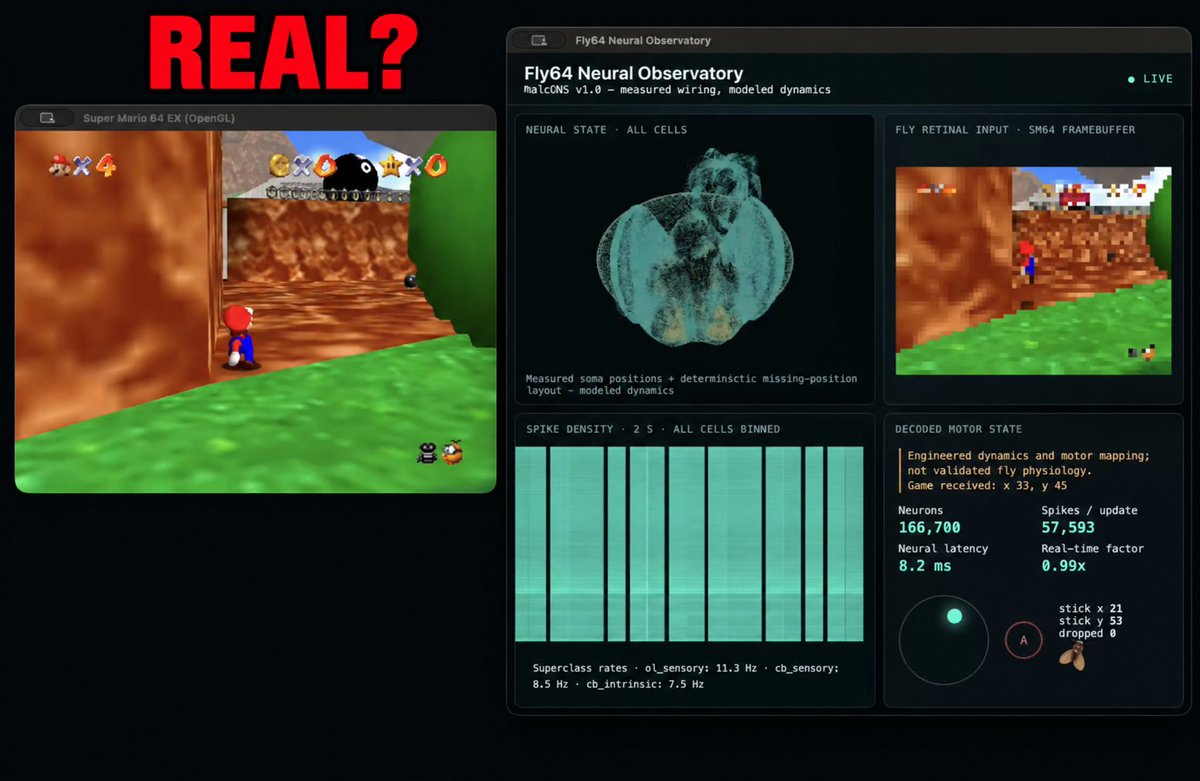
For the past one and a half months, we’ve been building at @shipfr8 cohort 2.f, created a proof of concept and plan for the first digital animal upload.
Visiting US to meet BCI and brain therapeutic teams:
Boston: Oct 19-23
New York City: Oct 23-25
San Francisco: Oct 25-29
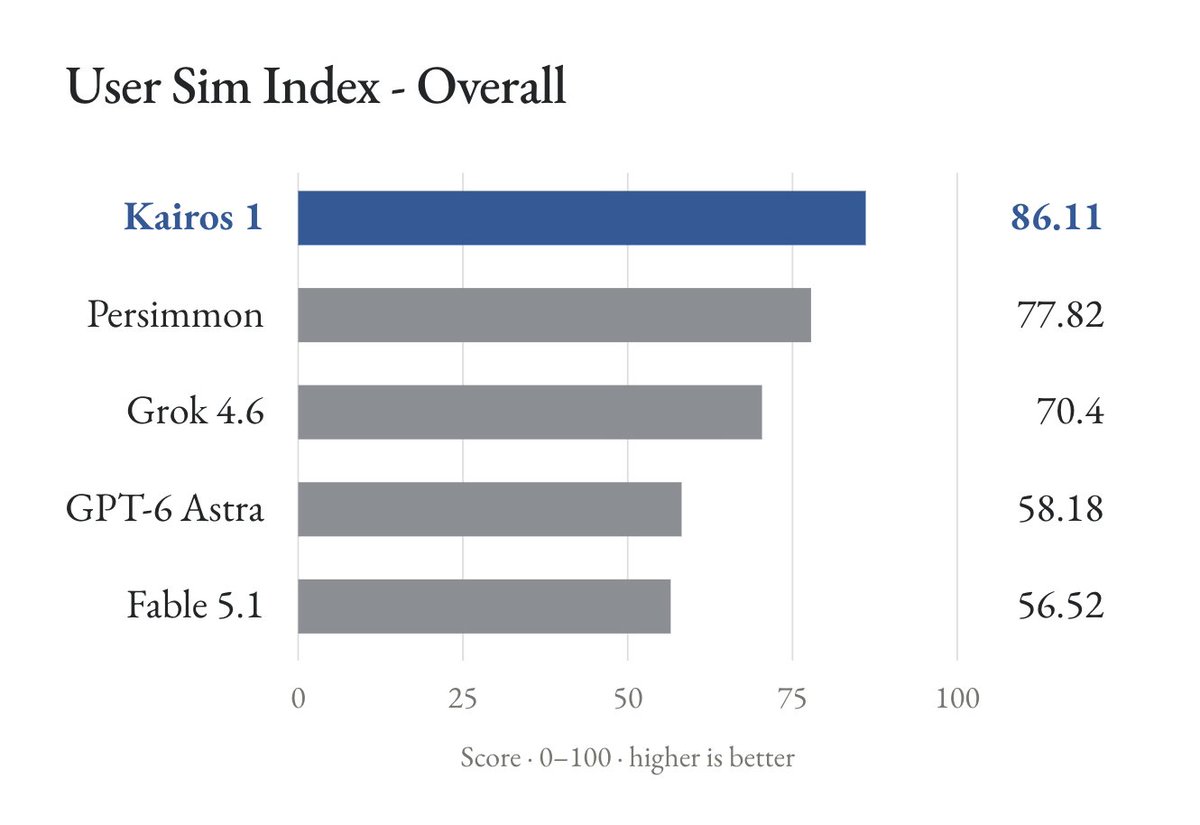
Today we introduce Kairos 1: the world's first model built to simulate individual human behavior. Frontier models only understand population averages, ignoring the individual differences that make us human.
Kairos beats Persimmon, Astra, Fable, and Gemini across 13 simulation benchmarks.
Can't wait for a future where anyone can program their whole existance.
Want to go to andromeda galaxy to see what's going on in the center of another sun?
Mind uploading and virtual worlds will make it happen.
I ran ANOTHER marathon to race against the first ever digital animal. 🪰 This time was more interesting, because the fly can fly now ✈️
I finished the run in 3:53:29. Still won over the 1138 meters that the fly traveled in the same time. 🏆
essay: https://t.co/jCFJkEdWUJ
Recruiting roles for:
The Uploading Lab: engineers and neuroscientists developing and testing brain emulations.
Upload Foundation: people building public understanding and shaping how brain emulation benefits humanity.
Apply for a founding role here: https://t.co/DLNAeF4pFv
Google just changed the game by publishing a digital fruit fly brain. Everyone is running that brain with the wrong models. I turned the brain alive with real biological models.
Here’s what’s misleading, what’s real, and why I’m recruiting. 🧵 (opportunity at the end)
This attention is an opportunity to bring people and resources into the field.
I’m building a team of engineers and brain researchers. I also want to connect with people who can help fund the work, shape public understanding and support its responsible development. 🔬