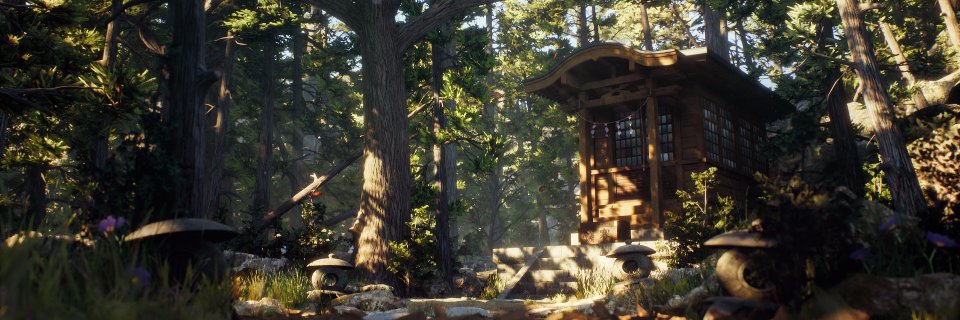
The graphics programmer behind the water technology in #NoMansSky is giving a talk today titled:
"The Changing Tides of NMS: Crying Saltwater Tears Trying to Implement Dynamic Water on a %@$#&ing Sphere"
Good luck, Tom!
https://t.co/0s80hz7ATC
I had a similar reaction. Everyone should applaud performance improvements, but gauge against the “speed of light”, not just a sloppy competitor. If you are measuring in seconds, you may have already anchored yourself incorrectly.
Structure the UI so you can put locally cached media up just a few vblanks after the process launches.
Structure the server so it can return everything necessary for the dynamic UI in one single query that was kicked off in parallel with the Gfx API initialization, branching to a modern transport protocol for large media files.
You should be able to double click on the launcher and have it responsive before your muscle memory can slam the pointer to a location to click on.
Hey! I'm sharing a free Blender add-on I've been working on for generating game-engine ready collision meshes.
QuickCollision can generate various hull shapes, and convex hull via StanHull from the PhysX toolchain.
It's free and open source here:
https://t.co/0X1T1yTOzp
From a game jam prototype to this absolute banger of a trailer was genuinely a designer’s dream 😭
So proud and grateful to all the teams that poured love into making it happen. Can’t wait for everyone to finally experience the crazy fun we had making it!
G:G GO BIG!
City Sample just got a major update🏙️
The new level was built entirely in Unreal Engine, using PCG for procedural world-building, with assistance from an LLM through the new Unreal MCP server.
Fully editable. No black boxes: https://t.co/ZbYK33aQf1
@SlendyMawnYT Thank you!
I highly recommend https://t.co/AT8Y0yfqup by @skx_doom
Its a fast good quality that is available on fab (and he updates it quire regularly).
I've recently released the Light Propagation Volumes (custom GI plugin) for #UE5
LPV is an algorithm of resolving the diffuse light bounce from the perspective of the sun in world space (firstly introduced in 2009 by Crytek).
It's non-temporal, performant and lightweight.
There are a few things that I look back on as my mistakes in the early days.
Quake was overly ambitious technically. We could have done all the great multiplayer and modding work inside a Doom++ engine, allowing the designers to work with a more stable base instead of rug-pulling everything out from underneath them a couple times. The follow up game could have then brought in full 6DOF environments and characters.
I pushed everyone too hard. I didn’t appreciate how maturing companies need more slack, and that running people at startup intensity constantly will wear them out. Quake was also where I really had to accept my personal limits. I was working pretty much as hard as humanly possible, and I was still slipping past my goal points.
On all of the founders’ shoulders, our original corporate stock arrangement and buy/sell agreement was a mistake, and resulted in bad incentives. We wanted to ensure that all ownership rested in the hands of people working hard on current projects, but the Silicon Valley standard approach of vesting stock would have worked out better.
One real problem that I don’t accept the blame for is that we were insisting that level designers be not just game designers, but also have strong visual design esthetics. They needed to make things that not only played well, but looked awesome, and it got more challenging as the technology provided a richer palette. Romero covered that well, which set our company expectations early on.
We should have figured out how to pair up artists and designers earlier, but there was infighting among the designers, and the ones that could manage the visuals were happy to disparage the ones that couldn’t.
Sorry, Sandy.
Hideo Kojima comments on the end of physical game production today in Italy:
"Today you can still download data. But at one point games will make into streaming services like Amazon or Netflix and companies will decide if you can play a game or not [...] At this point I won't have anything of my own [...] the data will be somewhere in a company and I will have the right to access it or not depending on how much this data tap is opened.
The fact that the initial data is not in my possession but is somewhere held by a private company means that I will always have that risk that for any reason, whether commercial or political, the company could prevent access to that data and therefore I will no longer be able to see that film, I will no longer be able to play that game.
This is what's happening next for the world of video games and I fear it will also happen for cinema."
It isn’t the point of this project, but looking at the triangulations made me think about some GPU optimization esoterica.
Everyone knows “triangle count” has an impact on performance. Graphics programmers also know that the ordering of the triangles can also make a significant difference, and integrate mesh optimization tools.
For the special case of planar figures like these, total triangle edge length can become the distinguishing performance characteristic. GPUs work with 2x2 blocks of pixels so they can generate derivatives for texture sampling and shaders. At triangle edges, they still usually have to do calculations for complete 2x2 blocks, regardless of whether 1,2,3, or 4 pixels in the block are actually needed. Long, skinny triangles can require over double the fragment shader invocations that area-maximizing triangles do.
Consider triangulating a circle: the obvious way is to make a single triangle fan, but you can reduce the total edge length by inscribing a polygon inside the circle and only fanning out from that to the circle. Slightly more vertex work, but less fragment work.
There probably isn’t any real world case where this would be a crucial optimization, but having an “optimization worldview” means always noticing the tradeoffs.
Holy fuck guys we’re not "pushing hard" for or replacing concept artists with AI.
We have a team of 72 artists of which 23 are concept artists and we are hiring more. The art they create is original and I’m very proud of what they do.
I was asked explicitly about concept art and our use of Gen AI. I answered that we use it to explore things. I didn’t say we use it to develop concept art. The artists do that. And they are indeed world class artists.
We use AI tools to explore references, just like we use google and art books. At the very early ideation stages we use it as a rough outline for composition which we replace with original concept art. There is no comparison.
I talked about how we use ML here if you would like to know more:
https://t.co/41KPNjaqI7
We've hired creatives for their talent, not for their ability to do what a machine suggests, but they can experiment with these tools to make their lives easier.
“Lightspeed L.A. has always recognized and valued the irreplaceable role of talent, which injects creativity, innovation, and the human touch into video games. Supporting our cast is the right thing to do and there was never any hesitation to consider the performer protections that anchor this agreement,”
- Steve C Martin, General Manager of Lightspeed L.A.
https://t.co/gaBKW51XoG
Last year I sat watching the Champs finals with KangKang. This year I watched him win it! Time flies but his passion and hard work stayed the same. I feel very sad for the TH boys, they had an amazing year and deserved a trophy as well❤️