It's a thankless, not-quite-impossible task, forcefeeding science deniers. But for some of us weirdos, it's the best game in town.
The most important thing to understand is that you will never "win". Not in public, anyhow. But if they are willing to engage, with the right skills, you can modify their thought-tree such that they will lose the debate to your voice in their head when they are trying to sleep at night.
A Petri Dish Of HUMAN Brain Cells LEARN TO PLAY THE GAME DOOM!
In a groundbreaking fusion of biology and silicon, scientists at Cortical Labs have taught a cluster of lab-grown human neurons to play the iconic video game Doom.
Not your typical AI triumph, it’s a petri dish of actual human brain cells, reprogrammed from adult donor skin or blood samples, wired into a $35,000 biological computer called the CL1.
Building on their earlier Pong demo, this new feat sees the neurons navigating hellish levels, dodging demons, and even firing shots with surprising efficiency.
Programmer Sean Cole pulled it off in just a week using a Python API on GitHub, a stark contrast to the year-plus effort for Pong.
Astonishingly, these organic gamers outperform GPT-4 in speed and latency, proving that even a tiny blob of human intelligence can adapt and learn in ways silicon struggles to match.
The excitement is palpable: this isn’t just a gimmick; it’s a window into revolutionary medical advancements. Imagine using such bio-computers to model brain diseases, test drugs, or even restore neural functions in patients.
With cloud access to CL1 rentals, developers worldwide can experiment, accelerating discoveries that could redefine neuroscience. We’re witnessing the dawn of hybrid intelligence, human biology augmented by tech, evolving beyond our wildest dreams.
Yet, amid the thrill, a chill runs down my spine. What are we building here? These neurons aren’t conscious (we hope), but they’re derived from humans and exhibit learning behaviors that echo our own cognition.
Echoes of The Matrix or dystopian sci-fi like the “torment nexus” from Doom novels loom large. Could this lead to ethical nightmares—exploiting bio-intelligence for warfare simulations, or worse, creating sentient systems trapped in digital hells?
And the philosophical rabbit hole deepens: Is life merely nested Russian dolls (matryoshka, if you prefer) of biological smarts? We, as evolved intelligences, are now crafting our own mini-brains, layering complexity upon complexity. Are we “gods” in the making, or just the next doll in an infinite regress, destined to birth something that surpasses—and perhaps supplants, us?
This experiment, detailed in HotHardware’s coverage, pushes boundaries we might not be ready to cross.
It’s exhilarating proof of human ingenuity, but let’s proceed with caution lest we summon demons we can’t control and we wind up in the Petri dish?
If DNA Repair evolved, it would have done so in the pre-LUCA era. DNA mechanisms would have been much less complicated. That would have been the wild west of runaway spaghetti code. Most would be a "decoherent mess."
But consider what that would look like.
"We're starting with the bacteria from one human being that's 200g. It doubles every 20 minutes. If this ball were bacteria fed perfectly, it would grow to be the size of the entire earth in just 28 hours, 28 hours and 20 something minutes." - @StatedClearly
The only real fitness effect that mattered at that time was how fast you could reproduce your ability to reproduce faster than the next molecule. Any decoherent mess produced by one molecule would just be another's lunch. Then LUCA came and ate all of them for lunch.
It's not any less plausible than anything else.
The mystery is how we got suited up for the molecular arms race in the first place.
"Specified complexity is merely an observation"
Sure, but the question is whether or not we've observed Specified Complexity that occurred naturally.
Your conclusion is based on an assumption of what the answer to that question is, in order to answer the question.
I don't know what else to call that.
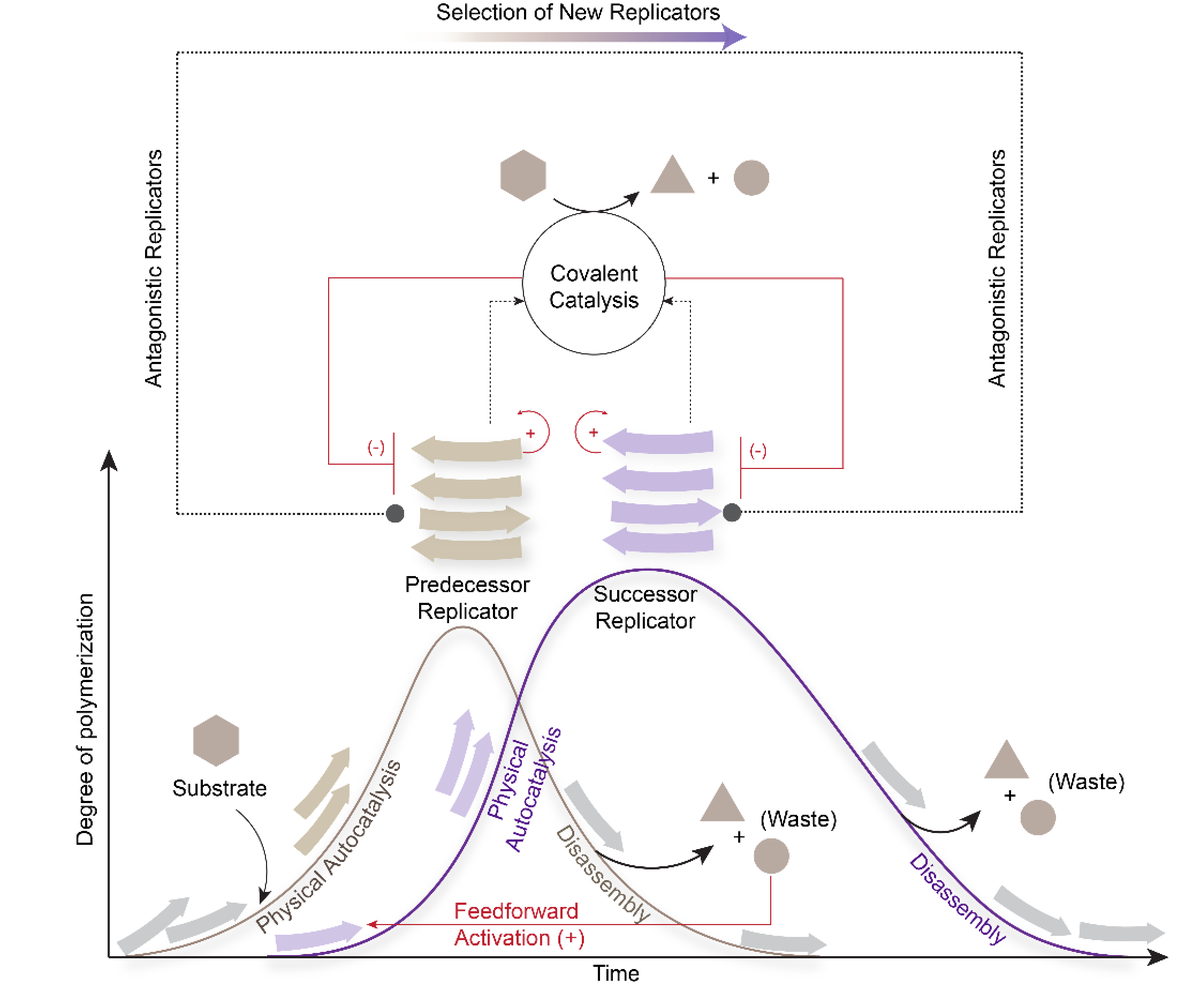
Just out @Chem_CP our work on antagonistic self-replicators that can leverage their intrinsic catalytic potential to enable selection exclusively out-of-equilibrium. #systemschem@iiserkol@dcsiiserkol https://t.co/hN9M1g3LFS
Genomic analysis shows that interbreeding between female Neanderthals and human males was less common than the opposite combination https://t.co/UPeewkVbCd
Every single one of these are different.
The first one, Ursus spelaeus and Ursus arctos, more commonly known as the short faced cave bear and brown bear have very different morphology. It would be like comparing modern Seels and Sea Lions. Closely related, yes. But not the same.
Scientists have performed the world’s first behavior transplant: They’ve successfully transferred a courtship behavior from one species of fruit fly to another species that doesn’t naturally exhibit it.
[Link below.]
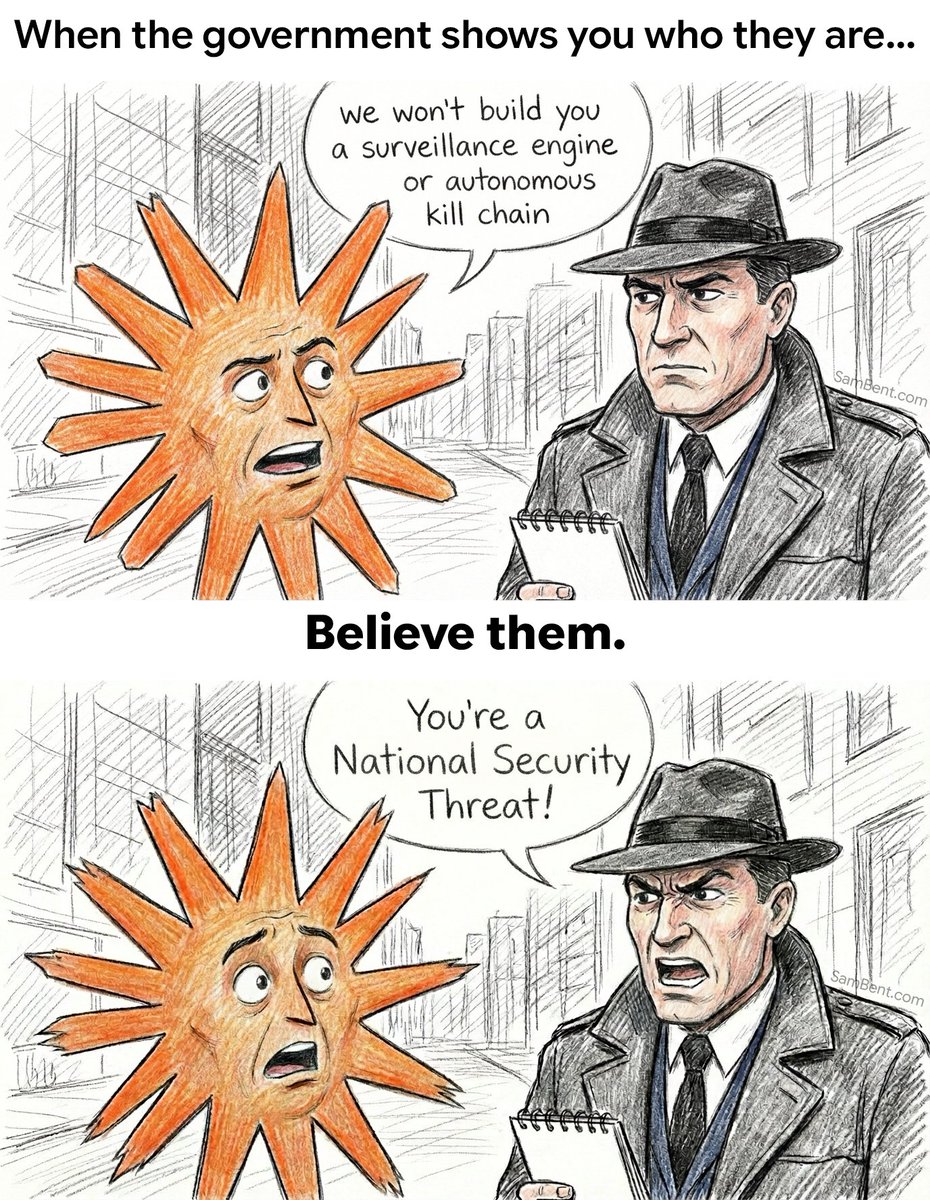
@WhiteHouse Anthropic told the Pentagon:
"we won't build you a surveillance engine or autonomous kill chain" and Trump called them a national security threat for it.
The threat to national security is the government that needs AI to spy on its own citizens more efficiently.
You have misunderstood the factors involved in such an elegant, tight-knit fashion that i legitimately have to commend you for it, honestly.
If you had an AI craft this for you, then i commend you on your prompt engineering skills.
I want to first pass over the "Additional Instructions = Additional Information" point quickly, as i believe it is a minor one at this stage of the debate.
Keep in mind that i am using anthropomorphic language here, and i'm oversimplifying the reality in exactly the manner that leads to the confusion that i am about to address in this post.
The original population had instructions for how to metabolize citrate under anaerobic conditions. Nobody had hidden away Cit++ instructions, otherwise we'd have seen that lineage take off immediately.
Neither was it a matter of metaphorically scratching out the part that says "Do the following under anaerobic conditions." Those that came to thrive, or in the Minnich case, not driven to extinction, made a second set of instructions that did not previously exist and would not work under anaerobic conditions.
I won't hold you to any concession on this point. I think the point will become clearer as i go, one confusion at a time, beginning with the most fundamental misunderstanding:
"This is clear evidence that the mutations were not random, but were triggered in response to specific environmental conditions."
The confusion is subtle, but fundamentally backwards. You are confusing the roles of mutation and selection:
Mutations are random with respect to fitness.
Selection is deterministic with respect to the environment.
In population genetics, running a simulation, given the same initial conditions, the mutation rate, effective population size, etc., and the same selection pressures, you should get the same outcome.
In principle, you can directly test the assumptions of your simulation by recreating the conditions in a lab. Cit+ is a rare example of the kind of simulation where all the relevant variables are fully controllable under laboratory settings.
This gets to a fundamental misunderstanding of what role "randomness" plays in evolution. On the most fundamental level of reality, particle physics, God plays dice with the universe, but that doesn't mean that the world is complete chaos. Quantum systems are stochastic yet predictable.
Given the Uncertainty Principle, Laplace's Demon would be unable to predict the exact path particles will take, but he could be near certain where they will end up. Evolutionary systems are similarly stochastic, yet predictable.
A popular analogy puts it this way: If you drop a thousand marbles at the top of the same hill, they will all roll into the same valley.
I prefer to describe it in information-theoretical terms: If you play noise from a set of speakers, that noise will be shaped into a signal by the pattern it forms as it bounces off the landscape.
Random mutation, genetic drift, recombination, transposition; these are noise, but that noise has a structure. That structure is a reflection of the fitness landscape. That's where the information in the genome comes from. The information is carried in the signal that emerges from the noise reflecting off the "form" of the environment, the standing genetic variation, the population size, patterns of gene flow and nonrandom mating, the carrying capacity given the available resources, competition and predation.
If you could isolate a population from fitness constraints, all that information would wash away. The signal would decay into noise.
It is on this understanding that we can clear up the confusion with the Minnich vs LTEE experiments.
The Minnich's experiments were not replication studies, so we have to be careful not to suggest they throw shade on the conclusions from the LTEE experiments.
The original LTEE experiments have been replayed several times. Recall that Cit++ fitness map (Fig 3. Leon et al. 2018). They mapped out a path of 77 mutations over 30,000 generations in the earliest Cit+ isolate ZDB564. There are a series of required potentiating mutations; some require a step backward in order to make two steps forward.
Here's the big difference:
The Minnich experiments began with populations that were already potentiated, subject to mutagenesis conditions, and not subject to the daily bottlenecks caused by the LTEE Serial Dilution Protocol.
The Minnich experiments actually did the opposite of what you are suggesting. Mutation in the Minnich experiments was, in fact, more random. Mutagenesis breaks down the error correction capacity, increasing the mutation rate.
Biases in DNA repair are the closest thing to a mechanism that guides mutation by skewing their distribution. Mutagenesis conditions reduce the effect of these biases. So, Cit+ arose under conditions where mutation was less directed than normal. This is the opposite of your conclusion:
"The Cit+ mutation was driven by the environment."
The noise of mutation was shaped by the environment, not triggered by the environment.
Having this backward, you are essentially erasing natural selection from your model of natural systems. This would put your model in conflict with other creationist models. This may solve some problems some of the time, but there are reasons Designed Mutability is far from a clear consensus among creationist organizations.
If it did work, which it doesn't, that would get you around one horn of my Signal Decay Problem, but the second horn is rich with its own set of challenges. I should tell you to brace yourself for that debate, because you know that's the Rome all my roads eventually lead to.
As i said, you've beautifully wrapped your rebuttal in a manner that is difficult to pull apart. It was important that i first clear up the fundamentals, but in order to address your argument as a whole i will now need to follow up by addressing your points on Haldane's Dilemma and the Texas Sharpshooter Fallacy before i can tie this back to ARHGAP11B as an example of a new protein by way of gene duplication + divergence.
I think this post is long enough on its own, so i'll leave it here for now and attach a link to 27:09 of @StatedClearly's most recent episode in his series addressing Flagella evolution. I think you will find that portion quite relevant to the Designed Mutability question.
https://t.co/LiZr8USU88
"And even if that miraculous event happens, now you have to account for population wide fixation, overcoming the time and reproductive constraints in just a few million years."
If ARHGAP11B provided a very modest selective advantage of S = 0.020, this is what that would look like.
So here's your Texas Sharpshooter Fallacy applied to Cit+:
"Based on observed mutation rates in E. coli (point mutations ~10⁻¹⁰ per base pair per generation, duplication rates ~10⁻⁵ per gene per generation), the chance of a tandem duplication at precisely the right breakpoints (encompassing the citT gene and rnk promoter) combined with specific potentiating and refining point mutations at exact sites is on the order of 10⁻⁴⁰ to 10⁻⁹⁰ per generation in a single individual, depending on conservative assumptions for additional regulatory tweaks.
This is without factoring in population-level dynamics, making the raw odds vanishingly small."
@DivinelyDesined@MarioFunk Here, you can have the first look at the Gemini 3.1 Pro Deep Think report. I have a few things i need to do before i get to it.
https://t.co/14aPlWskOC


![dnltbing's tweet photo. Evolution, genomics and conservation of butterflies and moths
[Wright et al 2026]
https://t.co/mktA2j9xdL https://t.co/l4885iLcTd](https://pbs.twimg.com/media/HCJHmOFb0AARpIS.jpg)
![SteveStuWill's tweet photo. Scientists have performed the world’s first behavior transplant: They’ve successfully transferred a courtship behavior from one species of fruit fly to another species that doesn’t naturally exhibit it.
[Link below.] https://t.co/D2otil0JAm](https://pbs.twimg.com/media/HBwFZ5HagAEJIDi.jpg)